A clinical trial management system (CTMS) is quoted as one price and paid for in three parts: the subscription for the contract term, the one-off work that puts the system into use, and the recurring effort a research team spends keeping records aligned afterwards. A quotation covers the first reliably, the second partly, and the third almost never.
Vendor pricing sits in a narrow band of models, and the model decides more than the headline figure does. The same study changes price substantially between per-user and per-site pricing, and the direction of that change depends on how many people touch the record. This guide covers the twelve lines that make up a CTMS bill, the five pricing models a quotation is built on, what the April 2026 UK regulations added to the compliance line, and a method for comparing two quotations that describe different purchases.
Vendors in this market quote against a specification rather than publish a price list, and figures repeated second hand age quickly. A number you can rely on comes from pricing the structure below against your own portfolio, then putting the seven questions in the final section to each supplier in writing.
What Do You Actually Pay For in a CTMS?
CTMS cost divides into twelve recognisable lines. Four of them appear on the quotation. Four sit in the contract and bill later, at go-live, on change or at exit. The final four land on your own team and arrive as hours rather than invoices. A budget built from the first four alone understates the commitment by two thirds of its lines.
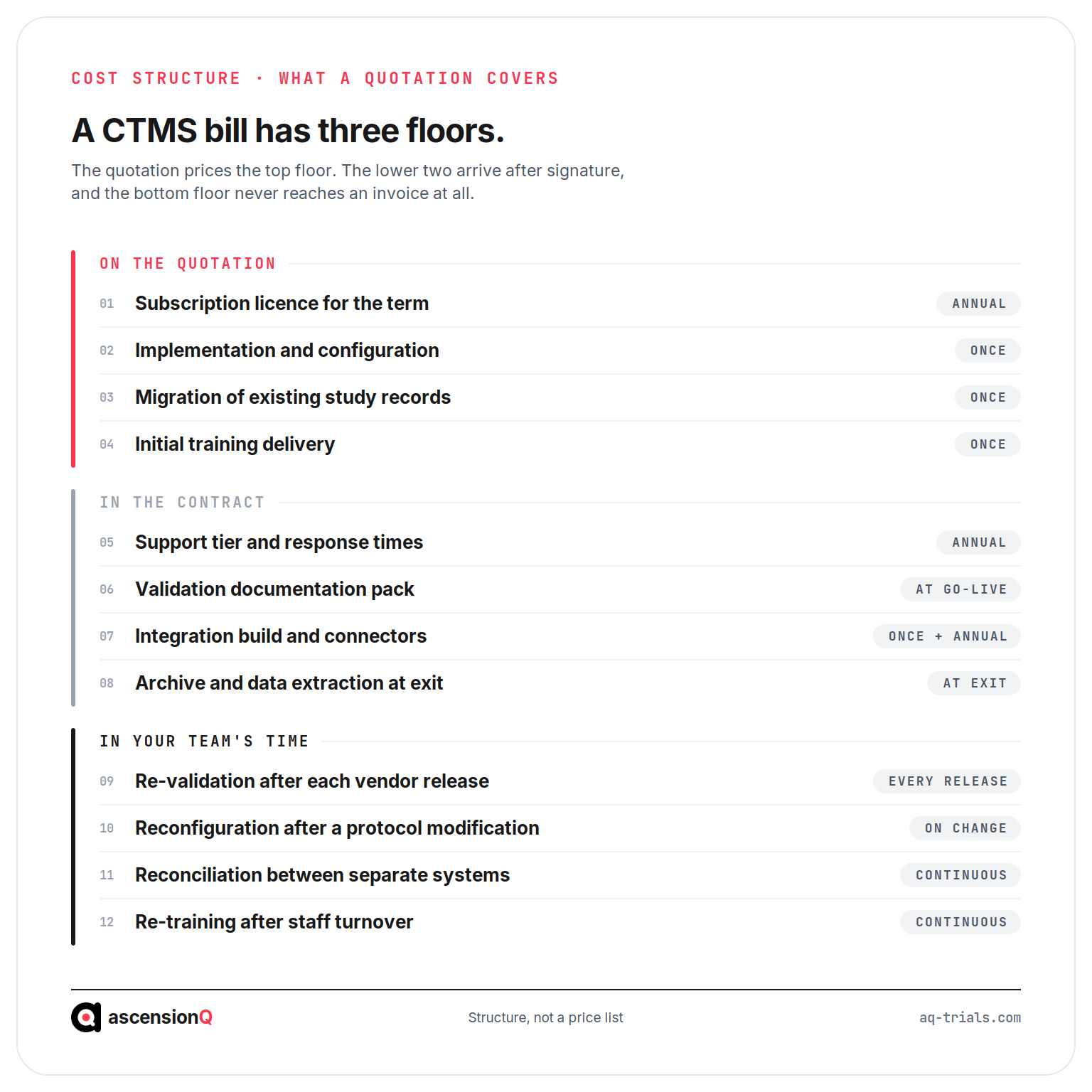
Five of those lines behave in ways a first-year budget hides.
- The subscription recurs for the whole term, which makes the annual figure the number to multiply rather than the first-year total.
- Implementation and migration are scoped by your data, which moves the estimate once the vendor sees how many studies, documents and historic records come across.
- Validation evidence is produced against a specification, so the size of that package follows the risk classification of the system. The GAMP 5 approach to computerised system validation sets out the deliverables involved.
- Re-validation follows the vendor’s release schedule, which turns their release frequency into your recurring workload for the life of the contract.
- Reconciliation between separate systems repeats at every monitoring visit, which makes it a standing cost that reaches no invoice at all.
The last line is the one procurement exercises miss most often. A price comparison run on licences alone rewards the system that pushes the most work back onto the research team.
Which Pricing Model Is the Quotation Built On?
Five models cover most of the market for clinical trial management software. Each one sets how the price behaves as a portfolio grows, and a site that reads only the headline figure meets that behaviour a year later. Read the middle column against your own growth plan rather than your current position.
| Pricing model | How the price scales | Who it suits | Where it bites |
| Per user, per month | With headcount, including occasional and read-only users | Small teams with stable staffing | Monitors, pharmacists, auditors and sponsors each need access, and the count grows quietly |
| Per site, per year | With the number of participating sites | Sites with many users in one location | A small satellite site carries the same charge as a busy hub |
| Per study | With the number of protocols under management | Organisations running a few large studies | A portfolio of small studies multiplies the line |
| Per module | With the number of functions switched on | Teams adopting in stages | Functions assumed to be included arrive as priced additions |
| Flat platform fee | With nothing, inside the agreed scope | Portfolios with predictable growth | The scope is fixed at negotiation, so growth beyond it reopens the contract |
Per-user pricing deserves particular attention in UK research. A single study at one NHS site touches a principal investigator, several coordinators, a research nurse, a pharmacist, a data manager, a monitor and a sponsor contact. Access requests continue after go-live, and each one has a price attached under that model.
The pricing model predicts your bill more reliably than the headline figure does.
Also Read: What Is a CTMS? The Complete Guide to Clinical Trial Management Systems
Where Does the Cost Land After the Contract Is Signed?
Costs after signature arrive in a second currency. Implementation and support are invoiced. Everything else is paid in staff hours that never reach a finance system, and those hours concentrate at the joins between systems.
A worked example makes the pattern concrete. Northgate General NHS Foundation Trust is a fictional site running an interventional study across three locations. A substantial modification to the protocol arrives. The modification itself carries no vendor charge, and the work it triggers carries a real one.
- A coordinator updates the visit schedule and the visit windows in the CTMS for clinical trial, then checks which future bookings now sit outside them.
- The document team files the approved version in the trial master file and the site copy in each investigator site file.
- Pharmacy updates the dispensing instruction and the accountability template for the new schedule.
- The quality team reissues the training record to every delegated member of staff and records completion against the new version.
- A QA lead confirms afterwards that the four systems agree on which version was live from which date.
One modification, five pieces of work, four systems holding part of the answer. The final step exists only because the systems are separate, and it repeats on every modification for the life of the study. That step is the cost that a licence comparison cannot see.
Software is quoted in pounds and paid partly in hours.
UK study costing runs through separate mechanisms that sit alongside the software line. A SoECAT maps each study activity to the party that pays for it, and NCVR sets the price of a commercial study delivered in the NHS. A CTMS licence is normally an organisational cost rather than a line inside one study’s costing, which places the business case at portfolio level and makes the number of studies the system carries the figure that matters.
What Did the April 2026 UK Regulations Change About Cost?
The Medicines for Human Use (Clinical Trials) (Amendment) Regulations 2024 came into force on 28 April 2026, and the Health Research Authority confirms that registration of a trial and publication of a summary of results became a legal requirement for the first time. Each change adds a record a study has to produce on request. A record the system fails to hold becomes manual work, so the regulations move cost between the two columns rather than adding a new invoice.
| What changed in 2026 | What the system has to produce | Where the cost lands |
| Registration of a trial and publication of a summary of results became a legal requirement, with results due within 12 months of the end of the trial | A reliable trial end date and a milestone history a results submission can be assembled from | Configuration at set-up, then a reporting task per study |
| Amendments became modifications, classified as substantial, important detail or minor | A version history showing which document version was live at each trial location on each date | Reconfiguration work on every modification |
| A notification scheme created a faster route for lower-risk trials, and eligible modifications are approved automatically unless concerns are raised within 14 calendar days | Modification dates tracked to the day against the study record | Milestone tracking in place of mailbox searching |
| Every trial follows the principles of Good Clinical Practice, and trials supporting a marketing authorisation follow the full guidelines | Audit-trailed records across the data life cycle, including activity performed by service providers | Validation evidence and vendor oversight |
| An approved trial recruits its first UK participant within two years, with extensions available | Approval dates, contract dates and first participant dates held together per site | Set-up milestone tracking |
The MHRA Inspectorate confirmed the position ahead of the date, stating that all trials will need to adhere to the principles of GCP, with full compliance for trials supporting a marketing authorisation. Any vendor claim about regulatory alignment should be tested against that source rather than a brochure.
The two-year recruitment condition turns local set-up speed into a licence-level risk. The HRA reports that combined review now averages 41 days, and that set-up time for studies going through combined review fell from 169 days to 122 days against a government target of 150 days. Approval moves quickly and local set-up holds the delay, which is the pattern the UK clinical research delivery KPIs track and the reason most sites still miss the 90-day set-up target. A system that holds those dates in one place converts the condition into a milestone a research office can manage weekly.
Also Read: Clinical Trial Management Software for NHS Trusts: 2026 Buyer’s Guide
How Do You Compare Two CTMS Quotations?
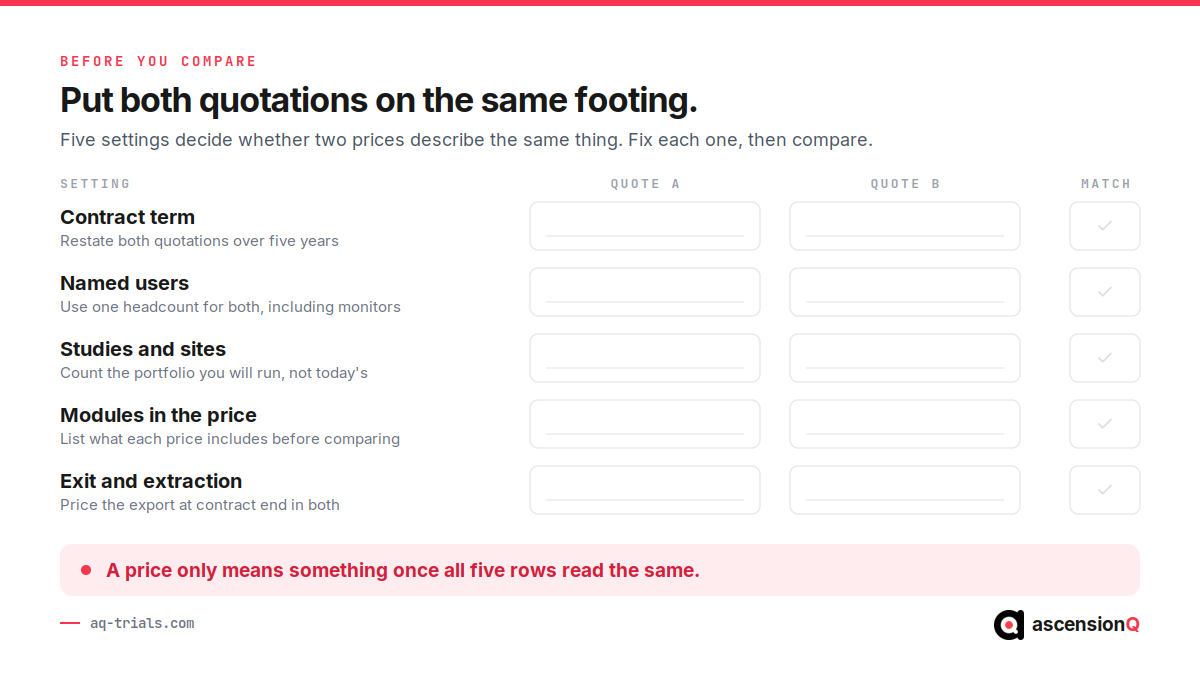
Two quotations rarely describe the same purchase. One prices three years with four modules for twenty named users. The other prices five years with two modules and unlimited read-only access. Comparison starts with normalisation, and five settings decide whether the two figures describe the same thing at all.
Seven questions expose the charges a quotation leaves out. Put them in writing and keep the answers with the quote.
- What does the validation package contain, and who produces it? The answer sets how much evidence your QA team writes before go-live.
- What happens to validation after each release? Release frequency and re-validation scope together define a recurring internal cost.
- What does an integration to our EDC cost to build, and what does it cost to maintain? Build cost is quoted and maintenance rarely is.
- What is included in migration, and what counts as an extra? Historic studies, closed studies and document metadata are the three items that move the number.
- What does a configuration change cost after go-live? Protocol modifications arrive throughout a study, so a per-change charge compounds.
- What is the price at renewal, and what caps the increase? A term price without a renewal cap is a one-year price.
- Who holds the data at contract end, in what format, and at what cost? Extraction terms decide whether the study record survives a change of supplier.
Ask for the demonstration to run on your own protocol structure and site set-up. A vendor who needs a follow-up call to answer the delegation or extraction question has told you where the manual work will sit.
Also Read: What Is Clinical Research Software and How to Choose the Right One?
How Does AQ Price a CTMS?
AQ prices by module rather than by feature tier, so a research team licences the modules the portfolio actually needs and adds others as the work grows. The features and comparison page sets out what sits inside platform pricing, and the commercial position is built for mid-market research organisations rather than enterprise contracts.
The structural difference shows in the lines that disappear. The modules of the AQ Platform share one access model, one audit trail and one study record, which removes the transfers, matches and chases that separate systems create.
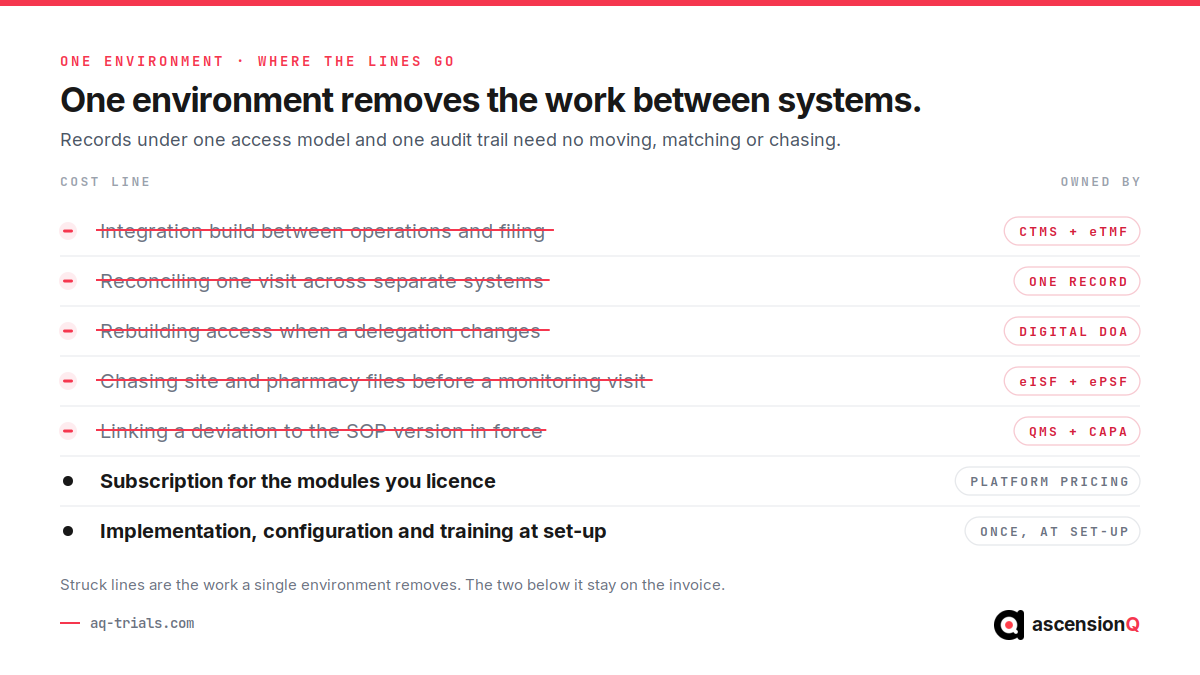
- AQ CTMS holds study set-up, sites, recruitment and the visit diary, and the diary measures every booking against the protocol window at the point of booking, which prevents the deviation instead of documenting it.
- AQ eTMF and AQ eISF hold sponsor and site documentation in one structure, which lets a monitor open the site file and the trial master file against the same index.
- AQ ePSF holds the IMP chain from receipt to destruction, which ties each dispensing entry to the visit that generated it.
- AQ QMS and AQ CAPA link SOP versions and training records to the findings raised against them, which shows an inspector the state of the system on the day of the event.
- AQ Digital DoA records delegated roles, qualifications and dates, which keeps access aligned with the authority that existed at the time and removes the rebuild after every staffing change.
AQ is aligned with Good Clinical Practice, UK GDPR and 21 CFR Part 11, and supplies validation, data security and governance evidence for NHS and sponsor procurement. Assurance covers G-Cloud, DSPT and Cyber Essentials.
Book a live demo and the walkthrough runs on your protocol structure, your site set-up and your module requirements. Bring the seven questions above and use the session to price the answers.