Delegation of authority in clinical research is the documented process by which the principal investigator assigns specific trial tasks to named, qualified staff and retains accountability for every one of them. The delegation of authority log is the record that proves it, task by task and person by person, with the dates each authorisation starts and ends.
Clinical trials operate through coordinated roles, structured responsibilities, and continuous oversight across study activities. Each action, from participant interaction to data handling and safety reporting, must align with an authorised individual and a defined scope of responsibility. AQ Digital DoA is the delegation module within the AQ Platform.
Research teams manage multiple staff members, evolving study requirements, and ongoing updates throughout the trial lifecycle. This creates a need for a clear system that maintains alignment between roles, responsibilities, approvals, and actual study execution.
Let us break down how responsibility is structured, assigned, and maintained across clinical trials, with a focus on operational clarity, regulatory alignment, and audit readiness.
Key Takeaways from AQ’s Guide to DoA
- Clear assignment of roles ensures structured execution across study activities
- Responsibility remains anchored at the investigator level with defined oversight
- Study tasks must align with staff qualifications, training, and role scope
- Delegation records must reflect real-time study activity and updates
- Timing of role assignment and approval directly impacts compliance
- Audit readiness depends on alignment between execution, documentation, and authorisation
- Common delegation gaps lead to traceability, qualification, and timing risks
- Digital systems enable continuous alignment between roles, tasks, and approvals
- Integrated platforms connect delegation with study execution, documentation, and quality processes
AQ’s DoA guide provides a complete view of how delegation operates across clinical trials and how structured systems ensure clarity, control, and compliance at every stage.
What is Delegation of Authority (DoA)?
Delegation of Authority (DoA) is a structured process in clinical research where the Principal Investigator (PI) assigns specific study-related tasks and responsibilities to qualified site personnel, while retaining overall accountability for the conduct of the trial.
It is documented through a Delegation of Authority log, which records:
- who is involved in the study
- what tasks are assigned to each individual
- when those responsibilities are active
- whether the individual is qualified and authorised
The DoA log functions as a control record that connects person → role → task → approval → execution within a clinical trial.
From a regulatory perspective, DoA demonstrates that:
- study activities are performed by appropriately trained and qualified individuals
- responsibilities are clearly assigned and authorised by the PI
- investigator oversight is maintained throughout the study
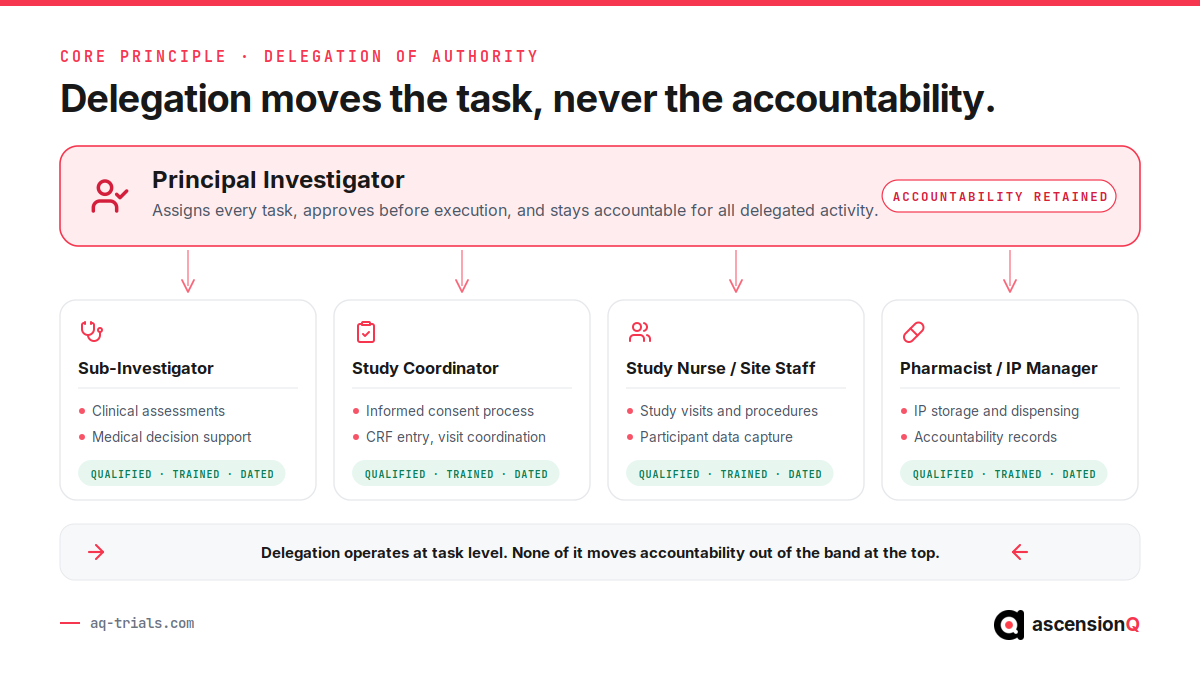
It is important to understand that delegation does not transfer responsibility. In fact, the PI remains accountable for all delegated activities, which makes accurate and timely documentation of DoA essential for compliance, participant safety, and data integrity.
In practice, DoA operates as a continuous process. It begins at study setup, evolves with staff and role changes, and remains active throughout the trial lifecycle to ensure that every task is performed by an authorised individual at the correct time.
Also Read: What is an eTMF in Clinical Trial Research?
Core Principle of DoA
Delegation of Authority establishes a controlled link between people, roles, and study activities.
Each task is assigned to a specific individual based on defined role, verified qualification, and recorded approval. This structure ensures that study execution follows a clear chain of authority from assignment to action.
The Principal Investigator anchors this structure by defining roles, approving responsibilities, and maintaining continuous oversight across all delegated functions.
A valid DoA framework maintains:
- clear ownership of every study task
- alignment between role and responsibility
- documented authorisation before activity begins
- continuous visibility of who performs each action
This principle ensures that every activity within a clinical trial remains structured, traceable, and aligned with defined authority at all times.
Also Read: What is ePSF in Clinical Trial Data Management?
Traditional vs Digital DoA Systems
Delegation of Authority shifts from static documentation to system-driven control when managed digitally, where role assignment, approvals, and study activities remain continuously aligned instead of being maintained as separate records.
| Aspect | Traditional DoA | Digital DoA |
| Structure | Paper logs or spreadsheets | Centralised system |
| Updates | Manual and periodic | Real-time and continuous |
| Role visibility | Limited across teams | Unified across all users |
| Task alignment | Separate from study activity | Directly linked to execution |
| Approvals | Delayed or batch-based | Instant and controlled |
| Traceability | Partial and fragmented | Complete audit trail |
| Compliance control | Retrospective validation | Pre-execution enforcement |
| Audit readiness | Requires preparation | Always inspection-ready |
Also Read: What is CAPA Management Software in Clinical Research?
What Is the Best Electronic Delegation Log for Clinical Trials?
The best electronic delegation log for clinical trials is the one that holds the delegation beside the training record and the site file it has to agree with. Most site systems file a delegation log as a document. Fewer build it as a dated, task-level record the system itself can check.
The systems below are the ones sites most often shortlist for electronic delegation. Each description paraphrases the vendor’s own product page, checked on 10 October 2026.
| System | How the vendor describes it | What the product page publishes on delegation | Fits best | Hosting stated on the product page |
| CRIO eRegulatory | An electronic regulatory binder, integrated with the vendor’s own eSource system | Electronic delegation (eDoA) logs, duty profiles copied between users, requested and delegated duties tracked, delegations viewed by staff member, and training document management with expiry alerts | Sites already running CRIO eSource that want the delegation log inside the regulatory binder | Not stated. Regional sign-in sites are listed for the United States, Canada, Australia and the European Union |
| Florence eBinders | An electronic investigator site file and participant binder for research sites | Audit trails on document changes, role-based access, eSignature requests, eISF templates with task assignments, and remote monitoring access. Delegation logs are not described on the page | Sites whose sponsors already monitor remotely through Florence | Not stated |
| Veeva SiteVault | A site-first platform holding CTMS, eISF and eConsent in one system | Study binders digitised for remote monitoring. Delegation logs appear only in a customer quote on the page, not as a published capability | Sites already exchanging documents with sponsors in Veeva | Not stated |
| RealTime eReg and eISF | eRegulatory and document management inside the RealTime site operations suite | eISF folder structures, version history, e-signature routing with signature histories, audit trails on document activity, and renewal alerts for credentials and training. Delegation logs are not described on the page | Site networks and academic medical centres running the wider RealTime suite | Not stated |
| AQ Digital DoA | The delegation module of AQ Platform | Task-level delegation with principal investigator approval, start and end dates on every authorisation, delegation tied to the training record, and a time-stamped audit trail on every change | UK and NHS sites, CROs and site management organisations that want delegation, training and the site file on one record | UK-hosted. NHS DSPT Standards Met (2026). Cyber Essentials certified |
None of these is the only option, and they are not built for the same buyer. CRIO is the one in this group whose product page sells a digital delegation log as a named feature. Florence, Veeva and RealTime hold the delegation log as a document in the site file, with the audit trail, access control and signature features that go with it. The dividing line for a site is whether the log is a file someone keeps current by hand or a dated record the system can test against training and activity.
In AQ Digital DoA, a task cannot be delegated until the person’s training record for it is complete, and every change to the delegation is time-stamped and attributable.
Also Read: Delegation of Authority Logs: Why Effective Dates Matter More Than Signatures
Why is Digital DoA Required in Clinical Trials?
- Centralised control over role assignment across studies and sites
- Real-time alignment between delegation and study activity
- Direct linkage between authorised personnel and executed tasks
- Continuous visibility of roles, responsibilities, and approvals
- Structured enforcement of delegation before task execution
- Integrated validation of training, qualifications, and permissions
- Elimination of duplicate records across systems and documents
- Immediate reflection of role changes and study updates
- Complete, time-stamped audit trails for all delegation actions
- Consistent responsibility tracking across CTMS, eTMF, eISF, and QMS
- Reduced administrative effort through automated workflows
- Improved coordination across investigators, coordinators, and site teams
- Accurate tracking of start and end dates for role validity
- Faster audit response with organised, exportable records
- Continuous inspection readiness with system-driven compliance
Also Read: What is CTMS
See the full delegation workflow on the AQ Digital DoA module page, or book a 30-minute demo on a live study.
What Tasks are Delegated for Clinical Trial Data Management?
| Task | Assigned To | Why This Delegation |
| Source data creation and documentation | Study Coordinator / Site Staff | Direct interaction with participants and access to clinical records ensures accurate primary data capture |
| CRF data entry in EDC | Study Coordinator / Data Entry Staff | Operational role responsible for timely transcription of source data into structured systems |
| Source Data Verification (SDV) | Clinical Research Associate (CRA) | Independent review ensures data accuracy and alignment between source and EDC |
| Data query review and resolution | Study Coordinator / Investigator (as required) | Site ownership of data enables clarification based on source records and clinical context |
| Adverse Event (AE/SAE) data recording | Study Coordinator with PI oversight | Clinical relevance requires site-level documentation with medical oversight |
| Medical coding (MedDRA, WHO Drug) | Data Management Team | Standardisation requires specialised coding knowledge and consistency across datasets |
| Data validation and consistency checks | Data Management Team | Centralised review ensures protocol alignment and dataset integrity |
| Data reconciliation (lab, imaging, IP) | Data Management Team with Site Support | Cross-system consistency requires coordination between central and site-level data sources |
| Protocol deviation documentation (data-related) | Study Coordinator / Quality Team | Site-level visibility ensures accurate capture of deviations linked to study conduct |
| Data cleaning and discrepancy management | Data Management Team | Central responsibility for identifying and resolving inconsistencies across datasets |
| Database status tracking and completeness review | Data Management Team | Oversight of dataset readiness for analysis and reporting |
| Interim data review preparation | Data Management Team / Biostatistics | Structured dataset preparation required for analysis cycles |
| Database lock preparation and support | Data Management Team with PI confirmation | Final validation ensures data completeness before locking |
| Audit trail maintenance and data change tracking | System-driven (EDC/CTMS) with oversight by Data Management | Automated tracking ensures traceability of all data modifications |
| Data extraction and reporting | Data Management / Biostatistics | Controlled data output required for analysis, monitoring, and regulatory use |
| Coordination across data stakeholders | Study Coordinator / Data Manager | Ensures alignment between site operations, data teams, and study timelines |
Who is Involved in Delegation of Authority?
Delegation of Authority includes all individuals who contribute to study execution, data handling, oversight, and compliance. Each role is assigned specific responsibilities based on qualifications, training, and involvement in the clinical trial. This ensures that every study activity is performed by an authorised individual with clear ownership and defined scope.
- Principal Investigator (PI) Defines roles, assigns responsibilities, approves delegation, and maintains overall study oversight
- Sub-Investigator (Sub-I) Performs clinical assessments and supports medical decision-making under PI supervision
- Study Coordinator (CRC) Manages daily study operations, participant coordination, documentation, and workflow execution
- Study Nurse / Site Staff Conducts study visits, performs procedures, and collects participant data
- Pharmacist / Investigational Product (IP) Manager Manages drug storage, dispensing, accountability, and pharmacy documentation
- Data Entry and Regulatory Staff Handles CRF entry, maintains regulatory records, and supports documentation workflows
- Clinical Research Associate (CRA) Monitors study conduct, verifies data accuracy, and reviews delegation alignment during site visits
- Data Management Team Performs data validation, coding, reconciliation, and dataset preparation for analysis
- Quality and Compliance Team Oversees deviations, audits, CAPA processes, and ensures adherence to regulatory standards
Also Read: What is QMS (Quality Management System) in Clinical Research?
Delegation of Authority Log Structure
The Delegation of Authority (DoA) log defines how responsibilities are assigned, approved, and tracked across study personnel. Each field in the log captures a specific element required to link a task with an authorised individual and a defined timeframe.
Let’s consider an example.
A clinical trial site initiates a Phase II study. The Principal Investigator assigns Sarah Khan as a Study Coordinator responsible for participant coordination, informed consent, and data entry.
The DoA log captures this assignment in a structured format:
- Staff Name and Role Sarah Khan is listed as Study Coordinator. This identifies who performs the assigned tasks.
- Delegated Tasks and Responsibilities Tasks include informed consent process, CRF data entry, and visit coordination. This defines what she is authorised to perform.
- Signature and Initials Sarah provides her signature and initials (SK). This allows verification across source documents and study records.
- Start Date of Delegation The start date is recorded as 01 March 2026. This defines when task execution becomes valid.
- Principal Investigator Approval The PI approves the delegation on 28 February 2026. This confirms authorisation before task execution begins.
- Training and Qualification Reference Sarah completes GCP training and protocol training. This supports that assigned tasks align with her qualifications.
- End Date of Delegation The end date is recorded as 30 September 2026. This defines the active duration of her responsibilities.
- Update and Change History A later update adds AE reporting responsibility on 15 April 2026. This reflects changes in role scope during the study.
When and How DoA Must Be Updated During a Study?
Delegation updates follow actual study activity. Each change in staff, role, or protocol creates a direct update requirement in the DoA log. The update reflects who performs which task, from what date, and under whose approval.
Example Scenario: Mid-Study Role Change and Audit Trace
A Phase III multi-site oncology study runs with active recruitment. At Site A, the study coordinator handles consent, CRF entry, and visit coordination.
Situation 1: New Staff Onboarding
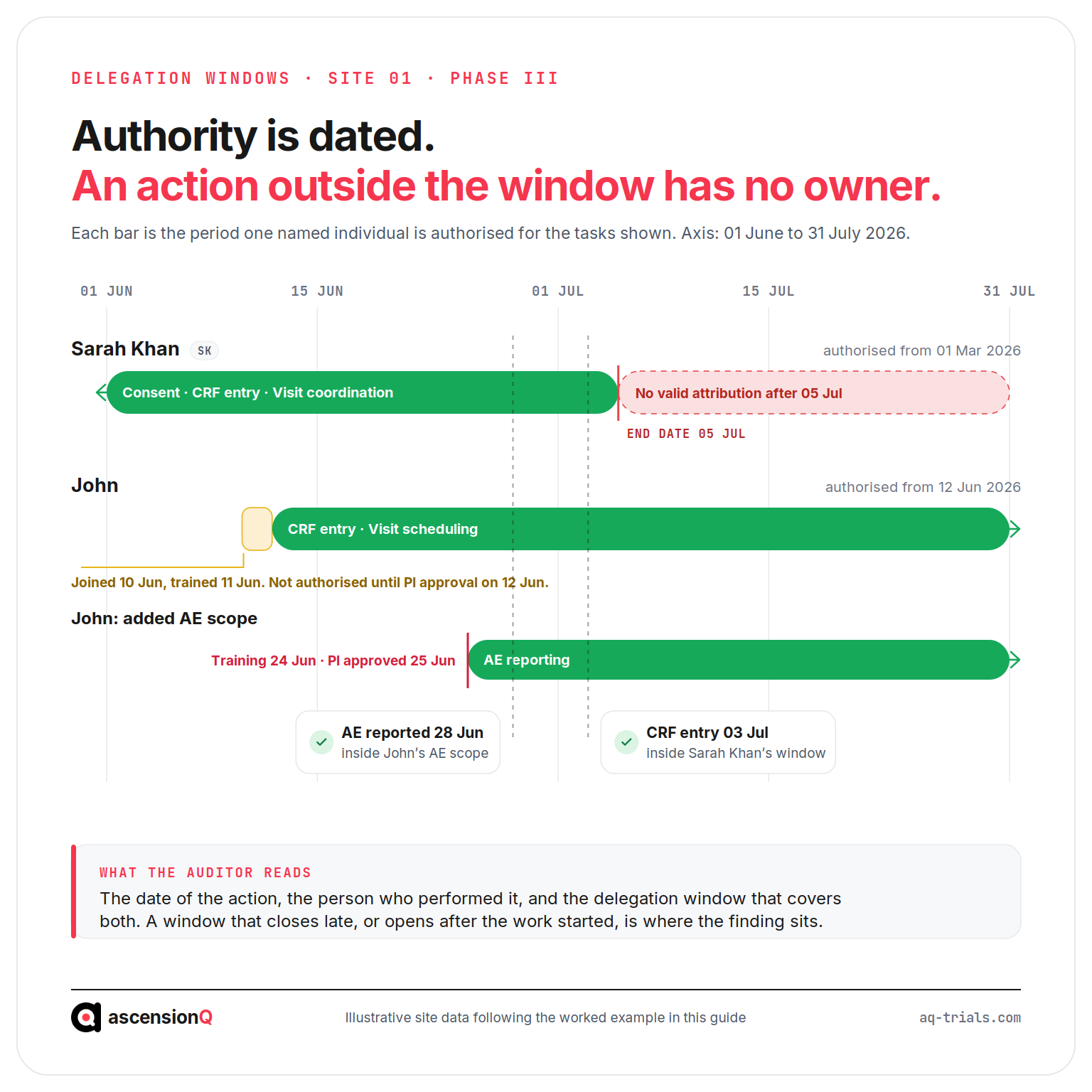
A new coordinator, John, joins on 10 June 2026 to support increasing patient load.
What happens operationally:
- John completes GCP and protocol training on 11 June
- PI reviews qualifications on 12 June
- DoA entry is created with assigned tasks: CRF entry and visit scheduling
- PI approval is recorded on 12 June
- Start date is set as 12 June 2026
Impact: John gains system access and begins tasks from 12 June. Every data entry action now traces back to his authorised role and start date.
Situation 2: Role Expansion Based on Study Needs
Patient volume increases. John starts supporting AE reporting from 25 June 2026.
What changes in DoA:
- New responsibility added under his name
- Training for AE reporting completed on 24 June
- PI approves expanded role on 25 June
- Update recorded with effective date
Impact: AE entries after 25 June align with his updated delegation. Earlier entries remain tied to previous scope.
Situation 3: Staff Exit and Responsibility Cut-Off
The original coordinator, Sarah Khan, exits the study on 05 July 2026.
What happens in DoA:
- End date recorded as 05 July 2026
- Her responsibilities remain valid only until that date
- System access aligns with end date
Impact: Any activity after 05 July cannot be attributed to Sarah. Audit trace remains clean and time-bound.
Situation 4: Audit Review (Real Validation Point)
An auditor reviews:
- AE reported on 28 June
- CRF entry on 03 July
DoA trace shows:
- John authorised for AE reporting from 25 June
- Sarah active until 05 July
- Each action aligns with valid delegation period
Outcome: Clear linkage between:
- task performed
- authorised individual
- approval date
- training status
Common Delegation of Authority Errors in Clinical Research
- Staff performing study tasks before delegation is recorded and approved
- Study personnel involved in trial activities missing from the DoA log
- Delegated responsibilities not aligned with staff qualifications or training
- Principal Investigator approval recorded after task execution
- Missing or incomplete training documentation linked to delegated tasks
- Inconsistent signatures and initials across study records and DoA log
- Delegation entries without clear start dates or incorrect effective dates
- Missing end dates for staff who exit the study or change roles
- Responsibilities assigned broadly without clear task-level definition
- Failure to update DoA after protocol amendments affecting responsibilities
- Duplicate or conflicting DoA records across paper logs and systems
- Delegation not aligned with actual study activity or system access
- Delayed updates following staff onboarding or role changes
- Lack of version control or history tracking for delegation updates
- Incomplete linkage between DoA, training records, and study documentation
- Absence of PI oversight evidence across delegation changes
- Over-assignment of tasks without clear ownership or accountability
- Delegation records maintained retrospectively instead of reflecting real-time activity
How DoA Failures Lead to Audit Findings and Compliance Risks?
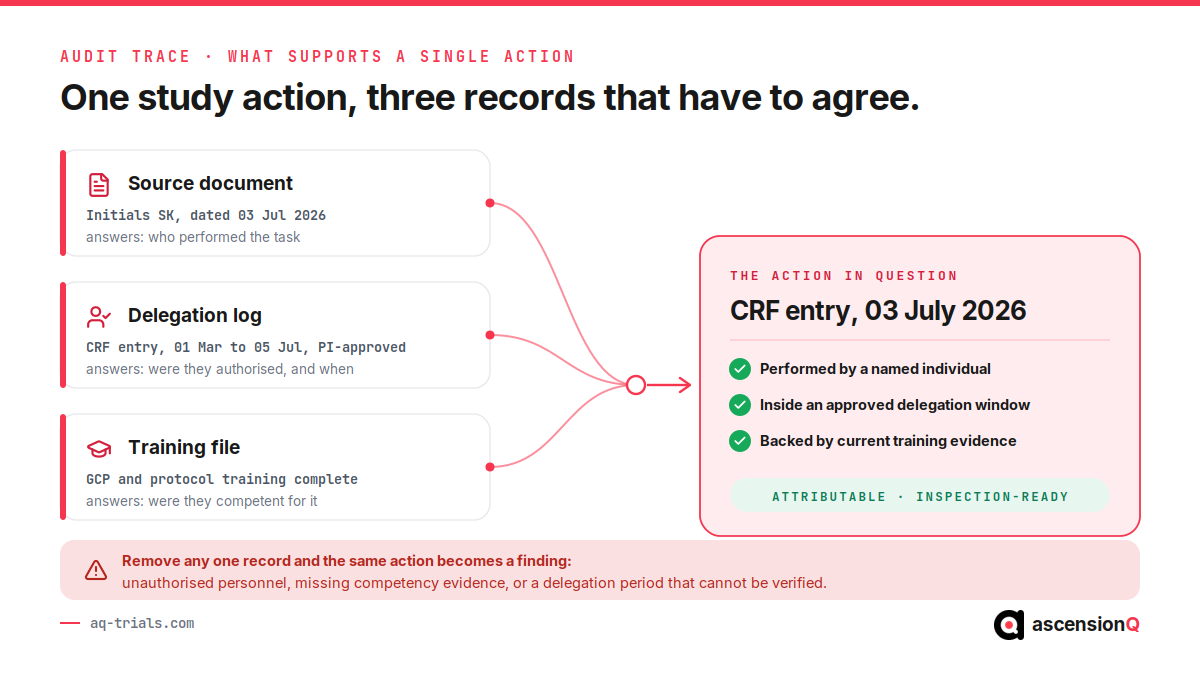
DoA failures appear when study activity, delegation records, and approvals fall out of alignment. Auditors review this alignment through three core checks: who performed the task, whether they were authorised, and whether timing matched delegation. Any mismatch converts into a finding.
1. Authorisation Misalignment
| Scenario | What Happens | Audit Finding | Compliance Risk |
| Task executed before PI approval | Consent taken on 12 May, approval dated 15 May | Activity performed without prior authorisation | Questioned validity of consent and participant eligibility |
| Staff not listed in DoA | Nurse performs visits without DoA entry | Unauthorised personnel involved in study | Loss of traceability and weak oversight |
2. Qualification and Training Misalignment
| Scenario | What Happens | Audit Finding | Compliance Risk |
| Task assigned beyond qualification | Data staff performs eligibility assessment | Role-task mismatch | Incorrect clinical evaluation |
| Missing training evidence | AE reporting assigned without protocol training | Task performed without competency validation | Inaccurate safety reporting |
3. Timing and Lifecycle Misalignment
| Scenario | What Happens | Audit Finding | Compliance Risk |
| Missing end date after staff exit | Staff remains active in DoA after leaving | Delegation period unclear | Responsibility tracking breakdown |
| Delayed DoA updates | Role changes applied later in records | DoA does not reflect actual activity | Misalignment between execution and documentation |
4. Traceability Gaps
| Scenario | What Happens | Audit Finding | Compliance Risk |
| Inconsistent signatures | Source documents and DoA initials do not match | Identity verification gap | Data ownership concerns |
| Fragmented delegation records | DoA spread across logs and systems | Incomplete audit trail | Difficulty verifying responsibility |
Also Read: DMS vs eQMS in Clinical Trial Data Management
Frequently Asked Questions
What is delegation of authority (DoA) in clinical research?
Delegation of authority is the documented process by which the principal investigator assigns specific trial tasks to qualified site staff. The investigator keeps accountability for everything delegated. The delegation of authority log is the record that shows who was authorised for which task, and from when.
What is the best electronic delegation log for clinical trials?
The best electronic delegation log records delegation at task level, with a start date, an end date and a link to the training record behind it. CRIO publishes a digital delegation log as a named feature of its regulatory binder. Florence eBinders, Veeva SiteVault and RealTime hold the log as a document in the site file. AQ Digital DoA holds delegation, training and the site file on one record.
What must a delegation of authority log record?
A delegation log records the person and role, the specific tasks delegated, the start and end dates of the authorisation, the principal investigator’s approval and the date of it, the training and qualification behind each task, and the delegate’s signature or initials. Each field answers a question an inspector asks.
Does delegation transfer responsibility away from the principal investigator?
No. The investigator may delegate trial tasks to suitably qualified people and keeps overall responsibility for the conduct of the trial at the site. The log therefore records oversight as well as assignment.
When must a delegation of authority log be updated?
The log is updated whenever a person joins the study, takes on a new task, changes role or leaves. Each change carries its own effective date. A protocol amendment that changes responsibilities triggers an update as well.
Can a delegation of authority log be signed after the task was performed?
A signature added later does not authorise work already done. The effective date defines the authorised window, so a task performed before that date has no valid delegation behind it. The honest response is to record the true date and handle the gap as a deviation.
Is a spreadsheet enough for a delegation log?
A spreadsheet can hold the fields, and some sites run one carefully. It carries no audit trail of its own, it is easy to overwrite, and it cannot test an effective date against a training record. Those three gaps are what a system-held log closes.
AQ Digital DoA: System-Controlled Delegation, Role-Based Authority, and Audit-Ready Responsibility
AQ Digital DoA establishes a controlled environment where role assignment, delegation, and study execution remain continuously aligned across clinical trial operations. It connects delegation records with real study activity, so each task, document action, and workflow reflects the authorised individual responsible at that point in time.
Traditional delegation approaches rely on separate logs and manual updates. AQ brings delegation into a single system where roles, responsibilities, approvals, and timelines operate together with full traceability.
- Centralised role assignment and delegation control All study personnel, roles, and responsibilities remain defined within one system, creating a consistent source of truth
- Direct linkage between tasks and authorised personnel Study activities across CTMS, eTMF, eISF, Pharmacy, and QMS align with assigned roles, ensuring each action reflects approved delegation
- Pre-execution authorisation and role validation Task access aligns with approved delegation, role permissions, and training status before activity begins
- Real-time updates across study operations Role changes, staff onboarding, and responsibility updates reflect immediately across all connected modules
- Time-bound delegation with full lifecycle tracking Start and end dates define active responsibility periods, maintaining accurate alignment with study timelines
- Complete audit trails and delegation history Every assignment, approval, and update is recorded with user identity and timestamp, supporting inspection-ready traceability
AQ Digital DoA transforms delegation into a system-driven control layer where responsibility remains clearly defined, continuously validated, and directly connected to execution across the entire study lifecycle.
A live walkthrough shows role assignment, PI approval and time-bound delegation held in one register, with each study task traced back to an authorised individual and a valid date range. Book a live demo to see how AQ Digital DoA manages delegation across studies, or read the full module detail on the AQ Digital DoA page.