A quality management system (QMS) in clinical research is the controlled system that holds an organisation’s procedures, training records, quality events and corrective actions, and shows an inspector who did what and when. Research sites and sponsors use it to keep study conduct aligned with Good Clinical Practice. AQ QMS is the quality management module of AQ Platform.
This guide explains how QMS operates within clinical research, how it connects with daily study execution, and how it ensures compliance, traceability, and audit readiness across the study lifecycle. It also outlines how AQ QMS functions as a connected quality layer within an end-to-end clinical research platform.
What you will understand through AQ’s Guide to QMS:
- How a QMS structures quality processes, procedures, and compliance within clinical research
- Why QMS is required to maintain control across documents, training, and study operations
- What a QMS controls, including documents, staff compliance, deviations, and CAPA
- How core QMS processes such as document control, training management, and audit tracking operate in real scenarios
- How CAPA functions within QMS to resolve and prevent quality issues
- What challenges arise when quality processes operate without a structured system
- How QMS ensures compliance, traceability, and continuous audit readiness across study activities
- Types of QMS systems and how they differ in control, visibility, and operational efficiency
- What features define an effective QMS software in clinical research environments
- How to implement a QMS without disrupting ongoing studies and operations
- The practical difference between QMS, CTMS, eTMF, and other clinical systems
- How AQ QMS connects quality processes with study execution within a unified platform
What is QMS (Quality Management System) in Clinical Research?
A Quality Management System (QMS) in clinical research provides a structured environment to manage quality processes, procedures, responsibilities, and compliance requirements within one controlled system. It establishes clear oversight across quality activities while ensuring that each document, training requirement, action, and outcome remains visible, traceable, and aligned with regulatory expectations.
QMS functions as the quality control layer within clinical research operations by connecting:
- controlled documents and procedural governance
- training requirements, acknowledgements, and competency validation
- staff compliance monitoring across roles and responsibilities
- quality events including deviations, nonconformances, and findings
- corrective and preventive actions (CAPA) with structured follow-through
- audit records, activity logs, and inspection-ready evidence
The structured approach of QMS ensures that quality expectations are consistently applied and verified across research teams. Each document update, training completion, acknowledgement, and corrective action is recorded within the system, which strengthens accountability and supports continuous audit readiness.
QMS also enables continuous visibility into quality status across the organisation. Research teams can monitor compliance activity, identify gaps, track unresolved issues, and maintain consistent quality practices across studies, sites, and operational roles.
Also Read: What is CTMS
Why QMS is Required in Clinical Research Operations?
- Ensures consistent execution of quality processes across studies, sites, and teams
- Maintains control over documents, procedures, and version updates
- Tracks staff training, acknowledgements, and competency requirements
- Monitors compliance status across roles and operational activities
- Captures deviations, nonconformances, and quality events in a structured way
- Manages corrective and preventive actions (CAPA) with clear ownership and follow-through
- Maintains complete audit trails and activity records for traceability
- Aligns study operations with regulatory frameworks such as GCP, FDA, and ICH guidelines
- Provides inspection-ready evidence across documents, training, and quality actions
- Identifies compliance gaps early through continuous monitoring and visibility
- Reduces reliance on manual tracking, spreadsheets, and disconnected systems
- Strengthens accountability across teams with defined roles and responsibilities
- Supports consistent quality practices across multi-site and multi-study environments
- Enables informed decision-making through quality dashboards and reporting
- Establishes a controlled environment where quality, compliance, and execution remain aligned
What Are the Quality Management System Requirements for Clinical Trials?
Quality management system requirements for clinical trials come from ICH E6(R3), adopted on 6 January 2025 and effective in the UK from 28 April 2026, which asks sponsors and sites to build quality into the trial and manage it in proportion to risk. Site-level requirements mean controlled procedures, trained staff, recorded deviations, and evidence an inspector can follow.
Seven requirements carry the quality system at site level. Each one has a source behind it and a piece of evidence the site has to be able to produce.
| Requirement | Where it comes from | What the site has to show |
| Quality managed in proportion to risk, focused on the factors critical to quality | ICH E6(R3), sections 3.10 and 6.2 | A risk assessment naming the factors critical to participant safety and to reliable results, and the control applied to each |
| Written procedures covering the activities the site performs | ICH E6(R3), with UK-specific annotations | A current, version-controlled SOP set, with a record of who approved each procedure and when |
| Staff qualified by education, training and experience | ICH E6(R3), section 2.1.1 | CVs, role-specific training records, and evidence that each person was trained before the task |
| Delegation recorded in proportion to the significance of the activity | ICH E6(R3), section 2.3.3 | A delegation log showing the activity, the person and the date the delegation took effect |
| Source records that are attributable, legible, contemporaneous, original, accurate and complete | ICH E6(R3), section 2.12.2 | The source record definition, where each record is held, and a traceable history of every change |
| Essential records retained for 25 years after the trial ends | The Medicines for Human Use (Clinical Trials) (Amendment) Regulations 2025 (SI 2025 No. 538), in force 28 April 2026 | Records that stay readable and retrievable for the full period, including after a system contract ends |
| Inspection findings answered with corrective and preventive action | MHRA GCP inspection guidance | A CAPA plan for each finding, with an owner, a due date and evidence of closure |
In AQ QMS, a published SOP is linked to the studies it applies to and to the training each role must complete, so the procedure version and the training record stay on the same study.
Also Read: CAPA Software for NHS Research: Deviations and MHRA Readiness
Core QMS Processes That Drive Quality and Compliance
| QMS Process | What It Controls in Clinical Research | Real-Time Example in Study Operations |
| Document Control | Manages SOPs, protocol guidelines, consent forms, and version-controlled documents with defined access and approvals | A new informed consent form version is released. The system updates the latest version, restricts old access, and records which site staff acknowledged the update |
| Training Management | Assigns and tracks required training linked to roles, procedures, and study requirements | A study coordinator receives mandatory training on a protocol amendment. The system tracks completion and restricts task access until training is completed |
| Deviation and Nonconformance Management | Captures protocol deviations, missed visits, and operational inconsistencies with structured logging and review | A participant visit occurs outside the protocol window. The system logs the deviation, flags it for review, and assigns follow-up actions |
| CAPA (Corrective and Preventive Action) | Manages investigation, root cause analysis, corrective actions, and prevention of recurring issues | Repeated missed visits trigger a CAPA. The system assigns investigation, defines corrective steps, and tracks resolution status |
| Audit and Inspection Management | Tracks internal audits, regulatory inspections, findings, and follow-up actions | During an internal audit, missing training records are identified. The system logs the finding, assigns corrective action, and tracks closure before inspection |
| Change Management | Controls updates to processes, documents, systems, and study workflows with approval tracking | A protocol amendment updates visit schedules. The system routes approvals, updates workflows, and ensures all dependent processes align |
| Risk Management | Identifies, assesses, and monitors risks related to study execution, compliance, and participant safety | High dropout rates at a site trigger a risk flag. The system records risk level, assigns mitigation actions, and tracks outcomes |
| Complaint Management | Records and manages participant or site-reported issues with investigation and resolution tracking | A participant reports adverse experience related to scheduling delays. The system logs the complaint and assigns investigation |
| Supplier and Vendor Quality Management | Tracks performance, compliance, and quality of external vendors and service providers | A lab vendor delays sample processing. The system records performance issues and triggers vendor review |
| Audit Trail and Activity Logging | Records every action with user, timestamp, and context for full traceability | A document update, training completion, and CAPA closure are all recorded with user identity and timestamps for inspection readiness |
What is CAPA (Corrective and Preventive Action) in QMS?
Corrective and Preventive Action (CAPA) in a Quality Management System (QMS) provides a structured process to identify, investigate, resolve, and prevent quality issues within clinical research operations. It ensures that deviations, nonconformances, audit findings, and operational risks are addressed with defined actions, clear ownership, and traceable outcomes.
CAPA functions as the problem-resolution and control mechanism within QMS by connecting issue detection, root cause analysis, corrective execution, and preventive measures into one continuous workflow.
Within clinical research, CAPA manages:
- identification of quality issues such as protocol deviations, missed visits, or compliance gaps
- root cause analysis to determine why the issue occurred
- corrective actions to resolve the immediate problem
- preventive actions to avoid recurrence across studies or sites
- assignment of responsibility and timelines for each action
- tracking of action status until closure
- documentation of all steps for audit and inspection readiness
Such a structured approach ensures that quality issues are not only resolved but also analysed and controlled to prevent repetition. Each CAPA record maintains full traceability, linking the issue, investigation, actions, and outcomes within the system.
CAPA also enables continuous quality improvement across clinical research operations. Repeated issues, patterns, and risks can be identified early, which helps teams strengthen processes, improve compliance, and maintain consistent study execution.
Also Read: What is CAPA Management Software in Clinical Research?
Common Challenges Without a Structured QMS
- Fragmented control across documents, training, and compliance activities
- Limited visibility into staff training, acknowledgements, and competency status
- Reliance on spreadsheets, emails, and manual tracking systems
- Lack of real-time monitoring across sites and operational teams
- Use of outdated or uncontrolled document versions
- Inconsistent understanding of procedures across staff and locations
- Delayed identification of deviations, nonconformances, and quality issues
- Weak CAPA tracking, ownership, and follow-through
- Time-consuming audit preparation with scattered records and evidence
- Reduced traceability across actions, decisions, and quality events
- Gaps in accountability across roles and responsibilities
- Limited detection of recurring issues and systemic risks
- Operational inefficiencies due to disconnected workflows
- Compliance risks due to incomplete or missing documentation
- Weak overall quality control across clinical research operations
Also Read: What Is Clinical Research Software and How to Choose the Right One?
Key Benefits of Implementing a QMS in Clinical Research
Here are the major benefits of a quality management system for clinical trial data management:
Centralised Quality Control Across Operations
Clinical research quality processes often operate across separate systems, which limits control and creates gaps in visibility. A Quality Management System (QMS) brings documents, training, compliance tracking, and quality workflows into one structured environment, which ensures that all quality activities remain connected, controlled, and consistently executed across studies and sites.
For example,
If you are a Quality Manager responsible for overseeing multiple studies, you need to verify whether SOP updates are approved, staff training is completed, CAPAs are resolved, and compliance requirements are met. Instead of checking documents in one system, training in another, and CAPA status in spreadsheets, QMS allows you to access all these activities in one place, review their status in real time, and take action where gaps appear.
Continuous Visibility Into Staff Compliance
Clinical research requires ongoing confirmation that staff have completed required training, acknowledged procedures, and remain aligned with protocol and regulatory expectations. A Quality Management System (QMS) provides continuous visibility into compliance status across roles, which ensures that gaps are identified early and addressed before they affect study execution.
For example,
If you are a Study Coordinator managing daily trial activities, you need to confirm that site staff have completed required training and acknowledged recent protocol updates before assigning visits. Instead of manually checking emails or separate training records, QMS shows which staff members have completed or missed requirements, which allows you to proceed with scheduling only when compliance conditions are met.
Structured Document Governance and Version Control
Clinical research relies on controlled documents such as SOPs, protocols, and consent forms, where accuracy and version consistency directly affect compliance. A Quality Management System (QMS) establishes structured document governance with controlled access, approval workflows, and version tracking, which ensures that teams always operate using current and approved documents.
For Example,
If you are a Principal Investigator (PI) preparing for participant enrolment, you need to ensure that the consent form being used is the latest approved version. Instead of verifying across shared folders or emails, QMS provides access to the current version, restricts outdated documents, and records acknowledgement, which ensures that participant consent aligns with regulatory and study requirements.
Consistent Training and Competency Validation
Quality execution in clinical research depends on more than training completion. It requires confirmed understanding of procedures, protocol updates, and role-specific responsibilities. A Quality Management System (QMS) structures training requirements, links them to study activities, and validates competency through assessments, which ensures that staff are prepared to perform tasks correctly.
For Example,
If you are a Site Nurse assigned to conduct study visits, your responsibilities depend on correct understanding of visit procedures and protocol updates. QMS helps assign required training based on your role, requires completion before task access, and includes a competency check through a quiz. This process confirms readiness before you begin participant interactions.
How QMS Ensures Compliance, Traceability, and Audit Readiness?
Consider a Phase III clinical trial running across multiple sites with ongoing participant visits, protocol updates, and regulatory oversight. Each activity, from document updates to staff training and visit execution, must remain aligned with regulatory expectations such as ICH-GCP and audit requirements.
A protocol amendment is released that changes visit schedules and introduces new safety procedures.
The Quality Team uploads the updated protocol and SOP into the QMS. The system enforces document control by:
- assigning version control with full history
- routing approvals through defined roles
- restricting access to outdated versions
Once approved, the QMS automatically links this update to required training.
The Study Coordinator and Site Staff receive assigned training based on their roles. The system:
- requires document acknowledgement before proceeding
- assigns training modules linked to the updated procedure
- includes a competency check to validate understanding
Until training is completed and acknowledged, the system restricts access to related study activities. This ensures that no staff member operates under outdated instructions.
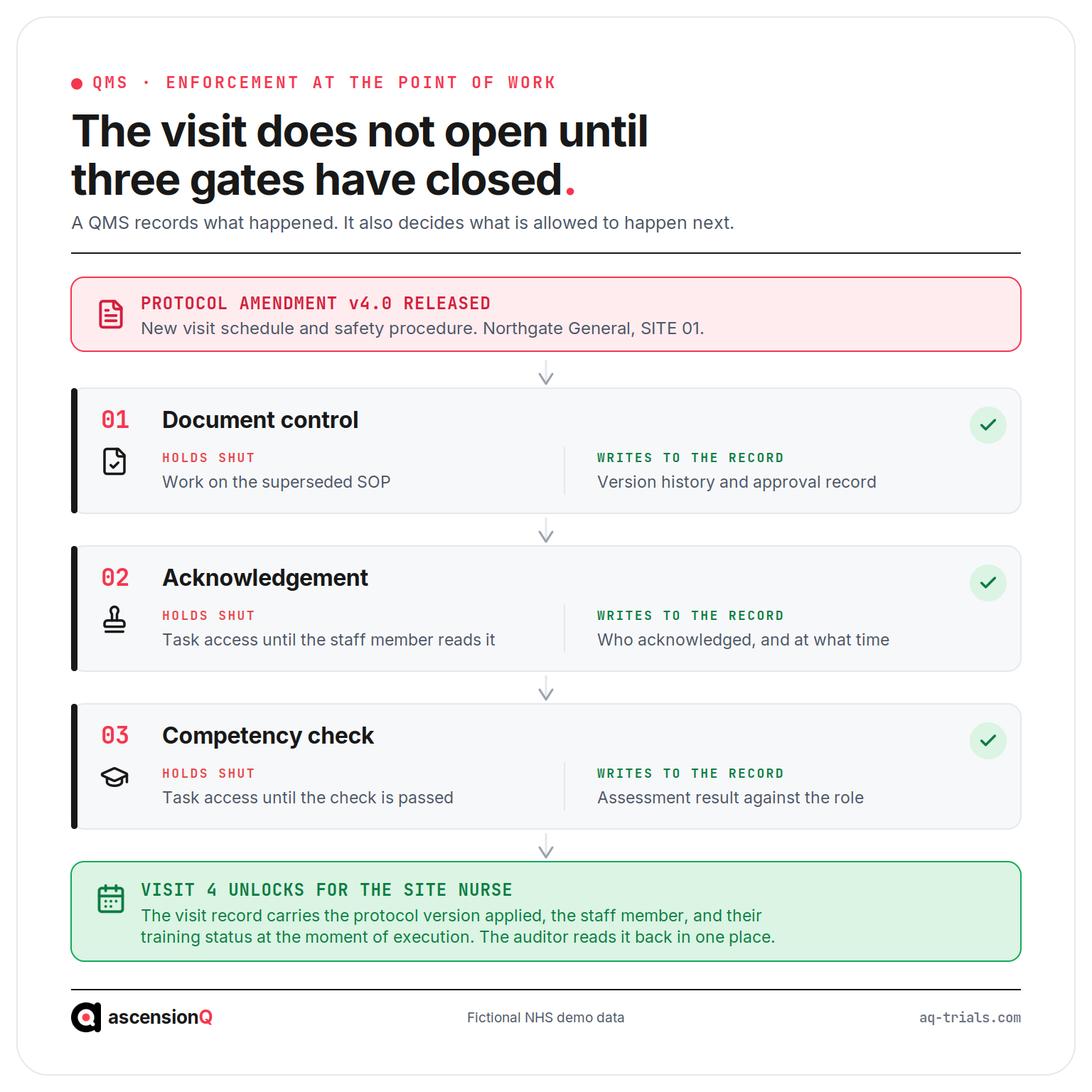
A participant visit is scheduled under the updated protocol.
The Site Nurse performs the visit following the new procedure. The activity is recorded within the system, which connects:
- the visit execution
- the protocol version applied
- the staff member responsible
- the training status at the time of execution
This creates a direct link between action and compliance.
During monitoring, a Clinical Research Associate (CRA) identifies that one visit occurred near the edge of the allowed window.
The QMS flags this as a potential deviation. The system:
- logs the event with timestamp and user details
- links it to the participant record and visit schedule
- assigns review to the responsible role
The Quality Lead reviews the case and initiates a CAPA. The system structures this process by:
- capturing root cause analysis
- assigning corrective actions
- defining preventive steps across sites
- tracking progress until closure
Each step is recorded with full traceability.
Now consider an external audit.
The Auditor requests evidence for:
- protocol version in use at the time of a specific visit
- staff training and acknowledgement records
- deviation handling and CAPA resolution
The QMS provides:
- document version history with approval records
- training completion logs with timestamps and user identity
- deviation records linked to CAPA with full action tracking
- audit trails capturing every system action
All records are exportable, time-stamped, and linked across activities.
QMS ensures that clinical research operates within a controlled environment where:
- compliance is enforced through system rules
- traceability is maintained across every action
- audit readiness is continuously established, not prepared at the last moment
Also Read: What is ePSF in Clinical Trial Data Management?
See the full quality workflow on the AQ QMS module page, or book a 30-minute demo on a live study.
Types of QMS Systems (Paper, Spreadsheet, eQMS, Hybrid)
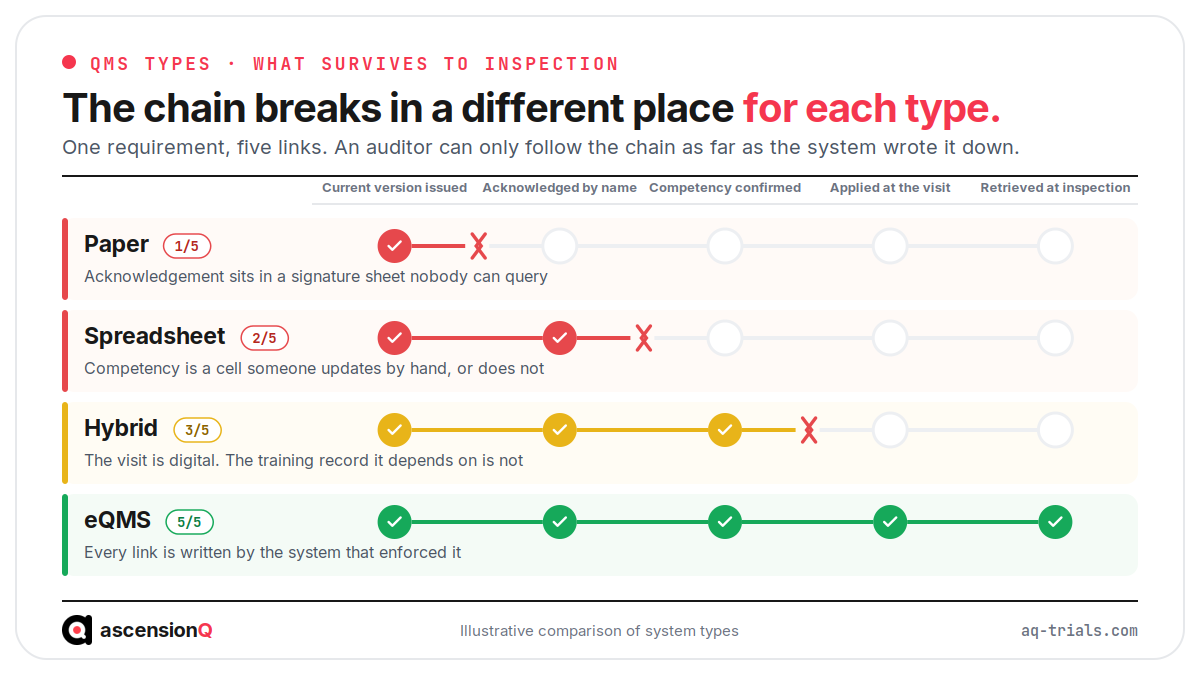
Clinical research organisations operate with different levels of quality system maturity. The type of QMS in use directly affects how well teams control documents, track compliance, manage training, and prepare for audits. Understanding the differences helps determine how effectively quality processes remain visible, traceable, and aligned with regulatory expectations.
- Paper-Based QMS: Uses physical documents and manual records; supports basic documentation needs but creates limited visibility, weak version control, and high audit preparation effort due to scattered evidence
- Spreadsheet-Based QMS: Uses tools like Excel to track training, CAPA, and compliance; provides initial structure but depends on manual updates, which leads to data inconsistencies, version conflicts, and limited traceability
- Electronic QMS (eQMS): Uses a centralised digital system to manage documents, training, compliance, and CAPA; enables real-time visibility, automated workflows, controlled access, and audit-ready traceability across all quality activities
- Hybrid QMS: Combines paper, spreadsheets, and partial digital tools; allows gradual transition but creates fragmented control, inconsistent data flow, and increased effort to maintain compliance and audit readiness
Also Read: DMS vs eQMS in Clinical Trial Data Management and GAMP 5 and Computerised System Validation
AQ QMS: Connected Quality Management for Clinical Research
AQ QMS provides a connected quality management environment where document governance, training requirements, staff compliance, and CAPA processes operate within one structured system. It aligns quality control with daily research operations, which ensures that each requirement, action, and outcome remains visible, traceable, and consistently enforced.
AQ QMS functions as an integrated quality control layer by connecting:
- controlled documents with version tracking, approvals, and access management
- training requirements, acknowledgements, and competency validation linked to roles
- staff compliance monitoring across procedures, updates, and study activities
- quality events such as deviations, findings, and operational gaps
- CAPA workflows with structured investigation, action, and resolution tracking
- audit trails and activity logs with complete traceability across all actions
This structure ensures that quality processes do not operate as separate administrative tasks but remain directly linked to execution. Each document update, training requirement, compliance check, and corrective action progresses within a unified system, which strengthens accountability and reduces gaps across teams.
AQ QMS also provides continuous visibility into quality status across clinical research operations. Research quality teams can monitor compliance activity, identify unresolved gaps, track corrective actions, and maintain consistent quality practices across multiple studies and sites.
What Is the Best QMS for Clinical Research Organisations?
The best QMS for a clinical research organisation depends on who holds the records. Sponsors and manufacturers governing quality across a product portfolio usually shortlist Veeva, MasterControl or Qualio. Research sites, NHS trusts and academic teams need the quality system on the same record as study conduct.
The systems below are commonly shortlisted by clinical research organisations. Each description paraphrases the vendor’s own product page, checked on 8 October 2026.
| System | How the vendor describes it | Capabilities the vendor publishes | Fits best | Hosting stated on the product page |
| Veeva Vault QMS | A cloud quality system for life sciences quality processes, with external partners able to join investigations | Deviations and complaints, internal and external audits, CAPA, change control including supplier change control, quality risk management, supplier quality. Document control and training are separate Vault applications | Pharmaceutical and biotech quality organisations governing quality across a product portfolio | Cloud. Region not stated |
| MasterControl Quality Excellence | A digital quality system that automates quality across the product lifecycle | Document control, change management, training management, audit management, risk management, quality events, supplier management. Analytics is a separate add-on | Regulated manufacturers moving off a paper or hybrid quality system | Cloud. Region not stated |
| Qualio | A quality and compliance platform for life sciences, with AI features for gap analysis and regulatory change tracking | Document control, training, CAPA and non-conformances, audit management, risk management, change control, design controls, supplier management, quality dashboards, and a validation service with pre-built documentation | Medical device, pharmaceutical, biotech and contract research organisation quality teams | Not stated. ISO 9001 and ISO 27001 badges shown on the page |
| Ideagen Quality Management | A quality management platform built around mobile smart forms and offline data capture | Mobile smart forms, offline capture, quality processes across multiple locations, audit capability, compliance tracking. Document control and training management are separate Ideagen solutions | Distributed field and multi-site operations. The product page names no clinical research use | Not stated |
| AQ QMS | The quality management module of AQ Platform, linking controlled documents and training to the studies they apply to | Document control with review, approval and publishing, a document library, role-based training assignment with quizzes and learning records, and reporting. AQ CAPA is a linked module on the same platform and keeps its own audit log | UK NHS, academic and mid-market research teams that want document control, training records and study conduct on one record | UK-hosted. NHS DSPT Standards Met (2026). Cyber Essentials certified |
No system on this list is the only option for a clinical research organisation. The useful split is where the quality system sits. A sponsor-side eQMS governs documents, quality events and suppliers for a whole organisation, and receives site evidence later. A site-side quality system has to tie a procedure version and a training record to the visit they governed.
Royal Free London runs AQ QMS and AQ CAPA for more than 300 users.
What QMS Do Phase 1 Units Use for MHRA Phase I Accreditation?
The MHRA Phase I accreditation scheme names no QMS product. It requires a quality system: written procedures for every activity the unit performs, quality control built into key procedures, routine quality assurance audits against the scheme requirements, and CAPAs implemented in good time. Units choose their own software to hold that evidence.
The scheme is voluntary and aimed at organisations running phase I trials, first-in-human trials in particular. Its requirements fall into five areas: clinical trial design and set-up, medical emergencies and facilities, staff, participant identification, and the quality system. The quality system area is the one a QMS has to serve.
| What the scheme asks for | What the unit has to be able to produce |
| Written SOPs covering every activity, including each accreditation requirement | A current SOP set, with procedures for the areas the scheme names, such as common medical emergencies, dose escalation, staffing levels and participant recruitment |
| Quality control built into key procedures, with defined escalation points | Evidence that each check happened at the defined point, and the record of what was escalated |
| Routine quality assurance audits against the scheme requirements | An audit schedule, the audit reports, and the CAPAs raised from them |
| CAPAs implemented in a timely manner | Closure evidence for each finding, which the MHRA requires for findings against scheme requirements |
| Staff current in training and assessed as competent | Training records showing annual updates for clinical staff and at least immediate life support training |
| Documented emergency scenario testing | A record of who took part, with at least one scenario a year for staff in contact with participants |
| A policy or SOP setting minimum staffing levels | The staffing policy, and evidence that appropriately trained staff were available on dosing days |
| Notification of changes to key personnel | A current list of key personnel, which generally includes the quality system lead |
| Variations reported for significant changes | A record of changes that alter SOP structure, names or references, submitted to the MHRA |
Accreditation is not a software decision. Certificates carry no expiry date, and each re-accreditation inspection asks for an updated compliance checklist, so the quality system holds this evidence continuously rather than assembling it for a visit. Major findings on participant safety have to be resolved before accreditation, and the MHRA asks for evidence that CAPAs against scheme requirements are complete.
Unaccredited organisations may still run phase I trials. Research ethics committees and R&D departments may take the absence of accreditation into account.
Key Features to Look for in a QMS Software
- Centralised document control with versioning, approvals, and access management
- Role-based training assignment with completion tracking and competency validation
- Staff compliance monitoring across documents, training, and quality activities
- CAPA management with root cause analysis, ownership, and resolution tracking
- Deviation and nonconformance tracking with structured logging and review workflows
- Audit and inspection management with findings, actions, and closure tracking
- Change management with controlled approvals and impact tracking
- Risk management with identification, assessment, and mitigation tracking
- Real-time dashboards for compliance status, training progress, and quality metrics
- Automated notifications for pending actions, overdue tasks, and compliance gaps
- Complete audit trails with user activity, timestamps, and traceability
- Integration capability with CTMS, eTMF, and other clinical systems
- Secure access control with authentication and data protection mechanisms
- Configurable workflows aligned with study protocols and organisational processes
- Scalable architecture to support multi-site and multi-study environments
How to Implement a QMS in Clinical Research?
Let’s say you need to implement a QMS in your clinical research environment. The goal is to introduce structured quality control without disrupting ongoing studies, while ensuring compliance, traceability, and operational alignment. This process requires careful evaluation, controlled setup, and phased adoption across teams and sites.
Select the Right QMS System Based on Operational Fit
Start by evaluating QMS vendors against your actual research workflows. Focus on how the system supports document control, training management, compliance tracking, CAPA, and audit readiness. Check configuration flexibility, integration capability with CTMS or eTMF, user roles, and reporting visibility. Ensure the system aligns with clinical research requirements rather than generic quality frameworks.
Validate Configuration and Workflow Alignment
Review how the system can be configured to match your study operations. Confirm that you can define document workflows, training requirements, role-based access, and CAPA processes according to your protocols. Avoid systems that force rigid workflows which do not reflect real study execution.
Map Existing Quality Processes Before Transition
Document how your current processes operate across SOPs, training, compliance tracking, and quality issue management. Identify gaps, overlaps, and manual dependencies such as spreadsheets or email-based tracking. This mapping ensures that the new system reflects operational reality rather than introducing disruption.
Introduce the System Without Disrupting Ongoing Studies
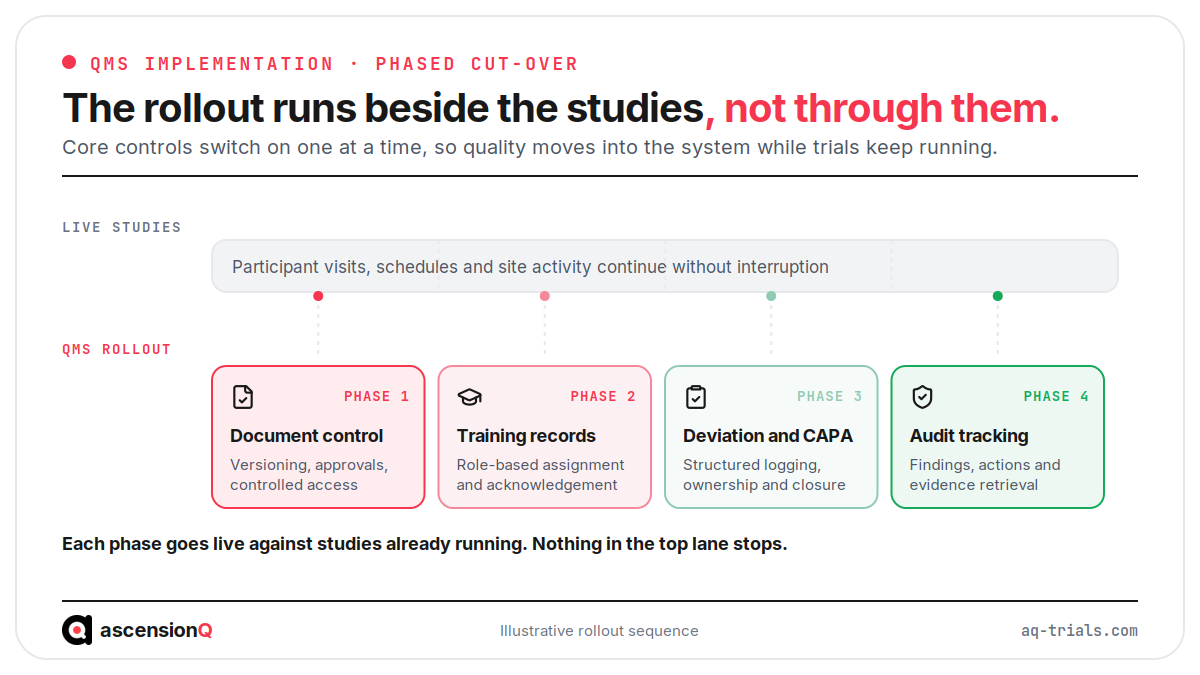
Begin implementation alongside existing workflows. Configure studies, documents, and user roles in parallel while active trials continue in current systems. Ensure that participant visits, schedules, and ongoing activities remain unaffected during the transition.
Set Up Core Quality Controls in Phases
Activate key modules step by step:
- document control and version management
- training assignment and compliance tracking
- deviation and CAPA workflows
- audit and inspection tracking
This phased setup allows teams to adapt gradually while maintaining control over quality processes.
Assign Roles and Responsibilities Across the System
Define who is responsible for document approvals, training oversight, compliance monitoring, and CAPA management. Ensure each quality activity has clear ownership to maintain accountability across teams.
Train Users Based on Roles and Responsibilities
Introduce the system to coordinators, investigators, quality teams, and site staff based on how they interact with quality processes. Focus on real tasks such as acknowledging documents, completing training, logging deviations, and managing CAPA.
Migrate Critical Data in Controlled Stages
Transfer active documents, training records, and ongoing quality actions into the system. Prioritise current and relevant data to maintain continuity, while older records can be archived or migrated later if required.
Enable Visibility and Monitoring From Day One
Use dashboards and reporting to track training completion, compliance gaps, and open CAPAs as soon as the system goes live. Monitor adoption across teams and identify areas where additional support or adjustment is required.
Refine and Expand Across Studies and Sites
Once core processes stabilise, extend the system across additional studies, locations, and teams. Adjust workflows based on usage patterns and operational feedback to maintain alignment with real research activity.
Maintain Continuous Control and Improvement
Regularly review compliance status, training completion, and quality trends. Update workflows, documents, and system configurations as study requirements evolve. Ensure that quality processes remain aligned with regulatory expectations and operational changes.
QMS vs CTMS in Clinical Research
| Aspect | QMS (Quality Management System) | CTMS (Clinical Trial Management System) |
| Core Purpose | Ensures compliance, quality control, and audit readiness | Manages study execution, scheduling, and coordination |
| Focus Area | Documents, training, compliance, CAPA | Participants, visits, timelines, site activity |
| Primary Users | Quality teams, compliance officers | Coordinators, investigators, operations teams |
| Key Function | Tracks training, deviations, CAPA, audit logs | Tracks enrolment, visits, site performance |
| Data Type | Quality and compliance data | Operational and study execution data |
| System Role | Governance layer controlling how work is done | Execution layer managing what work is done |
| Practical Use | If you are a Quality Lead, you monitor compliance, training gaps, and CAPAs | If you are a Study Coordinator, you schedule visits and track participant progress |
QMS vs eTMF vs Other Clinical Systems
| Aspect | QMS (Quality Management System) | eTMF (Electronic Trial Master File) | Other Clinical Systems (EDC, CDMS) |
| Core Purpose | Ensures quality control, compliance, and process governance | Manages and stores essential trial documents | Supports study execution, data capture, and operational workflows |
| Primary Focus | Training, compliance, CAPA, deviations, audit readiness | Regulatory documents, approvals, trial records | Participants, visits, clinical data, study coordination |
| Key Function | Tracks quality activities and enforces controlled processes | Maintains complete, version-controlled document repository | Executes study activities and captures clinical data |
| Data Type | Quality and compliance data | Regulatory and document-based records | Operational and clinical data |
| System Role | Governance layer controlling how work is performed | Documentation layer ensuring completeness of trial records | Execution and data layer driving study operations |
| Users | Quality teams, compliance officers, auditors | Regulatory teams, document specialists, sponsors | Coordinators, investigators, data managers |
| Practical Use | If you are a Quality Lead, you manage compliance, training, and CAPA | If you are a Regulatory Manager, you maintain trial documents for inspection | If you are a Study Coordinator, you manage visits and enter study data |
Frequently Asked Questions
What is a quality management system in clinical research?
A QMS in clinical research is the controlled system that holds an organisation’s procedures, training records, quality events and corrective actions. It shows who approved each procedure, who was trained on it, and what happened when something went wrong. Research sites and sponsors use it to evidence Good Clinical Practice.
What is the best QMS for clinical research organisations?
The best QMS depends on who holds the records. Veeva, MasterControl and Qualio are built for sponsor and manufacturer quality organisations and govern quality across a product portfolio. Research sites, NHS trusts and academic teams usually need the quality system on the same record as study conduct, which is where AQ QMS sits.
What QMS do Phase 1 units use for MHRA Phase I accreditation?
The MHRA Phase I accreditation scheme does not name a QMS product. It requires written SOPs for every activity the unit performs, quality control built into key procedures, routine quality assurance audits against the scheme requirements, and CAPAs implemented in good time. Units pick their own system to hold that evidence.
What are the quality management system requirements for clinical trials?
ICH E6(R3) asks for quality managed in proportion to risk and focused on the factors critical to quality. Site-level requirements are controlled procedures, staff qualified and trained before the task, delegation recorded with effective dates, source records that are attributable, legible, contemporaneous, original, accurate and complete, and essential records kept for the retention period.
How long must clinical trial quality records be kept in the UK?
Essential trial records must be kept for at least 25 years after the trial ends under the Medicines for Human Use (Clinical Trials) (Amendment) Regulations 2025, in force from 28 April 2026. Quality records that form part of the trial master file follow the same period. A site should confirm its own retention schedule against its sponsor agreements.
Is a QMS the same as a CTMS or an eTMF?
No. A QMS governs how work is done, through procedures, training, quality events and corrective actions. A CTMS manages what work is done, through studies, sites, visits and recruitment. An eTMF holds the essential records that evidence the trial. The three hold different records and are usually bought separately.
Does a research site need an eQMS, or will SOPs in a shared folder do?
A shared folder can hold documents. It cannot show which version was current on the day of a visit, who had acknowledged it, or whether the person performing a task had completed the training for it. An inspector asks for that chain. A controlled quality system records it as the work happens.
Explore AQ QMS
AQ QMS is an independently accessible module within the AQ clinical research platform, designed to manage quality control, compliance, and governance as part of a connected end-to-end research environment. It operates as a standalone quality system while remaining fully aligned with study execution, participant activity, documentation, and operational workflows across the platform.
AQ QMS brings together:
- document governance with controlled access, version tracking, and approvals
- training management with role-based assignment, acknowledgement, and competency validation
- staff compliance monitoring across procedures, updates, and study activities
- deviation tracking and quality event management
- CAPA workflows with structured investigation, action, and resolution tracking
- audit trails and inspection-ready records across all quality activities
All the mentioned quality processes are directly connected to clinical trial operations inside AQ Platform, which ensures that execution, documentation, and compliance progress together rather than across disconnected systems.
This structure enables research teams to maintain continuous visibility into quality status, enforce compliance through system-driven controls, and manage audit readiness as an ongoing process rather than a reactive effort.
A live walkthrough shows document governance, training records, deviation tracking and CAPA held in one quality system and linked to live study activity rather than reconciled after the fact. Book a live demo to see how AQ QMS supports audit-ready quality management across research operations, or read the full module detail on the AQ QMS page.