The majority of CAPA management software action plans fail during the design stage rather than the implementation stage.
Teams complete the actions, upload the evidence, and meet the due dates. The QA Lead approves the record, the CAPA closes, and three months later the same quality event appears again at the same site or another site under a different staff member’s name.
The problem exists within the structure of the action plan itself. The action plan targets the symptom instead of the root cause.
Coordinators receive retraining. Forms receive updates. Site file checklists receive additional reminders. Every action includes documentation, evidence, and approval records. The operational condition behind the original event continues to exist within the process.
Action plans built around the root cause produce a different outcome:
- Quality events stop recurring
- Effectiveness verification passes during the first review
- CAPA records withstand inspection scrutiny
- Operational processes reflect measurable structural improvement
Inspection readiness comes through demonstrated process correction rather than complete-looking documentation.
That level of CAPA planning requires deeper operational assessment. Teams need visibility into:
- Why the issue occurred
- Where the process failure exists within the system
- Which operational condition enabled the event
- What process change reduces the likelihood of recurrence across future studies and sites
This guide explains how to build that type of CAPA action plan within clinical trial operations.
Why Action CAPA Plans Fail: The Structural Problem
Every action plan failure has the same origin: the action plan was written before the root cause was properly understood.
Root cause analysis in clinical research is harder than it appears. A monitoring finding lands on a coordinator’s desk describing a consent form signed after a participant’s baseline visit. The obvious response is to retrain the coordinator. The obvious response is also wrong (or at least incomplete) in almost every case.
Genuine one-time errors by well-trained staff following well-defined processes do occur. They are far rarer than organisations acknowledge. Most quality events that appear to be individual errors are actually produced by process, system, or governance failures that will generate the same type of event again (regardless of who is in the role) until the underlying structure changes.
The three most common structural failures in clinical trial action plans are:
Addressing the person instead of the process. A coordinator failed to update the delegation log after taking on a new study task. The action plan schedules retraining on delegation log requirements. The retraining happens. The coordinator completes it. The next staff change at the site produces the same delegation log gap, because the process for updating the log after role changes still has no owner, no trigger, and no verification step. The person changed. The system did not.
Addressing the instance instead of the condition. An out-of-window visit is identified and documented. The action plan corrects the specific visit record, updates the visit log, and reminds the team of the visit window requirements. Nothing in the action plan examines why the visit window was missed: whether the scheduling system enforced it, whether the coordinator knew the specific window for that cohort after a recent protocol amendment, whether any alert existed for approaching window limits. The instance was corrected. The condition that produced it remains.
Addressing the corrective and forgetting the preventive. Corrective actions fix what already happened. Preventive actions change the conditions that made it possible. Action plans that contain only corrective actions leave the structural vulnerability intact. An inspector reviewing a CAPA for a repeated finding should be able to see, in the preventive actions, what changed in the system to reduce the probability of recurrence. If the preventive column is empty, or contains only training and reminders, the action plan has not engaged with root cause.
Start With the Root Cause Statement: Not the Action Plan
The root cause statement is the foundation of the action plan. Every action item should be traceable to something in the root cause statement or the contributing factors documented during RCA. If an action cannot be connected to the root cause analysis, it either belongs somewhere else or it should not be in the plan at all.
Before writing a single action item, answer three questions directly from the RCA output:
What structural condition made this event possible?
The root cause is the condition, not the event. The event is “a consent form was signed after the baseline visit.” The structural condition might be “study coordinators received their consent training from a training package that predated the protocol amendment changing the consent window, and no process exists to trigger training updates when consent-related protocol amendments are approved.”
What would have had to be different for this event not to have occurred?
The answer to this question defines the corrective action. If the training package had been updated when the protocol amendment was approved, the coordinator would have known the correct consent window. The corrective action is to update the training package. The systemic corrective action is to review all active training content for protocol-amendment-driven changes and update accordingly.
What needs to change structurally to reduce the probability of this type of event occurring again?
The answer to this question defines the preventive action. A mechanism needs to exist that triggers a training content review whenever a protocol amendment affects a procedure covered by existing training. The preventive action is to create that mechanism, not to retrain the coordinator again.
With these three answers in hand, action item design becomes a structured exercise rather than a brainstorming session.
The Architecture of an Effective CAPA Action Plan
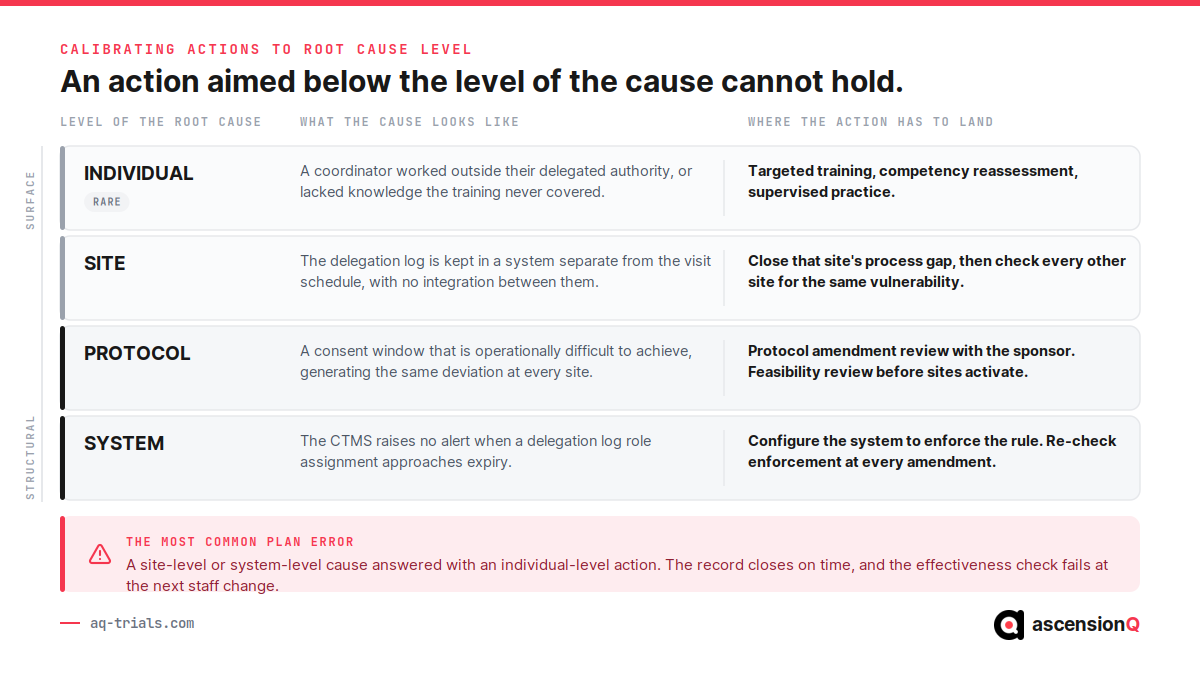
A well-built CAPA action plan in clinical research contains three distinct types of action items. Each serves a different function. Each operates at a different level of the system.
Type 1: Immediate Containment Actions
Immediate containment actions address the specific impact of the event that has already occurred. They do not resolve the root cause. They stop the situation from getting worse and protect participants, data, and regulatory standing while the investigation and corrective actions are underway.
In clinical research, immediate containment actions might include:
- Quarantining affected data pending review
- Notifying the IRB/IEC of the specific event as required
- Placing a temporary hold on the procedure that generated the event until the corrective process is updated
- Reviewing all active participants for the same type of gap
Immediate containment actions are time-critical and should be completed within days of the CAPA being opened. They are documented in the CAPA record but are separate from the root-cause-driven corrective and preventive actions that follow.
Type 2: Corrective Actions
Corrective actions address the root cause directly. They change the thing that failed (the process, the system, the document, the governance structure) so that the specific failure mechanism identified in the RCA can no longer operate in the same way.
Effective corrective actions in clinical research are specific about what will change, not just that something will change.
Weak corrective action: Update the delegation log process.
Strong corrective action: Revise the site delegation log SOP (version 3.1) to add a mandatory step requiring the coordinator to update the delegation log within 48 hours of any new study task assignment. Add a weekly delegation log review to the site coordinator’s task checklist. Assign the Principal Investigator as the oversight owner for delegation log completeness reviews, documented monthly in the site supervision log.
The strong version names the specific document, the specific change, the specific timeline, the specific responsible person, and the specific oversight mechanism. An inspector reviewing this action item can verify each element independently. An action owner completing this item knows exactly what is expected.
Type 3: Preventive Actions
Preventive actions operate at the level of the condition rather than the instance. They are designed to reduce the probability that the same type of failure recurs, at this site, at other sites, and in the future when the people involved have changed.
Preventive actions in clinical research often target:
- Protocol-level ambiguities that generate consistent misinterpretation across sites
- Training system gaps where content is not updated when procedures change
- Oversight gaps where no one holds accountability for a specific quality check
- System configuration gaps where the scheduling or documentation tool does not enforce the rule it is supposed to enforce
- Knowledge transfer gaps where critical operational knowledge lives with an individual rather than in a documented process
Example: A preventive action that engages root cause.
Root cause identified: No systematic process exists for reviewing training content when protocol amendments are approved. Amendments are communicated to site staff through a general notification, but no mechanism checks whether existing training packages need revision.
Preventive action: Establish a protocol amendment review checklist within the QMS that requires the Training Manager to assess whether any approved training content covers procedures affected by the amendment. Checklist completion is mandatory before the amendment is closed in the study management system. Training Manager is the process owner. QA Lead reviews checklist completion quarterly.
This preventive action does not train anyone. It creates a structural checkpoint that makes it operationally difficult to approve a protocol amendment without reviewing whether training needs to be updated. The process now enforces the check. It does not rely on an individual remembering to do it.
Calibrating Actions to Root Cause Level
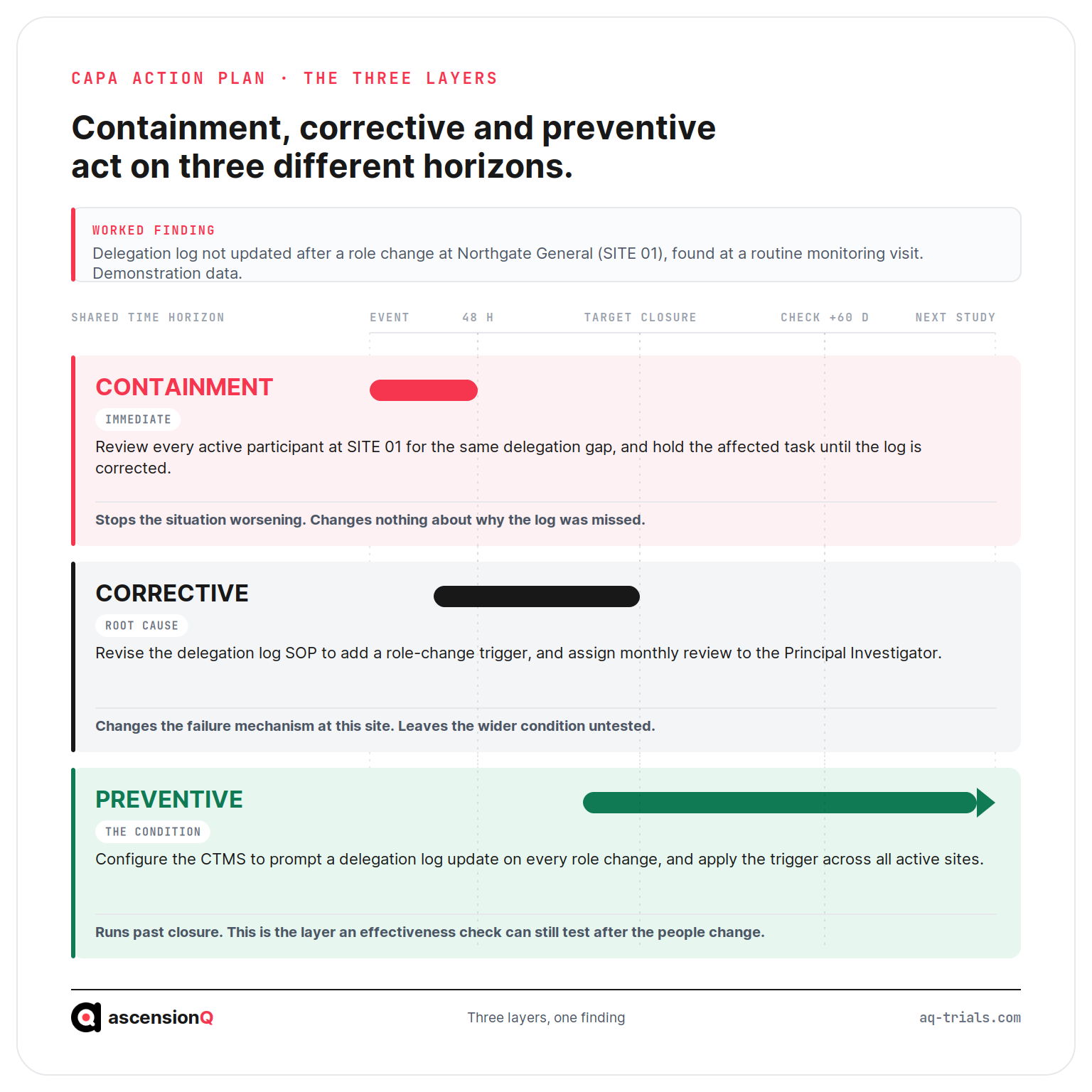
Root causes in clinical research sit at different levels of the system. The level of the root cause should determine the level at which the action is targeted. An action targeted below the root cause level will not be effective.
Individual level root causes: a specific person lacked knowledge, made a judgment error, or operated outside their delegated authority. These are rare and should only be concluded after all process and system explanations have been exhausted. Corrective actions at individual level include targeted training, competency reassessment, and supervised practice. Preventive actions at individual level include role-specific onboarding checklists, defined competency verification requirements, and oversight triggers when staff are new to a study task.
Site-level root causes: a specific site’s processes, resources, or oversight structures generated the failure condition. Common examples: a site without a dedicated quality oversight step in its visit management process; a site where the coordinator managing a complex protocol is under-resourced; a site where the delegation log is managed in a separate system from the visit schedule with no integration. Corrective actions target the specific site’s process gap. Preventive actions review whether other sites share the same structural vulnerability and apply the fix systematically.
Protocol-level root causes: the protocol itself creates conditions that consistently generate the quality event. A consent window that is operationally difficult to achieve. A visit schedule with overlapping windows across cohorts that creates booking errors. An inclusion criterion that coordinators consistently misinterpret in the same direction. Corrective actions at protocol level require protocol amendment review and sponsor engagement. Preventive actions include a protocol feasibility review process that assesses operational risks before sites are activated.
System-level root causes: the technology or management system in use does not support correct execution. The scheduling system does not enforce visit windows. The eISF does not prompt for a missing document category. The CTMS does not alert when a delegation log role assignment is approaching expiry. Corrective actions configure the system to enforce the rule. Preventive actions establish a system configuration review process that checks enforcement rules when protocol amendments change operational requirements.
The most common action plan error across all root cause levels is responding to a site-level or system-level root cause with an individual-level action. Retraining is an individual-level action. If the root cause is that the scheduling system does not enforce visit windows, retraining the coordinator on visit windows will not fix the system. The coordinator will know the rule and still have no automated support for applying it correctly across 80 participants with different enrolment dates.
Using Contributing Factors to Build the Preventive Layer
Contributing factors are the conditions that did not directly cause the quality event but made it more likely or more severe. The RCA should document them separately from the root cause. The action plan should address them separately in the preventive actions.
Contributing factors in clinical research commonly include:
- A recent staff change that disrupted institutional knowledge
- A recruitment peak that increased coordinator workload beyond sustainable levels
- A protocol amendment that changed requirements without a corresponding update to site-level materials
- A technology limitation that removed a safeguard that existed in a previous system
- An SOP that had not been reviewed since the previous version of the protocol
Each contributing factor represents a condition that, if unaddressed, lowers the threshold for the same type of failure to occur again. The root cause may be resolved. The contributing factor may still be present. In that case, the system is more resilient than it was, but it is running with a reduced safety margin.
Example:
A CAPA for repeated out-of-window visits identifies the root cause as: visit windows for the complex multi-cohort schedule were not configured in the scheduling system and were manually tracked by the coordinator in a separate spreadsheet.
Corrective action: Configure all visit windows for all cohorts in the scheduling system. Decommission the coordinator’s manual spreadsheet.
Contributing factor identified in RCA: Three months before the out-of-window events, a new coordinator took over the site management. The outgoing coordinator had designed the spreadsheet and had an intuitive understanding of its logic. The handover documentation did not include the spreadsheet’s logic or the visit window rules it encoded.
Preventive action targeting the contributing factor: Establish a site coordinator transition checklist that includes a mandatory handover session covering all active operational tools, non-standard tracking methods, and visit management logic. The incoming coordinator and outgoing coordinator both sign the checklist. The Principal Investigator reviews the completed checklist before the transition is finalised.
This preventive action does not address the scheduling system configuration. That is the corrective action. It addresses the knowledge transfer gap that made the missing configuration catastrophic when the staff change occurred. Both are necessary. Neither alone is sufficient.
CAPA Action Item Design: The Practical Requirements
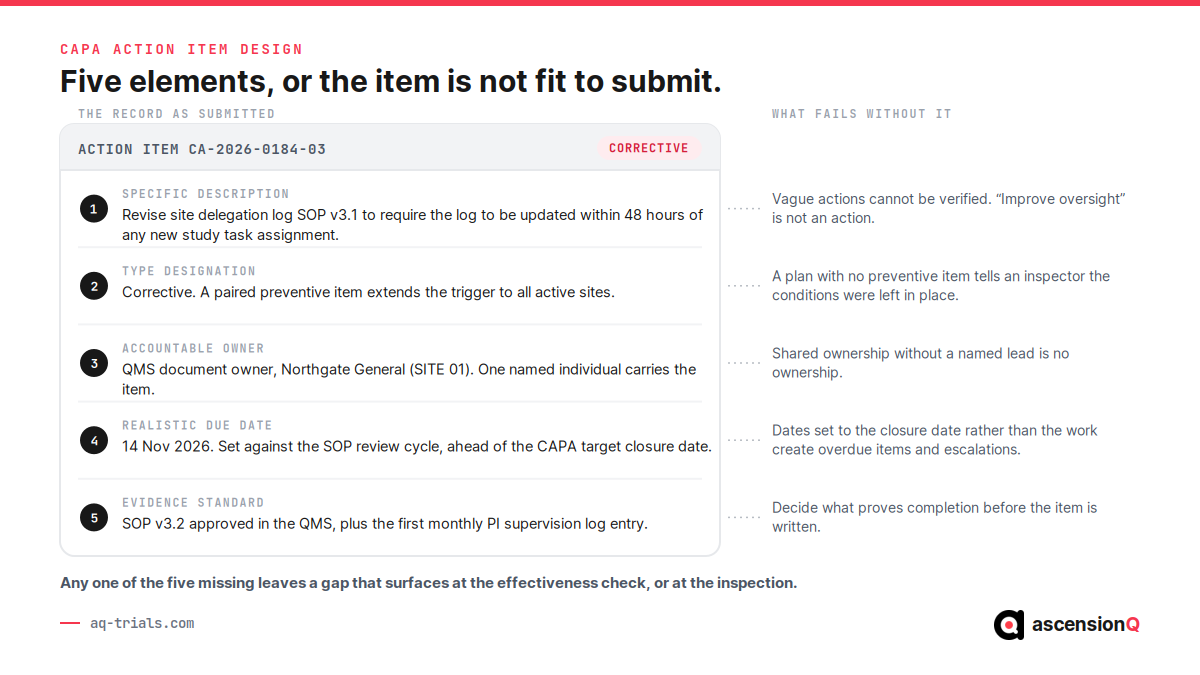
Every action item in the plan needs five elements before it is fit to submit for approval. Missing any one of these elements creates a gap that will appear in the effectiveness verification, or the inspection.
Specific description. The action item must describe exactly what will be done, to what standard, in what document or system, and how completion will be evidenced. Vague actions cannot be verified. “Improve oversight of the consent process” is not an action. “Add a monthly consent log review to the Principal Investigator’s site supervision responsibilities, documented in the supervision log using the updated site supervision template (version 2.0), with the first review completed by [date]” is an action.
Clear type designation. Every action item must be designated as Corrective, Preventive, or Both. This designation drives dashboard metrics, inspection reporting, and the effectiveness verification criteria. An action plan with no preventive actions sends a signal to inspectors that the organisation addressed the event without addressing its conditions.
Accountable owner. The action owner is the individual responsible for completing the specific item. The owner should be the person best positioned to execute the change, not necessarily the QA Specialist who wrote the CAPA. In clinical research, action owners may include site coordinators, Principal Investigators, Training Managers, QMS document owners, system administrators, or sponsor oversight leads. Every action item has one named owner. Shared ownership without a named lead is de facto no ownership.
Realistic due date. Due dates should be set against what the action actually requires, not against the CAPA target closure date. An action that requires a protocol amendment review cannot be completed in five days. An action that requires coordinating training across twelve sites cannot be completed in two weeks. Due dates that cannot be achieved create overdue items, generate escalation notifications, and signal to inspectors that the action plan was not built with operational reality in mind. Date extensions are available and audit-logged, but repeated extensions suggest the original due date was arbitrary.
Verifiable evidence standard. Before the action item is written, decide what evidence will demonstrate completion. The evidence standard should be specific enough that both the action owner and the QA Lead know in advance what a Complete item looks like. “Training completed” is not an evidence standard. “Training completion certificate uploaded to the action item, signed by the coordinator and the Training Manager, dated within the due date window” is an evidence standard.
The Action Plan Approval Step: What Reviewers Need to See
An action plan submitted for QA Lead approval should answer four questions on its face, without the reviewer needing to go back to the RCA or ask the QA Specialist for clarification.
Does every action item trace to the root cause or contributing factors? A reviewer who cannot connect an action item to the RCA output should return the plan and ask for the connection to be made explicit. An action item that cannot be connected to the RCA output does not belong in the CAPA.
Does the plan contain both corrective and preventive actions? A plan with only corrective actions has addressed the event without addressing its conditions. The reviewer should identify the preventive gap and return the plan unless there is a documented and justified reason why no preventive action is possible or appropriate.
Are all action items specific enough to be verified? Vague actions produce disputed completions. “Update the SOP” produces a completion when any version of the SOP changes, regardless of whether the specific change required by the root cause was made. “Update Section 4.3 of SOP-CL-014 to add the delegation log update trigger described in the corrective action plan” produces a verifiable completion.
Are the due dates operationally realistic? A plan with due dates that cannot be met creates a paper trail of overdue items that the organisation then has to explain during an inspection. A reviewer who can see that a cross-site training rollout has been assigned a two-week deadline should challenge that deadline before approving the plan.
For Critical CAPAs, dual approval (QA Lead followed by QA Director counter-signature) adds a second set of eyes on the plan at the most senior quality level. The QA Director’s review should specifically assess whether the plan’s corrective and preventive actions are proportionate to the risk level and whether the preventive layer adequately addresses the structural conditions identified in the RCA.
Designing CAPA Action Plans to Pass Effectiveness Verification
Effectiveness verification is the test of whether the action plan actually worked. Most effectiveness failures are predictable from the action plan design, because the actions addressed symptoms, the verification criteria measured symptoms, and the underlying condition was never changed.
Write the verification criteria before finalising the action plan.
Verification criteria define what ‘effective’ looks like after the actions are complete. Writing them before the plan is finalised forces a useful discipline: if the planned actions cannot produce a measurable outcome that satisfies the criteria, the actions need to be redesigned.
Example:
Action plan addresses: Missing delegation log entries following role changes.
If the corrective action is “retrain the coordinator on delegation log requirements,” the verification criterion will likely be “no further delegation log gaps identified in the 60-day post-training monitoring period.” This criterion is easy to satisfy temporarily and easy to fail when the next staff change occurs.
If the corrective action is “update the delegation log SOP to add a role-change trigger and assign oversight to the PI with monthly review,” the verification criterion can be “delegation log update within 48 hours confirmed for 100% of role changes in the 60-day post-implementation period, verified through site supervision log review.” This criterion tests the process change, not the individual’s compliance with retraining.
The second set of actions produces a verification criterion that, if passed, confirms the structural change held under real operating conditions.
Match the verification method to the action type.
Re-inspection and data review are the most common verification methods in clinical research. Re-inspection works well for actions that change a document, a checklist, or a supervision process: you can look at the new process operating and confirm it works. Data review works well for actions that change a system configuration or a scheduling rule: you can review whether the rule held across the relevant participant population in the verification period.
Record review (examining training records, supervision logs, delegation logs, or visit records) is appropriate when the action involved a process change that should be reflected in operational documentation. The key is that the record reviewed must reflect the specific change made, not just general compliance in the relevant area.
Plan the verification timeline against the action type.
Verification scheduled too soon after implementation has not given the change enough time to be tested under real operating conditions. A delegation log process change verified two weeks after implementation, before any new role changes have occurred at the site, has tested nothing. Verification scheduled too late misses the window to catch an early failure and reopen the CAPA while the evidence is still fresh.
A reasonable rule: schedule verification far enough after implementation that the changed process will have operated at least once across the full range of situations it was designed to govern. For a visit window enforcement configuration, that means enough time for participants across all cohorts and visit types to have had appointments scheduled. For a training update trigger process, that means enough time for at least one protocol amendment to have been reviewed under the new process.
When an Action Plan Fails Effectiveness Verification?
A failed effectiveness check produces a specific signal: something in the action plan did not address the root cause. The CAPA reopens at the Investigation stage. A new investigation note is created. The record shows ‘Reopened: Effectiveness Failure.’
The response to a failed effectiveness check is not to repeat the original actions more thoroughly. The response is to return to the root cause analysis and ask what the original analysis missed.
Failed effectiveness checks most commonly result from one of three analysis errors:
The root cause was stated at too shallow a level. The 5-Why chain stopped at the first plausible answer rather than continuing to the structural condition underneath it. A corrective action built on a shallow root cause addresses the surface rather than the foundation.
The root cause was accurate but the action plan addressed only the corrective layer. The specific failure was fixed. The conditions that produced it were left intact. The first effectiveness verification passed because no new event occurred in the verification window. Three months later, the conditions reasserted themselves and a new event of the same type appeared.
The root cause was site-specific but the condition was programme-wide. The RCA identified the root cause at the affected site. The corrective and preventive actions were applied at that site. The condition existed at three other sites in the programme. The quality event recurred at a different site where no action had been taken.
In each case, the appropriate response is a more thorough RCA, not a more thorough implementation of the same actions.
How AQ CAPA Supports Action Plan Quality?
The most common failure point in CAPA action plans is the gap between the RCA and the action plan, where a thorough root cause analysis produces actions that address symptoms rather than causes because the connection between RCA output and action design is never made explicit.
AQ CAPA closes this gap structurally.
The RCA section of every AQ CAPA record is built directly into the lifecycle. The 5-Why chain, the Fishbone analysis, the root cause statement, and the contributing factors field are structured data within the record, not attached documents. When the QA Lead approves the RCA, the content is locked and serves as the foundation from which the Action Planning stage opens. The action plan is built in the same record, in the stage immediately following the approved RCA. Every action item the QA Specialist creates sits adjacent to the root cause statement and contributing factors that should have produced it.
The system does not enforce a logical connection between RCA content and action items: that discipline belongs to the QA Lead review. But the structural proximity of the two stages, with the RCA approval required before action planning opens, means the connection is always visible to the reviewer. A QA Lead approving an action plan in AQ can see the root cause statement on the same record and judge immediately whether the proposed actions address it.
Each action item in AQ CAPA requires a type (Corrective, Preventive, or Both), a description, a named owner, and a due date. The type designation is mandatory: a plan cannot be submitted with unclassified action items. Due dates are validated against the CAPA target closure date, with a warning issued when an action item’s deadline is set later than the closure target.
Action item owners receive task notifications when the plan is approved. Evidence is uploaded directly against the specific action item it documents, not to the general CAPA record. QA Leads reviewing implementation progress can see, item by item, which actions are complete with evidence, which are in progress, and which are overdue, without opening each action item individually.
The effectiveness verification stage is gated on implementation completion. Verification criteria, method, and scheduled date are documented in the verification plan before verification is executed. The verifier is system-enforced to be a different person from the CAPA owner. For instance, if there’s any fail outcome, it automatically reopens the CAPA and creates a new investigation note referencing the failed verification. Notably, the connection between the failed check and the reopened investigation is built into the record, not reconstructed manually.
For QA Directors reviewing programme health, the CAPA dashboard shows on-time closure rate, repeat-finding rate, and overdue CAPA count calculated from live data. A rising repeat-finding rate is the programme-level signal that action plans across the portfolio are not addressing root causes, visible before an inspector arrives to make the same observation.
A live walkthrough shows an action plan built directly from a root cause statement, verification criteria set before implementation starts, and a different-person check enforced by the system at closure. Book a live demo to see how AQ CAPA holds that structure.