A clinical trial management system (CTMS) runs a study while the study is happening. An electronic trial master file (eTMF) holds the evidence that the study happened that way, and in the UK it now holds that evidence for 25 years after the trial concludes. The CTMS is the instrument. The eTMF is the record.
The two systems answer different questions. A CTMS answers what is happening now: which sites are open, who holds which delegated task, which monitoring visits fall due this month, where recruitment stands against target. An eTMF answers what happened: the protocol version in force on a given date, the signed delegation log, the monitoring report filed after the visit, the approval letter that authorised the site to start.
A CTMS is read during the trial. An eTMF is read after it.
This guide covers four things a study team needs to settle:
- What each system holds, and the retention duty attached to each.
- What the UK Clinical Trials Regulations changed on 28 April 2026.
- Where operational records and filed evidence drift apart, and what that costs at inspection.
- Six questions that route any record to the right system.
What Does Each System Actually Hold?
A CTMS carries the operational state of a study: sites, participants, visits, milestones, delegated tasks, monitoring schedules and finance. The values inside it change daily, and their usefulness comes from being current. An eTMF carries the essential records that allow a regulator to evaluate how the trial was conducted and how reliable its data are. The values inside it are fixed at the moment of filing, and their usefulness comes from being complete, attributable and unaltered.
The table below sets the two side by side on the dimensions that decide where a record belongs.
| Dimension | CTMS | eTMF |
| Question it answers | What is happening in the study right now? | What happened, and what proves it? |
| Time orientation | Present and forward. Values are expected to change. | Past and permanent. Values are expected to hold. |
| Typical content | Site status, participant screening and enrolment counts, visit windows, delegated tasks, monitoring plans, milestone dates, study budget and invoicing. | Protocol and amendment versions, regulatory approvals, signed delegation logs, monitoring visit reports, training records, safety reports, contracts, correspondence. |
| Structure standard | Configured to the sponsor’s operating model. No single industry structure. | Commonly built on the DIA TMF Reference Model, a published zone, section and artefact structure. |
| Primary users | Study managers, research nurses and coordinators, monitors, finance, R&D offices. | Sponsors, quality and regulatory teams, monitors, archivists, inspectors. |
| Regulatory position | A computerised system supporting trial conduct. Requires validation, access control and an audit trail. | A record required by law. The trial master file is named in the UK regulations, with a defined retention duty. |
| Retention duty (UK) | Governed by the sponsor’s own records policy and by the evidence the system feeds into the TMF. | 25 years from the conclusion of the trial for applications submitted on or after 28 April 2026. |
| What an inspector does with it | Tests whether oversight was active and decisions were timely. | Tests whether the conduct claimed by the team is supported by filed evidence. |
The systems overlap in one place that causes most of the confusion. Both hold a version of the delegation log, the site activation date and the monitoring schedule. The CTMS holds the working version and the eTMF holds the signed one. Two versions of the same fact create an obligation to keep them consistent.
Also Read: What Is a CTMS? The Complete Guide to Clinical Trial Management Systems
What Changed for the Trial Master File on 28 April 2026?
The Medicines for Human Use (Clinical Trials) (Amendment) Regulations 2025 came into force on 28 April 2026. The instrument was made on 28 April 2025 with a 12 month implementation period. It rewrote several duties that sit directly on the trial master file, and it left the CTMS side of the picture largely to the sponsor’s own governance.
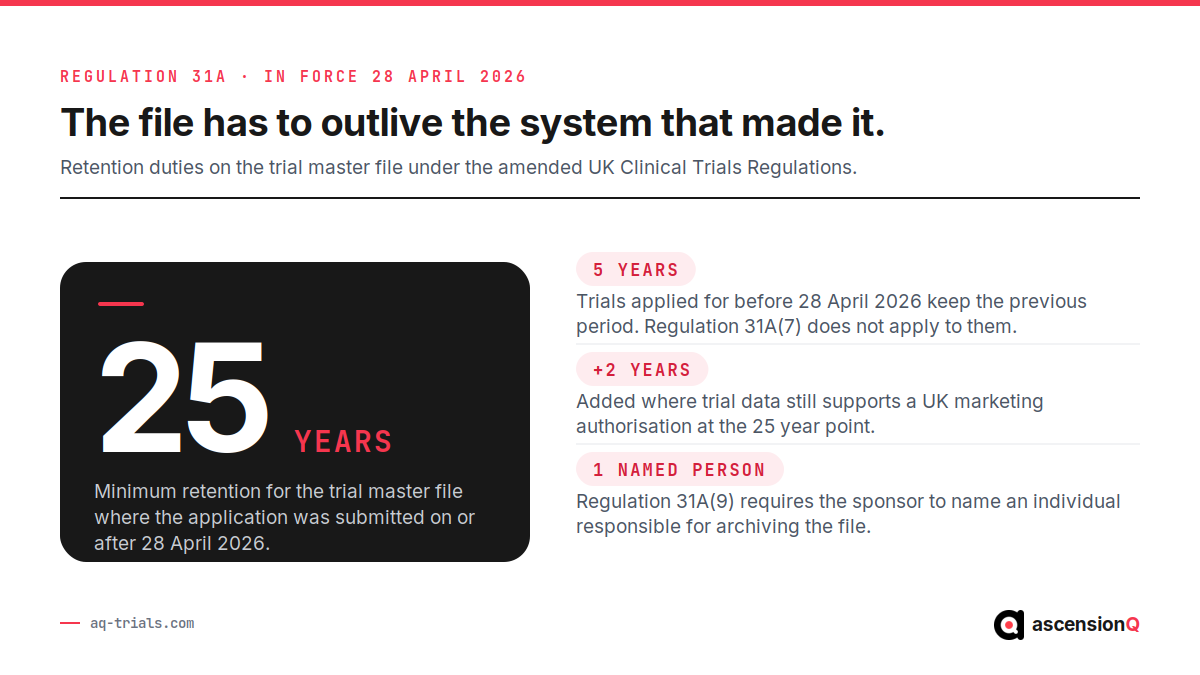
- Retention moved from 5 years to 25 years. Regulation 31A requires the documents in the trial master file to be retained for 25 years beginning with the day after the conclusion of the trial. The MHRA archiving guidance confirms this applies to trials with applications submitted on or after 28 April 2026.
- Trials approved under the old rules keep the 5 year period. Regulation 31A(7) does not apply to them under the published transitional arrangements, so a sponsor running both will operate two retention clocks at once.
- Archiving now has a named owner. Regulation 31A(9) requires the sponsor to appoint a named individual within the organisation responsible for archiving the documents held in the TMF. Ownership of the archive became a person, rather than a department.
- Marketing authorisation extends the clock further. Trial data still supporting a UK marketing authorisation at the 25 year point must be retained for at least a further two years from the day after that authorisation is granted.
- Good clinical practice became a legislative requirement. The Health Research Authority confirms a legislative requirement for CTIMPs to comply with the conditions and principles of the ICH guideline for good clinical practice.
- Terminology changed across both systems. “Amendment” became “modification”, “subject” became “participant” and “trial site” became “trial location”. Field labels, report headers and standard operating procedures carry the old words in many organisations.
The retention change is the one that separates the two systems most sharply. A CTMS is procured, configured, upgraded and eventually replaced on a commercial cycle measured in years. The trial master file it feeds has to remain readable and complete for a quarter of a century. Any evidence that lives only inside an operational system inherits that system’s lifespan.
Where Do Studies Lose Control When the Two Are Confused?
Problems appear at the join, in the gap between an operational action and the filed record of it. The action happens in the CTMS on the day. The evidence reaches the eTMF later, sometimes much later, and the two accounts stop agreeing. Inspectors read both.
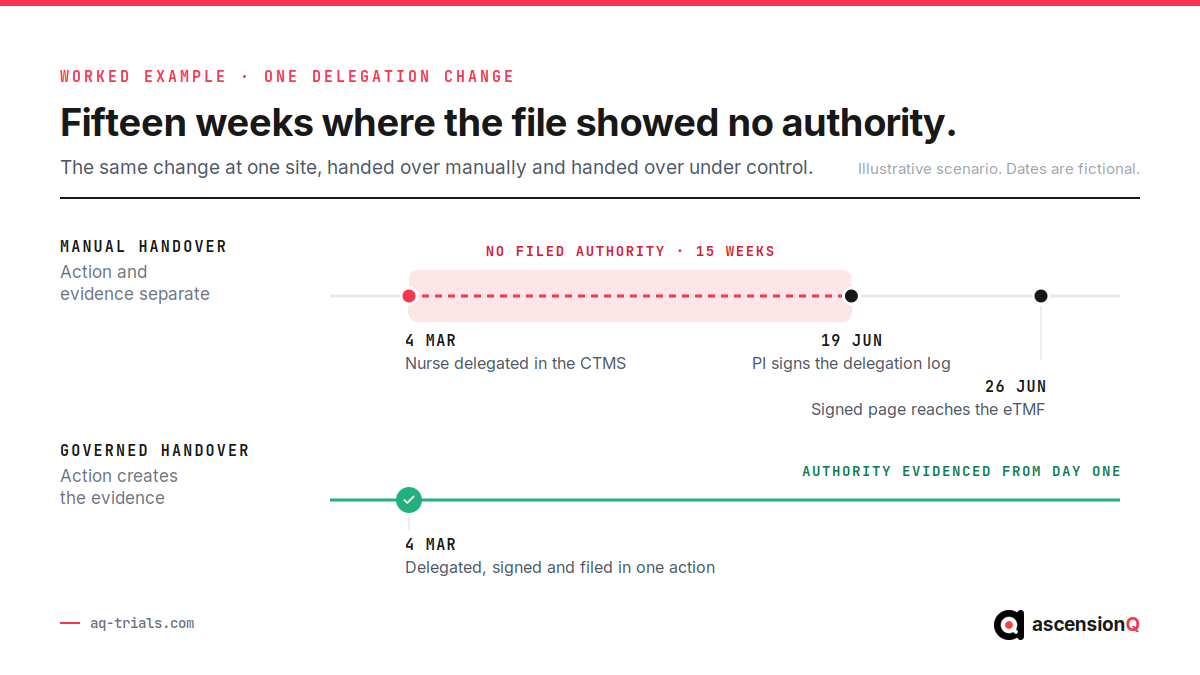
Consider a delegation change at a single site, a scenario familiar to any research team. A new research nurse takes on informed consent duties on 4 March. The coordinator updates the delegation log in the CTMS the same afternoon, and the nurse begins consenting participants. The principal investigator signs the paper delegation log at the next site visit on 19 June, and the signed page reaches the eTMF a week later. The CTMS shows a March start. The filed evidence shows a June signature. Fifteen participants were consented in between, and the file offers no authorisation covering them.
The same gap opens in several predictable places:
- Site activation dates. The operational tracker records a green light call. The file holds a confirmation letter dated four days later, which is the date an inspector will use.
- Protocol modifications. The CTMS switches sites to version 4.0 on the approval date. The file lacks evidence that each site received and acknowledged version 4.0, so the switch cannot be demonstrated per location.
- Monitoring visits. The visit shows as complete in the schedule. The visit report sits in a draft folder for eleven weeks, and the follow up letter never reaches the file at all.
- Training records. Staff appear as trained in the operational system. The file holds certificates for four of the seven people listed.
- Visit windows. Deviations are managed by phone and email. The file shows the deviation log without the assessment that closed each one.
Every item on that list is a handover with no system holding it. The person changed. The process did not.
Also Read: MHRA GCP Inspections: What to Expect and the Most Common Findings
Which Record Belongs in Which System?
Six questions settle almost every case. Apply them to the record itself, rather than to the team that produced it.
- Does the value change as work progresses? A changing value belongs in the CTMS. A recruitment count, a visit status and an open action all move by design.
- Does someone sign or approve it? A signature fixes a record in time, and a fixed record belongs in the eTMF.
- Would an inspector need it to reconstruct what happened? Reconstruction evidence belongs in the eTMF, whatever system produced it.
- Does it have to survive the system that created it? Anything with a 25 year duty has to exist independently of an operational tool.
- Does it exist per participant? Participant level clinical values belong in electronic data capture, with the CTMS holding counts and status only.
- Does the site hold its own copy? Site held essential records belong in the investigator site file, which forms the site side of the same trial master file.
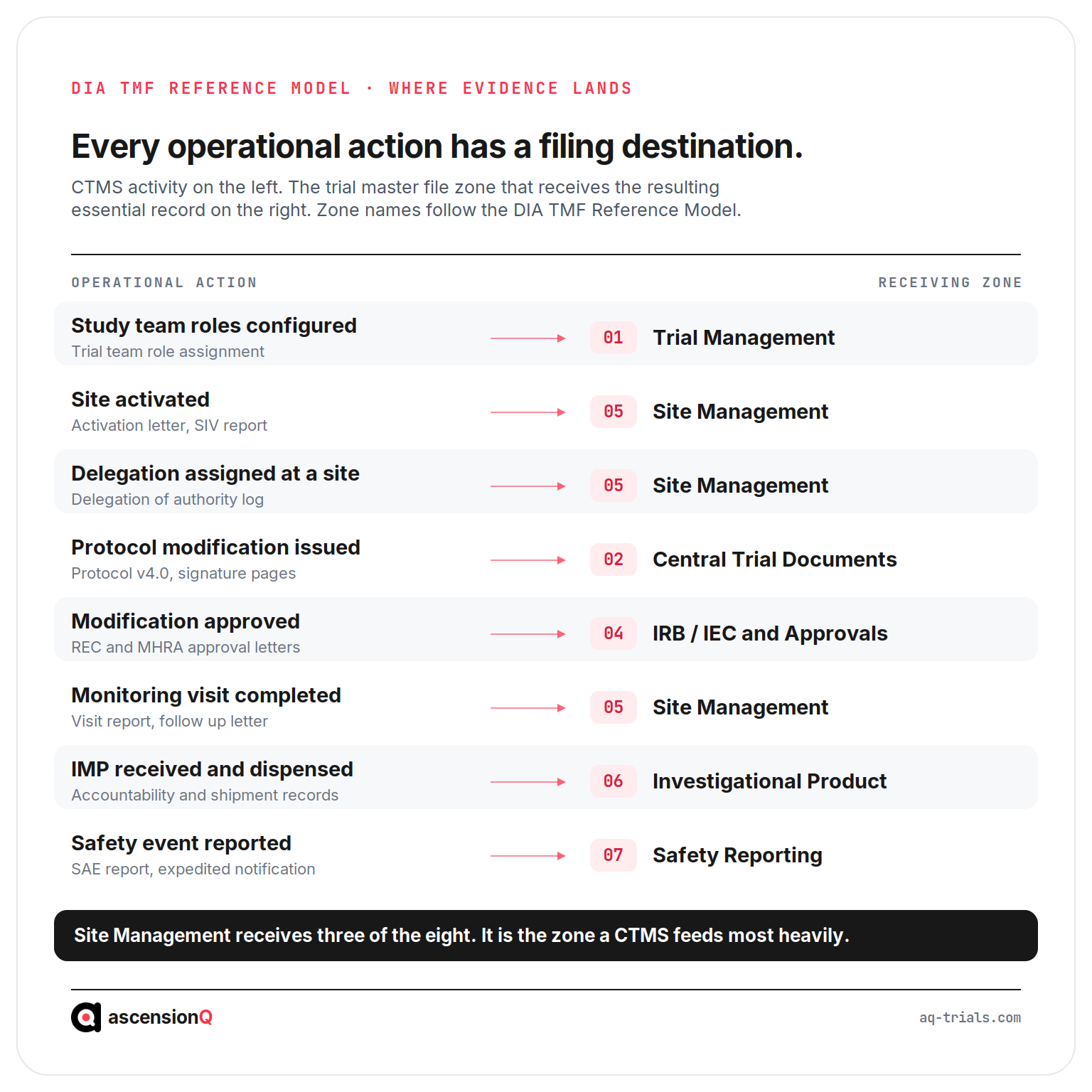
The DIA TMF Reference Model gives the destination for anything the questions send to the file. It publishes a zone, section and artefact structure that most eTMF systems adopt, so a record produced by an operational activity has a defined place to land. The figure below maps common CTMS activity to the zone that receives the resulting evidence.
ICH-GCP E6(R3) sharpens this further. The guideline replaced the term “essential documents” with essential records, which widens the obligation beyond documents to the data and metadata that evidence trial conduct. A screen in a validated system can be an essential record. The question stopped being what format a record takes, and became whether it can be produced, read and trusted years later.
How Do a CTMS and an eTMF Work Together?
Integration between the two systems has one purpose: to remove the manual handover where evidence goes missing. Each mechanism below produces a specific operational outcome.
- A shared study structure gives both systems the same site list, visit schedule and document expectation list, which means a new site inherits its expected filing set on activation.
- Event driven filing raises the expected record at the moment the operational event occurs, which allows a delegation change to open its own filing obligation on the day it happens.
- Placeholder records mark an expected document before the real one arrives, which makes an absence visible to the study manager rather than to an inspector.
- Completeness scoring grades each zone against what should be present, which turns TMF health into a weekly operational metric instead of a close out project. RAG scoring is the common method.
- A single audit trail across both records who did what and when in a form that survives export, which supports the ALCOA+ attributes that inspectors test.
- Milestone alignment keeps the operational date and the filed date on one record, which removes the reconciliation exercise that usually starts three weeks before an inspection.
UK delivery reporting adds a practical reason to hold both in step. Site set up performance is measured against national timelines, and the same dates that satisfy the 90 day set up target also have to be evidenced in the file. One governed date serves both. Two systems holding two versions of it serve neither. The UK clinical research delivery KPIs show how visible those dates now are.
Also Read: TMF Reference Model and the Investigator Site File: Where eISF Fits
What Should a Study Team Check Before Choosing Either System?
Procurement questions differ between the two, and the retention duty drives most of the difference. Ask the following before committing to either.
| Check | Ask a CTMS supplier | Ask an eTMF supplier |
| Audit trail | Which fields are audited, and can the trail be read without vendor assistance? | Does the trail travel with the document on export, including metadata? |
| Validation | What validation evidence is supplied, and who owns configuration testing? | What evidence supports the system as a place of record under GCP? |
| Structure | Can the study structure mirror the file structure without manual mapping? | Is the DIA TMF Reference Model supported, and at which version? |
| Exit and retention | What happens to operational history when the contract ends? | Can the file be exported in a readable, self contained form for 25 years? |
| Access control | Are permissions role based and traceable to a delegated task? | Can inspector access be granted read only and time limited? |
| Terminology | Have field labels been updated to participant and trial location? | Do the artefact names match current regulatory wording? |
The exit question deserves particular weight. A file that can only be read inside its original application creates a dependency that has to hold for 25 years. Ask to see an export before signing, rather than after.
CTMS and eTMF: The Distinction in One Line
A CTMS keeps a study under control while it runs. An eTMF proves that control existed, to a standard that has to hold for 25 years under the current UK regulations. Both systems are necessary, and the value of each depends on the other staying accurate. Teams that treat the two as one governed record spend inspection preparation confirming what the file already shows.
Further reading on the systems and rules named here:
- What an eTMF is, in full.
- What ICH-GCP E6(R3) changed for study oversight.
- The Medicines for Human Use (Clinical Trials) (Amendment) Regulations 2025 as made.
Frequently Asked Questions
What is the difference between a CTMS and an eTMF?
A CTMS runs a study while it is happening. An eTMF holds the evidence that the study happened that way, and in the UK it holds that evidence for 25 years after the trial concludes.
What changed for the trial master file on 28 April 2026?
The Medicines for Human Use (Clinical Trials) (Amendment) Regulations 2025 came into force, and the retention period for the trial master file became 25 years after the trial concludes.
Where do studies lose control between the two systems?
At the join, in the gap between an operational action in the CTMS and the filed record of it in the eTMF. Integration between the two exists to remove that manual handover.
How Does AQ Connect the Operational Record to the Filed Record?
AQ builds the CTMS and the eTMF as connected modules on one platform, which removes the handover described earlier in this guide. The mechanism matters more than the label.
- The CTMS holds study, site and visit structure, and that structure generates the expected document list in the eTMF, so filing obligations exist from activation.
- The eTMF is built on the DIA TMF Reference Model, so every record has a defined zone, section and artefact before it arrives.
- Digital delegation of authority captures signature and date at the point of delegation, which closes the March to June gap in the worked example above.
- The eISF gives each site its own governed file inside the same structure, so a monitor reconciles the sponsor and site copies zone by zone.
- Completeness scoring runs continuously across the file, which reports readiness as a current figure rather than a pre inspection exercise.
Study teams comparing systems usually want to see the join rather than read about it. Book a live demo to walk one delegation change from the operational record through to the filed evidence.