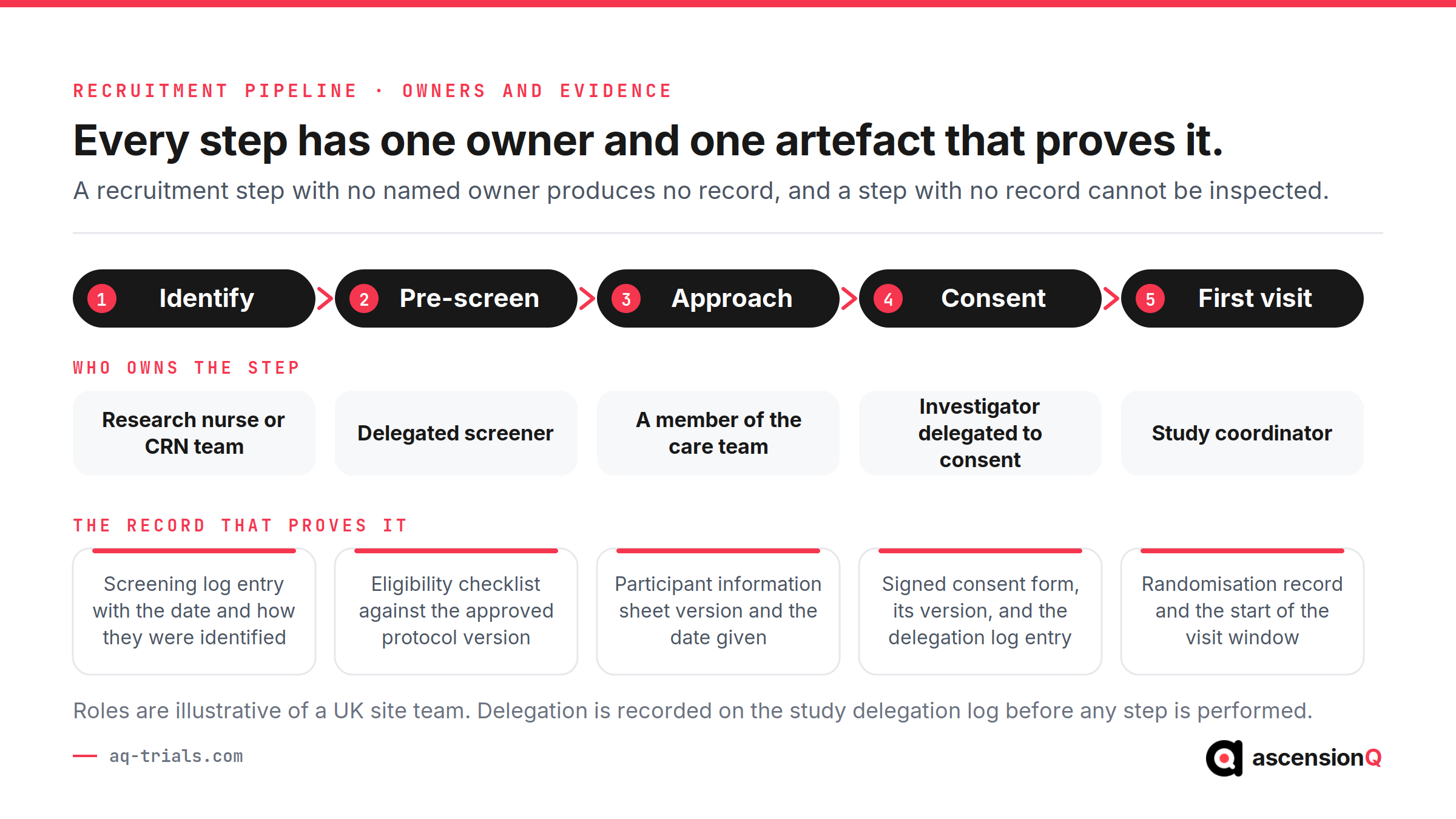
Patient recruitment in clinical trials is the process that converts a defined eligible population into consented, randomised participants, inside a fixed protocol and a fixed set of dates. The work divides into five steps: identification, pre-screening, approach, consent and the first study visit. Each step carries one delegated owner and one artefact that evidences it.
Recruitment in the UK now answers to national delivery measurement alongside the protocol. Published indicators put 98% of studies through combined review inside the assessment clock, and 61% of studies recruiting a first participant within 30 days of opening to recruitment. That gap is where recruitment strategy earns its keep.
The eligible population is rarely the constraint. The route to consent usually is.
What Does This Guide Cover?
- The five steps of a recruitment pipeline, and who owns each one at a site
- Where UK studies lose recruitment time, measured against the national indicators
- What the UK regulations in force since 28 April 2026 require before a site consents anyone
- Five recruitment strategies that hold up under operational pressure
- The records a recruitment pipeline has to produce for a monitor or an inspector
What Does Patient Recruitment in Clinical Trials Involve?
Recruitment describes a sequence of controlled steps, each of which changes a person’s status in the study record. A potential participant moves from identified, to pre-screened, to approached, to consented, to randomised. National reporting fixes a specific event as the point of recruitment and asks the site for the date of that event, so the definition decides which milestone a site enters and when the clock stops. AQ’s guide to CPMS and LPMS milestone data sets out how those dates travel from a local system to the national portfolio record.
Each step produces something a monitor can read months later:
- Identification records who was found, on what date, and from which source, which allows a site to demonstrate that its screening reflects its actual catchment.
- Pre-screening tests eligibility against the approved protocol version, which keeps ineligible participants out of the consent conversation.
- Approach records the participant information sheet version issued and the date it was given, which evidences the time allowed for a decision.
- Consent ties a signed form to a delegated investigator on the study delegation of authority log, which is the check an inspector runs first.
- First visit opens the visit window and starts the schedule of assessments, which converts a consented person into a recruited participant.
Where Do UK Studies Lose Recruitment Time?
The national picture separates two very different problems. Regulatory and ethical assessment runs close to target. Local set-up and the first approach run well below it. The UK clinical research delivery indicators report the split directly, drawn from the DHSC statistics release, and the same pattern appears at trust level in the 90-day set-up target.
| Indicator | What it measures | Latest reported | Target |
| Combined review | Studies approved within 60 days of application, or 90 days for an ATIMP | 98% | 99% |
| Opening to recruitment | Studies opening to recruitment within 60 days of HRA approval | 56% | 90% |
| First participant | Studies recruiting a first participant within 30 days of opening | 61% | 90% |
| Delivery | Open studies recruiting to time and target | 82% | 80% |
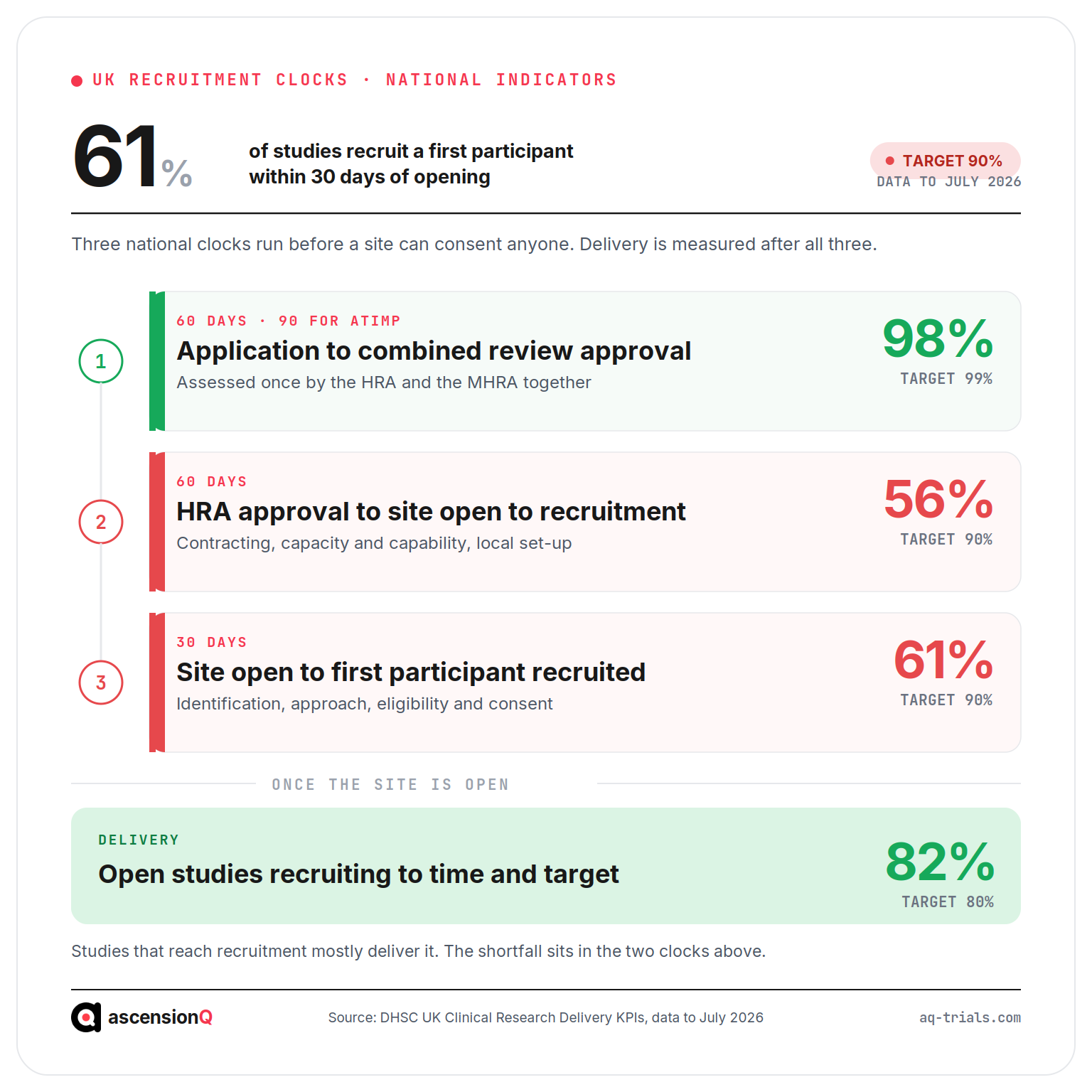
The delivery figure carries the useful message. Studies that reach recruitment mostly hit their target. The shortfall accumulates before the first approach, in the administrative sequence that has to complete before a coordinator may speak to anyone.
A worked example makes the sequence concrete. A cardiology unit with a strong catchment is recorded as open to recruitment on a Monday. The pharmacy file is signed off nine days later. The delegation log entry for the research nurse who runs pre-screening is countersigned two weeks after that. An eligible patient attends clinic on day four and leaves without being approached, because nobody delegated to consent for that study is available and the screening log has no owner yet. The site loses its 30-day indicator on sequencing, and the recruitment plan never gets tested.
A site that opens on paper and starts three weeks later has already spent its recruitment margin.
Also Read: Capacity and Capability Confirmation: Timelines and Delays
What Do the April 2026 UK Regulations Require Before You Recruit?
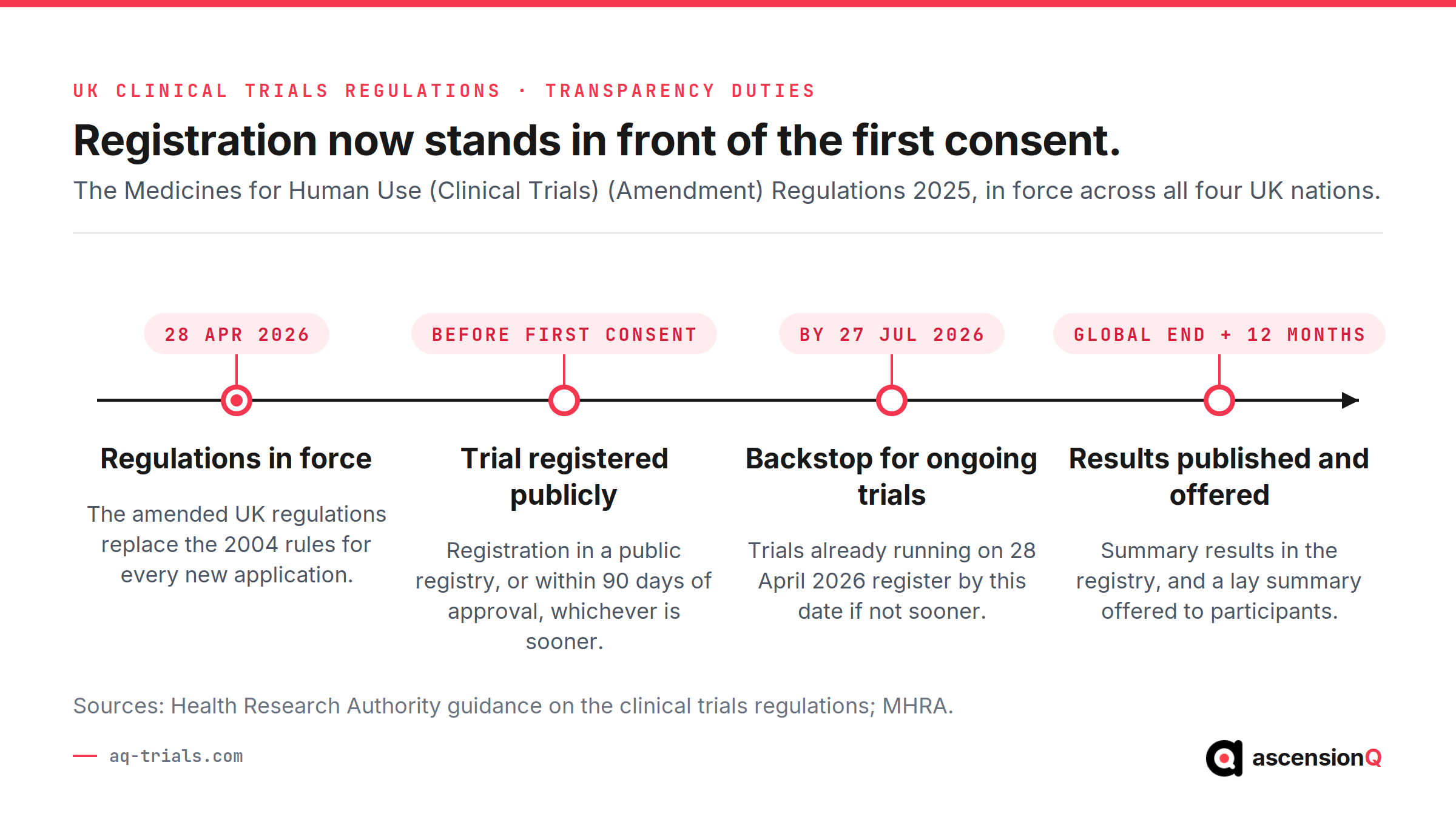
The Medicines for Human Use (Clinical Trials) (Amendment) Regulations 2025 came into force on 28 April 2026 across all four UK nations. Registration of a clinical trial and publication of summary results became legal requirements for the first time, and the registration duty lands directly on the recruitment timeline. Guidance from the Health Research Authority sets out the duties in detail.
Four points change how a recruitment plan is written:
- Registration precedes consent. A sponsor registers the trial in a public registry before the first participant gives consent, or within 90 days of approval, whichever falls sooner. The registry entry becomes a gate in front of the first approach rather than a task for later.
- Trials already running had a backstop. Studies ongoing on 28 April 2026 registered before first consent or by 27 July 2026, whichever came sooner, which brought a large existing portfolio into scope in one quarter.
- Results carry a fixed clock. A summary of results goes into the same registry within 12 months of the global end of trial, and a lay summary is offered to participants in a format they can understand. That duty shapes what a site promises during the consent conversation.
- The language changed. The regulations refer to participants rather than subjects, and to modifications rather than amendments, so recruitment materials and standard operating procedures need the same terms.
Simplified arrangements for consent also sit in the new framework, with HRA guidance covering the trial designs that qualify. Teams running cluster designs or low-intervention trials should read that guidance against their own protocol before assuming the standard consent model applies.
How Does Outreach-Led Recruitment Differ From Pipeline-Led Recruitment?
Two recruitment models are in common use, and they fail in different ways. Outreach-led recruitment treats a shortfall as a visibility problem and answers it with more activity. Pipeline-led recruitment treats a shortfall as a conversion problem and answers it with a measurement of where people stop moving. The second model produces a record that survives a monitoring visit.
| Aspect | Outreach-led | Pipeline-led |
| Opening question | How do more people hear about the study? | Where do identified people stop progressing? |
| Unit of work | The campaign | The individual participant record |
| Effort concentrates on | Materials, adverts and awareness events | Screening capacity, delegation and visit slots |
| What gets measured | Enquiries received | Conversion and elapsed days between each step |
| Ownership | Shared across the study team | One delegated owner per step |
| Response to a shortfall | Increase spend on outreach | Locate the step with the longest delay and resource it |
| Inspection evidence | Marketing artefacts and approval records | Screening log, eligibility record, consent version and delegation entry |
Both models need approved materials and an engaged local population. The difference is where a team looks first when the numbers miss.
Which Five Recruitment Strategies Hold Up in Practice?
Five strategies survive contact with a real study calendar. Each one describes a mechanism and the operational outcome it produces.
- Size the eligible population from evidence the site has already produced.
- Run clinician referral as a closed loop with an owner at each end.
- Use patient organisations as reviewers of the participant materials.
- Remove the visit burden the site controls.
- Record pre-screening and follow-up as structured data rather than a spreadsheet.
How Do You Size the Eligible Population Before the Study Opens?
Feasibility estimates written to win a study are a poor basis for a recruitment plan. A defensible estimate starts from evidence the site has already produced: coded activity for the condition, clinic volumes over the last two years, and the site’s delivered numbers on comparable protocols. AQ’s guide to clinical trial site selection covers how sponsors test that evidence.
- Query the patient administration system against the two or three criteria that exclude most people, which converts an eligible population estimate into a number the team can defend.
- Apply the site’s historical consent rate on similar protocols to that number, which produces a realistic monthly target rather than an aspiration.
- Count competing studies drawing on the same clinic, which prevents two protocols from bidding for one patient list.
How Do You Turn Clinician Referral Into a Tracked Route?
Referral from a treating clinician remains one of the strongest routes into a study, and it degrades quickly without a return path. A referral that produces no feedback stops arriving within a few weeks. The mechanism that keeps it alive is a closed loop with an owner at each end.
A workable version looks like this. The research team supplies one page listing the two inclusion criteria that matter most and a single route to refer. The referring clinician sends a name. The delegated screener records the referral in the screening log on the day it arrives, and returns an outcome within five working days, including the reason when a person is ineligible. The reason is what teaches the clinic which patients to send next.
What Do Patient Organisations Add to a Recruitment Plan?
Charities and condition-specific organisations reach people who are already interested in research and already understand the condition. Their contribution improves when the study team treats them as reviewers rather than distribution channels.
- Ask the organisation to review the participant information sheet before ethics submission, which reduces the number of comprehension queries at the consent conversation.
- Agree who answers questions that arrive through the organisation’s channels, which keeps unapproved wording out of circulation.
- Share the trial registry entry and the eventual lay summary of results, which meets the transparency duty and gives the organisation something to publish.
Also Read: A Quick Guide to Patient Centricity in Clinical Trials
How Does Visit Burden Change Who Can Take Part?
Travel time, parking cost and time away from work decide who can accept a study, and those factors fall unevenly across a catchment. Protocol design controls most of this, and a site can still influence the part it owns.
- Move routine bloods to a local phlebotomy service where the protocol permits it, which removes a hospital trip from several visits.
- Batch assessments into fewer, longer visits, which reduces the number of days a participant takes off work.
- Reimburse travel at the visit rather than by later claim, which removes an upfront cost that filters out lower-income participants.
- Use remote follow-up for assessments that carry no physical examination, an approach covered in AQ’s guide to decentralised clinical trials.
How Should Pre-Screening and Follow-Up Be Recorded?
Pre-screening carries the highest volume and the weakest records in most studies. A spreadsheet held by one coordinator answers the question of who was screened, and it fails the questions that follow: under which protocol version, by whom, and with what outcome. A structured screening record inside the study system answers all four.
- Record every identified person with a date, a source and an outcome, which turns a screening log into evidence of catchment.
- Stamp the protocol version against each eligibility assessment, which allows a monitor to confirm that screening followed the approved criteria in force on the day.
- Set a follow-up interval for people who ask for time to consider, which recovers participants who would otherwise be lost to silence.
- Report elapsed days between steps rather than totals alone, which shows where the pipeline slows while there is still time to act. Real-time recruitment visibility in a CTMS exists for this purpose.
What Must a Recruitment Record Prove at Inspection?
An inspector reads recruitment backwards. The starting point is a consented participant, and the question is whether every step behind that signature was performed by someone qualified and delegated to perform it, under the protocol version in force at the time. ICH-GCP E6(R3) sets the expectations that sit behind those checks.
- Delegation before the act. The delegation log shows the person consenting was delegated to consent on a date earlier than the signature.
- Version control on consent. The signed form matches the version approved and in use on that date, filed in the investigator site file.
- Eligibility traced to source. The eligibility record points at source data for each criterion rather than a tick.
- Screening numbers reconciled. The screening log reconciles with the numbers reported to the sponsor and to the national portfolio.
- Registration in place. The registry entry predates the first consent, in line with the duty now written into UK law.
Which Risks Follow Weak Recruitment Control?
Recruitment failures show up late and cost more than the recruitment budget itself. The common consequences are operational, financial and regulatory in turn.
- Extension of the recruitment period, which pushes every downstream milestone and holds staff on a study that should have closed.
- Additional sites opened to compensate, which multiplies set-up cost and monitoring effort for a small number of participants each.
- Reconciliation failures in the screening log, which appear as findings at a monitoring visit and as questions at inspection.
- Consent taken by an undelegated member of staff, which is a serious matter with a reporting duty attached.
- Reduced weight in future feasibility, because sponsors read delivered numbers rather than promised ones.
Also Read: What Is a CTMS? The Complete Guide to Clinical Trial Management Systems
How Does AQ Support Patient Recruitment?
AQ holds recruitment inside the same governed study record as the documentation and quality work around it, so the pipeline and the evidence stay in one place.
- AQ CTMS tracks identification, screening, consent and visit scheduling against the study plan, which shows elapsed days between steps while a shortfall can still be corrected.
- AQ Digital DoA records delegation and the qualifications behind it in real time, which allows a coordinator to confirm who may consent before an approach is made.
- AQ eISF holds the approved participant information sheet and consent form versions, which keeps the version used at the bedside aligned with the version in the site file.
- AQ QMS and AQ CAPA carry deviations found during recruitment through root cause and closure, which converts a screening discrepancy into a documented correction.
Teams comparing this against their current set-up can book a live demo built around a study they are running now.