Document and Quality Management refers to the structured, systematic processes involved in handling, tracking, and ensuring the quality of research data, documentation, and operations throughout the study lifecycle.
Notably, data management in clinical research goes beyond merely storing documents or managing tasks. In fact, it requires an integrated approach that ensures every element of the study (from planning and documentation to execution and compliance) is systematically organised, monitored, and improved.
Therefore, every clinical research team needs a centralised data management system, which is purpose-built to handle document management as well as:
- Streamlining the organisation and storage of all essential study documents, ensuring compliance and easy retrieval.
- Tracking and monitoring staff training, ensuring all team members are adequately prepared and meet protocol requirements.
- Managing deviations and nonconformances, enabling the identification, logging, and resolution of any issues in real-time.
- Implementing corrective and preventive actions (CAPA) to address identified issues and prevent recurrence.
- Ensuring continuous compliance and audit readiness, with clear and accessible logs of all processes, decisions, and actions.
- Maintaining real-time visibility into quality metrics to enable proactive oversight and management of quality across sites and study teams.
- Automating quality workflows to reduce manual tracking, enhance efficiency, and minimise errors.
- Improving communication and collaboration between teams, ensuring accountability across all study activities and processes.
Also Read: Difference Between eTMF and CTMS
DMS VS eQMS: Key Differences
DMS and eQMS serve distinct roles in clinical research. DMS focuses on managing and organising documents. It ensures that documents are stored, version-controlled, and easily accessible. eQMS, on the other hand, handles a broader scope of quality management. It encompasses not only document management but also training, compliance, audits, and corrective actions.
| Feature | DMS (Document Management System) | eQMS (Electronic Quality Management System) |
| Primary Focus | Document organisation, version control, and storage. | Comprehensive quality management across all study processes. |
| Functionality | Manages documents like protocols, SOPs, and consent forms. | Manages documents, staff training, compliance, CAPA, audits. |
| Compliance Monitoring | Tracks document access and approvals. | Tracks compliance across all operational and quality activities. |
| Audit Readiness | Ensures documents are accessible for audits and inspections. | Provides full audit trails for all actions, decisions, and processes. |
| Workflow Automation | Limited automation (e.g., document version control). | Extensive workflow automation across quality processes (e.g., CAPA, training). |
| Real-Time Monitoring | No real-time monitoring; primarily document-focused. | Provides real-time visibility into quality metrics, deviations, and CAPA status. |
| Integration | Integrates mainly with document management and storage systems. | Integrates across all quality management functions (e.g., training, audits, CAPA). |
| Role in Quality Management | Supports quality by ensuring correct documents are used. | Enforces quality across all aspects of clinical research. |
eQMS integrates various quality management functions, enabling real-time monitoring and automated workflows. It means that eQMS provides enhanced traceability across research activities, whereas DMS remains focused on document-centric tasks.
Also Read: What Is Clinical Research Software and How to Choose the Right One?
Why Do Clinical Researchers Need a Robust QMS Instead of a DMS?
Clinical researchers need more than just a system to store and manage documents. While a Document Management System (DMS) ensures that documents are organised and accessible, it lacks the broader functionality required to manage the quality and compliance aspects of clinical trials. A Quality Management System (QMS) integrates document control with other key processes to ensure that every aspect of a clinical trial is in line with regulatory standards and operational requirements.
For instance, you’re a Clinical Research Associate (CRA) who oversees multiple sites and monitors compliance with the study protocol. A DMS can help you store and access documents like study protocols and informed consent forms, but it won’t be able to track whether staff are trained, deviations are identified and corrected, or corrective actions are effectively implemented. You would still need to manually review various systems to ensure compliance, which is time-consuming and error-prone. Right?
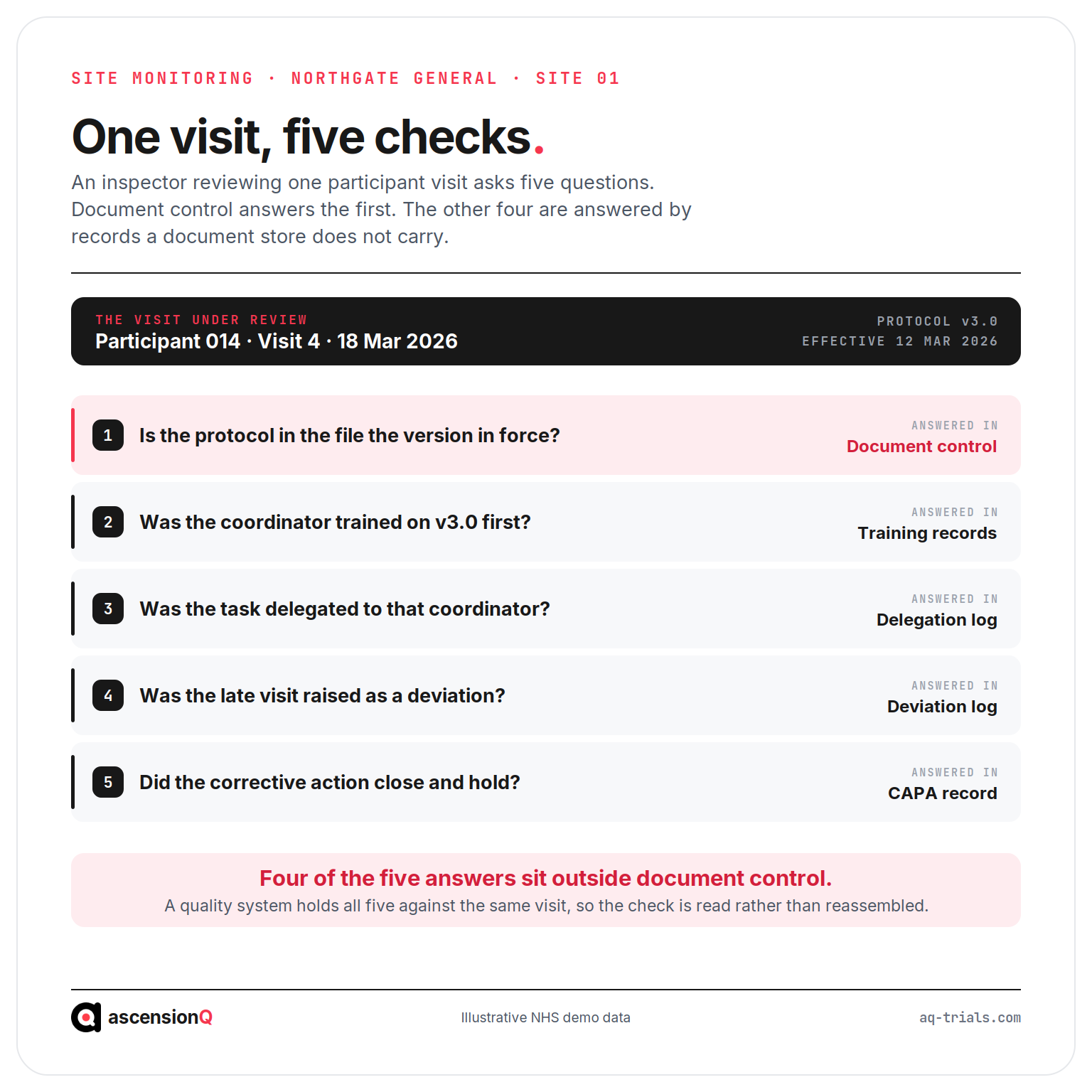
Therefore, you’ll require a dedicated QMS, which ensures all quality processes are centralised, efficient, and automated. If you use an eQMS, it will:
- Automate training management: Track staff training, ensure competencies are met before tasks are assigned, and eliminate the risk of untrained staff handling critical processes.
- Monitor deviations and CAPA: Log protocol deviations in real-time, assign corrective actions, and track resolution to ensure compliance is maintained across all sites.
- Ensure audit readiness: Provide a centralised and fully traceable record of all actions, decisions, and compliance activities, reducing the time spent preparing for audits.
- Provide real-time compliance monitoring: Offer instant visibility into compliance status, flagging any gaps or missed actions across sites.
- Streamline document management: Ensure that all study documents are up to date, with access restrictions, version control, and real-time updates across all team members.
Also Read: What is ePSF in Clinical Research?
The Benefits of AQ QMS Over Traditional DMS and eQMS Solutions
AQ QMS centralises all quality management processes into one integrated platform.
Unlike traditional Document Management Systems (DMS), which are focused solely on document storage and version control, AQ QMS streamlines all aspects of clinical trial management. It ensures that quality processes such as compliance monitoring, staff training, corrective actions, and audit trails are efficiently managed in real-time.
AQ QMS provides a comprehensive solution that addresses all the challenges clinical research teams face, enhancing efficiency, reducing risks, and ensuring consistent quality across all study sites.
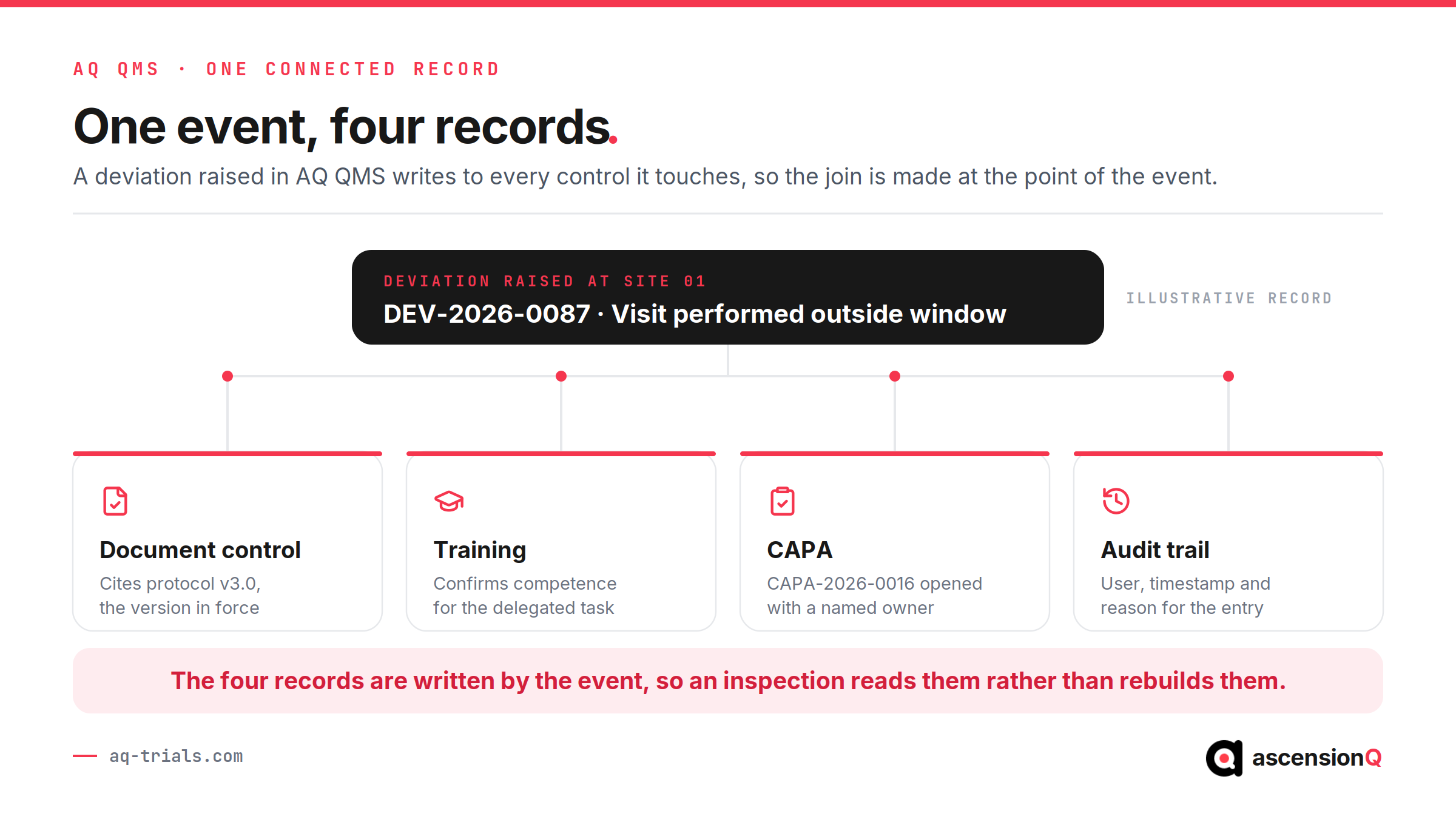
Key Benefits of AQ QMS:
- Improved Efficiency. All study documents, compliance checks, and corrective actions are centralised, reducing time spent on manual tracking and administration.
- Reduced Risk. Real-time monitoring and automated workflows help identify and resolve issues quickly, preventing non-compliance and operational disruptions.
- Proactive Quality Management. The system tracks compliance and quality metrics continuously, allowing teams to act before issues escalate.
- Enhanced Collaboration. Centralised access to documents and compliance status improves communication and coordination across teams and study sites.
- Audit-Ready Compliance. AQ QMS ensures all actions are traceable and readily accessible, making audit preparation faster and simpler.
- Scalability. AQ QMS is adaptable to both small and large studies, growing with the needs of your research projects.
A live walkthrough shows document control and quality management working off the same record: version-managed documents, deviations and CAPAs linked to the studies they came from, and an audit trail available without preparation. Book a live demo to see AQ QMS against your current document and quality set-up.
Quick Summary
Quality management in clinical research requires adherence to stringent regulations and standards, such as GCP, UK GDPR, and MHRA guidelines which ensure that data is properly managed, research is conducted ethically, and participant safety is prioritised.
A standard Document Management System (DMS) can manage and store study documents, but it falls short in ensuring compliance with all the complex regulatory requirements. DMS lacks the capability to track staff training, manage CAPA (Corrective and Preventive Actions), or monitor protocol deviations in real-time, which are essential for regulatory adherence.
Therefore, clinical research teams require an Electronic Quality Management System (eQMS). An eQMS integrates not only document management but also compliance monitoring, staff training, deviation tracking, and CAPA management in one platform.
AQ QMS offers a unified solution, enabling real-time compliance, efficient tracking, and full regulatory readiness, while aligning with UK-specific standards and improving overall research quality.