AQ eISF — Electronic Investigator Site File Software for Inspection-Ready Documentation
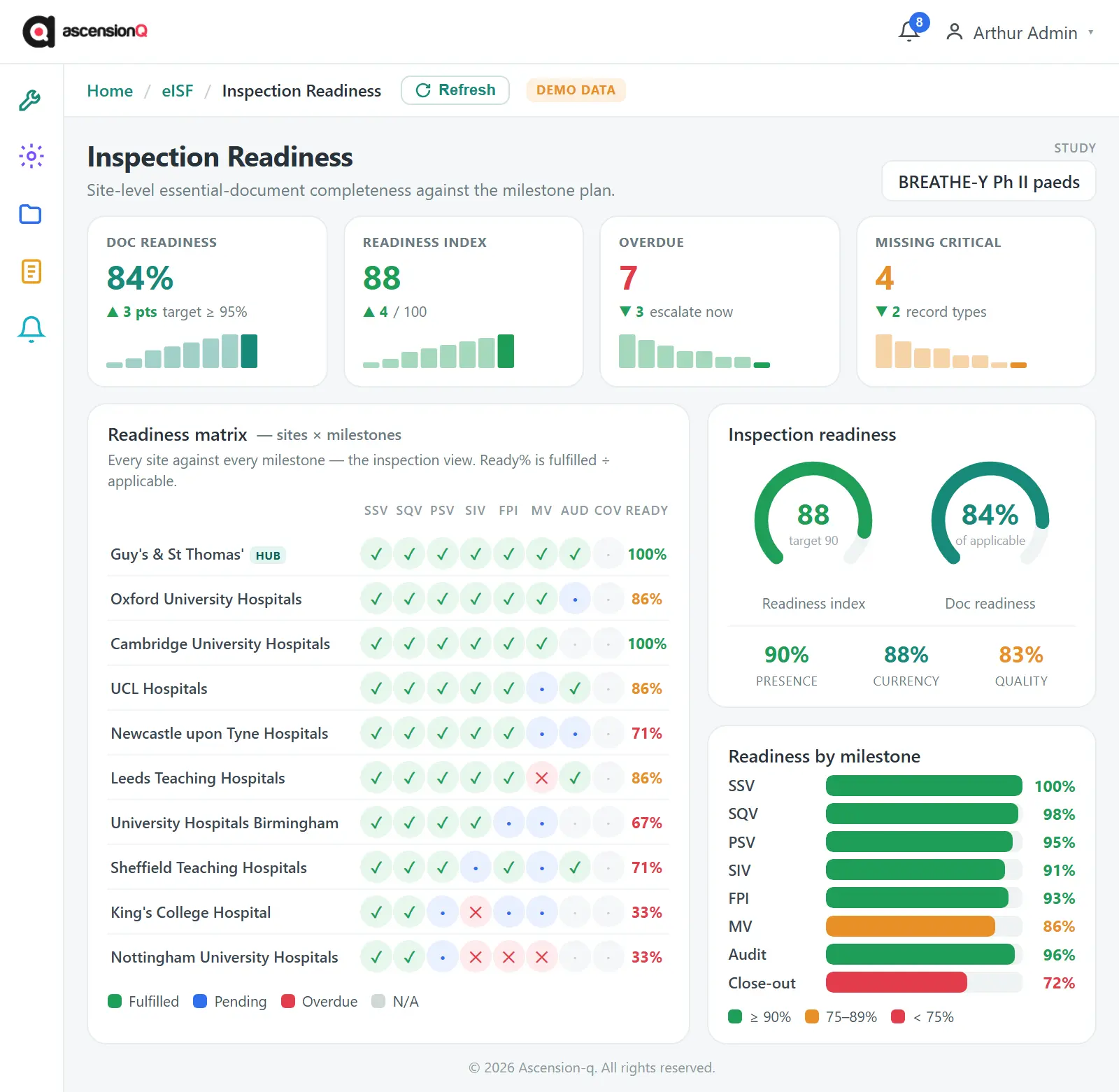
FIG.01 — Live study mission control
REALTIME
Investigator Site Documentation Challenges That Slow Research Teams
Without a centralised eISF, research teams rely on paper files, shared drives, sponsor portals, and local trackers to manage site documentation — fragmenting oversight and increasing administrative effort. Most of that time is spent chasing documents and preparing files for monitoring visits instead of focusing on study delivery.
FORMAT · MIXED
OWNER · DISTRIBUTED
Documentation gaps during monitoring
The CRA arrives and asks for the latest IB acknowledgment. It's in someone's email. The training certificate has expired since the last visit. The follow-up letter from last quarter is filed in a different folder structure than this quarter's. The visit runs over.
Delegation log
changes
A new sub-investigator joined three weeks ago. Their CV is somewhere. Their GCP certificate hasn't been logged. The delegation log says the previous sub-I is still active. When the monitor opens the delegation log, nothing matches.
Inconsistent folder
structures
ach coordinator organises study files differently. The senior CRC's structure is the one the team learned. When she leaves, the new hire can't find anything. Each study's binder reflects whoever set it up.
Multiple document
versions
The protocol v3.2 amendment is signed and filed. The training log still references v3.1. A CRC submits source data using a v3.1 visit window. The monitor flags it. The team can't quickly prove which version was in effect when.
Parallel spreadsheets &
trackers
The regulatory expiry tracker is in Excel. The training matrix is in another Excel. The delegation log is on paper. When the inspector asks for a current snapshot, the QA lead spends three hours building it from sources that don't reconcile.
Multi-day
monitoring prep
The CRA's confirmation email arrives. The team blocks two days to pull binders together, chase signatures, locate lab ranges, and patch filing delays. The actual study work pauses. The monitor visit is now defending the file rather than reviewing the data.
From scattered site documents to one inspection-ready Investigator Site File.
AQ eISF helps research teams manage essential site documents within one structured environment, making it easier to maintain document control, reduce manual filing effort, improve visibility, and keep site documentation aligned with day-to-day study activity.
Less Manual Filing
Burden
Replace paper binders, shared-drive folders, and parallel trackers with one structured site file. Coordinators stop reconstructing filing every monitor visit; senior CRCs stop being the only person who knows where things live.
Clearer Document
Visibility
Research teams see at a glance which documents are present, which need attention, and which are missing — across every active study. No more discovering an expired training certificate during a CRA visit.
Faster Retrieval and
Review
Essential documents stay organised, searchable, and presentable. Teams spend less time locating records and more time on study delivery. The monitor visit reviews data, not document logistics.
Stronger Inspection
Readiness
Documentation stays structured and accessible throughout the study lifecycle. The site stays close to inspection-ready every day — not just the week before MHRA, FDA, or sponsor audit pressure arrives.
AQ's eISF Core
Capabilities
AQ’s eISF is built with all the powerful features and functionalities clinical research sites, coordinators, and study teams require in one place for managing investigator site documentation across multiple clinical trials.
01 — Study Templates
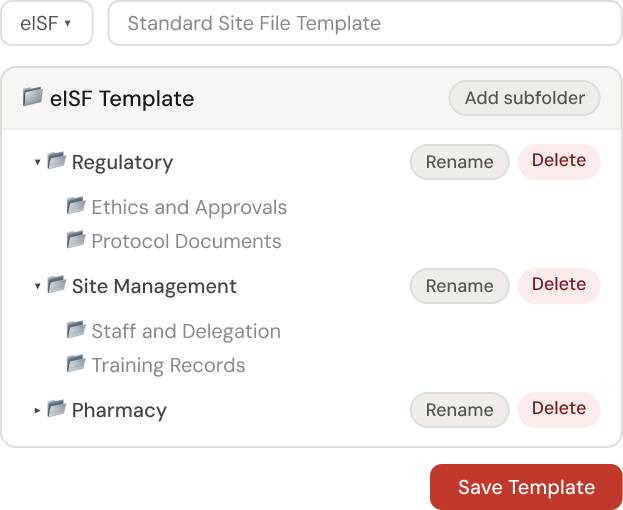
Study File Template Configuration
Administrators build folder and subfolder structures once — defining the complete eISF or ePSF hierarchy for a study category. When a study site file is created, the selected template applies the full folder structure instantly. Templates are editable, category-specific, and reusable across studies.
02 — File Management
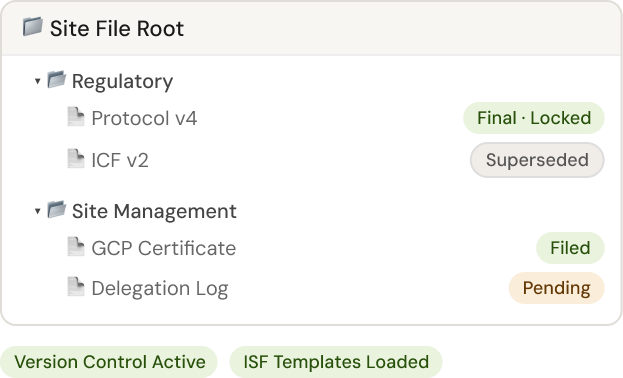
Structured Document
Filing
Folder and file structures organise site documentation across studies. Upload, version, lock, move, and restore documents while maintaining a consistent, audit-ready filing structure. Deleted documents are recoverable via an authentication-gated restore with reason tracking.
03 — Site Oversight
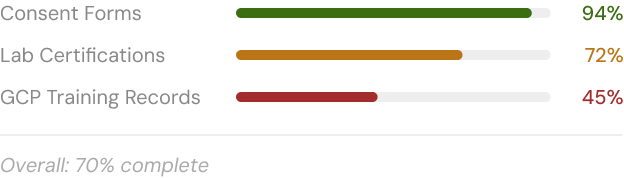
Completeness Tracking and Visibility
Study teams see exactly which documents are filed, missing, or require attention across every active study. Search, retrieval, and history tracking keep site documentation under continuous control and visible at study level.
04 — Compliance and Audit
Document Review and Electronic Signatures
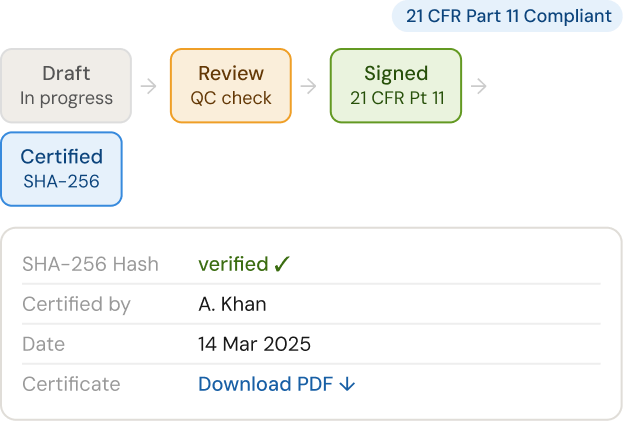
Controlled approval workflows and mandatory signing enforce compliant document authorisation. True copy certification captures a SHA-256 hash, 21 CFR Part 11 electronic signature, and generates a downloadable PDF certificate. Every document action is recorded in a full, exportable audit trail.
05 — Team Coordination
Site Collaboration and Communication
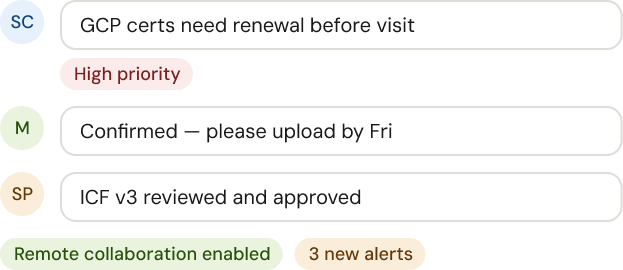
Site teams, monitors, and sponsors collaborate within the document environment. Threaded comments support user tagging, high priority flagging, and resolution tracking. Unresolved comments block document deletion. In-app notifications and remote monitoring support keep communication connected to the relevant records.
06 — Access and Roles
User Permissions and Study Access
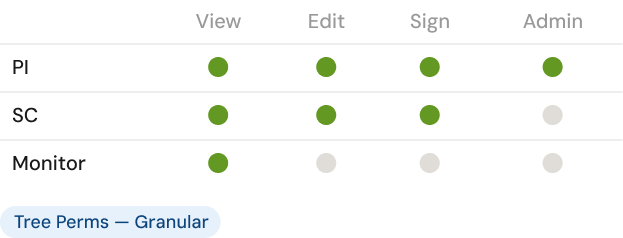
Role-based permissions, folder restrictions, and tree- level access management give coordinators, PIs, monitors, and sponsors precisely scoped access across every study. Restricted folders are invisible to unauthorised users. Every permission change is audited.
07 — Analytics
Dashboards and Operational Reporting
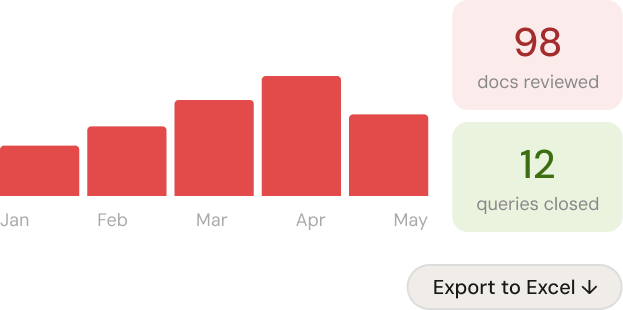
Real-time dashboards present site documentation activity, completeness metrics, and operational performance across studies. Page visit analytics, activity tracking, and study-level audit log exports give teams full operational visibility. Reports export directly to Excel.
How AQ eISF supports inspection-ready site operations.
AQ eISF helps research teams maintain site documentation in a way that supports day-to-day control, not just end-stage preparation. Sites stay closer to inspection-ready throughout the life of the study — for MHRA, FDA, sponsor audits, and routine monitoring.
Continuous readiness vs spike preparation
STUDY LIFECYCLE
Clearer visibility across completeness & status
Structured placeholders, expiry awareness, delegation records, and completeness indicators help research teams quickly understand which documents are present, which require attention, and where updates are needed across the investigator site file. This visibility helps teams maintain documentation aligned with MHRA and ICH-GCP expectations without relying on manual trackers.
Guided presentation for monitors & inspectors
AQ eISF allows research teams to present site documentation in a clear, organised format during monitoring visits, audits, and inspections. Controlled access enables monitors, sponsors, and auditors to review the right documents efficiently without repeated document requests or lengthy folder searches.
Better control through QC, delegation, & CAPA
Quality checks across site documentation help teams identify issues earlier. Delegation updates, documentation findings, and corrective actions remain linked through connected workflows so teams can review, assign, and resolve issues with clear accountability.
Real-time confidence through dashboards
Operational dashboards provide a clear view of documentation status across studies, helping teams spot gaps early and maintain consistent readiness. Visibility into documentation health supports data integrity principles such as ALCOA+ and strengthens confidence during monitoring visits, internal audits, and regulatory inspections.
Supporting the Teams Responsible for Inspection-Ready Site Documentation
NHS and Hospital Research Environments
NHS Trust R&D departments, hospital Clinical Research Facilities, and academic research units running multiple concurrent studies under MHRA and HRA oversight. Replace paper binders and shared drives with one structured site file built for NHS research governance, pharmacy coordination, and multi-team oversight
Research Sites and Site Operations Teams
Dedicated commercial research sites, site management organisations, and multi-site networks running 5+ concurrent industry-sponsored studies. Centralise documentation across studies and sponsors. Demonstrate quality maturity during sponsor qualification audits.
Academic and University Research Centres
Academic medical centres, university research units, and CTSA-affiliated programmes managing both industry-sponsored trials and investigator-initiated studies. Replace REDCap-plus-Excel patchwork with a structured ISF that scales beyond pilot studies.
Sponsors and CROs Working with Sites
Give sponsors and CROs structured, role-based access to site documentation — reducing repeated document requests and accelerating monitoring review cycles.
What an electronic Investigator Site File actually changes.
Most clinical research sites have spent years adding tools without removing any. The result is layered software that solves one problem each and creates new ones at the seams. A structured eISF is the consolidation point — replacing paper binders, shared drives, parallel trackers, and inconsistent sponsor portals with one site-owned, inspection-ready system.
Maintain complete site
documentation
eISF systems store protocols, approvals, training records, and essential study documents in one structured investigator site file.
Organise essentials across
studies
eISF platforms organise documentation by study, site, and document category, allowing research teams to manage multiple trials without folder confusion.
Prepare for monitoring
visits
eISF systems keep study documentation structured and accessible so monitors can quickly review required documents during monitoring visits.
Maintain traceable
audit trails
eISF platforms record document history, including uploads, updates, approvals, and signatures across the study lifecycle.
Enable remote
monitoring
eISF systems allow sponsors and CRO monitors to securely review site documentation remotely between monitoring visits.
Prevent Version Conflicts Across Study Documentation
eISF systems reduce duplicate uploads, outdated records, conflicting document versions, and uncontrolled file circulation across active studies.
Why Choose AQ eISF for Site Documentation Control?
Most site documentation alternatives sit in one of two categories: heavyweight enterprise platforms built for sponsor-side use and priced for enterprise budgets, or general-purpose tools — paper binders, shared drives, sponsor portals — that fail the first inspection that tests them. AQ eISF was built for the gap in between: a structured, validated, inspection-ready Investigator Site File designed for site-led research, deployed in weeks, priced for site and academic research budgets, and connected to the rest of the AQ platform.
Integrated Trial Management Platform
AQ's eISF operates within a broader CTMS, allowing sites to manage study operations, documentation, delegation tracking, and records within one connected platform with mission control dashboards.
Modern Trial Documentation Governance
Structured document architecture, retrieval workflows, role-based permissions, and traceable auditability — combined with 21 CFRPart 11 compliant electronic signatures for controlled approvals.
Flexible Clinical Study File Architecture
Supports study file organisation that adapts to different protocols, sponsors, and site workflows while maintaining a consistent documentation structure across active studies.
Configurable Investigator Site File Structure
Trial management teams can configure investigator site file categories and document structures to match study requirements, sponsor expectations, and internal governance processes.
Secure Trial Documentation Environment
Controlled access through role-based permissions, secure document storage, and traceable activity records — digital delegation of authority logs maintain clear accountability across site staff.
Affordable Platform for Research Sites
Structured clinical trial documentation management designed for research sites — easier to adopt across teams managing mixed processes, legacy workflows, and different levels of digital maturity.
AQ Guides Your Team Through Setup, Configuration, and Adoption
AscensionQ supports research teams through the eISF platform’s setup, configuration, and onboarding — with 20 years of experience in clinical research data management.
Configuration
Training
User Guides
Support
Guidance
Upgrade How Your Site Documentation Is Managed
Reach out to the AQ team to schedule a live demo of our eISF platform. We will walk you through how AQ eISF helps organise investigator site documentation, improve document visibility, support delegation oversight, and maintain clearer control across day-to-day site operations. You can also explore product tutorials, user guides, and other platform resources to gain a deeper understanding of how AQ eISF supports inspection-ready research environments.
BOOK A DEMO
Request a Guided AQ Tour
Practical walkthroughs aligned with active research delivery.
We’ll only use your details to arrange your demo and
send relevant AQ updates. No spam.
Here is what our Clients are saying About us


It was a very good experience
Enjoy using AQ. Very easy to use, support and guidance available if required.
– Rebekah C.
Senior Research Nurse
It was a very good experience
The AscensionQ platform has helped my research staff set-up multiple studies faster and manage participant appointments more effectively. The software is easy to use and the team is always there to help us.
– Fran Westwell
Lead / Senior Research Nurse
Key Questions Beyond Software Features
What is an electronic investigator site file (eISF)?
An electronic investigator site file (eISF) is the controlled home for site-level study documentation: protocol versions, approvals, consent forms, delegation records, training and monitoring evidence. AQ eISF structures the site file from templates, tracks completeness against milestones and keeps every document in its correct place, retrievable the moment a monitor or inspector asks.
How does AQ eISF keep the site file inspection-ready?
AQ eISF maintains the site file continuously rather than assembling it before a visit. The system generates required document placeholders, calculates due dates against site activation, and tracks what is filed, signed, overdue or waived, holding an audit trail as work happens. Inspection readiness becomes a daily operating state, aligned with MHRA and sponsor expectations.
Does AQ eISF support remote monitor and sponsor access?
Yes. AQ eISF gives monitors and sponsors controlled, role-based access to current site documentation without shipping files or scheduling on-site retrieval. Reviewers see the right document version in its correct place, with access traceable and attributable. This supports remote and on-site monitoring while keeping the site in control of who sees what.
How does AQ eISF handle version control and electronic signatures?
Every document holds one current approved version with a traceable history of those before it. Electronic signatures require active re-authentication, and the system records who signed, when and which version. Once signed, documents lock, visible but not editable without an audited unlock, supporting ALCOA+ attributable, contemporaneous records.
Can AQ eISF work across multiple sites and smaller sponsored studies?
Yes. AQ eISF keeps the site file consistent across multi-site studies, so every site files to the same structure and completeness logic. The same control suits small teams and biotech-sponsored early-phase trials running without a dedicated coordinator: records stay current by default, and reviewers grade evidence on its quality, not the size of the team.