AQ CTMS — Clinical Trial Management System Software for Study Execution and Oversight
Most clinical trial management software still behaves like a digital filing cabinet: useful for storage, slow on the things that actually move a study forward. AQ CTMS works differently. It’s a live operational engine that centralises study planning, participant management, visit diaries, site capacity, communications, and reporting in one connected system — not a passive record of what already happened.
FIG.01 — Live study mission control
REALTIME
Operational silos disrupt study oversight and coordination
Clinical trial data management requires a unified operational system across study planning, participant recruitment, site capacity management, communications, and reporting. Such coordination ain’t possible if you’re stuck on fragmented legacy systems.
Limited recruitment visibility
The weekly enrollment number arrives on Friday from a spreadsheet someone compiles by hand. By the time leadership sees the slowdown, three weeks of recruitment activity have already gone past. The site that needed support last month wasn't flagged until this month's report.
Disconnected visit diaries
A participant misses a visit window. The diary doesn't know. The coordinator finds out when the monitor flags it. The PI finds out from the coordinator. The data manager finds out from the PI. The information takes four days to travel across people who all needed it at the same time.
Unclear site capacity
The decision to activate a new study at an existing site is being made by someone who doesn't have visibility into the site's current workload. Three weeks in, the site is over capacity, screening rates collapse, and the site team is asked to "make it work
Missed follow-up
Tasks live in email. Reminders live in calendar invites. The follow-up that needed to happen Monday is in someone's task list and someone else's head. The audit trail of what was done, by whom, when, and why — doesn't exist as a record.
AQ delivers real-time visibility and control across study operations.
As a connected clinical trial management system, AQ CTMS offers continuous visibility into participant movement, site workload, upcoming visits, and operational progress across studies. Shared operational insight helps teams guide study activity with faster decisions, stronger alignment across sites, and smoother day-to-day study delivery.
Immediate insights into study activity
Study progress becomes far easier to understand once enrolment flow, visit calendars, site workload, and milestone progress appear within one operational view. Teams quickly grasp what is happening across participants, locations, and study phases.
Coordinated participant & visit management
Participant progression and visit calendars demand constant alignment with protocol windows and site availability. AQ enables research teams to organise participant journeys, appointment timing, and site workload within one structured environment.
Early detection of operational pressure
Operational strain often appears through subtle signals such as delayed visits, uneven workload, or slow participant progression. AQ CTMS software highlights these patterns quickly so teams respond before study progress slows.
Smoother study delivery across sites
AQ CTMS smooths study delivery as participant flow, visit coordination, team activity, and operational metrics operate within one coordinated environment. All studies move forward with clearer direction and stronger operational alignment.
Everything a Clinical Trial Management System Should Do, in One Place
AQ CTMS brings the controls required to run study activity in one connected operational environment, helping research teams manage clinical trial data with ease. Our core CTMS modules include Study Management, Participant Manager, E-Planner, User Management, and Analytics. Each works together to for stronger study conduct and operational control.
01 — Study Management
Study Planning and Milestone Control
Manage protocol schedules, study milestones, visit windows, and task allocation in one place. Study configuration, investigator assignments, and operational timelines give research teams structured oversight of planning across active trials.
02 — Recruitment
Patient Recruitment and Engagement
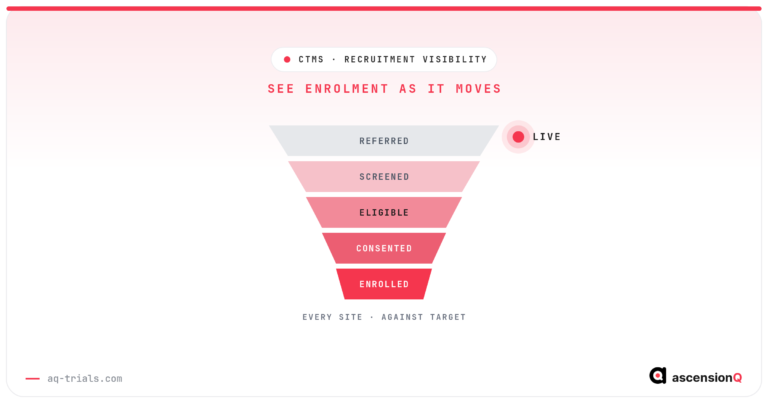
Support feasibility, recruitment workflow, and participant progression with live enrolment visibility. Teams see exactly where recruitment is moving, slowing, or requires operational attention across every active study.
03 — Scheduling
Diary, Visit and Appointment Management
Coordinate visit diaries, appointment planning, and study calendars so participant activity, team coordination, and site operations stay aligned. Screening appointments, cohort visits, and visit scheduling are managed in one structured place.
04 — Capacity Management
Site Capacity and Staff Utilisation
Use live visibility into site locations, buildings, floors, rooms, and resource availability to manage operational capacity. Room occupancy, bed and chair availability, and blocked capacity history give teams the control to coordinate study activity without scheduling pressure.
05 — Communications
Study Communications and Task Follow-Through
Manage study communications, reminders, task progression, and operational follow-up so teams reduce missed next steps. Bulk SMS and email, campaign templates, appointment notifications, and responsibility ownership are organised across research teams.
06 — Analytics
Reporting, KPIs and Operational Insight
Use integrated reporting and health metrics to monitor recruitment performance, appointment behaviour, occupancy, and staff intensity. Analytics dashboards give research teams clearer insight into study activity and operational indicators.
How AQ CTMS Protects Timelines and Execution
AQ CTMS connects to AQ eISF for site documentation, AQ QMS for quality and governance, AQ CAPA for findings and corrective actions, and AQ eTMF for trial master file. Trial operations stop being a coordination problem across tools — they become one operational view
awareness
conflict
On-Time Capacity Management and Diary Control
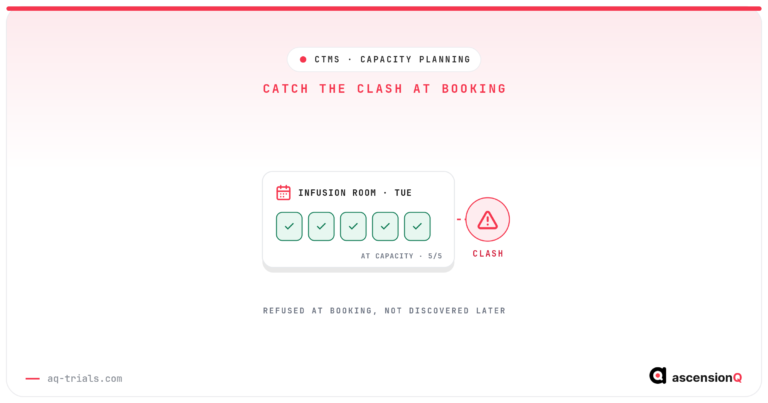
Scheduling pressure often begins quietly through small diary conflicts, uneven staff workload, or room availability constraints. AQ CTMS highlights all operational signals early so teams rebalance before scheduling pressure affects study timelines.
Recruitment and Patient Engagement Visibility
Enrolment progress and participant engagement directly influence study timelines. AQ CTMS helps research teams understand participant progression, screening momentum, and engagement continuity so corrective action can occur before enrolment gaps slow delivery.
Unified Communications, Tasks, and Follow- Up
Delayed follow-up or unclear responsibility creates hidden operational drag. AQ CTMS organises reminders, operational actions, and responsibility ownership within a coordinated workflow so study activity continues moving forward across sites and teams.
Study Conduct Dashboards
Operational dashboards surface a unified view of trial conduct across active studies. AQ CTMS supports clearer trial oversight, sponsor coordination, and complete operational visibility with study progress, milestones, and risk signals visible in real time
Built for the teams keeping study conduct visible, coordinated, and on track.
AQ CTMS supports operational and oversight teams working across active programmes
in clinical research. It helps teams coordinate participant activity, site workload,
operational communication, and delivery milestones across ongoing studies with clearer
alignment and stronger operational awareness.
Clinical Operations Teams
Clinical operations teams with responsibility for delivery performance across sites and studies. AQ CTMS centralises operational visibility, supports recruitment and capacity oversight, and replaces manual reconciliation with real-time operational signals
Site Delivery Teams & Study Coordinators
Study coordinators and site delivery staff manage the daily rhythm of participant visits, operational communication, and site-level activity. AQ CTMS helps from organising study commitments, managing site workload, and coordinating participant interactions within one structured environmen
Research Managers & Office Leadership
Leadership teams often rely on fragmented operational signals when reviewing study progress. AQ CTMS provides consolidated operational insight that helps research managers evaluate study workload, study progress, and delivery performance across multiple studies
Sponsors & CRO Oversight Teams
Programme sponsors and teams within a Contract Research Organisation require dependable oversight across study progress and site performance. AQ CTMS supports cross-organisational coordination with clearer operational signals around recruitment progress, study milestones, and site activity.
Why Choose AQ CTMS?
Because it is built to be all-encompassing and more advanced for smarter and hassle-free clinical trial data management.
Unified Platform Architecture
AQ CTMS operates as a unified clinical research software where planning, recruitment, visit diaries, communications, milestones, capacity coordination, and reporting exist within one connected environment. So, it helps maintain clearer oversight of study conduct and operational control.
Advanced Operational Control
AQ CTMS supports active study conduct through connected operational controls across participant activity, site coordination, and milestone progress. Clinical operations teams understand operational pressure earlier and guide study execution with stronger coordination.
Lower Cost and Admin Burden
AQ clinical trial research software reduces reliance on fragmented tools, spreadsheets, and manual coordination. So, research teams can manage study activity within one connected system, which lowers administrative effort and operational overhead across clinical research programmes.
Constantly Evolving Intelligence
AQ’s clinical trial management system continues evolving with AI-powered capabilities that support smarter coordination across study activity. Its intelligent signals and learning workflows are advanced enough to help research teams recognise operational pressure and respond earlier.
See How AQ CTMS Fits Your Research Environment
Explore how AQ CTMS supports coordinated study delivery across sites, teams, and participants within a modern Clinical Trial Management System designed for organisations operating in Clinical Research. Our team will walk you through how the platform works in practice and how it can support your operational requirements across active studies.
BOOK A DEMO
Request a Guided AQ Tour
Practical walkthroughs aligned with active research delivery.
We’ll only use your details to arrange your demo and
send relevant AQ updates. No spam.
Here is what our Clients are saying About us
It was a very good experience
The AscensionQ platform has helped my research staff set-up multiple studies faster and manage participant appointments more effectively. The software is easy to use and the team is always there to help us.
– Fran Westwell
Lead / Senior Research Nurse
It was a very good experience
AQ is more than a great platform for the operational management and analytics of clinical trials, it’s about a team that are passionate about making a product that genuinely helps. The platform continues to grow and expand into areas of need; the developers are truly responsive and care about their relationships with their customers. The support from the team has been exceptional
– Rachel Thompson
Programme Manager
It was a very good experience
very positive, easy to train new staff to use. AQ is a very user friendly system, we have been using it in our department for over 5 years now. The booking system with calendar views makes it easy to manage our very busy research clinic. The automated emails and text appointment reminders have improved compliance.
– Madi F.
Senior Research Nurse
It was a very good experience
AscensionQ has made the booking of research trial participants straightforward and efficient for our busy clinic. The system has many helpful functions and is easy to use. The reminder setup and mobile app has improved appointment compliance across all of our studies.
– Madi Farrar
Senior Research Nurse
Key Questions Beyond Software Features
What is a clinical trial management system (CTMS)?
A clinical trial management system (CTMS) is the operational record for running studies: study setup, recruitment, participant flow, visit scheduling, milestones, site capacity and financial tracking in one place. AQ CTMS replaces spreadsheets and disconnected trackers with one live operational record, so research teams see what is planned, what is happening and what needs action across every study.
What can AQ CTMS do?
AQ CTMS controls study planning, recruitment and participant flow, visit scheduling, operational tasks, site capacity, milestone tracking and financial visibility. Dashboards show study progress, recruitment status, open actions and risks across the portfolio. R&D directors, study managers and coordinators get one current view of delivery instead of updates spread across trackers, inboxes and meetings.
Can AQ CTMS manage multiple studies and multi-site trials?
Yes. AQ CTMS gives consistent visibility across studies, sites and teams from one operational record. Multi-site networks and research units running concurrent protocols track recruitment, visits, milestones and site capacity in one place, with no manual reconciliation between local trackers. Each site works to the same structure while leadership sees portfolio-level progress and risk.
How does AQ CTMS replace spreadsheets and shared trackers?
Spreadsheets depend on who remembered to update which file, so study status drifts and visibility lags. AQ CTMS holds recruitment, visits, milestones and actions in one record that refreshes continuously. Owners, due dates and escalation are visible, and operational status stays connected to documentation and quality evidence rather than sitting in a separate file.
Does AQ CTMS connect to eTMF, eISF and quality records?
Yes. AQ CTMS feeds live study activity into eISF, eTMF, QMS, CAPA and Digital DOA. Operational state, documentation and quality issues stay linked on one study record, so a deviation, document gap or delegation change carries its study context with it. This connection keeps the wider study record current and inspection-ready.