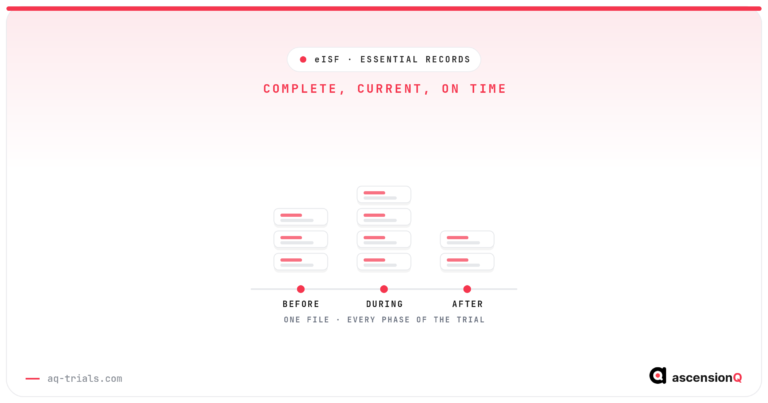
Inspection readiness maintained as a daily state.
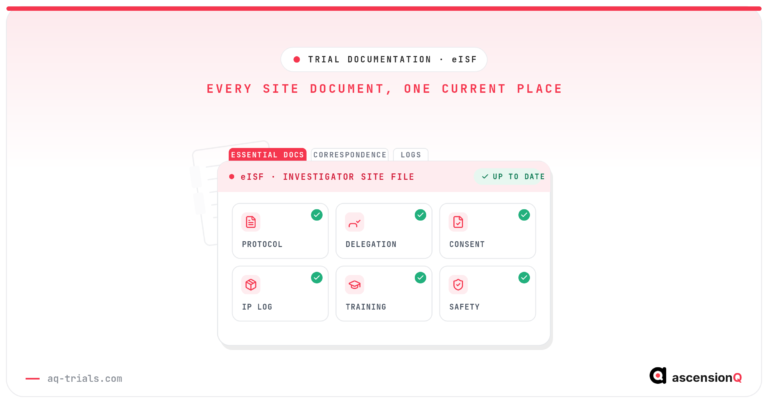
The electronic investigator site file for NHS Trusts, CRDC hubs and spokes, academic units and CROs. Every expected document is a tracked slot with a code, a due date and an owner — readiness calculated straight from the file, one standard from one site to thirty.
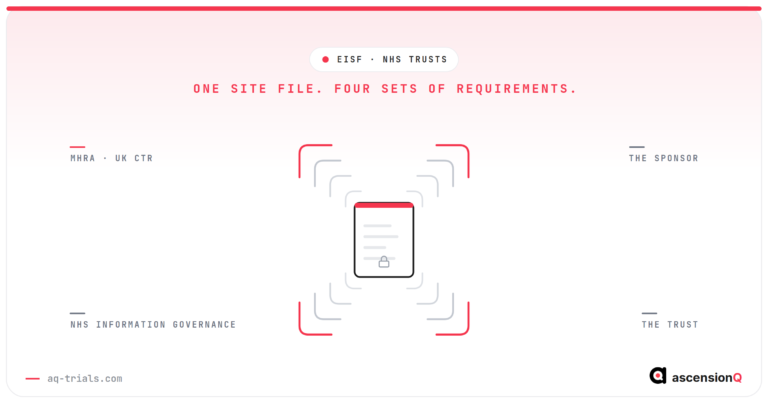
Four ways a site file drifts out of step with the study it is meant to document.
Documentation oversight is concentrated in a single role
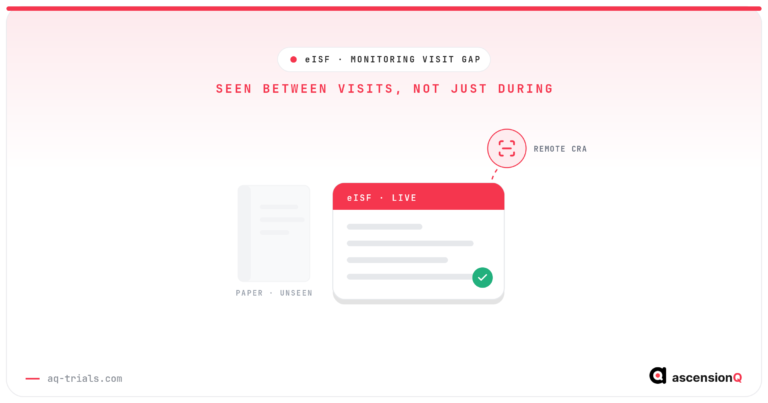
One coordinator holds the knowledge of what’s due, and when. It holds only while they stay in post.
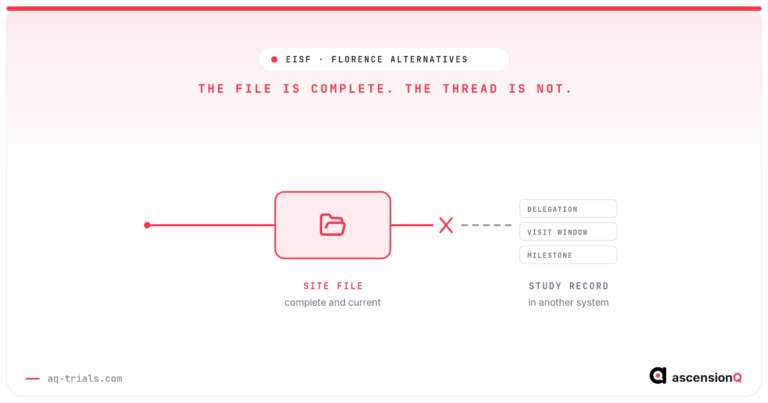
Logs fall behind the conduct of the study
Delegation and training records should be real-time. In practice they’re current to the last signature.
Superseded versions remain in circulation
An amendment files correctly while logs and site copies keep running against the version it replaced.
Each site maintains its own structure
A monitor covering four sites learns four folder structures — UK set-up runs 247 days against 197 in Spain.
8 documentation controls, one governed study file.
All eight controls operate on one governed record, so what one control captures is available, unaltered, to the next.
Study binders
A binder created from a template, applied across one site or every site in the network.
Milestone library
The milestones a study expects, each carrying its own expected-document set.
Roles & permissions
Configurable roles governing who may upload, sign, certify or administer the file.
Document placeholders
Every expected document held as a tracked slot with a status, a due date and an owner.
Uploading documents
Uploads fulfil the placeholder they were opened from.
Signature & certification
Authentication at the point of signing, with certification of true copy as a formal wizard.
Dashboard & reporting
Six analysis views and four exportable reports, all reading the same live record.
Versions & governance
Superseding, locking and removal, each retained in full and requiring re-authentication.
The consent form the template anticipated is the consent form the inspector reads.Investigator and pharmacy files, governed separately.
Binder type is chosen at creation. Each holds its own folder structure, template, reference date and readiness figure — and behaves in exactly the same way.
From empty placeholder to filed evidence.
Each placeholder is assigned to a role when the binder is created, so the work reaches the person entitled to do it. Select a step to follow a document through the four stages every document passes through.
STD-63822 · eISF · Alder Hey Children's
Conduct phaseThe template has created the slot: folder 06.01, milestone SIV, due 14 Sep, owner named, signature required. Nothing has been filed, and the gap already counts against readiness.
The coordinator selects the placeholder; the upload panel opens pre-linked to that slot. Upload stays disabled until both a file and an External Document ID are supplied.
The status flips to Fulfilled, the file appears beneath the placeholder in the tree, and completeness recalculates. The Investigator’s signature is still outstanding.
With a document filed, the row carries its action menu — preview, download, supersede with a new version, certify as a true copy, or lock against further change.
What changes for the researcher doing the work.
A study advances once its file is complete.
Five phases, one stage at a time and in one direction. Completed phases open read-only, so the file evidences its condition at each stage as well as today.
“Every document, signature and version sits in one binder. When a monitor visits we are not reconstructing anything — it is already in the state we would otherwise have to prepare it for.”
A controlled electronic site file for every new study, replacing fragmented paper and SharePoint — with the existing portfolio migrated in phases.
Two ways to look deeper into AQ eISF.
The module guide, and how AQ compares against other clinical software.
Questions research teams ask.
Anything not covered here, ask us directly at enquiries@aq-trials.com.
The controlled repository for site-level study documentation: protocol versions and amendments, regulatory and ethics approvals, consent forms, delegation of authority, training records and monitoring evidence. It is the site’s own record of how it conducted the study, and the file examined during a site inspection. AQ eISF builds it from a template, establishes each expected document as a tracked placeholder with a due date and named owner, and holds every version, signature and action on one permanent audit trail.
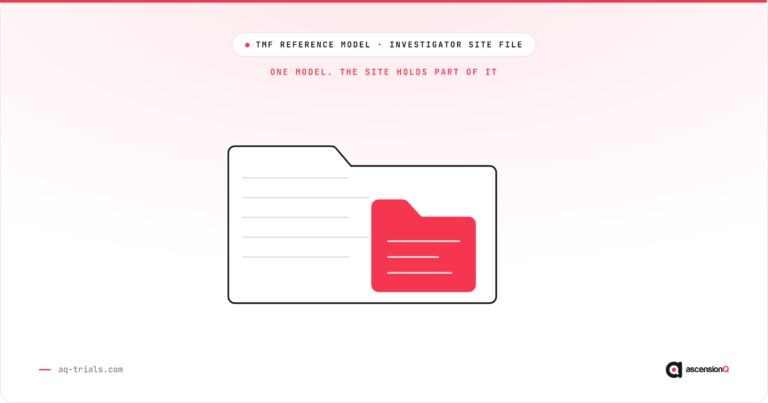
The trial master file is the sponsor’s record of the trial. The investigator site file is the site’s record of its own conduct. UK regulation provides for both and allows the two to hold different content. A site filing into a sponsor’s eTMF retains its obligation to hold and evidence its own investigator site file, and an inspection of a site examines the site’s file.
Each required document exists as a placeholder with a due date calculated from the study reference date, so the file reports at any point what is fulfilled, pending, overdue or waived, by site and by milestone. Owners are notified ahead of a due date and escalated thereafter, and phase advancement waits until every item is cleared.
Fulfilled placeholders divided by applicable placeholders. Applicable is everything the study expects at its current phase, less any placeholder waived with a recorded reason. Both calculations display on the dashboard alongside the figures.
AQ is listed on the Digital Marketplace under G-Cloud, where pricing, service definition and exit terms are published. Procurement is a framework call-off rather than a full tender. Pricing reflects the modules adopted and the scale of the operation, so a quotation is prepared against your configuration. A trial period is available on a case-by-case basis.
Those systems address different requirements. The list of documents a study is expected to produce, the calculation of when each falls due, and a defensible readiness figure sit outside all three, which is why parallel spreadsheets are maintained alongside them. AQ eISF replaces the spreadsheets.
Connected Intelligence organises records, proposes where an upload belongs, surfaces documentation gaps and detects quality signals early. Every suggestion is reviewed by an individual. Authority over signature, certification, record closure and phase advancement rests with the responsible user, and the readiness figure is calculated from filed and waived placeholders. UK-hosted and aligned with NHS DSPT expectations.
Yes. A reviewer is established as a study-scoped user with access to the sites and folders to which they are entitled, reviewing the current version in its filed position. Restricted folders remain visible only to named users, and every access is attributable.
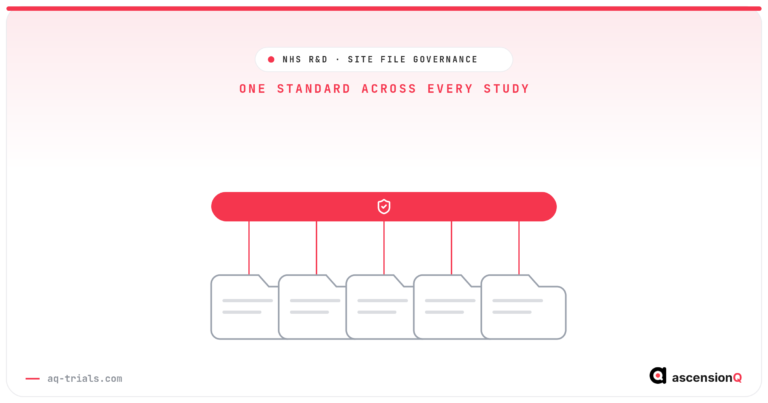
Yes. One template may be applied across every site, or a distinct template and reference date assigned per site. The cross-site matrix presents every site against the same milestones, and phase advancement waits until the outstanding list is cleared at all of them.
The same controls applied to different files. eISF holds the investigator site file. ePSF holds the pharmacy site file — investigational product accountability, dispensing logs, storage temperature records, cold-chain verification and calibration. A study may run both, each from its own template.
Request a live AQ platform
demonstration.
Thirty minutes on your own studies — documentation, study activity, quality processes and pharmacy, in one governed record.
BOOK A DEMO
Request a Guided AQ Tour
Practical walkthroughs aligned with active research delivery.
We’ll only use your details to arrange your demo and
send relevant AQ updates. No spam.
Pick a module, your organisation type, or both — we'll match the guides and email them to you.
Try one filter at a time, or clear to see all guides.
AQ's Built For
Resources

Free guides · PDF
✓ Written for first-in-human & Phase 1 sites
✓ Inspection-ready checklists & templates
✓ Aligned to MHRA, FDA & EU Annex 11
- Instant download · no sales call