The essential documents are the records that individually and collectively allow a clinical trial to be evaluated: its conduct, its compliance with Good Clinical Practice, and the reliability of its data. Under ICH-GCP, the investigator is responsible for holding a defined set of these records at the site, in the electronic Investigator Site File (eISF). This guide is the checklist: every essential document, grouped by the phase it belongs to, with who holds it and what ICH-GCP E6(R3) changes.
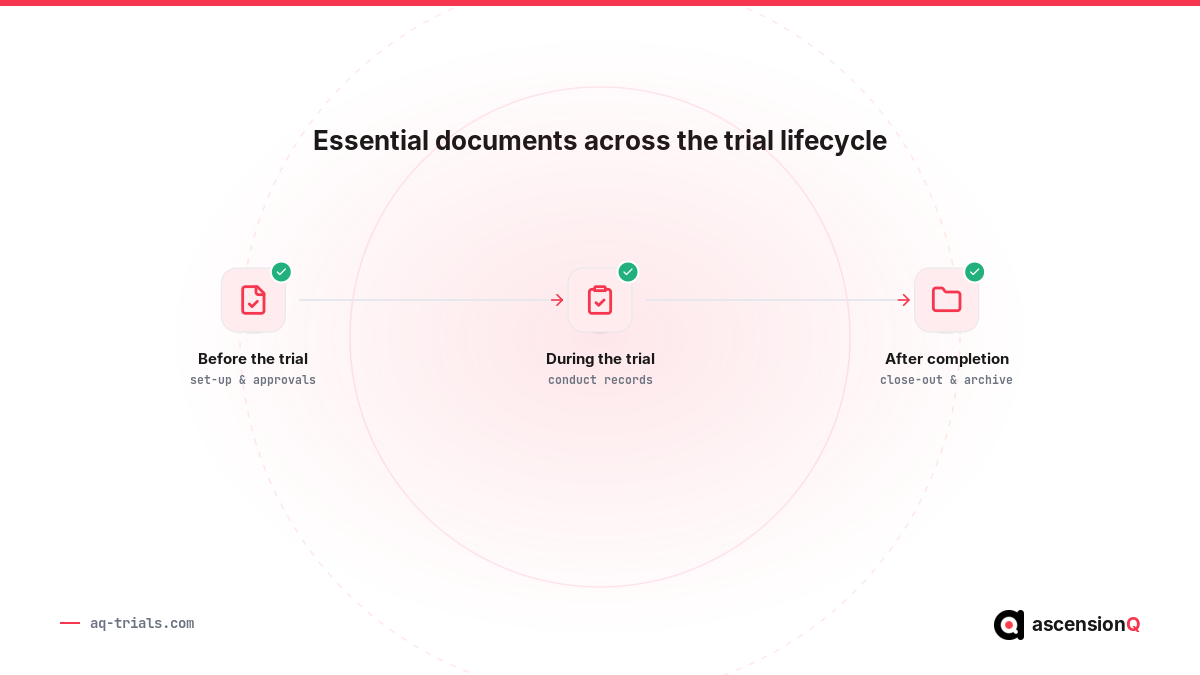
The list originates in Section 8 of ICH-GCP E6(R2), which grouped essential documents into three phases: before the trial begins, during the trial, and after it completes. It is the single most predictable thing an inspector asks to see, which is exactly why a site should be able to produce any item on demand, not reconstruct it before a visit.
- Essential documents fall into three phases: before, during, and after the trial.
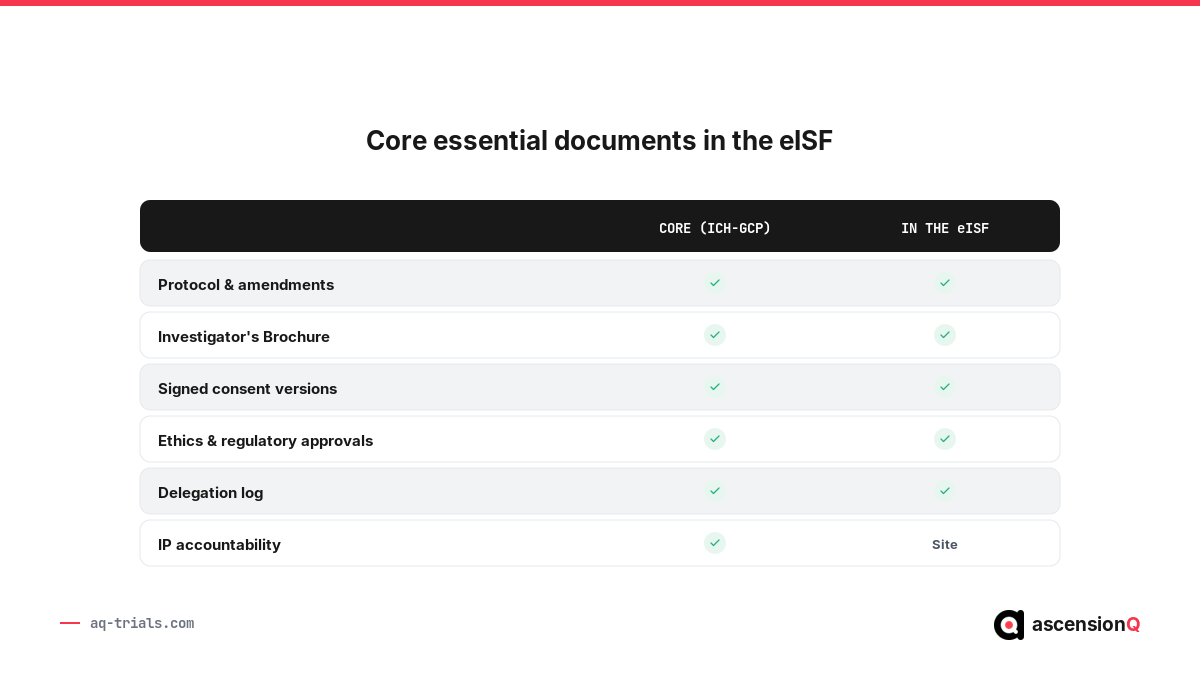
- The investigator holds the site copy in the eISF; the sponsor holds its copy in the Trial Master File.
- ICH-GCP E6(R3) renames “essential documents” to “essential records” and moves to a risk-based approach rather than a fixed list.
- A checklist proves a document is present; it does not prove it is current or complete. Those are separate, ongoing checks.
What are the essential documents in a clinical trial?
Essential documents are the evidence base of the trial. If the trial were questioned by a monitor, an auditor, or a regulatory inspector, these are the records that answer the question. ICH-GCP defines them as the documents that permit evaluation of both the conduct of the trial and the quality of the data produced.
They are not filed for their own sake. Each one demonstrates that the investigator and sponsor complied with GCP and the applicable regulatory requirements at the point the activity happened. A trial is only as defensible as the records that survive it.
Before the trial: the documents to have in place
These are collected during study set-up, before the first participant is enrolled. Most are approvals and agreements: the authority to run the trial at all.
| Document | What it evidences |
|---|---|
| Investigator’s Brochure | The investigator had current safety and efficacy information. |
| Signed protocol, amendments & sample CRF | Agreement on how the trial would be conducted and recorded. |
| Ethics committee (IRB/IEC) approval | Independent ethical review before enrolment. |
| Regulatory authority authorisation | The trial was approved by the competent authority (e.g. MHRA). |
| Approved consent form & participant information | The exact wording participants were consented against. |
| Investigator CVs & financial disclosure | The site team was qualified; conflicts were declared. |
| Lab certification & normal ranges | Test results could be interpreted against validated references. |
| Signed agreements & insurance | Responsibilities and indemnity were defined up front. |
During the trial: the documents that accumulate
These build continuously as the trial runs. This is where filing discipline slips first, because the volume is highest and the work is busiest.
| Document | What it evidences |
|---|---|
| Signed consent forms | Every participant consented before any trial procedure. |
| Delegation of authority log | Each task was performed by an authorised, trained person. |
| Monitoring visit reports & follow-up | The sponsor oversaw conduct and issues were resolved. |
| Updated approvals & amendments | Changes were approved before they took effect. |
| Source documents & signed CRFs | Data was recorded, attributable, and traceable to source. |
| Safety reports (SAEs / SUSARs) | Safety events were reported and handled correctly. |
| Screening, enrolment & ID logs | Participant accountability across the trial. |
The delegation of authority log deserves particular attention: it is checked at almost every inspection, and a task performed before its effective date is a finding regardless of a later signature.
After the trial: close-out and archive
| Document | What it evidences |
|---|---|
| IP accountability & destruction records | Investigational product was reconciled and disposed of correctly. |
| Completed participant ID code list | Final participant accountability, retained securely. |
| Final close-out monitoring report | The site was formally closed by the sponsor. |
| Treatment allocation & decoding records | Blinding and randomisation were handled correctly. |
| Final report to ethics / authority | The trial’s end was reported as required. |
After close-out, the file is archived and must remain readable and retrievable for the full retention period, which in the UK is at least 25 years.
What changes under ICH-GCP E6(R3)?
The 2025 revision, ICH-GCP E6(R3), changes the language and the philosophy. “Essential documents” becomes “essential records“, reflecting that evidence is increasingly data rather than paper. The prescriptive Section 8 list moves to Appendix C, and the emphasis shifts to a risk-based approach: teams determine which records are essential for their specific trial rather than filing against one fixed checklist.
The checklist in this guide remains the right starting point. The core records are unchanged. What E6(R3) asks is that you justify the set for your trial, keep it current, and treat completeness as an ongoing judgement, not a one-off tick-box. The principle reflected in MHRA good clinical practice guidance is the same: the file must let someone reconstruct the trial.
Why does a checklist alone not make a file inspection-ready?
A checklist answers one question: is the document present? An inspection asks three:
- Complete: is every expected record actually there?
- Current: is the filed version the right one (the current protocol, not a superseded amendment)?
- Timely: was it filed close to when it was created, not reconstructed the week before the visit?
A ticked box can hide a superseded version, a missing signature, or a document filed six months late. This is the gap between a file that looks complete and one that is genuinely inspection-ready.
How does AQ eISF keep essential documents complete?
The AQ eISF starts each study from an expected-document list built on the ICH-GCP essential set, structured to mirror the sponsor’s Trial Master File. Filed, missing, and expected records are visible against that list in real time, so a gap surfaces in daily operations rather than during inspection preparation.
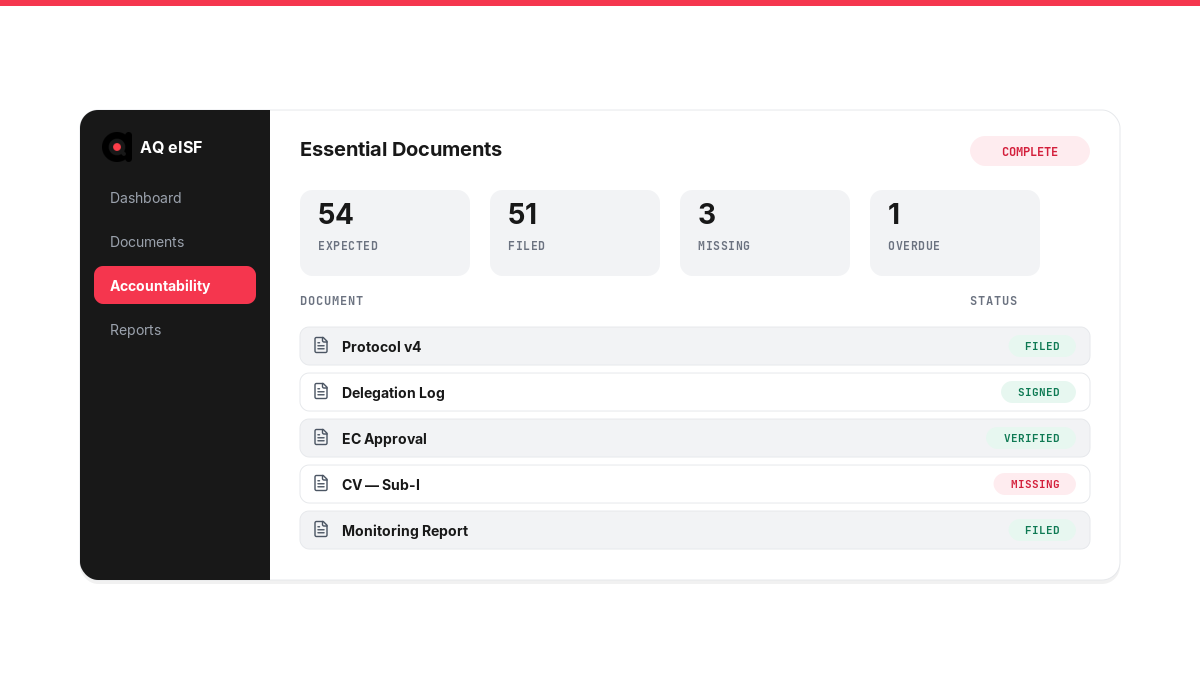
Version control keeps the current record current; the audit trail records who filed what and when, which is where timeliness is proven. The system tracks presence, version, and completeness. Confirming a record is genuinely the right one remains a human review. The eISF makes that review fast and evidenced rather than a manual reconstruction.
Read also: What is eISF: Electronic Investigator Site File in Clinical Research, The DIA TMF Reference Model: A Practical Guide to the 11 Zones, and Clinical Research Audits: Types, Process, Checklist and Audit Readiness.
Book a live demo to see how AQ tracks the essential documents against a defined expected set across every site.