For NHS R&D offices, Principal Investigators and research units. AQ Digital DoA records who is authorised to do what, from which date and on which evidence — and the same record decides what each person can do inside the platform.
Illustrative study delegation matrix. Red: delegated and in date. Amber: evidence expiring, review due. Grey: not delegated. Each cell links to the CV, GCP certificate and training record that support it.
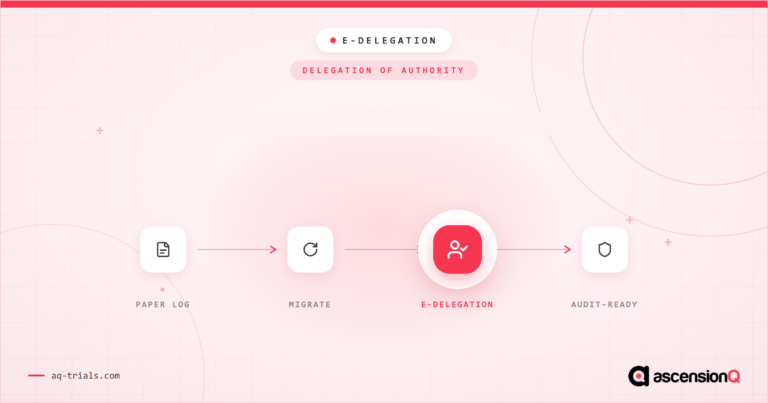
A delegation log records who the Principal Investigator has authorised, for which tasks, and from when. Paper logs, spreadsheets and PDFs share one weakness: the record sits apart from the training evidence, the system access and the study activity it is supposed to govern. NHS trust SOPs require PI sign-off before any activity, start and end dates for every person, and current CVs and GCP certificates for every name on the log. A static document cannot hold those conditions on its own.
“Tasks performed outside of the delegation period”, and “discrepancies between documented delegation of trial related tasks and actual activities performed”.
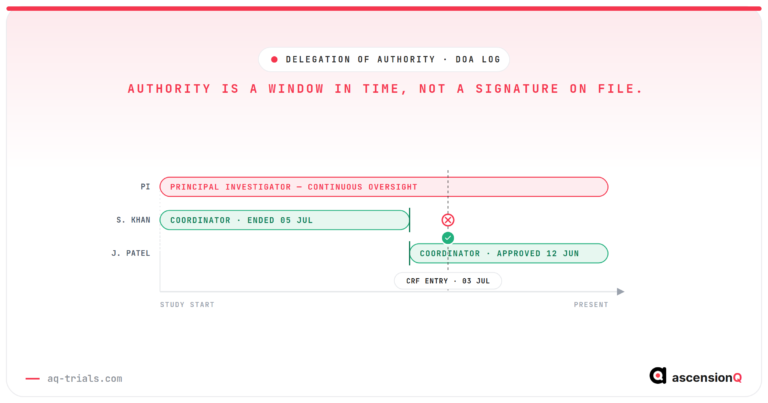
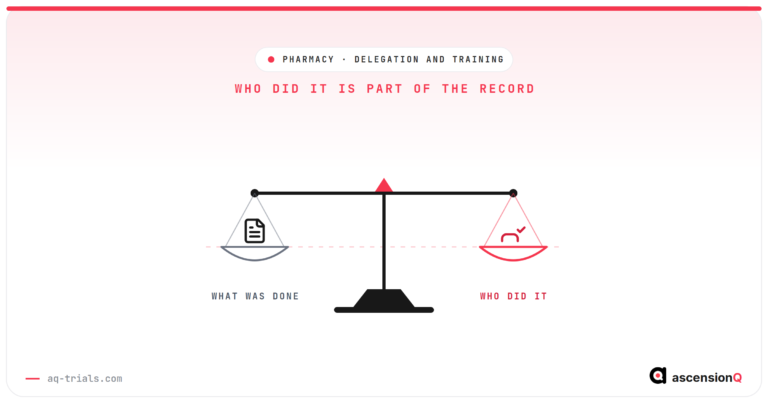
Staff begin work weeks before the log is signed, and the PI signs after the first participant visit. The gap between first activity and effective date is the finding; a later signature cannot close it.
A GCP certificate or CV expires mid-study and the delegation stays on the log. Nobody is prompted, so the person continues to consent, dispense or assess on evidence that no longer supports it.
Leavers retain system access and joiners act before their delegation is live. Access and delegation are administered in different places, so the two records drift apart.
A monitor asks who was authorised to take consent eighteen months ago. Superseded versions are missing and end dates were never entered, so the answer takes an afternoon of reconciliation.
Built for the way NHS research offices, Phase 1 units and site networks run delegation across many studies at once.
A study-specific log built from a task library, with role profiles that pre-fill the usual tasks.
Each delegation is tied to the CV, GCP certificate, protocol training and SOP acknowledgements behind it.
The delegate accepts the tasks, then the PI approves and signs electronically.
The delegation record decides what a person can do in the platform, from the effective date.
Connected Intelligence checks delegation, training and evidence at the point of action, and flags the gap.
Every study a person is delegated on, every person on a study, and every gap across a site or network.
Each change creates a new version with the actor, the time and the reason for change.
Read-only access to the log, its history and the linked evidence, scoped to one study for a defined period.
End dates close access the same day, an incoming PI re-approves, and the final log is locked and filed.
Open a delegate to see what they are authorised to do, from which date and on which evidence — or follow one person from study set-up through to close-out.
 ONC-2291 · Site 07 · Delegation of authorityCycling · select to stop21 CFR Part 11 signed
The coordinator proposes five tasks for a research nurse joining the study. The proposal names the tasks; it grants nothing.
GCP certificate, CV, NMC registration and protocol training are held with their dates. One task is blocked because its training is outstanding.
The investigator re-authenticates and signs. The signature is bound to these four grants and to the date they take effect.
Protocol v4.0 consent training is filed, so the fifth task becomes eligible. The investigator signs a new dated entry; the original grant stays visible beneath it.
His NMC registration renews annually and his GCP certificate in 2029. Both are held with their dates, and a warning is raised thirty days before either lapses.
When he leaves the study the investigator end-dates every task in one action. Nothing is deleted: the record of what he was authorised to do, and when, remains in the log.
Staff work across a portfolio, not a study. One certificate sits behind delegations on four studies at once — so one renewal clears all four, and until it is filed each affected delegation is flagged where it stands.
One view of completeness, expiring evidence and pending PI approvals across every study.
Approve and sign from a phone between clinics, with every event dated by the system.
Role profiles make a new delegation a short, evidenced action rather than a rewrite.
Standard task libraries and role profiles applied across every site.
Read-only, study-scoped, time-boxed access to the live log and its history.
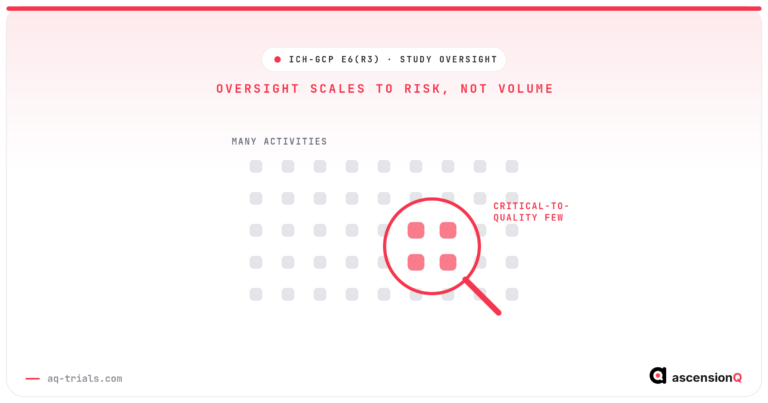
ICH E6(R3) 2.3.3 requires the investigator to maintain a record of the persons and parties to whom trial-related activities have been delegated; 2.3.1 requires proportionate oversight, and 2.3.2 ties training to the delegated activity. Since 28 April 2026 compliance with the ICH E6 conditions and principles has been a legal requirement for UK trials of investigational medicinal products, and NIHR guidance states the log must be completed before the delegated individual commences any study-related activity.
AQ Digital DoA is structured to support those expectations: a dated, attributable record, evidence linked to each delegated activity, and a history retained for the required period.
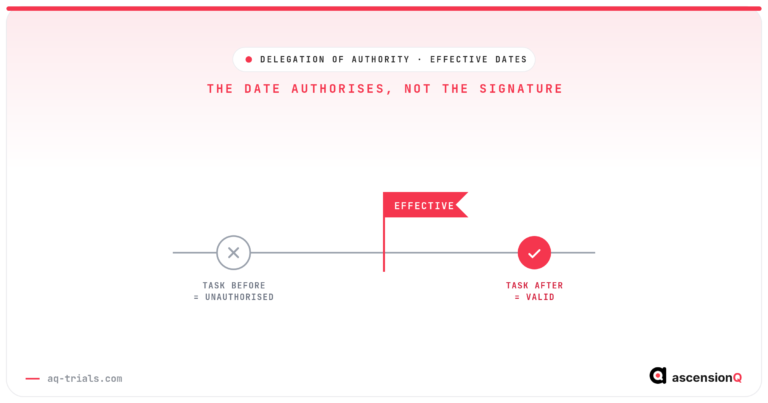
The effective date is the control and the signature is the confirmation. Why effective dates matter more than signatures.
The person is on the team and their evidence is on file, but the delegated task is not available to them.
PI approval sets the date, and the platform grants the matching permission that day. Start dates are locked at approval.
Access is withdrawn the same day, and the log still answers who was authorised on any date in the study.
Anything not covered here, ask us directly at enquiries@aq-trials.com.
A delegation of authority log, also called a delegation log or delegation of duties log, records the people the Principal Investigator has authorised to perform trial-related activities. Each entry holds the name, role, delegated tasks, effective start and end dates, the delegate’s signature and the PI’s signature and date. ICH E6(R3) requires a record of delegation proportionate to the significance of the activity.
Yes, where the system provides attributable, dated electronic signatures, an audit trail of every change, controlled access, and retention of the record and its history for the required period. AQ Digital DoA is configured to support 21 CFR Part 11 and EU Annex 11 expectations for electronic records and signatures, gives monitors and inspectors read-only access, and archives the signed log with its audit trail to the electronic site file.
The delegate accepts the tasks and the Principal Investigator approves and signs before the person performs any delegated activity. NIHR guidance for commercial studies states that the log must be completed before the delegated individual commences any study-related activity. In AQ Digital DoA the effective date is set by the PI’s approval, and the person cannot act on the delegated task before that date.
The effective date is the date from which the person is authorised. The signature date confirms who authorised it. A signature added after an activity cannot authorise that activity retrospectively. AQ Digital DoA locks the effective date at PI approval and reports authorisation for any date in the study.
Yes. The evidence check runs before the delegate accepts and before the PI signs, using the training records and SOP acknowledgements held in the AQ QMS. Expiry dates are monitored while the delegation is live, and the person and the PI are prompted before evidence lapses.
Yes. Permissions in AQ follow the delegation record. A delegated task switches the corresponding platform permission on from the effective date and off from the end date, so access and delegation stay aligned.
ICH E6(R3) states that delegation documentation may not be required where activities are performed as part of clinical practice, and that documentation should be proportionate to the significance of the activity. The trust’s delegation SOP decides. AQ Digital DoA supports both approaches through the configurable task library.
A leaver’s delegations are given an end date and their access closes the same day. An incoming PI reviews and re-approves the open delegations. At close-out the final log is signed by the PI, locked and filed to the electronic site file with its full history.
Yes. Access is read-only, limited to the study, time-boxed and logged, and includes the current log, the version history and the linked evidence.
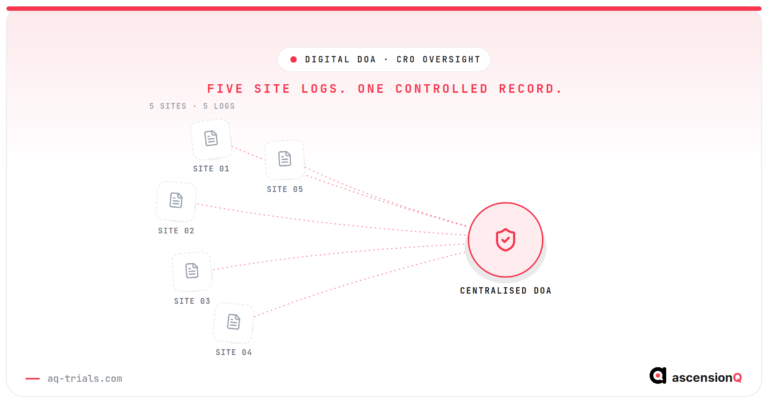
Yes. A person’s evidence is held once and linked to every delegation. The cross-study view shows every study a person is delegated on, and the site and portfolio views show completeness and expiring evidence across all studies.
For the retention period that applies to the trial. Under the UK Clinical Trials Regulations in force from 28 April 2026, the site file for a clinical trial of an investigational medicinal product is retained for 25 years. AQ Digital DoA archives the final signed log and its audit trail with the electronic site file.
No. Connected Intelligence flags gaps and suggests actions; a named, authorised user confirms every change, every suggestion is labelled and logged, and no identifiable participant data is used.
Thirty minutes, on your own study structure: a new study log from the task library, an evidence check, a PI signature from a phone, a permission switching on, an expiring GCP certificate raising a flag and a leaver closed off the same day. Then the same log opened as a monitor would see it.
Pick a module, your organisation type, or both — we'll match the guides and email them to you.
Try one filter at a time, or clear to see all guides.
✓ Written for first-in-human & Phase 1 sites
✓ Inspection-ready checklists & templates
✓ Aligned to MHRA, FDA & EU Annex 11