Who did it matters as much as what was done, because a pharmacy record entry counts as evidence only when the person who made it was delegated that activity and was trained to perform it on the day. ICH E6(R3) sets out both conditions directly. A dispensing line with a correct count, signed by someone absent from the study delegation log, proves that stock moved and leaves the authority behind the movement unevidenced.
This guide covers the authorised-and-trained condition attached to every pharmacy action, what a delegation log records, which activities need documented delegation, what keeps training current, and the questions an inspector asks of one entry. It sits under the guide to IMP accountability in clinical trials, which covers the unit-level record these people maintain.
- ICH E6 GCP Principle 5.1 requires individuals involved in a trial to be qualified by education, training and experience for their tasks, and that principle carries legal force in the UK from 28 April 2026.
- Clause 2.3.3 requires a record of the persons to whom the investigator delegated trial-related activities, documented in proportion to the significance of those activities.
- Training is current when it covers the protocol version and procedure version in force on the date of the action.
- An inspector traces one entry backwards to the initials, the delegation log row, the effective dates and the training record.
What Makes a Pharmacy Action Authorised?
A pharmacy action is authorised when three conditions hold at the same moment. The investigator delegated that activity to that person, the person holds the qualification and training the activity requires, and the delegation was in force on the date of the action. All three sit in ICH E6(R3) section 2.3, and the site evidences each one separately.
- Delegation. Clause 2.3.1 allows the investigator to delegate trial-related activities and holds the ultimate responsibility with the investigator, which is why the delegation log carries the investigator’s signature rather than a line manager’s.
- Qualification and training. Clause 2.3.2 requires delegates to be “appropriately qualified” and “adequately informed about relevant aspects of the protocol, the investigational product(s) and their assigned trial activities”, which makes protocol-specific training part of the authority itself.
- Effective dates. Authority applies to a period, which is why every delegation log row carries a start date and an end date and why an entry is tested against the dates rather than against the current version of the log.
The legal weight changed on 28 April 2026. Paragraph 1 of Part 2 of Schedule 1 to the Medicines for Human Use (Clinical Trials) Regulations 2004, as substituted from that date, requires trials to be conducted in accordance with the ICH GCP Principles. Principle 5.1 states that “individuals involved in a trial should be qualified by education, training and experience to perform their respective task(s)”, and it names pharmacists among them.
The count proves the action. The authority proves the record.
Pharmacy carries a second standard alongside the trial one. The Royal College of Pharmacy states in its professional guidance on the safe and secure handling of medicines that tasks are delegated only to persons who are legally entitled, authorised, appropriately trained and competent to handle medicines. A trial delegation log sits on top of that arrangement, and the conditions attached to delegating IMP management to a pharmacist are covered in what ICH E6(R3) requires of IMP management at the site.
What Does a Pharmacy Delegation Log Record?
A pharmacy delegation log records each person the investigator authorised, the activities delegated to them, the period the authority ran, and the initials that appear on the pharmacy record as a result. Clause 2.3.3 requires that record without prescribing its format. The table sets out the fields a working log carries.
| Field | What it settles |
|---|---|
| Name, role and employer | Which individual the authority attaches to, so no shared job title stands in for a signatory |
| Signature and initials sample | How that person appears on a record, so initials on a dispensing line resolve to a name |
| Activities delegated | The precise acts the person may perform, which “pharmacy duties” leaves open |
| Start date | The first date on which entries by that person are supported |
| End date | The last date the authority ran, which closes a leaver out of the file |
| Investigator signature and date | That the delegation came from the accountable person |
| Training evidence reference | Where the matching training record sits |
A pharmacy team often appears on two logs at once. The study delegation log held by the investigator covers pharmacy staff performing delegated trial activities, and some sites keep a pharmacy-specific extension of it. One of the two has to be the authoritative version for each named activity. The digital delegation of authority record holds this evidence at sites that keep it electronically, and the file section it belongs to is set out in what belongs in a pharmacy site file.
Also Read: Who Is Accountable for IMP at a Trial Site?
Which Pharmacy Activities Need Documented Delegation?
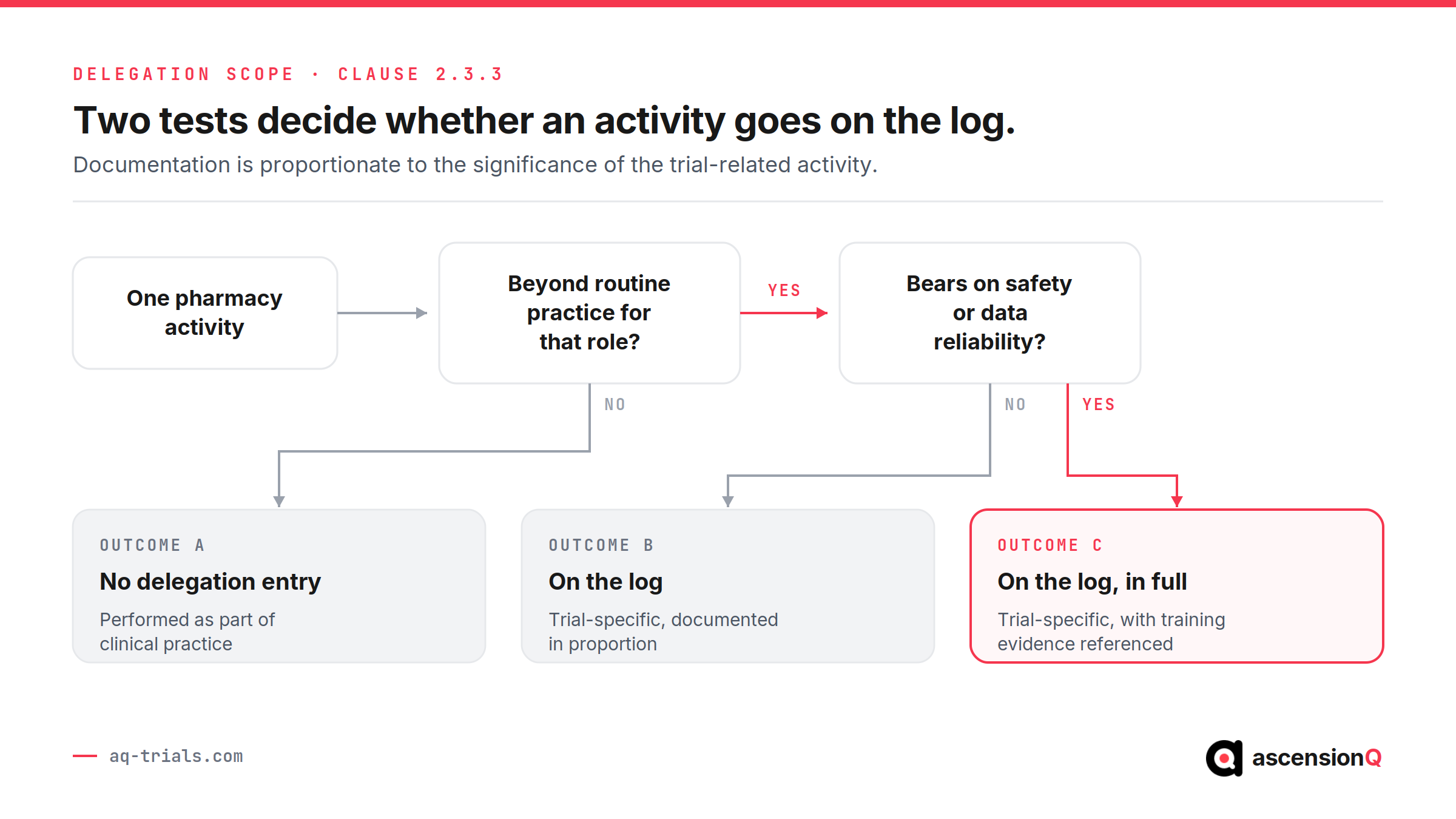
Trial-specific pharmacy activities need documented delegation, and the depth of that documentation follows the significance of the activity. Clause 2.3.3 states the rule plainly: “Documentation of delegation should be proportionate to the significance of the trial-related activities. In situations where the activities are performed as part of clinical practice, delegation documentation may not be required.” Two tests sort one activity from another.
- Does the activity go beyond routine practice for that role? A registered pharmacist screening a prescription for clinical appropriateness acts inside normal practice. The same pharmacist releasing a trial shipment from quarantine acts under a trial procedure, which puts that act on the log.
- Does the activity carry weight for participant safety or data reliability? Clause 2.3.1 scales oversight to exactly that, so an activity that decides which kit reaches a participant is documented more fully than an administrative filing step.
Most UK trial pharmacies document the trial-specific list in full, because each act on it writes a line in the accountability record. That list usually holds receipt and release from quarantine, dispensing against a trial prescription, the independent second check, returns counting and reconciliation, emergency code breaking, and preparation of stock for return or destruction. The protocol and the pharmacy manual state where a sponsor asks for more.
Each of those acts belongs to a defined trial pharmacy service rather than to general dispensing.
What Counts as Current Training for a Trial Pharmacy Role?
Training counts as current when it covers the protocol version and the procedure version in force on the date the person acts. Clause 2.3.2 scopes it usefully: “Trial-related training to persons assisting in the trial should correspond to what is necessary to enable them to fulfil their delegated trial activities that go beyond their usual training and experience.” A trials pharmacist therefore needs training on this study. Five strands make up the record.
- Good clinical practice training establishes the general framework, and its date decides whether the site’s own refresher interval has passed.
- Protocol training ties the person to a numbered protocol version, which is what makes an amendment a training event rather than an email.
- Pharmacy manual and IMP handling training covers storage conditions, kit handling and the dispensing steps for that study, which is the material clause 2.3.2 names directly.
- Site procedure training records the version of each standard operating procedure the person was trained against, so a revision shows as a gap rather than passing unnoticed.
- System access training applies where the pharmacy record is electronic, and it pairs the person’s permissions with the activities on the delegation log.
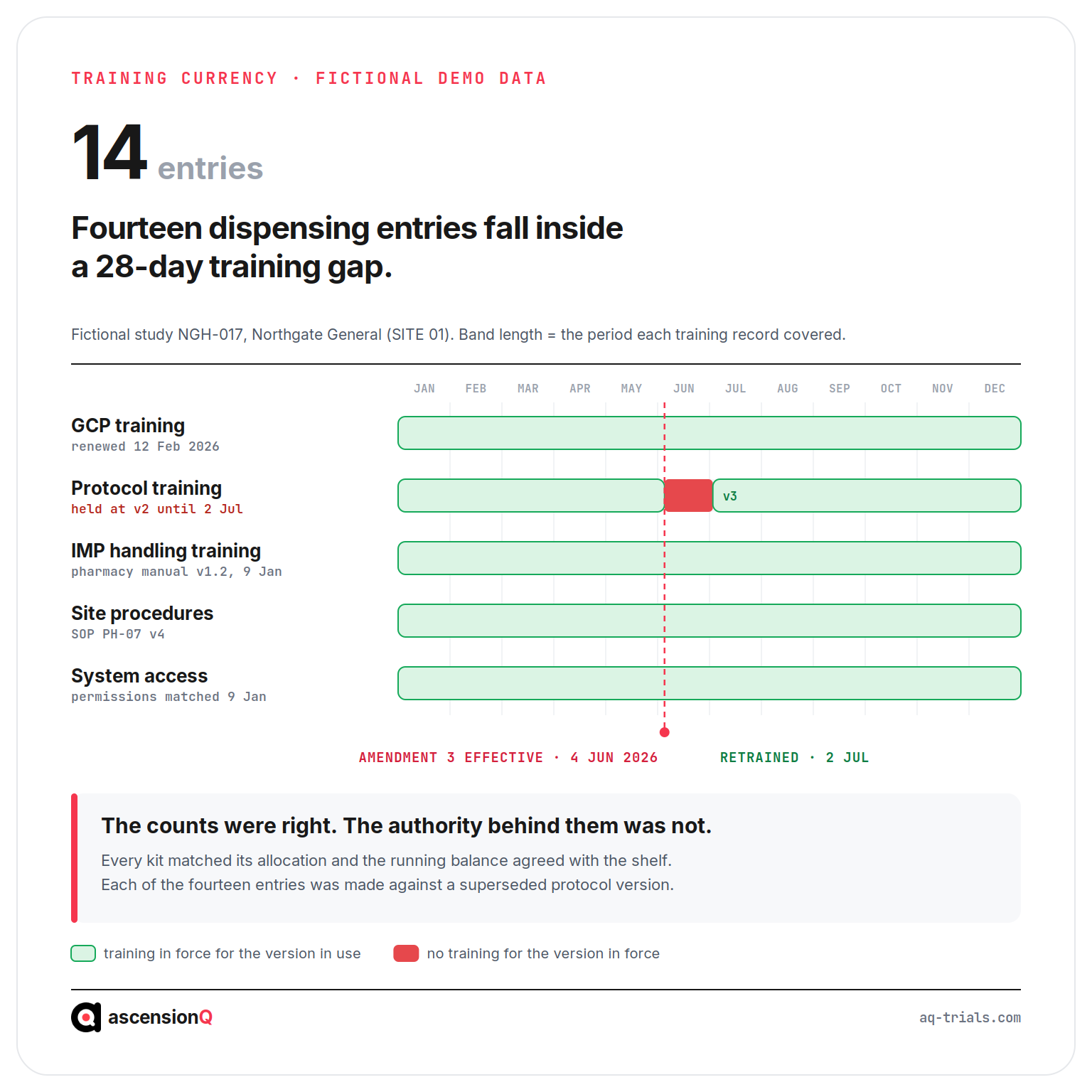
Currency is a property of a date, so the record has to answer a question about the past. The useful test is whether the file can show what a named person was trained on during a week three months ago. Procedures, training records and version control sit within the site’s quality management system, which sets the refresher intervals.
How Does a Training Lapse Break the Accountability Record?
A training lapse breaks the accountability record by leaving a run of entries that nothing in the file supports. The stock reconciles, the counts are right, and the evidence behind each line is missing. A hypothetical example shows the shape of it.
Study NGH-017 runs at Northgate General (SITE 01). Protocol amendment 3 takes effect on 4 June 2026 and changes the dispensing window for one arm. A pharmacy technician on the delegation log for dispensing and returns holds protocol training recorded against amendment 2. She makes 14 dispensing entries between 4 June and 2 July. Every kit matches its allocation and the balance agrees with the shelf.
Nothing was miscounted. The evidence still failed.
The monitor finds 14 entries made by a person whose training record stops at a superseded protocol version. The stock stands. The site investigates the gap, retrains the technician against amendment 3 and documents a review of the entries made in that window. A cause that would recur, such as an amendment distribution step that never reached pharmacy, moves into the site’s corrective and preventive action process.
What Does an Inspector Ask About Delegation and Training?
An inspector starts at one entry in the pharmacy record and works backwards to the authority behind it. Each step depends on the one before it.
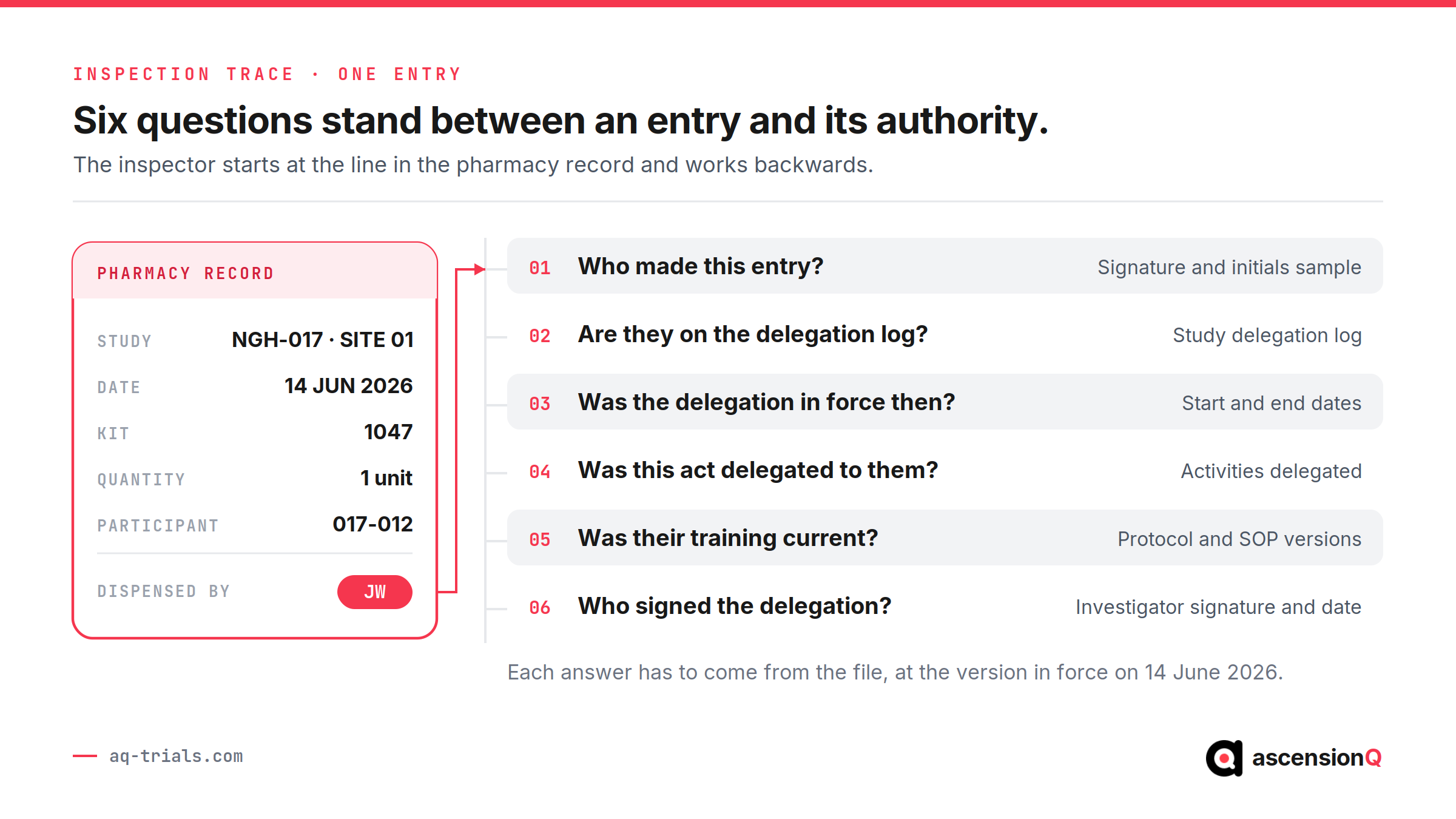
- Who made this entry? The initials on the line have to resolve to one named person through the signature sample.
- Where does that person appear on the delegation log for this study? A pharmacy-wide competency record answers a different question.
- Was the delegation in force on that date? The start and end dates are read against the date of the entry.
- Which activities were delegated, and does this entry fall inside them? A person delegated to receive stock and a person delegated to dispense it are two different rows.
- What training did that person hold on that date? The protocol version and the procedure version on the training record are compared with the versions in force.
- Who signed the delegation? The signature traces to the investigator and to the date the authority started.
The same six questions apply to a paper file and to an electronic one. The difference is retrieval time. Findings across MHRA inspections more broadly are covered in the guide to the most common MHRA GCP inspection findings.
Also Read: What Does ICH E6(R3) Require of IMP Management at the Site?
Frequently Asked Questions
When does a pharmacy record entry count as evidence?
Only when the person who made it was delegated that activity and was trained to perform it on the day. Both conditions must hold at the same moment.
What does a pharmacy delegation log record?
Each person the investigator authorised, the activities delegated to them, the period the authority ran, and the initials that appear on the pharmacy record as a result.
What counts as current training for a trial pharmacy role?
Training that covers the protocol version and the procedure version in force on the date the person acts.
Delegation, training and the pharmacy record are three views of the same evidence, and they read best when a reviewer moves between them without leaving the study file. AQ’s electronic pharmacy site file page sets out how AQ approaches pharmacy records as part of one connected site record. Book a live demo to talk through how your delegation and training evidence sits alongside the rest of your study record.