IMP accountability in clinical trials is the documented, unit-by-unit record that proves where every investigational medicinal product sent to a research site went, from its release to the site until its return or destruction. At a UK site the trial pharmacy usually keeps that record on the investigator’s behalf. The record has to agree with the sponsor’s supply system, the trial prescriptions, each participant’s trial record and the stock on the shelf at every point in the study.
This guide covers what counts as an investigational medicinal product (IMP), what accountability must reconcile, the journey from depot to patient, what the pharmacy file holds, who is accountable, what UK law and ICH E6(R3) require, where the record breaks, how blinding changes the work, how reconciliation runs and what to compare before buying software.
- Responsibility for IMP management rests with the investigator or institution under ICH E6(R3) section 2.10.1, and the work is usually delegated to the trial pharmacy.
- The site record covers delivery, inventory, use by each participant, return and destruction, with dates, quantities, batch numbers, expiry dates and code numbers.
- Every unit received sits in exactly one place at any moment: dispensed, returned, destroyed, on the shelf or documented as lost.
- Most accountability failures occur at handovers, where one record is updated and the matching record is not.
- A monitor tests the record by reconciling it against the sponsor’s shipment records, the prescriptions and the participant records.
What Is an Investigational Medicinal Product?
An investigational medicinal product is any medicine or placebo being tested, or used as a reference, in a clinical trial. UK law defines it in regulation 2 of the Medicines for Human Use (Clinical Trials) Regulations 2004 as “a pharmaceutical form of an active substance or placebo being tested, or to be tested, or used, or to be used, as a reference in a clinical trial”. The definition also covers a licensed medicine used or assembled differently from its authorised form, used for an unauthorised indication, or used to gather further information about an authorised use. ICH E6(R3) gives the same scope in its glossary.
A placebo is therefore an IMP. A comparator bought from the market is also an IMP when the protocol uses it as a reference. UK guidance uses the separate term non-investigational medicinal product (NIMP) for a medicine the protocol describes but does not test, such as a rescue medicine or a background treatment. The classification is fixed in the protocol and the clinical trial application, and both belong to the sponsor. Which record each class attracts at site, and who fixes the classification, are set out in the comparison of IMP and NIMP record requirements.
| Product used in the trial | Usual classification | Record the site keeps |
|---|---|---|
| Test medicine supplied by the sponsor | IMP | A full accountability line for every unit |
| Placebo matched to the test medicine | IMP | A full accountability line for every unit |
| Licensed comparator used as a reference | IMP | Full accountability, unless an alternative approach for authorised products is agreed under local rules |
| Rescue medicine named in the protocol | NIMP | The record the protocol and sponsor specify |
| Background treatment named in the protocol | NIMP | The record the protocol and sponsor specify |
Most IMP reaches the site as a kit. A kit is a labelled pack carrying a unique number that links it to the sponsor’s randomisation and supply system. The pharmacy records every movement against that number, and the number is what makes unit-level accountability possible. The full UK definition, the NIMP and auxiliary medicinal product boundary, and who numbers a kit are covered in what an investigational medicinal product is under UK law.
What Does IMP Accountability Have to Reconcile?
IMP accountability has to reconcile the pharmacy’s own record with every other record that describes the same units. The pharmacy ledger states what the site holds and what it has done with each kit. The trial record, spread across the sponsor’s systems and the participant’s notes, states what the study believes happened. Accountability holds only while the two tell the same story.
Accountability is proven when two independent records reach the same number.
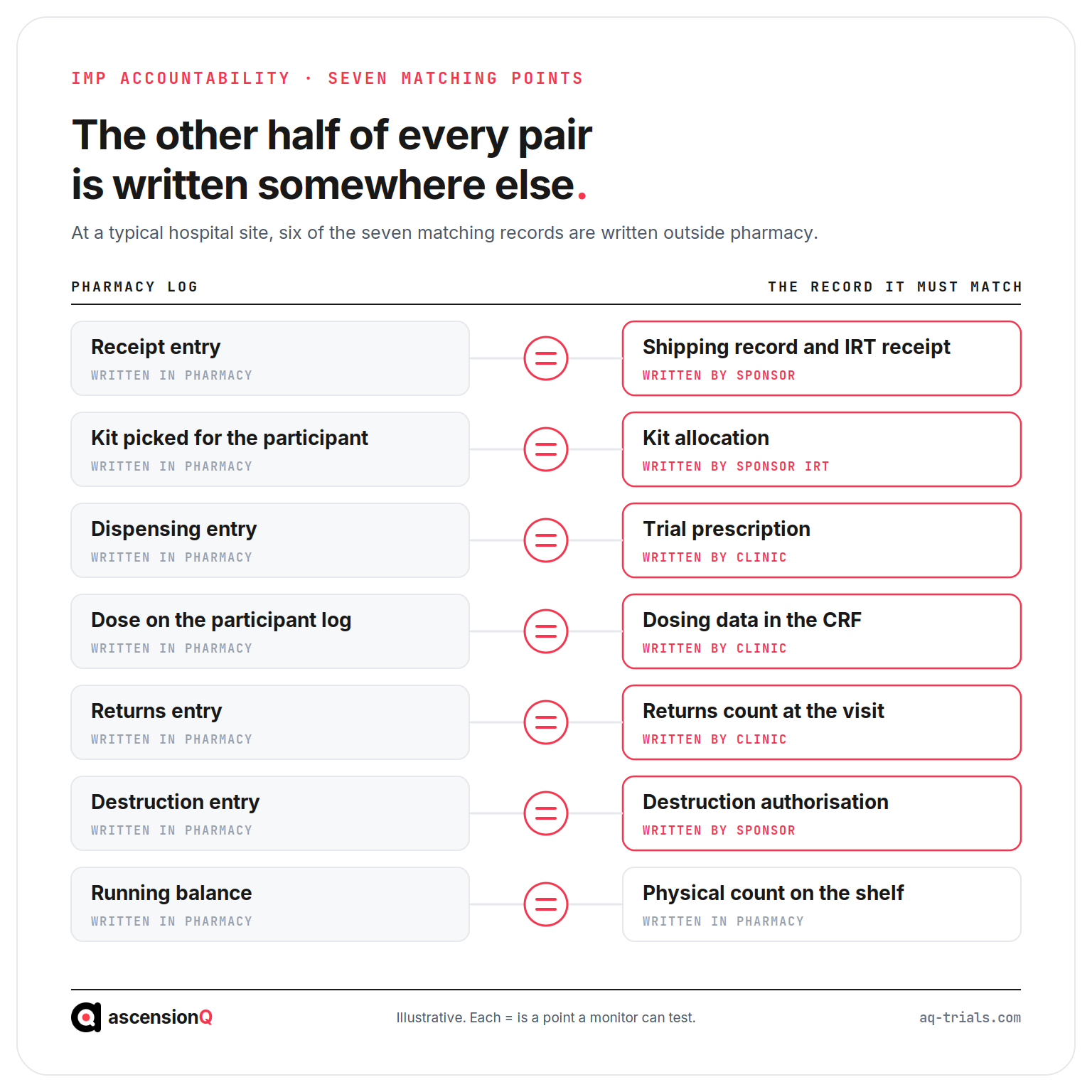
The sponsor’s interactive response technology (IRT), also called a randomisation and trial supply management (RTSM) system, allocates kits and tracks shipments. The site ledger reconciles against the IRT and does not replace it, and which record the RTSM holds and which the pharmacy holds sets out that boundary and the four points where a value crosses it. The table sets out the seven points where the pharmacy record meets another record.
| Pharmacy record entry | Must agree with |
|---|---|
| Receipt of a shipment | The sponsor’s shipping record and the receipt confirmed in the IRT |
| Kit assigned to a participant | The allocation the IRT returned for that participant and visit |
| Dispensing entry | The trial prescription signed by an authorised prescriber |
| Participant, visit and dose | The participant’s trial record and the dosing data in the case report form |
| Units returned | The count taken when the participant brought medicine back |
| Destruction or return to sponsor | The sponsor’s written authorisation and the destruction certificate |
| Running balance | The physical stock on the shelf, including quarantined stock |
Timing matters as much as the number. ICH E6(R3) section 2.12.2 expects source records to be attributable, legible, contemporaneous, original, accurate and complete, with changes that stay traceable. A log that reaches the right balance a week late still fails the contemporaneous test.
Each row is a handover. A handover is where one person updates one record and another person updates the other, sometimes days apart. Most of the matching records are written outside the pharmacy, by the sponsor’s systems or by the clinical team.
How Does an IMP Travel from Depot to Patient?
An IMP travels from a sponsor’s depot to a patient through a chain of handovers, and each handover leaves a record that the next one depends on. The chain groups into five phases at site. The table shows the handover in each phase and the record it must leave behind.
| Phase | The handover | The record it leaves |
|---|---|---|
| Release and shipment | The sponsor releases certified stock and ships it to the site | Release documentation, the shipping record and the transit temperature record |
| Receipt and quarantine | Pharmacy checks the delivery against the packing list and holds it until released for use | Receipt entry with batch, expiry and kit numbers, plus the release decision |
| Storage | Stock sits under the conditions the sponsor specifies | Temperature records and the running balance |
| Prescription and dispensing | An authorised prescriber writes a trial prescription and pharmacy dispenses the allocated kit | The prescription, the dispensing entry and the participant-level log |
| Return, reconciliation and disposition | The participant returns unused medicine, and the sponsor authorises return or destruction | Returns count, reconciliation record and destruction certificate |
ICH E6(R3) section 2.10.8 also allows IMP to be shipped to the participant’s home or supplied through a pharmacy closer to the participant. Those routes add handovers outside the hospital. They keep the same duty to account for every unit. All twelve handovers, and the record each one leaves, are set out step by step in the twelve steps a trial medicine takes from depot to patient.
Receipt is the phase with the tightest gate. Why every delivery is held until a named person releases it, what the check counts against the packing list and what the release decision records are set out in receipt and quarantine at a trial pharmacy.
Storage is the phase with the heaviest record set. The temperature records, their integrity and the excursion workflow are covered in the investigational product storage records checklist.
Also Read: Investigational Product Storage Records: A Compliance Checklist
What Does the Pharmacy Site File Hold?
The pharmacy site file holds every record the pharmacy needs to show how it received, stored, dispensed and disposed of IMP for one study. It is a separate record from the investigator site file, held and maintained by pharmacy, and the reasons are set out in the guide to why pharmacy documentation needs its own file.
ICH E6(R3) Appendix C lists several of these records among a trial’s essential records. They include a sample of the IMP label, the handling instructions or pharmacy manual, the IMP shipping records, the certificates of analysis for shipped product, and the record of IMP accountability at the investigator site. A working pharmacy file groups them roughly as follows.
- Set-up records hold the protocol, the pharmacy manual and the label sample, which fixes the procedure the pharmacy must follow from day one of the study.
- Release and shipping records hold the release documentation, shipping records and certificates of analysis, which show the stock arrived certified and intact.
- Accountability logs hold the study-level log and the participant-level logs, which carry the running balance for every kit.
- Storage and equipment records hold temperature data and calibration certificates, which prove the stock stayed within its conditions.
- Dispensing records hold trial prescriptions and dispensing entries, which connect each kit to one participant and one visit.
- Returns and disposition records hold returns counts, sponsor authorisations and destruction certificates, which close each unit’s line.
- People records hold delegation and training evidence, which show that each person who acted was authorised to act.
Each study keeps its own pharmacy file, even where one pharmacy supports many studies. Shared records, such as a fridge’s temperature log or a calibration certificate, are filed once and referenced from each study that relies on them. A twelve-section index, with the owner and signatory for each section, is set out in what belongs in a pharmacy site file.
The separation between the two site files matters most at inspection. The contents matter every day, because an incomplete file breaks the chain long before anyone inspects it.
Also Read: ePSF vs eISF: Why Pharmacy Documentation Needs Its Own File
Who Is Accountable for IMP at a UK Site?
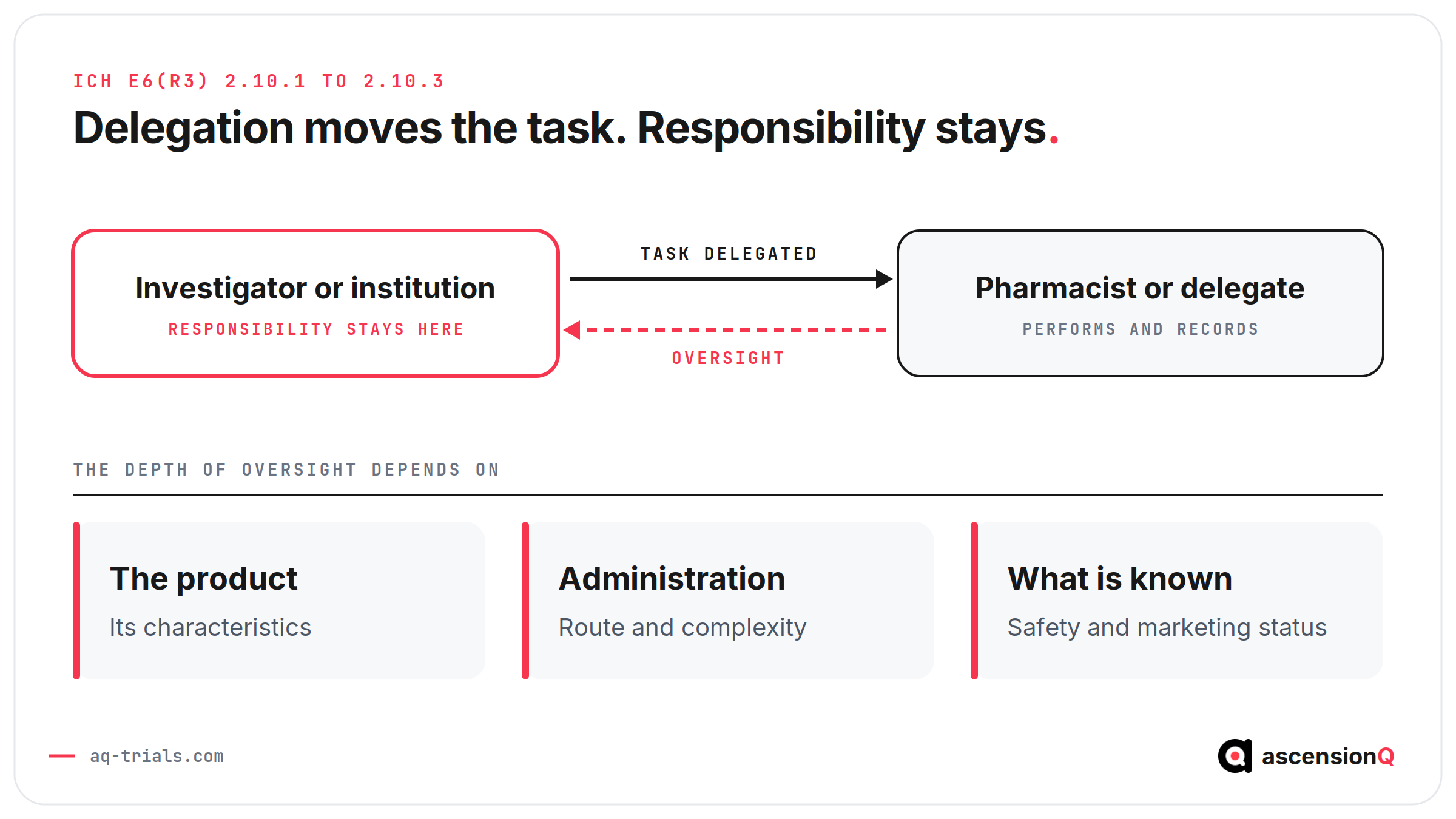
The investigator or institution is accountable for IMP at a UK site. ICH E6(R3) section 2.10.1 states that responsibility for IMP management, “including accountability, handling, dispensing, administration and return, rests with the investigator/institution”. Section 2.10.2 allows that work to be delegated to a pharmacist or another individual, who then works under the investigator’s oversight. Section 2.10.3 sets the depth of that oversight by the product’s characteristics, the route and complexity of administration, and what is already known about its safety.
Delegation moves the task. Responsibility stays where E6(R3) puts it. At most UK sites the delegated work lands in a dedicated trial pharmacy service, and how a clinical trial pharmacy differs from routine dispensing explains that service and its in-house, outsourced and homecare models. Every person who touches the record falls into one of three tiers.
- Holds accountability. The investigator and the institution own the outcome, which is why the principal investigator signs the delegation log that authorises pharmacy staff.
- Acts and records. Trial pharmacists, pharmacy technicians, prescribers and research nurses each perform a delegated step and write the entry for it, which makes every line attributable to a named, authorised person.
- Reads and verifies. Monitors, quality assurance staff, the sponsor and inspectors review the record without changing it, which is how independent verification stays independent.
A signature from someone who is missing from the delegation log, or whose training has lapsed, breaks accountability even when the count is right. The authority to act is part of the record, and what makes a pharmacy action authorised and trained covers the three conditions behind every entry and the questions an inspector asks of one line. Each of the eleven parties is placed in its tier, role by role, in who is accountable for IMP at a trial site.
What Do UK Law and ICH E6(R3) Require?
UK law and ICH E6(R3) require a site to keep records that show every unit of IMP was received, stored, used only as the protocol allows, and returned or destroyed on the sponsor’s authority. The amended UK clinical trials regulations took effect on 28 April 2026, and the guide to the new UK clinical trials regulations covers what changed for sites and sponsors. The provisions that bear most directly on the pharmacy record are these. Section 2.10 is taken clause by clause, as it applies at a UK site, in what ICH E6(R3) requires of IMP management at the site.
| Source | Provision | What it asks of the site |
|---|---|---|
| ICH E6(R3) 2.10.4 | Investigational product records | Records of delivery, inventory, use by each participant, and return or destruction, with dates, quantities, batch or serial numbers, expiry dates and the code numbers of product and participant |
| ICH E6(R3) 2.10.5 and 2.10.6 | Storage and use | Storage as the sponsor specifies, and use only in accordance with the approved protocol |
| ICH E6(R3) 2.10.7 | Participant instruction | Explaining correct use to each participant and checking at appropriate intervals that they follow it |
| ICH E6(R3) 2.11 | Randomisation and unblinding | Following the randomisation procedure and breaking the code only as the protocol allows |
| ICH E6(R3) 3.11.4.5.3 | Monitoring of IMP management | A monitor confirming that receipt, storage, use, return and disposition are controlled and documented adequately |
| UK Clinical Trials Regulations 2004, as amended | Definitions, labelling and manufacture | The legal meaning of an IMP and NIMP, and the labelling rules and Qualified Person certification IMP must meet before it reaches a site |
| MHRA GXP data integrity guidance | Record integrity | Records that are attributable, legible, contemporaneous, original and accurate, with a traceable history of changes |
| Royal College of Pharmacy hospital standards | Professional standard | Pharmacy systems that ensure clinical trial medicines are used in line with regulatory requirements, with audit trails for supply, storage and return |
The data integrity expectations come from the MHRA GXP data integrity guidance, which applies to the pharmacy log as it applies to any other GCP record. The particulars regulation 46 puts on every pack, and who may change a label after Qualified Person certification, are set out in the IMP labelling requirements for UK trials. Who certifies a batch before it reaches a site, and what the sponsor’s separate release to that site adds, are set out in who releases IMP to a UK site and what QP release is. The professional standard sits in descriptors 4.3 and 5.3 of the Professional Standards for Hospital Pharmacy Services, now published by the Royal College of Pharmacy.
Pharmacy review also happens before a study opens. The national pharmacy review at study set-up is explained in the guide to HRA Technical Assurance for pharmacy and radiation. The local set-up that follows approval, and the conditions that must hold before a first dispense, are set out in how a trial pharmacy reaches green light before the site initiation visit. The MHRA does not approve site systems. It inspects the records those systems produce, and the most common MHRA GCP inspection findings show where those records fall short. The order in which those records are requested from pharmacy, the facility walkthrough and the way a finding is graded are set out in what an MHRA inspector looks for in a pharmacy site file.
Where Does the Accountability Record Break?
The accountability record breaks at handovers, where one record changes and the record it must match does not. The typical break is a correct action recorded in the wrong place, at the wrong time or by the wrong person. Seven break points recur.
- Late receipt entries. The shipment is confirmed in the IRT on arrival and entered in the pharmacy log two days later, so the log is no longer contemporaneous.
- Kit substitution. A kit other than the one the IRT allocated is dispensed, so the shelf and the allocation diverge from that visit onward.
- Prescription changes. The dose changes after dispensing, and the dispensing entry still refers to the superseded prescription.
- Returns that stop at the clinic. A research nurse counts returned medicine at the visit, and the count never reaches the pharmacy log.
- Quarantined stock counted as usable. Stock under investigation after a temperature excursion stays in the available balance.
- Destruction before authorisation. Expired stock is destroyed before the sponsor’s written authorisation arrives, so the record cannot show the decision came first.
- Unauthorised signatures. A dispensing entry is signed by someone missing from the delegation log for that study.
A hypothetical example shows how quietly this happens. At a monitoring visit for study NGH-017 at Northgate General (SITE 01), the pharmacy log shows a balance of 31 kits. The shelf holds 30. The IRT shows kit 1047 allocated to participant 017-012 at an unscheduled visit three weeks earlier. The prescription sits in the clinic notes. The dispensing happened out of hours, and the log entry was never made.
Every action in that example was correct. The record still failed, because the process let one handover finish without the matching entry. The fix is a process that makes the log entry part of the dispensing step itself. The format of the log changes how each of these breaks surfaces, and the comparison of paper accountability logs against an electronic pharmacy record sets out where errors enter each one, how a correction is made, and what a late reconciliation costs. A trust’s own stock control system records the same delivery as a single product line, and the guide to why a hospital pharmacy stock system is not a trial record sets out the per-participant and audit trail evidence it cannot carry.
The shelf was right. The log was wrong.
An unexplained difference is investigated and documented. A difference with a systemic cause moves into the site’s corrective and preventive action process.
How Does Blinding Change IMP Accountability?
A blinded design changes IMP accountability by forcing the record to prove what happened to every unit without revealing to blinded staff what each unit contained. Kit numbers carry that load. The blinded record shows a kit number, a participant and a date, and the treatment behind the number stays with the IRT and any unblinded staff.
ICH E6(R3) section 2.11 asks the investigator to follow the randomisation procedure and to break the code only as the protocol allows. The same section requires the site to be able to unblind “without undue delay and hindrance” in an emergency, from the start of the trial. Any premature unblinding must be documented and explained promptly to the sponsor. Section 4.1 of E6(R3) extends the duty to safeguard blinding into data governance.
- Kit numbering separates identity from content, which lets pharmacy account for every unit while treatment stays hidden.
- Unblinded pharmacy roles handle information the blinded team must not see, which requires their records to be held apart from the blinded record.
- The code break procedure is tested before any participant is dosed, which proves the site can unblind within the protocol’s timeframe.
- The unblinding record captures who broke the code, when and why, which gives the sponsor the explanation E6(R3) requires.
Monitors check this too. ICH E6(R3) section 3.11.4.5.2 includes verifying that the blinding is maintained. The four code break mechanisms a UK site runs, and the record each unblinding leaves behind, are set out in how a pharmacy keeps the blind and breaks it in an emergency.
How Does an IMP Reconciliation Work?
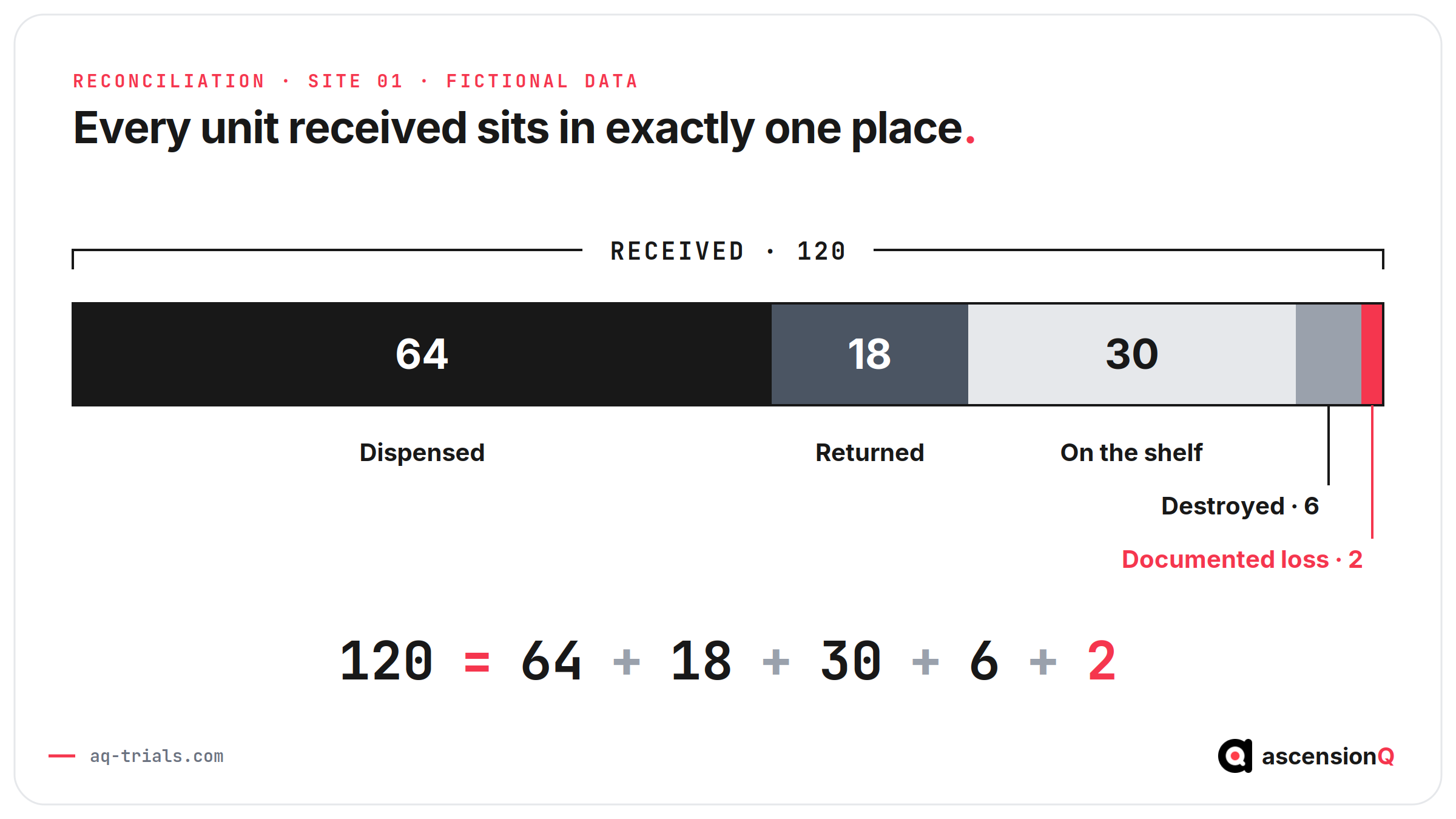
An IMP reconciliation works by proving that every unit received is accounted for in exactly one category, and that the total matches the physical stock. The sum is simple. Units received equal units dispensed, plus units returned, plus units destroyed, plus units on the shelf, plus units documented as lost or damaged.
The monitor tests that sum from four directions.
- Shipped against received compares the sponsor’s shipping records with the pharmacy receipt entries.
- Dispensed against prescribed compares dispensing entries with trial prescriptions and IRT allocations.
- Returned against dispensed compares returns counts with what each participant was given, which also shows whether participants took the medicine as instructed.
- Shelf against log compares the physical count with the running balance, including quarantined stock.
Reconciliation runs at monitoring visits and again at close-out. ICH E6(R3) section 3.11.4.5.2 includes confirming the final accountability of the IMP, including return and destruction, during site close-out. A reconciliation performed only at close-out finds every error at once and too late to correct the process that caused it.
The fictional SITE 01 figures show the sum in practice. The pharmacy received 120 units. It dispensed 64, took back 18 in returns, destroyed 6 on the sponsor’s authority and holds 30 on the shelf. Two units are documented as lost, and each carries its own investigation record. The categories add back to 120, so the record closes. A total of 120 that relies on an unexplained adjustment has not reconciled.
Also Read: Drug Accountability Logs: What Auditors Actually Check
What Should a Site Compare Before Buying IMP Accountability Software?
A site should compare IMP accountability software on whether it can keep the pharmacy record and the trial record in agreement, and prove it did, for the life of the study and beyond. The criteria below follow from the requirements set out above.
| Criterion | The question to ask |
|---|---|
| Accountability model | Does the record hold a running balance at kit level and at participant level, with every unit in exactly one category? |
| Corrections and audit trail | Does every change keep the original entry readable, with who, when and why? |
| Storage and calibration records | Can temperature data and equipment calibration be tied to the stock they cover? |
| Reconciliation against the sponsor’s IRT | How does the site compare its ledger with sponsor allocation and shipment data, and where are differences recorded? |
| Access control against delegation | Does permission to act follow the study delegation log and current training? |
| Validation evidence | What does the supplier provide, and what testing must the site perform itself? |
| NHS assurance | What is the supplier’s position on the Data Security and Protection Toolkit, Cyber Essentials and the Digital Technology Assessment Criteria? |
| Exit and archiving | Can the full record, including its audit trail, be exported in a readable format when the contract ends? |
A demonstration tells a site more when it uses the site’s own hardest cases. A useful test replays a recent month that included a kit substitution, a returns count from the clinic and a destruction run, and asks the system to show each one end to end.
Validation is a shared responsibility between supplier and site. The guide to GAMP 5 and computerised system validation explains how that evidence is planned.
Frequently Asked Questions
What is IMP accountability in clinical trials?
The documented, unit-by-unit record that proves where every investigational medicinal product sent to a research site went, from its release to the site until its return or destruction.
Who is accountable for IMP at a UK site?
The investigator or institution. ICH E6(R3) section 2.10.1 places responsibility for IMP management, including accountability, handling, dispensing, administration and return, with the investigator and institution.
What does an IMP accountability record have to reconcile?
The pharmacy’s own record against every other record that describes the same units. The pharmacy ledger states what the site holds and what it has done with each kit, and those entries must agree with the other records.
Where does the accountability record usually break?
At handovers, where one record changes and the record it must match does not. The typical break is a correct action recorded in the wrong place, at the wrong time or by the wrong person.
How does an IMP reconciliation work?
It proves that every unit received is accounted for in exactly one category, and that the total matches the physical stock.
AQ’s electronic pharmacy site file page sets out how AQ approaches pharmacy records as part of one connected site file, alongside the investigator site file and the study record. Book a live demo to talk through how your pharmacy records connect to the rest of your study evidence.