HRA Technical Assurance is a set of national pre-submission reviews that settle the specialist pharmacy and radiation questions in a study once, before the application reaches a Research Ethics Committee. The Health Research Authority runs two schemes under that heading. Pharmacy Assurance provides a single technical pharmacy review for eligible multi-centre studies. Radiation Assurance coordinates expert review of every ionising radiation exposure in a study, and the HRA manages it on behalf of all four UK nations.
Both reviews sit ahead of e-submission of the IRAS form. Their outputs travel to participating NHS organisations inside the Local Information Pack, so a site opens its capacity and capability assessment holding a completed technical answer rather than a set of questions. This guide covers what each scheme reviews, who reviews it, which studies are eligible, the published clocks, when each submission is due, what a site receives, and the local work that remains.
Key takeaways
- Technical assurance is pre-submission work. Radiation Assurance should complete before the REC, HRA and HCRW Approval and ARSAC applications, and Pharmacy Assurance should be submitted at least three weeks before REC submission.
- The two schemes run on different clocks. Pharmacy Assurance tests a 30 calendar day timeline for HRA-managed studies. Radiation Assurance runs to a maximum of 40 calendar days.
- Every published timeline excludes query time. A study with open queries takes longer than the headline figure suggests.
- Neither scheme is mandatory. The HRA expects NHS sponsors to use Pharmacy Assurance, and states that Radiation Assurance should be used for all studies taking place in NHS secondary care.
- Sites receive completed forms rather than raw documents. Radiation risk information reviewed centrally does not need reviewing again locally, and local duties under IR(ME)R remain with the site.
What Is HRA Technical Assurance?
Technical assurance covers the two areas of a study where specialist judgement is required and where every participating site would otherwise form that judgement separately. A pharmacy department assesses how an investigational medicinal product will be received, stored, prepared, dispensed and accounted for. A medical physics department assesses the dose and risk attached to each research imaging procedure. Both rest on the same protocol text, and both produce the same answer at every site.
The HRA runs each scheme as a single national review performed by registered reviewers, then distributes the result. The two schemes differ in scope, in who reviews, in the clock they run to, and in the document a site eventually receives.
| Aspect | Pharmacy Assurance | Radiation Assurance |
|---|---|---|
| What it reviews | Technical pharmacy arrangements for the investigational medicinal product | Every ionising and non-ionising research exposure in the protocol |
| Who reviews | HRA registered pharmacists and pharmacy technicians | Clinical Radiation Expert and Medical Physics Expert |
| Eligible studies | Multi-centre NHS studies, Phase I to III oncology and Phase III non-oncology | All studies in the NHS or HSC involving ionising radiation |
| Single-site studies | Not eligible for submission | Covered where the study is in secondary care |
| Published clock | 30 calendar days, HRA-managed route | 40 calendar days maximum, HRA-managed route |
| Output | Completed pharmacy technical review form | Research Exposure Form and an HRA confirmation email |
| Where it lands | Local Information Pack, then the Pharmacy Site File | Local Information Pack, IRAS Part B section 3, and the ARSAC application |
| Mandatory | No, and the HRA expects NHS sponsors to use it | No, and the HRA states it should be used across NHS secondary care |
Why Does Technical Assurance Exist?
A multi-centre study without technical assurance generates the same specialist questions at every site it opens. Each pharmacy department reads the protocol, the Investigator’s Brochure and the IMP dossier, finds the same ambiguities, and emails the sponsor. Each medical physics department calculates the dose for the same research CT. The sponsor answers twenty versions of one query, and each answer arrives at one site only.
Consider a Phase III oncology trial opening at eighteen NHS sites. The protocol specifies reconstitution in a negative pressure isolator and gives a four-hour in-use stability window. Site 04 asks whether the window starts at reconstitution or at the end of the infusion bag preparation. That query takes six working days to resolve. The same query then arrives from Site 07, Site 11 and Site 14 over the following month, and each one restarts the same clock. Every step is performed promptly, and the study still loses a month of pharmacy set-up across the portfolio.
The question was answered once. The answer travelled to one site.
Technical assurance moves that review upstream and gives the answer a route to every site. The HRA describes the effect for sites in three parts:
- A single technical review replaces the individual reviews each site would otherwise perform, which removes duplicated specialist effort across the study.
- Information spread across several trial documents arrives summarised in one form, which gives a pharmacy or physics team a single reference point instead of a document set.
- The reviewed information reaches sites in the Local Information Pack, which supplies it at the moment a site starts its capacity and capability assessment rather than partway through.
The timing matters as much as the content. A site working to the 90-day set-up target runs costing, capacity assessment, contracting and pharmacy set-up concurrently. A query raised in week two and answered in week five removes that concurrency for one of the longest stages.
What Does Pharmacy Assurance Cover?
Pharmacy Assurance coordinates a standardised single technical pharmacy review for eligible studies across the UK. Registered pharmacists and pharmacy technicians perform the review against the study documents the sponsor submits, and they produce a pharmacy technical review form that summarises the arrangements a receiving pharmacy needs to plan against.
Eligibility is defined by phase and by the number of sites:
- In scope: all Phase I to III oncology studies and all Phase III non-oncology multi-centre studies taking place in the NHS.
- Out of scope: single-site studies, which the HRA does not accept for submission.
- Status: the scheme remains in phased roll-out, and the HRA intends it to become a component of HRA and HCRW Approval once that roll-out completes.
Sponsors choose between two routes. The HRA-managed route puts reviewer selection with the HRA, and an applicant may request up to three trusts or health boards for consideration. The self-managed route is open to non-commercial studies where the sponsor or co-sponsor is the same organisation as the reviewing trust or health board, and the completed review returns to the HRA for confirmation. Documents go to the technical assurances team by email, and submission timing carries a hard consequence: inclusion of the review form in the Local Information Pack is only possible where the application is submitted by or on the day of e-submission.
The completed form does two jobs at a site. It supports the local capacity and capability assessment, and it is then retained in the Pharmacy Site File for future reference. That second job makes it a permanent study record rather than a set-up convenience, which puts it under the same filing discipline as the rest of the pharmacy file held separately from the investigator site file.
Also Read: Investigational Product Storage Records: A Compliance Checklist.
What Does Radiation Assurance Cover?
Radiation Assurance is a UK-wide process fully managed by the HRA on behalf of all four UK nations, and it applies to research in NHS and HSC secondary care settings. It covers studies falling under the Ionising Radiation (Medical Exposure) Regulations 2017 in England, Scotland and Wales, and the equivalent Northern Ireland regulations of 2018. The HRA states that all studies taking place in the NHS or HSC and involving ionising radiation are submitted through the process.
Two expert roles perform the review, and each answers a different question:
- Medical Physics Expert (MPE): performs a radiation dose and risk assessment for all the radiation exposures proposed in the protocol, which establishes the quantified dose figure the study carries.
- Clinical Radiation Expert (CRE): assesses all radiation exposures at any site in the study and advises the Chief Investigator and the REC on suitability and clinical justification, which establishes whether each exposure is warranted.
- Both roles together: confirm that the written information given to participants about ionising radiation risk is appropriate, which links the technical review directly to the Participant Information Sheet.
The HRA runs a consistency review before the expert stage, so that regulators and sites receive consistent information across an application. Published timelines separate the two routes. An HRA-managed submission runs to a maximum of 40 calendar days excluding queries. A self-managed consistency review runs to a maximum of 14 calendar days excluding queries. Modifications processed as an HRA-managed submission run to 30 calendar days excluding queries.
A study that administers a radioactive substance carries a further approval. ARSAC research applications are submitted at the same time as the REC application, and the applicant attaches the email confirming Radiation Assurance is in place together with the Research Exposure Form. Radiation Assurance therefore acts as a precondition for a clean ARSAC submission rather than a parallel activity.
Which Studies Need Which Review?
Most studies need neither review, some need one, and a subset of oncology imaging trials need both plus an ARSAC application. Three protocol features decide it: the presence of an investigational medicinal product, the presence of ionising radiation for research purposes, and the administration of a radioactive substance.
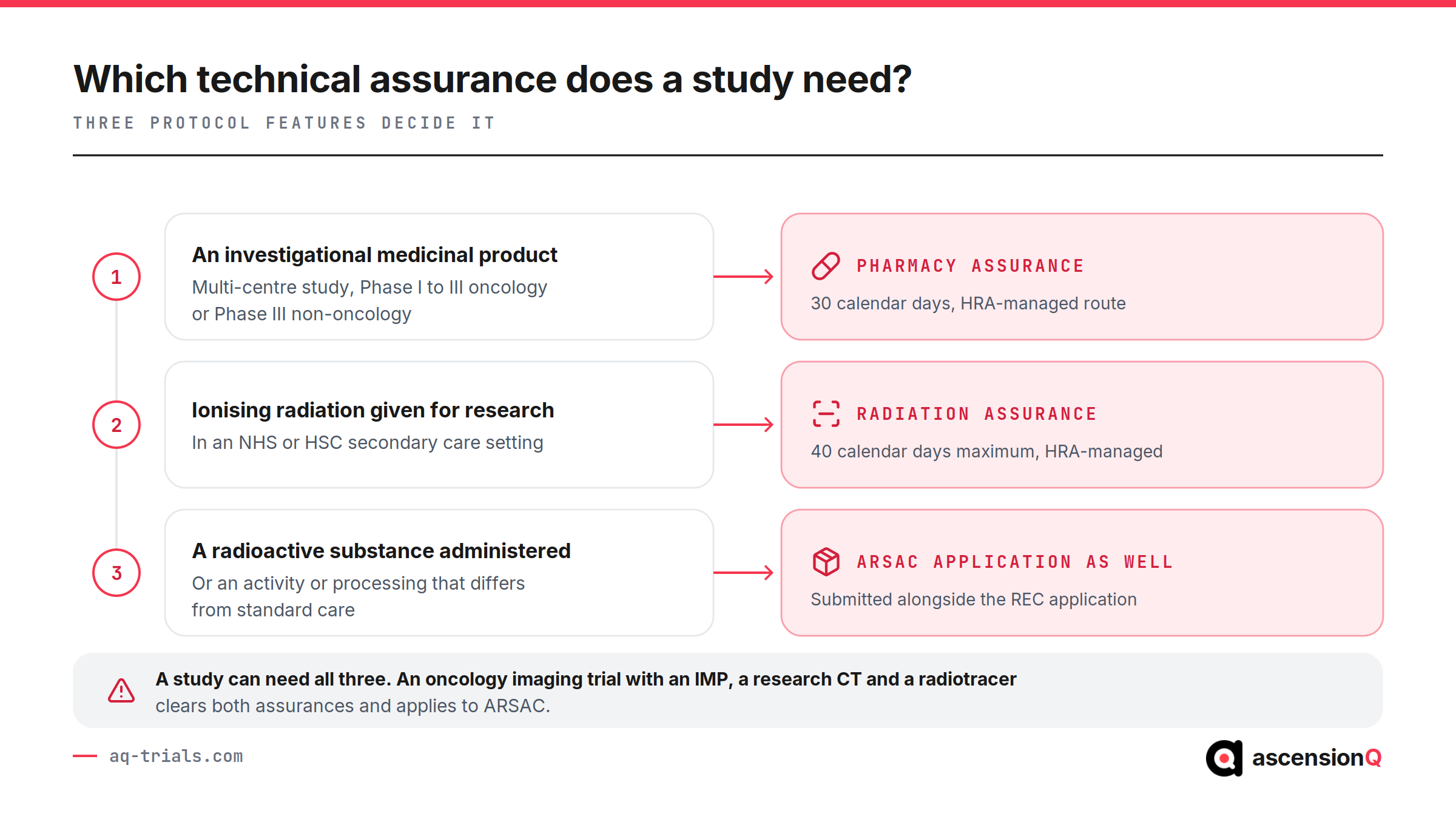
The ARSAC boundary causes most of the confusion in practice. ARSAC approval is required where a protocol requires the administration of radioactive substances, or specifies a frequency, activity or processing that differs from standard care. A protocol with no radioactive administrations, or one that includes them only as standard care inclusion criteria, falls outside that requirement. Radiation Assurance covers a wider set, because it reaches every study in NHS or HSC secondary care that involves ionising radiation.
When Should Each Review Be Submitted?
Technical assurance is planned backwards from the REC submission date. Radiation Assurance should be completed before applying for the relevant regulatory approvals, which the HRA lists as REC review, HRA and HCRW Approval, and ARSAC review. Pharmacy Assurance should be submitted no later than three weeks prior to submission for REC review. A sponsor that fixes its REC date first, then works backwards, arrives at both submission dates without guesswork.
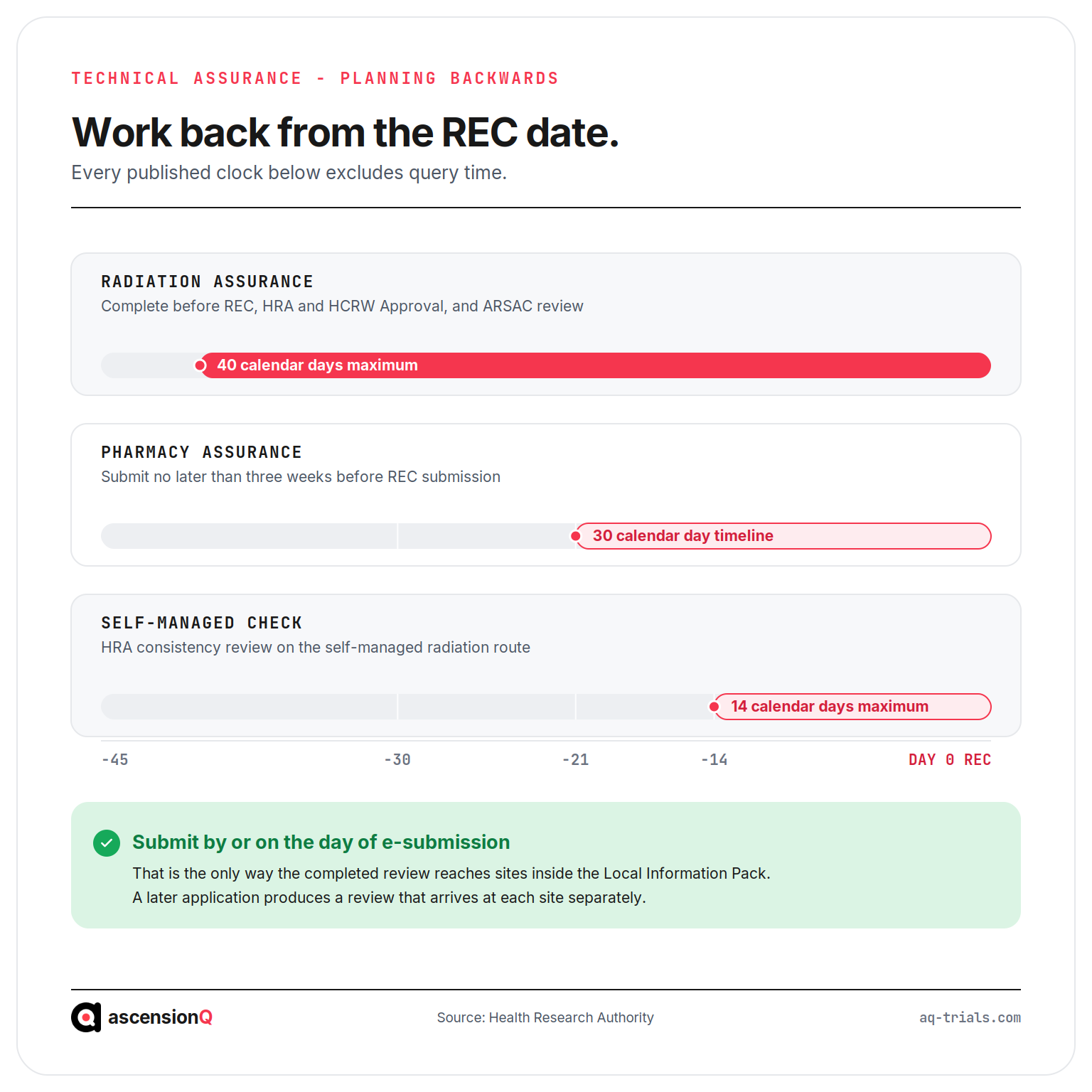
Three details change the plan more often than teams expect:
- Query time sits outside every published clock. A 40-day radiation timeline describes review days, so an application with two rounds of queries occupies more calendar time than the figure implies.
- Radiation Assurance is a pre-submission review. It takes place before e-submission of the IRAS form, and the applicant copies the lead MPE and CRE reviews into Part B section 3 afterwards.
- Late pharmacy submission costs the Local Information Pack. Inclusion in the pack requires submission by or on the day of e-submission, and a later application produces a review that reaches sites separately.
Published performance gives a realistic planning basis for each scheme. The HRA reports a Radiation Assurance target of assurance within 40 days of receiving a submission, and a median of 42 days for the quarter covering January to March 2025, against 161 studies reviewed in 2024. Pharmacy Assurance carries a target of 30 days, and reported a median of 20 days for the quarter covering October to December 2024, with 186 studies reviewed in 2025 and a median of 22 days for that year. Both series cover HRA-managed reviews only, because the HRA does not report on self-managed studies.
A standardised review fee applies on the HRA-managed route where reviewers are based in England, Northern Ireland or Wales. The published rate is £500 per reviewer for a new study and £250 per reviewer for a Radiation Assurance modification, with a £1,000 minimum fee for Radiation Assurance. The sponsor pays the reviewing organisation directly, and the HRA takes no part in the payment.
What Do the Reviews Deliver to a Site?
Each scheme produces named artefacts, and each has a destination. A site that knows which document answers which question stops asking the sponsor for material it already holds.
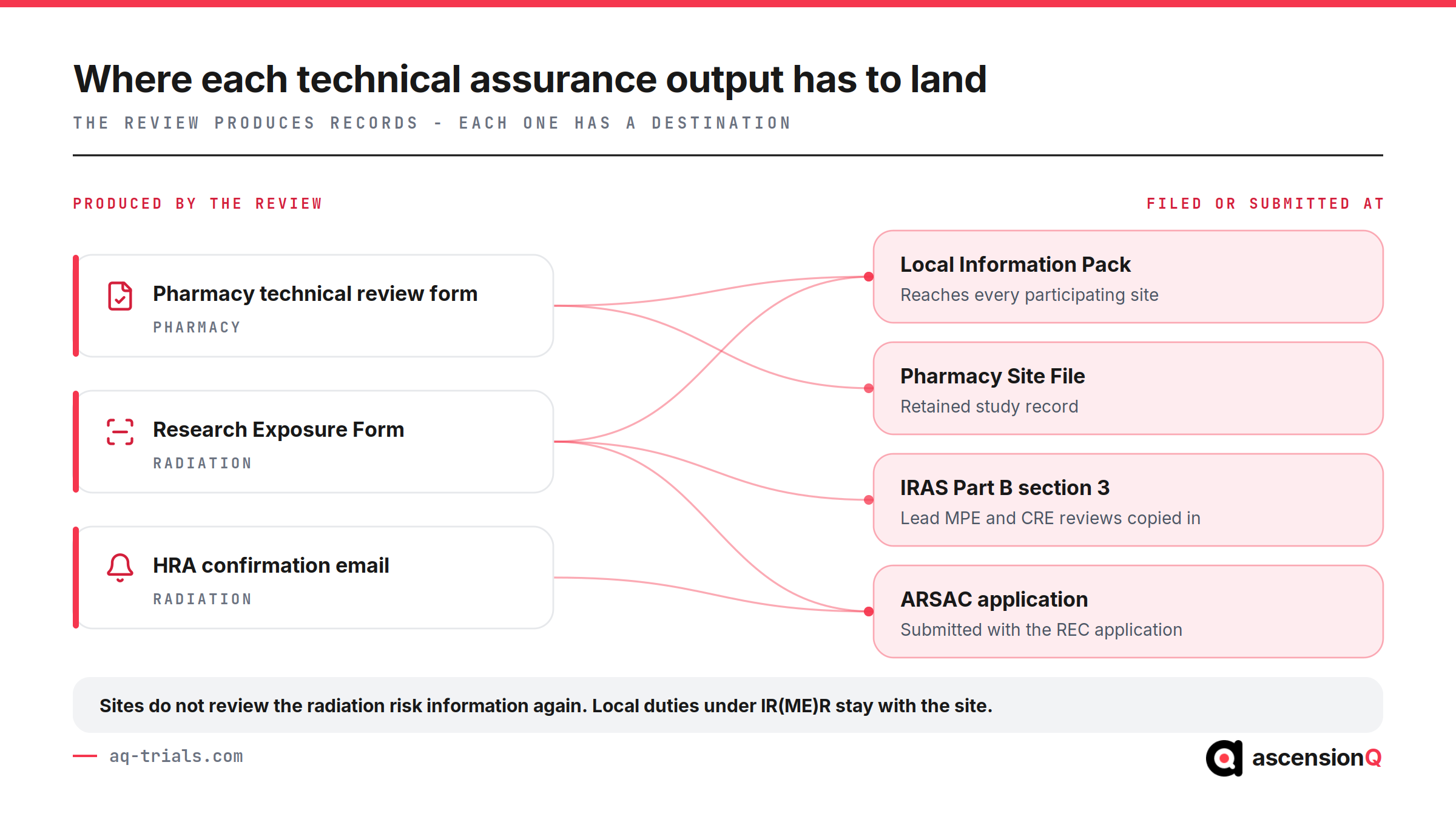
The radiation outputs carry a specific instruction about local effort. Sites do not need to review the risk information contained in those documents, and sites still need to meet local requirements under IR(ME)R. Central review settles the dose and justification questions. Local justification, authorisation, operator entitlement and local procedures remain a site responsibility.
- Pharmacy technical review form: supports the local capacity and capability assessment, then sits in the Pharmacy Site File as a retained record.
- Research Exposure Form: details all ionising and non-ionising research exposures, and its lead MPE and CRE reviews are copied into IRAS Part B section 3 by the applicant.
- HRA confirmation email: evidences that Radiation Assurance is in place, and accompanies the Research Exposure Form into the ARSAC application.
- Modification site notification form: the route the HRA uses to tell sites about changes to a study that already holds Pharmacy Assurance.
The file each document lands in decides whether the set survives the study. Pharmacy documents belong in the pharmacy file and site documents belong in the investigator file, which is the distinction that keeps both provable at inspection.
Also Read: NHS R&D: Governing Site Files Across a Trust’s Studies.
Where Do Sites Still Lose Time?
Technical assurance removes a review. The local work that follows stays where it was, and a site that treats a completed form as the end of pharmacy or physics involvement loses the advantage the review created. The contrast below describes two operating patterns rather than two levels of effort.
| Aspect | Assurance treated as paperwork | Assurance treated as an input |
|---|---|---|
| Arrival of the review form | Filed on receipt, read at green light | Read on receipt, drives the pharmacy plan |
| Local specialist review | Repeated in full, duplicating the national review | Scoped to local feasibility and local IR(ME)R duties |
| Queries to the sponsor | Raised on points the form already answers | Raised only on genuinely local questions |
| Capacity assessment start | Waits for pharmacy to read the document set | Starts against a summarised technical position |
| Study modifications | Noticed when a discrepancy appears at a visit | Tracked from the modification site notification form |
| Evidence at inspection | Reconstructed from email threads | Held as a dated record in the site file |
Three further points of leakage sit outside the assurance schemes entirely, and they explain why a study with both reviews complete can still open late:
- Costing runs on its own clock. Commercial studies price through National Contract Value Review, which proceeds independently of technical review and frequently finishes later.
- The set-up metric closes at contract signature. Site set-up now ends at the Date Site Confirmed, so a fast technical review shows up in national reporting only where contracting keeps pace.
- Local milestone data has to be entered. National figures reflect what sites record, which is the mechanism the UK clinical research delivery KPIs depend on.
Central review shortens the queue. Local governance decides the elapsed time.
Also Read: CPMS and LPMS: What Sites Must Enter and When.
How Does AQ Support Technical Assurance Evidence?
AQ Trials holds the records that technical assurance produces in the files that have to prove them, and keeps the set-up dates around them visible while a team can still act.
Each module holds a different part of the assurance record:
- The electronic Pharmacy Site File holds the pharmacy technical review form and the modification site notification form as controlled documents with versions and dates, which gives a pharmacy team one current position rather than an email thread.
- The electronic Investigator Site File holds the Research Exposure Form and the Radiation Assurance confirmation alongside the essential document set, so a monitor or inspector reads the assured position from the file.
- The CTMS carries the set-up milestones with their dates, which turns the gap between a completed review and a signed contract into a visible number rather than a retrospective finding.
- Portfolio-level views apply the same records across every open study, which is the position an NHS research office needs to manage many set-ups at once.
AQ performs no part of the HRA review. It holds what the review produces, files it where the regulations expect to find it, and dates the local work that follows. Book a live demo to see how AQ tracks set-up evidence from technical assurance through to a site open to recruitment.
Frequently Asked Questions
Is HRA Technical Assurance mandatory?
Neither scheme is mandatory. The HRA expects NHS sponsors to use Pharmacy Assurance, and states that Radiation Assurance should be used for all studies taking place in secondary care within the NHS. The HRA intends Pharmacy Assurance to become a component of HRA and HCRW Approval once its roll-out completes.
How long does HRA Technical Assurance take?
Pharmacy Assurance runs to a 30 calendar day timeline on the HRA-managed route. Radiation Assurance runs to a maximum of 40 calendar days on the HRA-managed route, 14 calendar days for a self-managed consistency review, and 30 calendar days for a modification. Every one of those figures excludes query time.
Do sites repeat the radiation review locally?
Sites do not need to review the risk information contained in the Research Exposure Form and the confirmation email. Local requirements under the Ionising Radiation (Medical Exposure) Regulations remain with the site, so local justification, authorisation and procedures still apply.
What does Pharmacy Assurance cost?
The standardised fee on the HRA-managed route is £500 per reviewer for a new study, paid by the sponsor to the reviewing trust or health board. Radiation Assurance modifications are £250 per reviewer, and Radiation Assurance carries a £1,000 minimum fee. Sponsors without that funding may be able to use the self-managed route where they meet the eligibility criteria.
Which studies are eligible for Pharmacy Assurance?
All Phase I to III oncology studies and all Phase III non-oncology multi-centre studies taking place in the NHS are eligible for submission. Single-site studies are not eligible.
Sources
- Pharmacy Assurance (Health Research Authority)
- Radiation Assurance (Health Research Authority)
- Technical Assurances performance (Health Research Authority)
- Technical Assurance review fee (Health Research Authority)
- How and when to submit research applications to ARSAC (GOV.UK)