Investigational product storage records are the documented evidence that an investigational medicinal product was held under its approved conditions for the whole time it was at site. They cover the storage environment, the temperature history, every excursion and its resolution, and the access controls that kept the product secure. An inspector reads these records to answer one question: was the product a participant received still fit for use? Complete, contemporaneous records evidence the answer in minutes. Records reconstructed after the fact leave the product itself under doubt.
Storage sits alongside accountability, not inside it. The drug accountability log proves the right quantity moved through the correct receipt-to-destruction chain. Storage records prove the product was kept in specification for every hour of that chain. A site can reconcile its counts perfectly and still fail on storage if the fridge drifted out of range overnight and nobody logged it. This guide sets out what the storage record set contains, why it fails at inspection, and a practical compliance checklist grouped by the point in the product lifecycle where each control applies.
Key Takeaways
- Storage records are a distinct control. Accountability proves quantity; storage proves the product stayed within its approved conditions the whole time.
- Temperature is the load-bearing record. Continuous monitoring with calibrated devices, contemporaneous review, and full ALCOA+ attributes is what an inspector checks first.
- An excursion is not a finding on its own. An unmanaged excursion is. Detection, quarantine, sponsor notification, and a documented disposition decision are the record that protects the site.
- A checklist proves presence, not currency. A tick against a control means nothing without the dated, attributable evidence behind it.
- The pharmacy site file owns these records. They are held, versioned, and inspected in the electronic Pharmacy Site File, separately from the investigator site file.
What Belongs in the Storage Record Set?
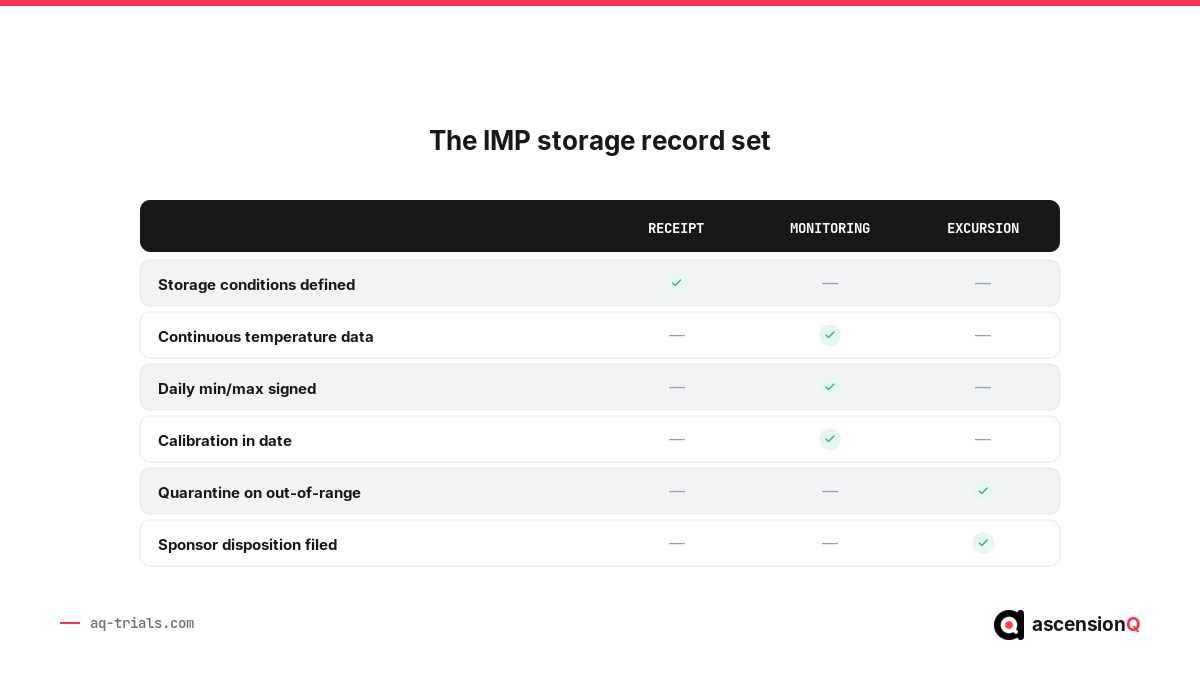
Storage records extend well beyond a temperature chart. They form a connected set that together evidences controlled conditions from delivery to final disposition. Each record answers a specific question an assessor will ask, and each has a named owner at site. The full set lives in the pharmacy site file, which is a separately owned record for good reason, explained in why pharmacy documentation needs its own file.
- Storage condition specification. The approved storage range for each product, taken from the label and the pharmacy manual, recorded before any stock arrives.
- Receipt and storage-on-arrival record. Confirmation that product went into the correct storage location at the correct temperature within the required window of delivery.
- Continuous temperature monitoring data. The calibrated logger or building management feed for every storage location, with the reading interval defined in an SOP.
- Daily manual check log. The min and max readings a pharmacy technician confirms and signs, giving a human review point on top of the automated feed.
- Calibration certificates. Evidence that every monitoring device was calibrated against a traceable standard and remains in date.
- Excursion records. Each out-of-range event, its investigation, sponsor notification, and the disposition decision on the affected stock.
- Access and security records. Who could reach the storage location, how access was restricted, and how any restricted-access product was controlled.
A storage record set is only as strong as its weakest link in that chain.
Why Do Storage Records Fail at Inspection?
Storage records rarely fail because a site ignored temperature. They fail because the evidence was captured reactively, in pieces, held in places that do not reconcile. The monitoring device recorded faithfully, but nobody reviewed the readings until the monitor asked. An excursion happened, an email went to the sponsor, and the disposition decision never made it back into the file. Each gap is small on its own. Together they mean the site cannot prove the product stayed in specification without rebuilding the story from memory.
Example. A research pharmacy stores an investigational biologic at 2 to 8 degrees Celsius. The data logger captures a reading every fifteen minutes. Over a bank holiday weekend the fridge reaches 9.4 degrees for three hours before recovering. The logger records the excursion correctly. No one reviews the download until the following Thursday. Two participants have been dosed from that fridge by then. The site now has a temperature record that proves an excursion, no contemporaneous review that would have caught it, no quarantine, and no sponsor assessment of the affected units. The finding is not the excursion. The finding is that the control designed to catch it was never operated.
This is the central contrast an assessor is testing. Reactive storage records are assembled when someone asks for them. Controlled storage records exist continuously, are reviewed on a defined cadence, and carry their own owner and audit trail. The recurring finding areas that MHRA GCP inspections report most often include pharmacy and investigational product handling, and storage evidence sits at the centre of it.
| Aspect | Reactive storage records | Controlled storage records |
|---|---|---|
| Temperature review | Data downloaded when the monitor asks | Reviewed daily against defined limits, signed |
| Excursion capture | Noticed late, sometimes missed | Alerted in real time, quarantine triggered |
| Disposition decision | Held in an email thread | Recorded in the file against the affected units |
| Ownership | Unclear once staff change | Named role, carried through handover |
| Inspection posture | Reconstructed under pressure | Produced complete, in minutes |
The Investigational Product Storage Compliance Checklist
The checklist below groups controls by the point in the product lifecycle where they apply. Each item states the control and the dated, attributable evidence that proves it. A tick with no evidence behind it is the gap an assessor writes up. Treat the tables as the minimum an MHRA assessor expects to see, aligned with MHRA good clinical practice guidance and the storage principles of ICH-GCP E6(R3).
Before receipt
| Control | Evidence that proves it |
|---|---|
| Approved storage conditions defined per product | Pharmacy manual and label range recorded before stock arrives |
| Storage location assigned and qualified | Location mapped, monitoring device installed and in calibration |
| Monitoring interval and alert limits set | SOP stating reading frequency, warning and action limits |
| Roles assigned for daily checks and review | Delegation entry naming the responsible pharmacy staff |
Storage conditions and monitoring
| Control | Evidence that proves it |
|---|---|
| Product stored within approved range at all times | Continuous logger data for the full storage period |
| Daily min and max confirmed by a named person | Signed daily check log with date and time |
| Monitoring devices calibrated and traceable | In-date calibration certificate against a national standard |
| Backup power or contingency for failure | Recorded contingency plan and any failover events |
Excursions and disposition
| Control | Evidence that proves it |
|---|---|
| Excursions detected and logged promptly | Excursion record with detection date, duration and range |
| Affected stock quarantined pending assessment | Quarantine action recorded against the specific units |
| Sponsor notified and disposition obtained | Sponsor assessment and use or destroy decision in the file |
| Recurrent excursions escalated | Link into a corrective and preventive action record where a pattern emerges |
Access, security and retention
| Control | Evidence that proves it |
|---|---|
| Storage location access restricted | Access list and physical or system controls recorded |
| Restricted-access product controlled appropriately | Controlled-drug register or equivalent where relevant |
| Records retained for the required period | Archiving record showing readable retention to the regulatory limit |
| Records available for the full storage period | Complete, gap-free history from receipt to disposition |
Working through an inspection soon? Our companion guide walks the accountability side of the same record set. Read what auditors actually check.
How Does ALCOA+ Apply to Temperature Data?
Temperature data is a form of clinical trial data, so it carries the same data integrity expectations as any other record. The MHRA applies the ALCOA+ principles set out in its GxP data integrity guidance. Each attribute maps to a concrete control in the storage record. The mapping below shows what each principle demands of a temperature record specifically.
- Attributable. Every daily check and every disposition decision names the person who made it, so responsibility is never ambiguous.
- Legible. Readings and review notes are permanent and readable for the full retention period, which favours a structured system over a fading printout.
- Contemporaneous. Reviews are recorded at the time they happen, which is what turns a logger download into a live control rather than a reconstruction.
- Original. The calibrated logger feed is the primary record, and any transcribed value traces back to it.
- Accurate. Devices are calibrated and in date, so a recorded 5 degrees is a true 5 degrees.
- Complete. The history covers every hour of storage, with no unexplained gaps where a device was offline.
- Consistent. Timestamps run in sequence across the monitoring feed and the manual log, so the two never contradict each other.
- Enduring and Available. Records survive to the retention limit and are retrievable on request, which is exactly what an assessor tests when they ask for a specific date range.
Data integrity for temperature records is a whole-lifecycle expectation rather than a filing step. Sites that govern it through a quality management system hold the SOPs, calibration schedule, and review evidence in one controlled place, which keeps the ALCOA+ attributes intact by design.
Also Read: Drug Accountability Logs: What Auditors Actually Check
What Happens When a Temperature Excursion Occurs?
An excursion is an expected operational event, not an automatic finding. Fridges fail, deliveries sit on a loading bay, power drops. The record that protects the site is the one that shows the excursion was caught, contained, and resolved through a defined sequence. The steps below are the workflow an assessor expects to see evidenced.
- Detect. The monitoring system flags a reading outside the action limit and records the date, time, peak value and duration.
- Quarantine. The affected units are segregated and marked not for use, so no further dosing can draw on questionable stock.
- Notify. The sponsor or its delegate receives the excursion detail and the storage history for assessment.
- Assess. The sponsor determines whether the product remains fit for use against its stability data, and records that decision.
- Resolve. The disposition is applied, the units are released or destroyed, and the whole event is filed against the stock it concerned.
A single excursion handled this way strengthens the file rather than weakening it. A pattern of excursions is a different signal. A fridge that drifts repeatedly turns the event from operational into systemic. That pattern belongs in a corrective and preventive action record, so the cause is fixed rather than the symptom logged again.
How Should a Trials Pharmacy Manage IMP Accountability and Temperature Excursions Electronically?
A trials pharmacy manages both electronically by holding accountability and storage conditions on one record, keeping the temperature feed under daily recorded review, and routing every excursion through detection, quarantine, sponsor assessment and disposition. The sponsor decides whether excursed product stays fit for use. The pharmacy evidences that decision.
Electronic handling changes the evidence rather than the responsibility. Two records have to agree at any moment. The quantity record tracks each unit from receipt to destruction. The condition record shows the storage history behind those same units. An electronic system earns its place when one excursion can be traced to the exact units affected, the participants dosed from them, and the sponsor decision that released or destroyed them.
Who Decides Whether Excursed Product Can Still Be Used?
The sponsor decides. The pharmacy detects the excursion, quarantines the affected units and supplies the storage history. The sponsor assesses that history against the product stability data and records a disposition. A site that releases excursed stock on its own judgement has taken a decision that is not its to take.
- Pharmacy. Detects the excursion, segregates the units, notifies the sponsor and records each step at the time it happens.
- Sponsor or its delegate. Assesses the exposure against stability data and issues the disposition in writing.
- Investigator. Handles participant safety follow-up where product was already dosed from the affected stock.
- Quality function. Opens a corrective and preventive action where the same location excurses repeatedly.
What Must an Electronic Excursion Record Hold?
An excursion record is complete when a reader who was not there can reconstruct the event and its outcome. The fields below are the minimum. Each one answers a question an assessor asks out loud at inspection.
| Field | Why it matters |
|---|---|
| Excursion reference | Gives the event one identity that the stock record, the sponsor correspondence and any CAPA can all point to |
| Storage location and device ID | Ties the reading to a calibrated device, so the data has a traceable origin |
| Peak value and duration | Sets the exposure the sponsor assesses against the product stability data |
| Detection date, time and detector | Shows whether the control operated at the time or only after the event |
| Units affected | Links the event to specific stock, which is what connects storage to accountability |
| Quarantine action and time | Evidences that no further dosing could draw on questionable stock |
| Participants dosed before detection | Turns a storage question into a safety question where it is one |
| Sponsor notification and assessment | Records who was told, when, and what they decided |
| Disposition applied | Closes the event against the units it concerned, released or destroyed |
| CAPA reference where a pattern exists | Shows a recurring cause was addressed rather than logged again |
In AQ Pharmacy, an excursion is raised against the specific units it affected, so the accountability record and the storage history close the same event rather than two separate ones.
An electronic record earns its keep at the moment someone asks which participants received that stock.
Weak Versus Strong Storage Records
The difference between a record that satisfies an assessor and one that invites a finding is rarely the temperature itself. It is the evidence around the reading. Consider the same excursion documented two ways.
Weak. “Fridge 2 high temp over weekend. Checked Thursday, seemed fine, product used.” No peak value, no duration, no named reviewer, no quarantine, no sponsor assessment, and a transcription that cannot be traced to the logger.
Strong. “Fridge 2 recorded 9.4 degrees for 3 hours 15 minutes from 02:10 on 12 July, logger ID TL-114. Detected on review 12 July 09:20 by A. Okafor. Units 0142 to 0148 quarantined 09:35. Sponsor notified 12 July, stability assessment received 15 July, units released for use. Excursion record EX-2026-018.” Every attribute an assessor needs is present, dated, and attributable.
The strong entry took a controlled system operating in real time. The weak entry is what reactive record keeping produces once the moment has passed. This is the same daily-readiness posture that underpins inspection readiness across every part of the trial.
What Are the Risks Without Controlled Storage Records?
- Participant safety exposure. Product dosed after an unreviewed excursion may sit outside its stability data, which is a safety question before it is a documentation one.
- Critical or major findings. Missing temperature history or unmanaged excursions are the kind of pharmacy findings that carry weight at an MHRA inspection.
- Wasted investigational product. A site that cannot prove conditions were maintained often has to destroy stock it could otherwise have used.
- Sponsor confidence lost. A sponsor overseeing multiple sites reads storage record quality as a proxy for how the whole site is run.
- Reconstruction cost. Staff time spent rebuilding a storage history from emails and memory is time taken from active trial delivery.
Frequently Asked Questions
How should a trials pharmacy manage IMP accountability and temperature excursions electronically?
Hold the accountability record and the storage history against the same units, so an excursion can be traced to the stock it affected and the participants dosed from it. Keep the temperature feed under a daily review that is signed at the time. Route each excursion through detection, quarantine, sponsor notification, sponsor assessment and a recorded disposition. The electronic part matters because it keeps those steps attached to each other instead of spread across a logger, a spreadsheet and an email thread.
Is a temperature excursion itself an inspection finding?
No. Excursions are expected operational events and inspectors know it. The finding comes from an excursion that was detected late, never quarantined, or resolved without a recorded sponsor decision. An excursion handled through the full sequence and documented at each step strengthens the file.
Who decides whether excursed investigational product can still be used?
The sponsor, or a delegate named by the sponsor, assesses the exposure against the product stability data and records the disposition. The site detects, quarantines and supplies the storage history. A site should not release excursed stock on its own judgement.
How often should temperature data be reviewed?
Follow the frequency set in your own SOP, which for most research pharmacies is a working-day review of the minimum and maximum readings alongside real-time alerting on the action limits. The review has to be recorded by a named person at the time it happens. A weekly download of logger data is the pattern that lets an excursion run for days before anyone sees it.
What calibration evidence does an inspector expect?
An in-date calibration certificate for every monitoring device, traceable to a national standard, covering the whole period the device produced readings you rely on. An inspector will check the certificate dates against the storage history. A gap between certificates leaves the readings in that window unsupported.
Do storage records belong in the pharmacy site file or the investigator site file?
Storage records belong in the pharmacy site file, which the pharmacy owns and maintains. The investigator site file holds the investigator records. Keeping the two separate reflects who does the work and who answers for it at inspection.
How do storage records differ from the drug accountability log?
The accountability log proves the right quantity moved through the correct receipt-to-destruction chain. Storage records prove the product stayed within its approved conditions for every hour of that chain. A site can reconcile its counts perfectly and still fail on storage. Inspectors read the two together.
How Does AQ Pharmacy Support Investigational Product Storage Records?
The AQ electronic Pharmacy Site File holds the storage record set as a connected, continuously current record rather than a folder assembled before an inspection. It structures each control from the checklist above so the evidence is captured at the point of work and stays attached to the stock it concerns.
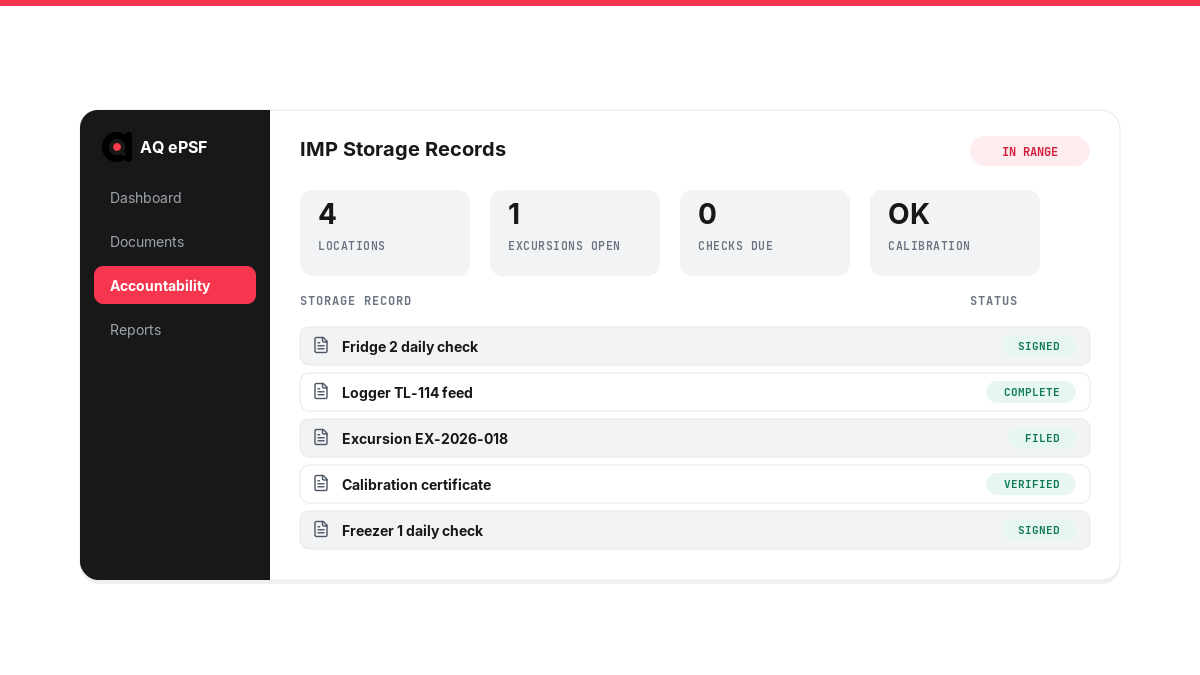
- Structured storage records keep the specification, monitoring data, daily checks and calibration certificates in one place per product, which removes the reconciliation step at inspection.
- Excursion workflow records detection, quarantine, sponsor notification and disposition as a single linked event, which stops a decision from living in an email thread.
- Owner and review tracking assigns each daily check and review to a named role, which keeps responsibility intact when staff change.
- Audit trail on every entry captures who recorded what and when, which preserves the ALCOA+ attributes without extra effort from the pharmacy team.
- Escalation into CAPA connects a recurrent excursion to a corrective and preventive action, so a pattern is addressed at its cause.
AQ Pharmacy does not decide whether excursed product is fit for use. That judgement stays with the sponsor against its stability data. What the system does is make sure the record supporting that judgement is complete, contemporaneous, and available the moment an assessor asks. AQ Pharmacy works alongside the wider pharmacy site file and the connected clinical trial platform so pharmacy evidence sits within the same oversight layer as the rest of the trial.
See how AQ Pharmacy keeps investigational product storage records inspection-ready. Book a 30-minute product tour.
Also Read: ePSF vs eISF: Why Pharmacy Documentation Needs Its Own File