The investigator or institution is accountable for investigational medicinal product (IMP) at a trial site. Every other person who touches the IMP record either acts and records under delegation, or reads the record to verify it. The three groups never swap places, and that separation is what makes the record trustworthy.
This article takes the roles one by one: the trials pharmacist, the pharmacy technician, the assistant technical officer (ATO), the prescriber, the research nurse, the monitor, quality assurance, the sponsor and the inspector. It sits under the complete guide to IMP accountability in clinical trials, which sets out the record all of these roles share.
- One party holds accountability for IMP at a site: the investigator/institution, which ICH E6(R3) treats as a single responsibility.
- Five roles act on IMP and write entries in the record, each for the steps delegated to them.
- Four roles only read the record, and their value depends on never changing it.
- Most role failures happen at the boundary between tiers, where a reader writes or a recorder acts without authority.
Who Holds Accountability for IMP at a Trial Site?
The principal investigator and the institution hold accountability for IMP at a trial site, as the single responsibility that ICH E6(R3) writes as “investigator/institution”. Section 2.10.1 states that responsibility for IMP management, “including accountability, handling, dispensing, administration and return, rests with the investigator/institution”. Section 2.3.1 adds that the investigator “retains the ultimate responsibility” for any activity delegated to others.
The two holders carry different parts of that responsibility, and the sponsor’s support sits beside them.
- The principal investigator leads the trial team at the site and authorises who may act, which is why the delegation log carries the investigator’s signature.
- The institution is the NHS trust or research unit in whose remit the trial runs, and it provides the pharmacy, the staff and the facilities that section 2.2.2 expects to be adequate.
- The sponsor may facilitate IMP management under section 2.10.1, for example by supplying forms or computerised systems, and that support leaves the site’s responsibility where it was.
Delegation moves the task and leaves the accountability in place. The three tiers below apply to every study.
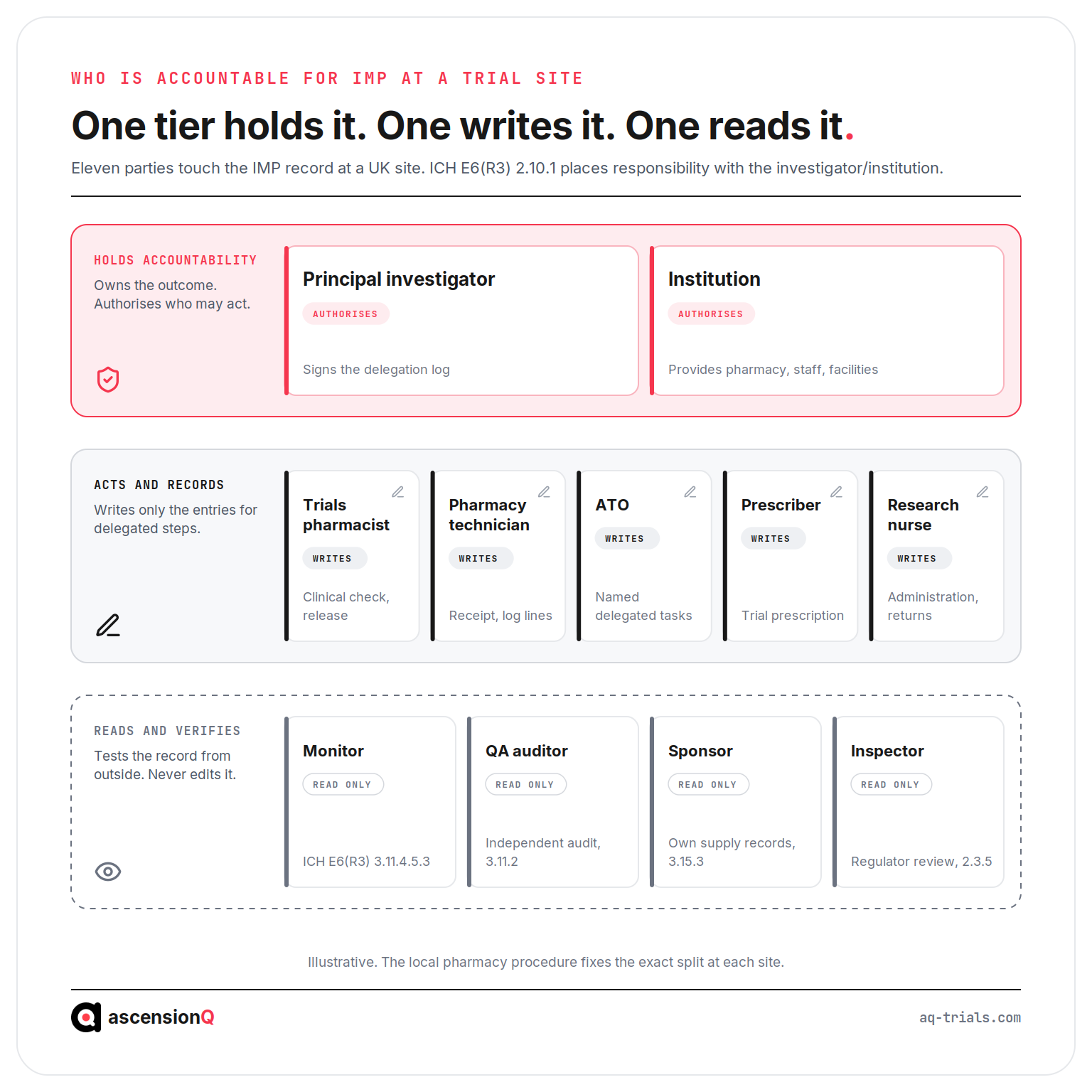
Accountability stays with one party. The record is written by many.
Which Roles Act on IMP and Write the Record?
Five roles act on IMP and write entries in the record. Each writes only the entries for the steps delegated to that person. Section 2.10.4 names “a pharmacist or other appropriate individual” as a person who may keep the IMP records on the investigator’s behalf.
| Role | What the role does with IMP | The entry the role signs | Registered with |
|---|---|---|---|
| Trials pharmacist | Maintains the study’s IMP record, clinically checks each trial prescription and decides when received stock is released for use | Clinical check, release decision and final check of dispensing | General Pharmaceutical Council (GPhC) |
| Pharmacy technician | Receives deliveries, keeps the running balance, assembles and labels kits and prepares returns | Receipt entries, accountability log lines and assembly records | GPhC |
| Assistant technical officer (ATO) | Handles stock, counts and assembly tasks under the supervision the local procedure sets | Only the entries for tasks delegated to them by name | Not on the GPhC register |
| Prescriber | Decides the participant should receive the IMP at the protocol dose | The trial prescription | Their own professional regulator |
| Research nurse | Hands over or administers the kit, explains correct use and collects returns at the visit | Administration entry and the handover of returns | Nursing and Midwifery Council |
The GPhC maintains registers of pharmacists and pharmacy technicians in Great Britain. An ATO works in an NHS pharmacy support role outside those registers, so the local procedure fixes what an ATO may do and who supervises it. The research nurse’s duty to explain correct use comes from section 2.10.7. The prescriber’s role follows section 2.7.1, which places trial-related medical decisions with a qualified physician, or another qualified healthcare professional where local rules allow, who is an investigator or sub-investigator.
A trials pharmacist answers to the GPhC for their own professional practice. That professional accountability sits alongside the GCP responsibility for IMP, which stays with the investigator or institution.
The pharmacy site file shows the same split from the file’s side, section by section. Every person in this tier needs a current entry on the study delegation log before the first entry they sign.
Also Read: What is DOA: Delegation of Authority in Clinical Research
Which Roles Only Read the IMP Record?
Four roles only read the IMP record: the monitor, quality assurance, the sponsor and the inspector. Each tests the record from outside. None of them writes an entry in the site’s accountability log.
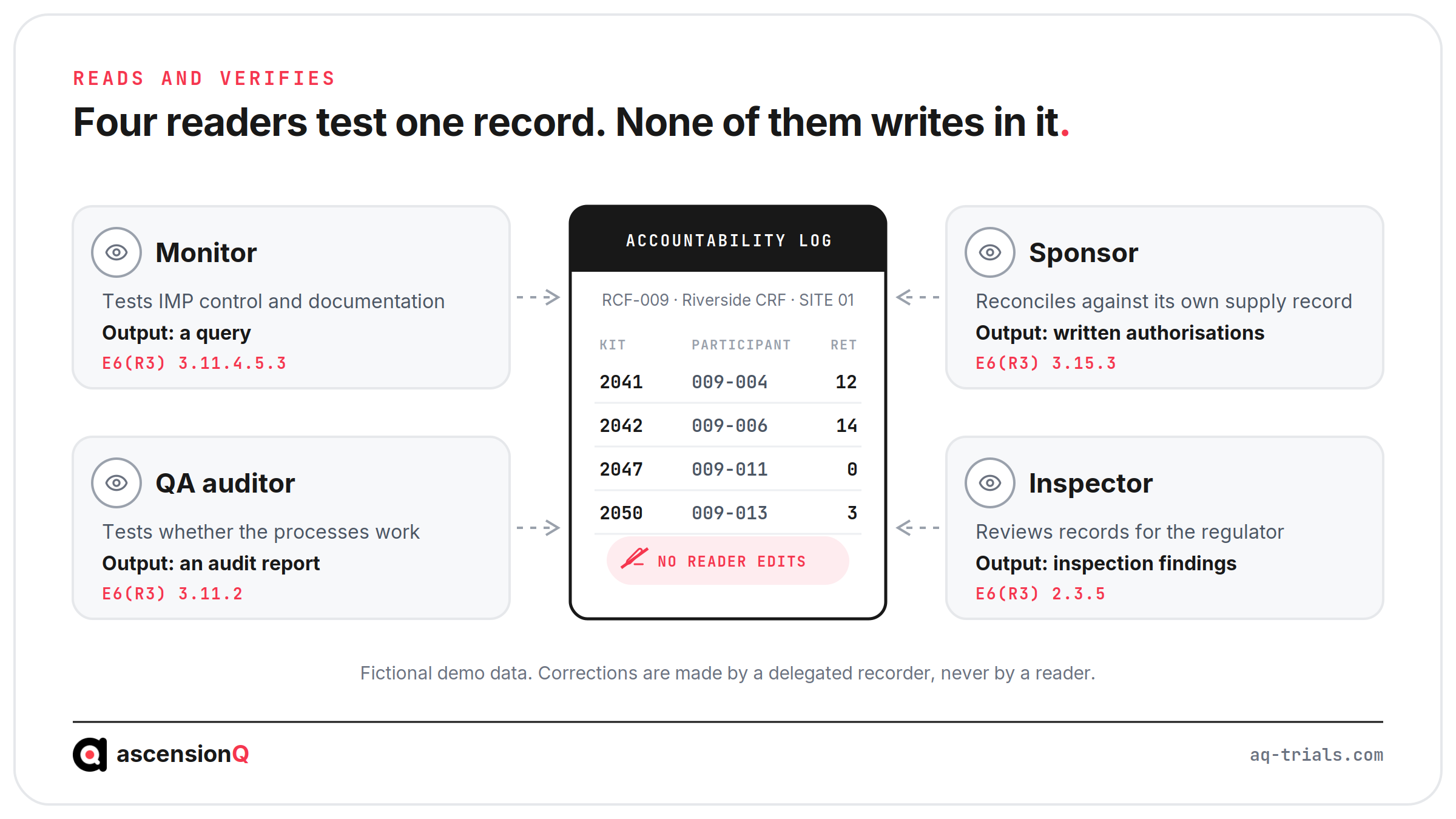
- The monitor confirms that receipt, storage, use, return and disposition are “controlled and documented adequately” under section 3.11.4.5.3, and section 3.11.4 expects monitoring by “persons not involved in the clinical conduct of the trial at the site being monitored”.
- Quality assurance audits whether the processes behind the record work, and section 3.11.2.1 expects auditors who are “independent of the clinical trial/processes being audited”.
- The sponsor keeps its own records of shipment, receipt, return and destruction under section 3.15.3, and it authorises return or destruction in writing for the site to file.
- The inspector reviews documents, facilities and records on behalf of the regulator, and section 2.3.5 expects the investigator and institution to permit that inspection.
The sponsor sits in the reading tier for the site ledger and in the writing tier for its own supply records. The sponsor’s allocation system and the site ledger are separate records that reconcile against each other, as the twelve steps from depot to patient show. In the UK, MHRA GCP inspections can include investigator sites alongside the organisation under inspection. The findings inspectors raise across all areas are covered in the guide to common MHRA GCP inspection findings.
Where Do Role Boundaries Break?
Role boundaries break when a person acts in a tier that is not theirs. The count can still be right when this happens. The record fails on attribution instead.
- A reader writes. A monitor corrects a returns count in the log, and the entry now carries the name of someone independent of the trial conduct it records.
- A recorder acts without authority. A receipt is signed by a member of pharmacy staff who is missing from the delegation log for that study.
- A holder steps back. The investigator treats IMP as a pharmacy matter, and nothing on file shows the oversight that section 2.10.2 expects.
- A system stands in for a role. The site relies on the sponsor’s allocation record in place of its own ledger, and the site then holds no record of its own to reconcile.
A hypothetical example shows how quietly the first two happen. At a monitoring visit for study RCF-009 at Riverside CRF (SITE 01), the monitor finds that participant 009-006 returned 14 tablets and the log shows 12. She amends the log line herself to save time. The same visit shows a delivery receipt signed by an ATO who joined the pharmacy team after the delegation log was last updated.
Both entries now hold the right numbers. Two lines in the record are signed by people with no authority to sign them.
A reader who writes is no longer independent.
The fix restores each person to their tier.
- The monitor raises a query in place of a correction, which leaves the amendment to a delegated recorder and keeps the monitor’s review independent.
- A delegated pharmacy technician corrects the line with the original entry readable, a reason and a date, which keeps the change attributable.
- The investigator reviews the ATO’s receipt and records a file note, which documents the gap and the decision taken on it.
- The delegation log is updated before the ATO signs again, which closes the gap for every later entry.
Also Read: Drug Accountability Logs: What Auditors Actually Check
Frequently Asked Questions
Who is accountable for IMP at a trial site?
The principal investigator and the institution, as the single responsibility ICH E6(R3) writes as “investigator/institution”.
Which roles write entries in the IMP record?
Five roles act on IMP and write entries, and each writes only the entries for the steps delegated to that person.
Which roles only read the IMP record?
Four: the monitor, quality assurance, the sponsor and the inspector. Each tests the record from outside and never changes it.
Accountability works when every name in the record belongs to the tier it acts in. AQ’s electronic pharmacy site file page sets out how AQ approaches pharmacy records as part of one connected site file. Book a live demo to talk through how pharmacy roles and responsibilities connect to the rest of your study evidence.