A trial medicine takes twelve steps from the sponsor’s depot to the patient and on to its final disposition, and each step is a handover that leaves its own record. Together those records form the IMP chain of custody: the documented sequence showing who held each unit of investigational medicinal product (IMP), in what condition, and what they did with it.
The chain is the spine of the accountable record a UK site pharmacy keeps, set out in the complete guide to IMP accountability in clinical trials. This article walks the twelve steps in order, names the record each one leaves, and shows where those records end up.
- Three of the twelve steps happen before the site holds any stock.
- Five parties act along the chain: the sponsor, the courier, the site pharmacy, the clinical team and the participant.
- Every record in the chain carries the same kit number, which is what lets a monitor follow one unit from step to step.
- The twelve records end up with four different holders, so the chain is proven by comparing them.
What Is the IMP Chain of Custody?
The IMP chain of custody is the continuous series of records that traces a unit of IMP from its release by the manufacturer to its use, return and destruction. ICH E6(R3) describes the same scope in Appendix C. Section C.3.1(w) counts as essential any record that provides “traceability and accountability information about the investigational product from release from the manufacturer to dispensation, administration to trial participants, return and destruction or alternative disposition”.
Section 2.10.4 of E6(R3) then sets what the site’s part of the chain must contain. Each entry carries three kinds of detail.
- Dates and quantities fix when each movement happened and how many units moved.
- Batch or serial numbers and expiry dates tie each unit to its manufacture and its shelf life.
- The unique code numbers of product and participant link each kit to one person without revealing the treatment inside it.
The unit being traced is usually a kit, the numbered pack described in the guide to what an investigational medicinal product is under UK law. The kit number is the thread that runs through all twelve records.
Custody is proven one handover at a time.
What Are the Twelve Steps from Depot to Patient?
The twelve steps run from certification at the manufacturer to final disposition at the end of the study. The figure shows which party acts at each step and the record that step leaves behind.
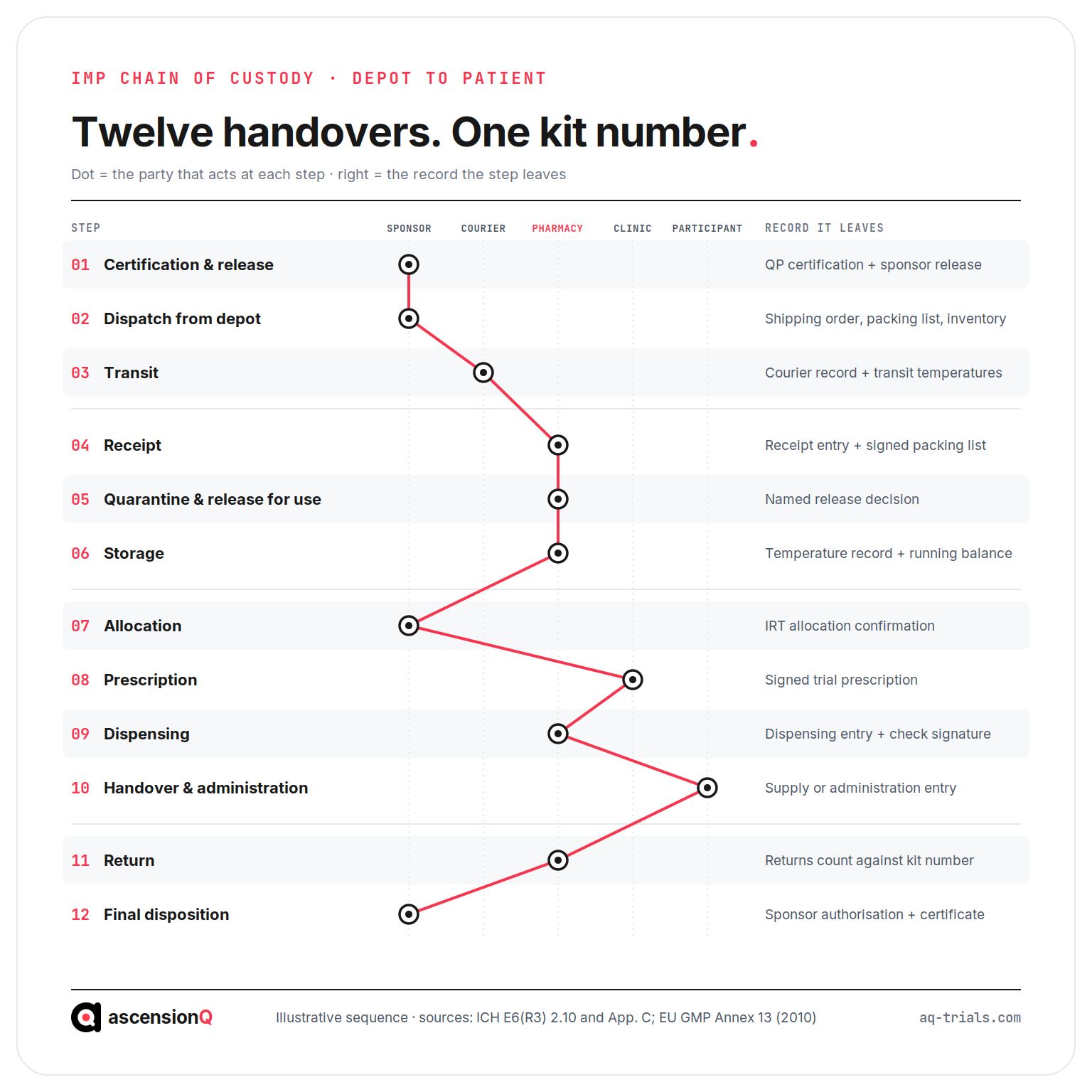
The sponsor acts at the start, at allocation and at the end. The pharmacy therefore keeps a chain that begins and ends outside its own walls.
How Does IMP Leave the Depot?
IMP leaves the depot after two release decisions and a shipping order from the sponsor. The sponsor keeps control of the stock until both decisions are recorded.
- Step 1. Certification and release. A Qualified Person (QP) certifies the batch, and the sponsor then releases it for use in the trial. The January 2010 version of Annex 13 to the EU GMP guide calls this a “two-step procedure” and requires both steps to be recorded in the sponsor’s trial files (paragraph 43). ICH E6(R3) section 3.15.3(a) adds that product should be supplied after the required ethics and regulatory approvals. The record is the QP certification and the sponsor’s release.
- Step 2. Dispatch. The depot ships according to the sponsor’s shipping order and keeps “a detailed inventory of the shipments” that names each addressee (paragraphs 44 and 46). A trial with an interactive response technology (IRT) can generate the resupply request from that system. The record is the shipping order, the packing list with its kit numbers and the depot’s shipment inventory.
- Step 3. Transit. A courier carries the shipment under the conditions the sponsor sets, usually with a temperature logger in the box. E6(R3) Appendix C lists “documentation of investigational product storage conditions, including during shipment” among the essential records. The record is the courier documentation and the transit temperature record.
The UK position on these three steps comes from the MHRA Inspectorate. Its February 2022 statement on new standards for investigational medicines said the UK would continue to apply the 2010 Annex 13 to the two-step release procedure and to the handling and shipping of IMPs, pending the UK’s future clinical trial legislation.
What Happens When IMP Reaches the Site?
IMP that reaches the site passes through three pharmacy steps before any participant can receive it.
- Step 4. Receipt. Pharmacy checks the delivery against the packing list, counts the kits, captures batch, expiry and kit numbers, and confirms receipt in the sponsor’s system. The record is the receipt entry in the accountability log and the signed packing list.
- Step 5. Quarantine and release for use. Stock is held apart until a named person confirms the delivery arrived complete, intact and within its transit conditions. The record is the release decision, with the name, the date and the basis for it.
- Step 6. Storage. Stock sits under the conditions the sponsor specifies, as E6(R3) section 2.10.5 requires. The record is the storage temperature record and the running balance in the log.
Storage carries the heaviest record set of any step. That record set and the excursion workflow are covered in the investigational product storage records checklist.
How Does a Kit Reach the Participant?
A kit reaches the participant through four steps that pass from the sponsor’s system to the clinic, then to the pharmacy and finally to the participant.
- Step 7. Allocation. Site staff register the participant’s visit in the IRT, and the IRT returns the kit number to dispense. The record is the allocation confirmation for that participant and visit.
- Step 8. Prescription. A prescriber authorised on the study delegation log writes a trial prescription. The record is the signed trial prescription.
- Step 9. Dispensing. Pharmacy dispenses the allocated kit, completes the participant details on the label and records the kit against the participant. A second person usually checks the dispensing before the kit is released. The record is the dispensing entry, the participant-level accountability line and the check signature.
- Step 10. Handover and administration. The kit passes to the research team or to the participant, and staff explain its correct use as E6(R3) section 2.10.7 requires. The record is the supply or administration entry in the participant’s notes, which section 2.10.4 expects to show that participants “were provided the doses specified by the protocol”.
A hypothetical visit shows how fast these four records accumulate. Participant 017-004 attends visit 3 of study NGH-017 at Northgate General (SITE 01). The IRT allocates kit 1023 at 09:50. The prescriber signs the trial prescription at 10:05. Pharmacy dispenses kit 1023 after a second check at 11:20, and the research nurse hands it over with dosing instructions at 11:40.
Four people wrote four records in under two hours. Each record names kit 1023, and that shared number is what lets a monitor move from one record to the next.
How Does the Chain Close?
The chain closes when every dispensed unit has come back or been used, and every remaining unit has gone back to the sponsor or been destroyed on its authority. Two steps do that work.
- Step 11. Return. The participant brings back unused medicine and packaging, and staff count it and hold it apart from usable stock. The record is the returns count against the kit number.
- Step 12. Final disposition. The sponsor authorises return or destruction in writing, and pharmacy then ships the stock back or destroys it. ICH E6(R3) section 3.15.3(b) expects sponsor procedures to cover the “return of unused investigational product(s) to the sponsor”, or another disposition the sponsor authorises. The record is the sponsor’s authorisation, plus the return shipment record or the destruction certificate.
The monitor confirms the closed chain at site close-out. E6(R3) section 3.11.4.5.2 includes confirming “the final accountability of the investigational product” during that visit.
Also Read: Drug Accountability Logs: What Auditors Actually Check
Where Do the Twelve Records End Up?
The twelve records end up with four holders: the sponsor’s trial files, the sponsor’s IRT, the pharmacy site file and the participant’s record. A monitor tracing kit 1023 needs all four.
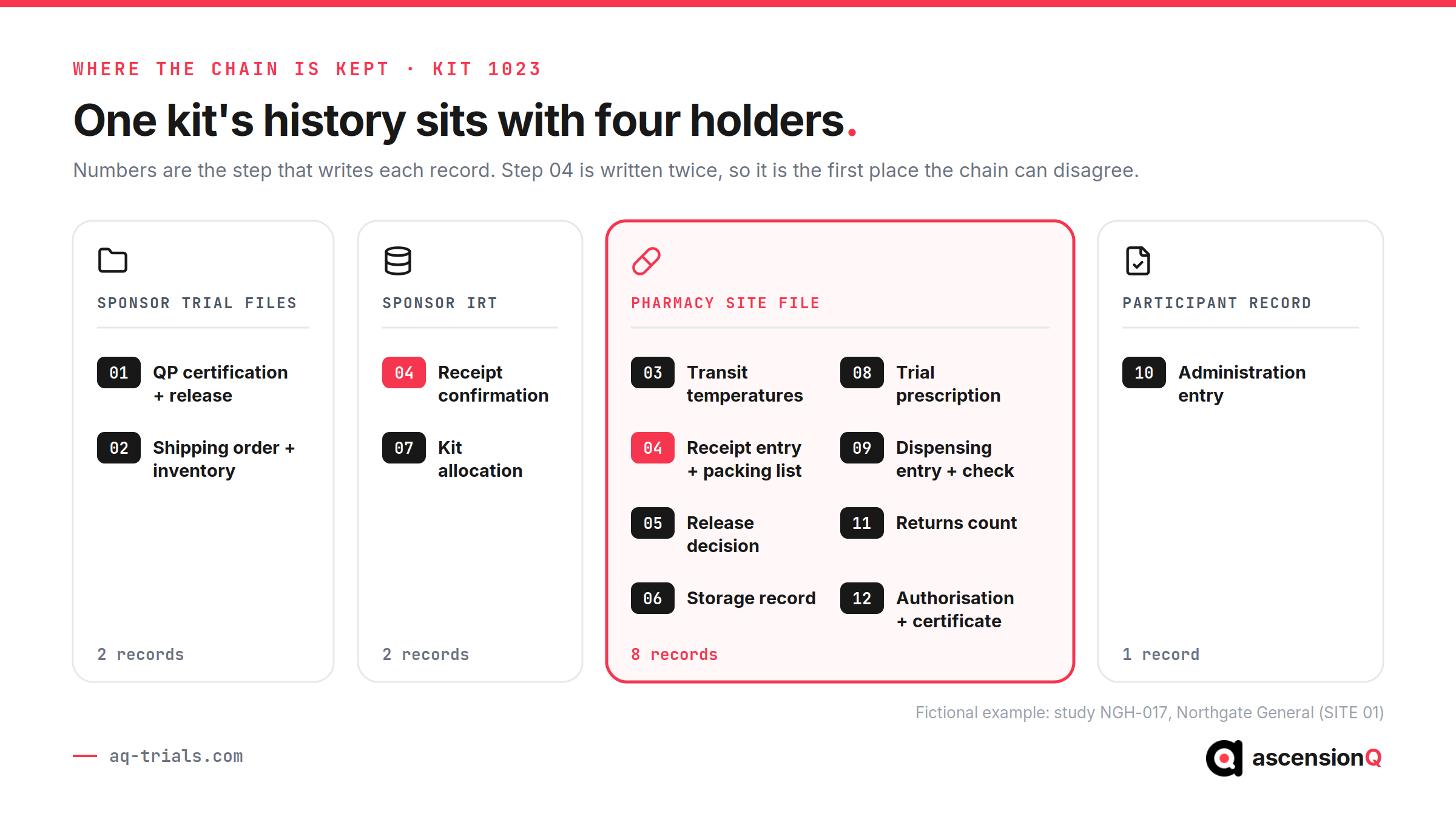
- The sponsor’s files hold the release and dispatch records, which the site sees as copies or confirmations.
- The IRT holds the receipt confirmation and the allocation, which is why the site ledger reconciles against it.
- The pharmacy site file holds most of the chain, in a file kept apart from the investigator site file for the reasons set out in why pharmacy documentation needs its own file.
- The participant’s record holds the administration entry, which is the record that shows the dose reached the person it was dispensed for.
Reconciliation is the test that the four holders agree. A record that sits with one holder and is missing from another is a break in the chain, even when the stock on the shelf is right.
How Do Other Supply Routes Change the Chain?
Other supply routes change the chain by adding handovers, and every added handover adds a record. ICH E6(R3) section 2.10.8 allows IMP to be shipped to the participant’s location or supplied at a location closer to them, such as a local pharmacy. Annex 13 paragraph 47 covers the rarer case of stock moving between trial sites.
| Route | What changes in the chain | The extra record |
|---|---|---|
| Direct to the participant’s home | A courier delivery replaces the handover at step 10 | Proof of delivery and the conditions in transit to the home |
| Local pharmacy or healthcare centre | A second dispensing location joins the chain | That location’s own receipt and dispensing records |
| Transfer between trial sites | Stock leaves one site’s custody for another’s | The storage history at the sending site, reviewed with the advice of the QP, and relabelling and recertification where needed |
Annex 13 states that transfers between sites “should remain the exception” and should be covered by standard operating procedures. The wider rules on delivering trial activity away from the site are covered in the guide to decentralised clinical trials.
Frequently Asked Questions
What is the IMP chain of custody?
The continuous series of records that traces a unit of IMP from its release by the manufacturer to its use, return and destruction.
How many steps does a trial medicine take from depot to patient?
Twelve, from certification at the manufacturer to final disposition at the end of the study. Each step is a handover that leaves its own record.
Where do the chain of custody records end up?
With four holders: the sponsor’s trial files, the sponsor’s IRT, the pharmacy site file and the participant’s record. A monitor tracing one kit needs all four.
A chain of twelve handovers holds only while each record is written at the step it describes. AQ’s electronic pharmacy site file page sets out how AQ approaches pharmacy records as part of one connected site file. Book a live demo to talk through how your pharmacy records connect to the rest of your study evidence.