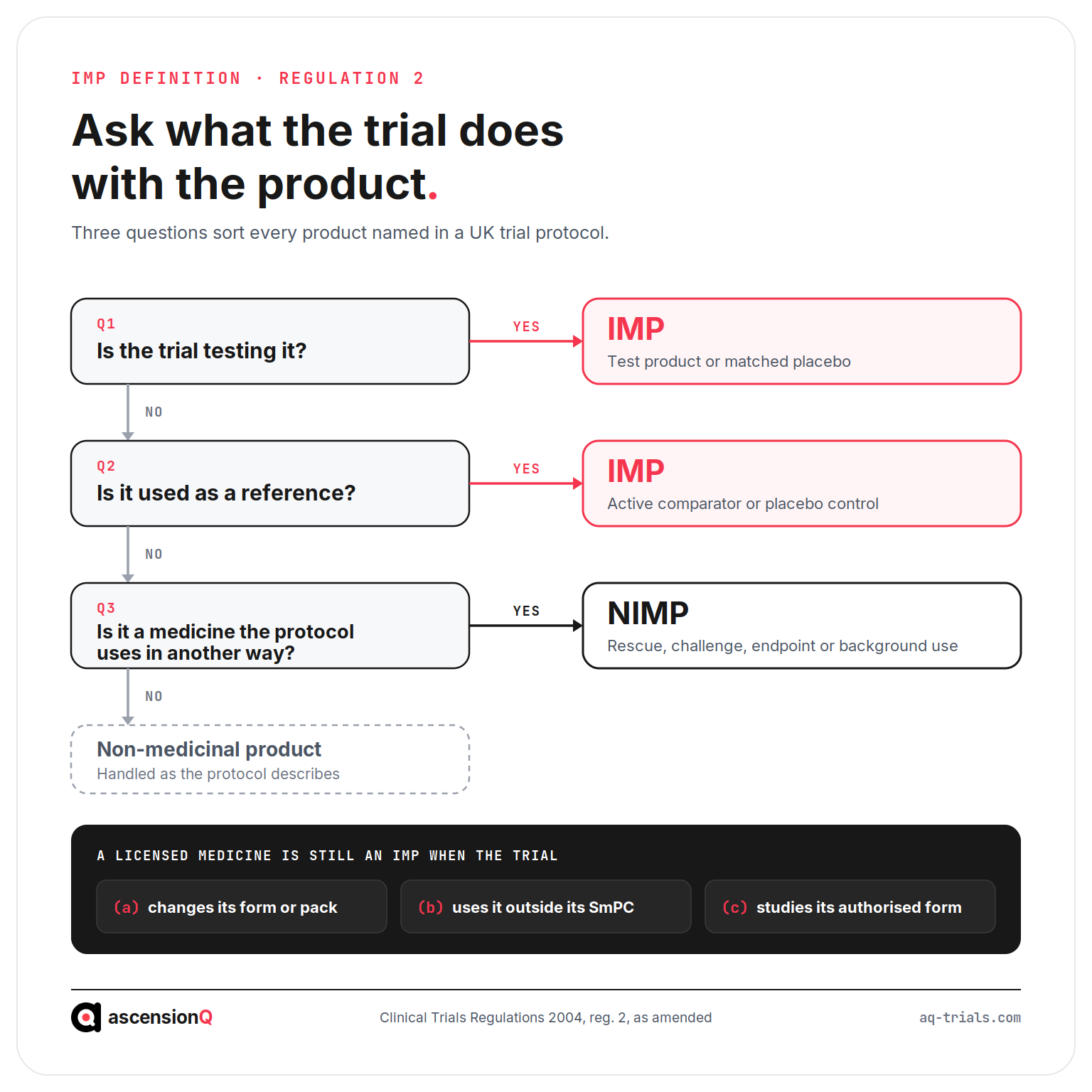
An investigational medicinal product is a medicine or placebo, in a pharmaceutical form, that a clinical trial is testing or using as a reference. UK law sets that definition in regulation 2 of the Medicines for Human Use (Clinical Trials) Regulations 2004. A licensed medicine is also an investigational medicinal product (IMP) when a trial uses it outside its authorised form, indication or purpose.
The definition decides which units enter the accountable record a site pharmacy keeps for every trial. That record, from release to destruction, is covered in the complete guide to IMP accountability in clinical trials. This article covers the UK definition, the difference between an IMP, a non-investigational medicinal product (NIMP) and an auxiliary medicinal product, the point at which a licensed drug becomes an IMP, and what a kit is and who numbers it.
- A product’s role in the protocol decides its class, so the same medicine can be an IMP in one trial and a NIMP in the next.
- Placebo and any comparator used as a reference are IMPs in their own right.
- UK law has defined the NIMP in regulation 2 since 28 April 2026, and the EU term auxiliary medicinal product uses near-identical wording.
- A kit is the numbered pack a site receives and dispenses, and its number is assigned on the sponsor’s side before the stock is released.
How Does UK Law Define an Investigational Medicinal Product?
UK law defines an investigational medicinal product in regulation 2 of the Clinical Trials Regulations 2004, as amended with effect from 28 April 2026. The core wording reads: “a pharmaceutical form of an active substance or placebo being tested, or to be tested, or used, or to be used, as a reference in a clinical trial”. The IMP accountability guide starts from this definition, because it fixes the scope of everything the pharmacy must account for.
Each phrase in the definition brings a different product into scope. The table breaks the wording into its working parts.
| Phrase in regulation 2 | What it brings into scope |
|---|---|
| “a pharmaceutical form” | The product in the form given to the participant, such as a tablet, capsule, injection or infusion |
| “of an active substance or placebo” | Placebo counts in its own right, so a matched dummy tablet is an IMP |
| “being tested, or to be tested” | The product whose effect the trial is designed to measure |
| “used, or to be used, as a reference” | The comparator, including a marketed medicine bought in and used as the active control |
| “in a clinical trial” | A study that meets the regulation 2 definition of a clinical trial, which limits IMP status to trial use |
ICH E6(R3) gives the same scope in its glossary. It also states that the term “investigational products” is synonymous with drugs, medicines, medicinal products, vaccines and biological products. A UK site can therefore read the ICH term and the UK statutory term as one category.
The trial decides what the product is.
When Does a Licensed Medicine Become an IMP?
A licensed medicine becomes an IMP whenever a trial tests it or uses it as a reference. Regulation 2 then names three further cases for a product that holds a marketing authorisation. The product is an IMP where, for the purposes of the trial, it is:
- (a) used or assembled differently from its authorised form. The regulation includes formulation and packaging, so an over-encapsulated tablet made to look like its placebo is an IMP.
- (b) used for an indication outside its summary of product characteristics (SmPC). A heart failure medicine tested in a kidney disease population is an IMP for that trial.
- (c) used to gain further information about its authorised form. A trial comparing two licensed medicines at their licensed doses falls here, because the trial is still studying them.
The third case covers most pragmatic trials of licensed medicines. A hypothetical example shows the effect at site. Study NGH-021 at Northgate General (SITE 01) compares two licensed blood pressure medicines at licensed doses. The pharmacy already stocks both on its routine formulary. Both are IMPs for this study, so every unit dispensed to a trial participant carries a trial identity that ward stock of the same medicine does not carry.
Authorisation still changes some of the work that follows. ICH E6(R3) section 2.10.4 allows “alternative approaches” to the standard accountability records for authorised medicinal products, in line with local regulatory requirements. MHRA labelling guidance also lets a product with a UK marketing authorisation carry a standard dispensing label with trial identifiers added where possible. Those are decisions about records and labels. The classification stays IMP.
What Is the Difference Between an IMP, a NIMP and an Auxiliary Medicinal Product?
An IMP is the product a trial tests or uses as a reference, while a NIMP and an auxiliary medicinal product are medicines the protocol uses for another purpose. UK law now defines a non-investigational medicinal product in regulation 2 as “a medicinal product used or to be used in a clinical trial, as described in the protocol, but not as an investigational medicinal product”. The definition arrived with the amendment regulations that took full effect on 28 April 2026, summarised in the guide to the new UK clinical trials regulations.
Auxiliary medicinal product (AxMP) is the EU term for the same idea. Article 2(2)(8) of Regulation (EU) No 536/2014 defines it as “a medicinal product used for the needs of a clinical trial as described in the protocol, but not as an investigational medicinal product”. UK sites meet the EU term in the protocols of multinational trials.
| Term | Where it is defined | Role in the trial | Typical examples |
|---|---|---|---|
| Investigational medicinal product (IMP) | UK regulation 2; ICH E6(R3) glossary | Tested, or used as a reference | Test medicine, matched placebo, active comparator |
| Non-investigational medicinal product (NIMP) | UK regulation 2, since 28 April 2026 | Used as the protocol describes, other than as an IMP | Rescue medicine, challenge agent, endpoint assessment product, background treatment |
| Auxiliary medicinal product (AxMP) | Regulation (EU) No 536/2014, Article 2(2)(8) | Used for the needs of the trial, other than as an IMP | The same four categories in EU guidance |
| Non-medicinal product | MHRA NIMP guidance | Used in the same way as a NIMP, outside the definition of a medicinal product | Named case by case in the protocol |
MHRA guidance on non-investigational medicinal products lists four common NIMP categories. They are rescue or escape medication, challenge agents such as skin prick test allergens, products used to assess an endpoint such as a PET radiopharmaceutical, and background treatment given to every participant regardless of randomisation.
One medicine can hold different classes in different trials. An anti-emetic is an IMP in a trial that tests it. The same anti-emetic is a NIMP in a chemotherapy trial that names it as rescue medication. The sponsor fixes each product’s class in the protocol, and the record the site keeps then follows that class.
What Is a Kit, and Who Numbers It?
A kit is the labelled pack of IMP that a site receives, stores and dispenses as one unit, identified by a unique number. The number links the pack to the sponsor’s randomisation and supply system without showing what the pack contains. A kit can hold one bottle, a blister card, a set of vials or a whole treatment period, depending on the protocol.
MHRA IMP labelling guidance names this number directly. The label must carry “the batch or code number”, and for a product in its final container this can be “a code or kit number” that “allows for identification of ‘blinded’ products within that kit”. The same guidance asks for information that identifies the trial and information that links the product to the participant.
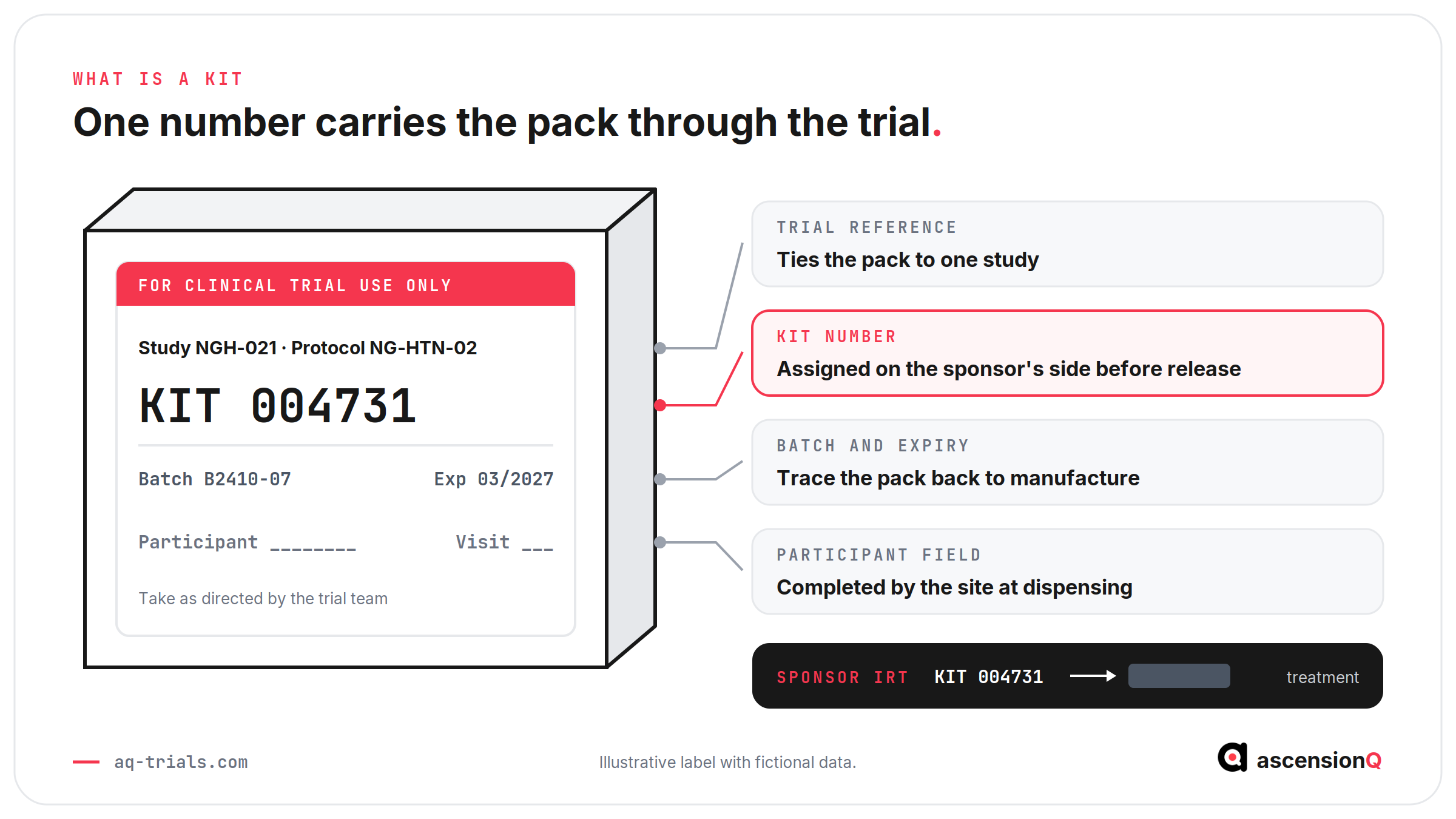
Kit numbers are assigned on the sponsor’s side before stock reaches the site. ICH E6(R3) section 3.15.2(a) makes the sponsor responsible for ensuring the product is “coded and labelled in a manner that protects the blinding”. The sponsor, or a packaging contractor working to the sponsor’s specification, applies the numbers during packaging. The sponsor’s interactive response technology (IRT) then holds the link between each kit number and the treatment inside it.
The kit number does four jobs at site.
- Identity. The number separates the pack’s identity from its contents, which lets blinded staff record every movement of the pack.
- Allocation. The IRT returns a kit number for each participant and visit, which tells pharmacy exactly which pack to dispense.
- Accountability. ICH E6(R3) section 2.10.4 requires records to include “the unique code numbers assigned to the investigational product(s) and trial participants”, which makes the kit number the key of every log line.
- Traceability. The batch number printed beside it links each kit to a manufacturing batch, which lets a recall reach the exact packs affected.
One exception puts labelling in pharmacy hands. Regulation 37 allows a doctor, a pharmacist or a person supervised by a pharmacist to assemble an IMP in a hospital or health centre without a manufacturing authorisation. The product must then be used only in that hospital or health centre, or at another that is a trial site for the same trial. A pharmacy assembling under this exemption produces the label itself, so the label content becomes part of its own set-up work.
Where Do Sites Misread the Definition?
Sites misread the definition when they classify a product by what it is on the shelf. The test that counts is the role the protocol gives it. Four misreadings recur.
- “Licensed means routine.” A licensed comparator is issued from ward stock with no trial identity, so its units never enter the accountability record.
- “Placebo is inert, so it is exempt.” Placebo is named in the definition, so every placebo kit carries a full accountability line.
- “Every protocol medicine is an IMP.” A rescue medicine is logged as an IMP, which creates records the protocol never asked for.
- “The batch number is enough.” One batch can fill hundreds of kits, so a log that records only the batch has no unit-level line.
Each misreading starts at study set-up. The pharmacy prevents it by confirming each product’s class against the protocol and the pharmacy manual before the first delivery. Stored stock then carries its own record set, covered in the investigational product storage records checklist.
Also Read: Drug Accountability Logs: What Auditors Actually Check
Frequently Asked Questions
What is an investigational medicinal product?
A medicine or placebo, in a pharmaceutical form, that a clinical trial is testing or using as a reference. UK law sets that definition in regulation 2 of the Clinical Trials Regulations 2004.
When does a licensed medicine become an IMP?
Whenever a trial tests it or uses it as a reference. A marketing authorisation does not change that classification.
What is a kit in a clinical trial?
The labelled pack of IMP that a site receives, stores and dispenses as one unit, identified by a unique number. The number links the pack to the sponsor’s randomisation and supply system without showing what the pack contains.
Every product the protocol classes as an IMP needs a record that follows it from receipt to destruction. AQ’s electronic pharmacy site file page sets out how AQ approaches pharmacy records as part of one connected site file. Book a live demo to talk through how your pharmacy records connect to the rest of your study evidence.