There is no doubt that CROs require a digital Delegation of Authority system, not a paper-based log or spreadsheet. Because CRO operations span multiple sites, multiple investigators, and continuous study activity, delegation must stay aligned with who performs each task, who approves it, and when it is valid.
Well, it can be even more effective if the digital DOA operates as a centralised system across all sites and studies. Yes, a centralised digital DOA ensures that role assignment, PI approval, training validation, and task execution stay connected within one environment across CTMS, eTMF, eISF, and QMS. Each activity aligns with an authorised individual, defined responsibility, and valid timeframe.
Lets discuss in detail how a centralised digital DOA system strengthens delegation control, improves CRO oversight, and maintains compliance across multi-site clinical trial operations.
Multi-Site Trial Complexity Requires Centralised Delegation Control
CRO-led clinical trials run across multiple sites, investigators, and study teams within a single protocol. Each site maintains its own Delegation of Authority log, staff structure, and update cycle. This creates separation between site-level delegation records and CRO-level oversight. As study activity moves across sites, delegation must stay aligned with the Principal Investigator (PI), Sub-Investigators, Study Coordinators (CRC), Clinical Research Associates (CRA), and Data Management teams.
Unfortunately, a document-based or site-managed DOA approach breaks this alignment. Role assignment, PI approval, training validation, and task execution remain disconnected across systems such as CTMS, eTMF, eISF, and QMS. This creates gaps in investigator oversight, responsibility tracking, and audit traceability under ICH GCP and 21 CFR Part 11 expectations.
Notably, a centralised digital DOA system establishes a single, system-controlled environment where delegation connects directly with study execution across all sites. It ensures that every task performed in the clinical trial traces back to an authorised individual, with verified training, defined role scope, and valid approval timing.
A centralised digital DOA platform gives CRO teams:
- Centralised delegation control across all sites, studies, and investigators
- Alignment between PI oversight and site-level task execution
- Real-time updates across staff onboarding, role changes, and protocol amendments
- Direct linkage between DOA, CTMS workflows, eTMF documentation, and QMS processes
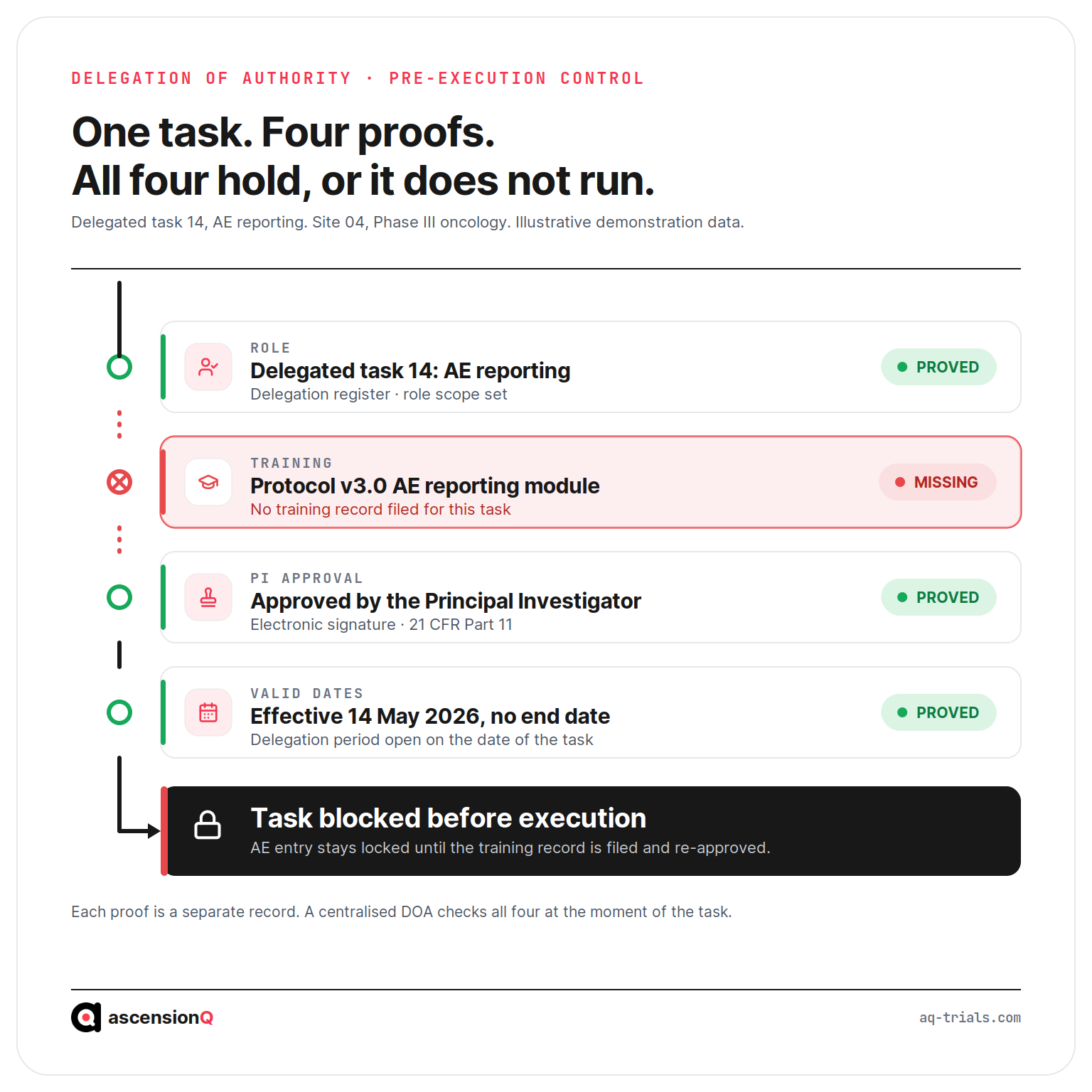
- Verification of training, qualification, and role eligibility before task execution
- Elimination of fragmented DOA logs across spreadsheets, paper records, and local systems
- Consistent role and responsibility structure across sponsors and protocols
- CRO-level visibility across Study Coordinators, CRAs, Data Managers, and site staff
- Time-bound delegation with clear start dates, end dates, and role validity
- Complete audit trail aligned with ALCOA+ principles for data integrity
- Continuous inspection readiness across multi-site clinical trial operations
Ultimately, this shifts Delegation of Authority from site-level documentation to a centralised system-driven control structure, which allows CROs to manage responsibility, oversight, and compliance across the full clinical trial lifecycle through one unified environment.
Read More in Detail: What is DOA: Delegation of Authority in Clinical Research
Fragmented Paper-Based Delegation VS Centralised Digital DOA Platform
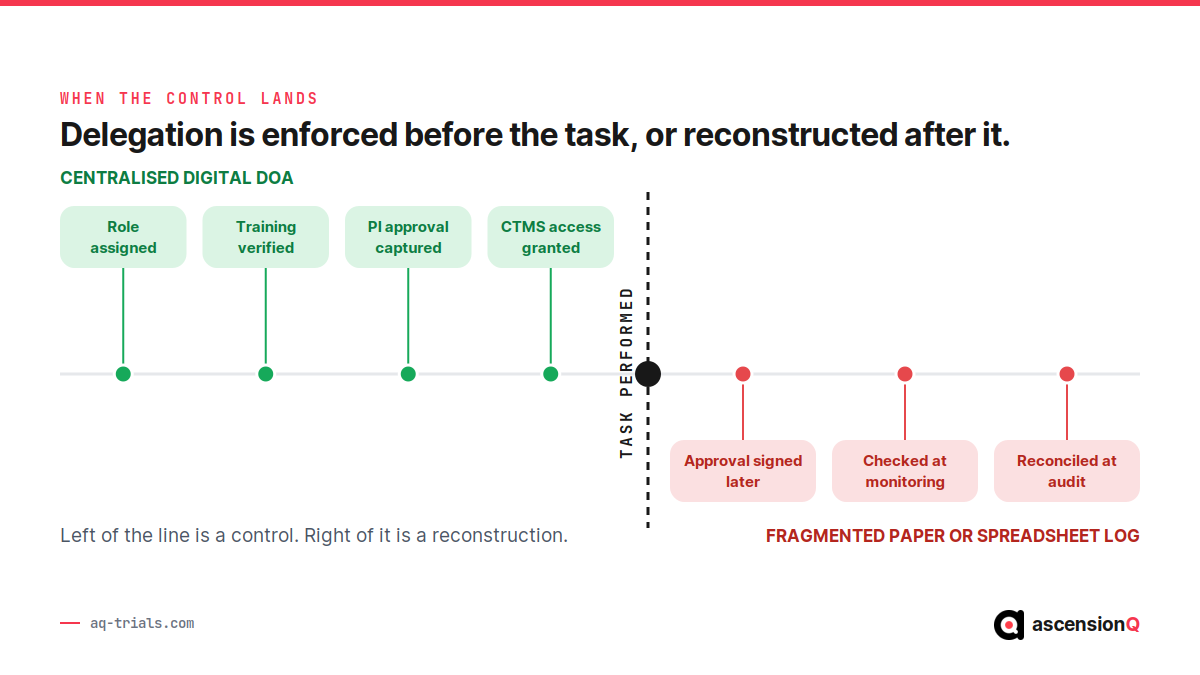
Paper-based and site-managed DOA logs create separation between role assignment, PI approval, training validation, and study execution across sites. On the other hand, a centralised digital DOA platform connects delegation with CTMS workflows, eTMF documentation, eISF records, and QMS processes, so each task aligns with an authorised individual in real time.
| Aspect | Fragmented Paper-Based Delegation | Centralised Digital DOA Platform |
| Structure | Separate logs per site, spreadsheets, paper records | Single system across all sites and studies |
| Role Assignment | Inconsistent across sites | Standardised across CRO operations |
| PI Oversight | Limited visibility across sites | Direct visibility across all investigators and staff |
| Updates | Manual, delayed, batch-based | Real-time updates across systems |
| Task Alignment | Disconnected from actual study activity | Direct linkage with CTMS and execution |
| Training Validation | Checked separately or retrospectively | Integrated with role eligibility and access |
| Approvals | Recorded after activity in many cases | Controlled before task execution |
| Traceability | Partial and fragmented | Complete audit trail with timestamps |
| Compliance (ICH GCP, 21 CFR Part 11) | Retrospective validation required | Built-in compliance with system enforcement |
| Audit Readiness | Requires preparation and reconciliation | Continuous inspection-ready state |
| Data Consistency | Duplicate and conflicting records | Single source of truth across systems |
| CRO Visibility | Limited to site-level review | Portfolio-level visibility across studies |
Also Read: eQMS vs DMS in Clinical Trials
Operational Advantages of a Centralised Digital DOA Platform for CROs
A centralised digital DOA platform answers the core need for CROs. It brings control, visibility, and compliance into one system across all sites and studies.
- Centralised control of delegation across all sites, investigators, and study teams
- Single source of truth for roles, responsibilities, and approvals
- Real-time alignment between delegation and study execution
- Direct linkage between authorised personnel and tasks performed
- Continuous PI oversight across multi-site operations
- Verified training and qualification before role assignment
- System-enforced approval before task execution
- Complete audit trail with time-stamped delegation history
- Built-in compliance with ICH GCP and 21 CFR Part 11 requirements
- Integration with CTMS, eTMF, eISF, and QMS for unified operations
- Elimination of duplicate, inconsistent, and fragmented DOA records
- CRO-level visibility across all studies, sites, CRAs, and site staff
- Early identification of delegation gaps, missing approvals, and role misalignment
- Time-bound responsibility tracking with clear start and end dates
- Standardised delegation model across sponsors and protocols
- Reduced manual effort and faster coordination across teams
- Continuous inspection readiness with structured, exportable records
Also Read: What is an eTMF in Clinical Trial Research?
How Does a Centralised DOA System Improve CRO Oversight Across Multiple Sites?
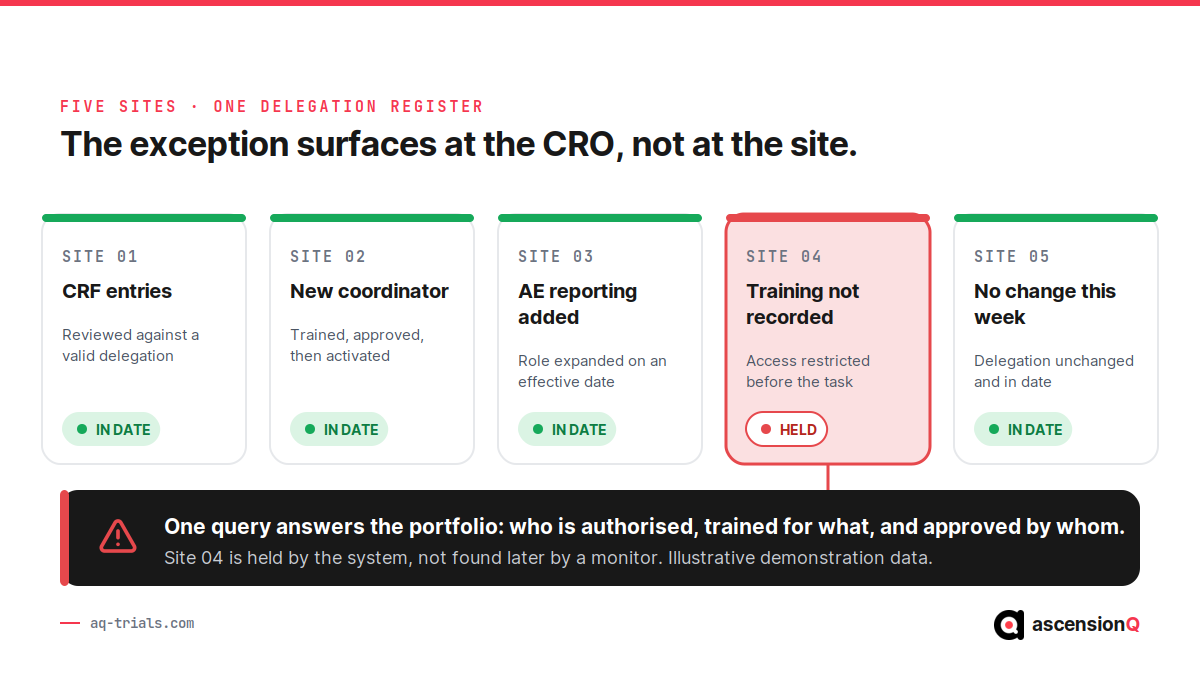
For instance, you’re a CRO who’s required to manage a Phase III oncology study across five sites. Each site includes a Principal Investigator (PI), Sub-Investigators, Study Coordinators, and site staff. Study activity will run in parallel across locations, while responsibility will be clearly defined, approved, and time-bound.
So, as a CRO, you will rely on a centralised digital DOA system to maintain control across all sites through one environment.
You will begin with a centralised delegation setup. All site staff will be entered into the system with defined roles, assigned tasks, training records, and PI approvals. Each responsibility will link to a start date and approval timestamp. You will view delegation across all sites in one place without dependence on separate logs.
Consequently, you will move to real-time oversight of staff changes. Let’s say a new Study Coordinator has joined Site 2. Training records will be attached to the profile. PI approval will be recorded before activation. You’ll use the system to assign role-based access in CTMS and EDC. Ultimately, you will be able to see the update instantly and confirm that task execution will begin only after approval. SMOs that supply coordinators to investigators carry the same evidence burden for every person they place; see how AQ supports SMOs.
Next, let’s say you need to track role expansion across sites. For instance, Site 3 has assigned AE reporting to an existing coordinator. Training will be completed before assignment and PI approval will be recorded with an effective date. The system will align AE entries with the updated responsibility. So, you will validate that safety reporting will link to an authorised individual at the correct time.
Moving forward, you will also need to perform cross-site oversight validation. For instance, you will review CRF entries at Site 1 and AE reporting at Site 3. The DOA system will show:
- authorised individual
- valid delegation period
- linked training and qualification
- PI approval before execution
SSo, it will help confirm alignment without manual reconciliation or site-level follow-up.
Then you will also need to identify delegation gaps early. For instance, at Site 4, the system has flagged missing training for a delegated task. You can restrict the access and trigger correction before execution begins. This will prevent misalignment between role, qualification, and activity.
Lastly, you’d use DOA to maintain continuous oversight across the study as well. Delegation, approvals, training, and execution will remain connected across CTMS, eTMF, and QMS. Each action will trace back to an authorised role within a valid timeframe.
So, now it should be clear how a centralised, digital DOA will allow you:
- maintain visibility across all sites and study teams
- validate responsibility before task execution
- track PI oversight across investigators and staff
- detect and resolve delegation gaps early
- confirm alignment between execution and authorisation at any time
Also Read: What is CAPA Management Software in Clinical Research?
How does Integration Between a Centralised DOA, CTMS, eTMF, and QMS Improve Control?
A centralised digital DOA with integration to other important clinical research software, such as CTMS, eTMF, eISF, and QMS brings control into the workflow itself.
Each role, responsibility, approval, and training record stays aligned with system activity. So, each task links to an authorised individual with verified qualification and valid approval timing.
- DOA + CTMS (Clinical Trial Management System) Task execution aligns with assigned roles and responsibilities Access depends on approved delegation and role validity Study activities map directly to authorised personnel
- DOA + eTMF (Electronic Trial Master File) Document creation, review, and approval link to delegated roles Each document action traces to an authorised individual Signature control aligns with role-based permissions
- DOA + eISF (Electronic Investigator Site File) Site documentation reflects current delegation status Investigator and site staff responsibilities stay aligned with records Delegation updates reflect immediately in site files
- DOA + QMS (Quality Management System) Deviations, CAPA, and audit findings link to responsible roles Root cause analysis traces to delegated responsibility Quality events align with authorised task ownership
How Can CROs Use AQ Digital DOA to Strengthen Delegation Control and Compliance?
AQ Digital DOA establishes a system-controlled environment for delegation across CRO operations. It connects role assignment, PI approval, training validation, and study execution within one platform. This ensures that each task performed across CTMS, eTMF, eISF, and QMS aligns with an authorised individual, a defined role, and a valid timeframe.
CRO teams use AQ Digital DOA to manage delegation as an active control mechanism instead of a static log.
How AQ Digital DOA Strengthens Delegation Control?
- Centralised management of all site staff, investigators, and study teams within one system
- Role-based assignment linked directly to study tasks and responsibilities
- PI approval captured and enforced before task execution
- Time-bound delegation with defined start and end dates
- Real-time updates across staff onboarding, role changes, and protocol amendments
- Direct linkage between delegation and CTMS activity, eTMF documentation, and QMS events
- Controlled access based on role, training status, and approval
How AQ Digital DOA Strengthens Compliance?
- Built-in alignment with ICH GCP requirements for investigator oversight
- System validation aligned with 21 CFR Part 11 expectations for electronic records and signatures
- Complete audit trail with time-stamped records of delegation, approval, and updates
- Continuous validation of training and qualification before responsibility assignment
- Elimination of retrospective corrections through pre-execution control
- Structured traceability across all study activities and documentation
- Consistent delegation framework across sponsors, protocols, and sites
So, ultimately, AQ Digital DOA transforms delegation into a controlled, traceable, and system-driven process that supports CRO-level oversight, operational efficiency, and regulatory compliance at scale.
A live walkthrough shows delegation set up across multiple sites in one register, PI approval enforced before a task can be performed, and an audit trail that records each change with its effective date. Book a 30-minute product tour to see how AQ Digital DOA handles delegation across a CRO portfolio.