AQ Platform is a connected clinical research software platform built to manage study operations, research documentation, quality processes, and delegated responsibilities within one controlled environment. It brings together core clinical research modules, including CTMS, eTMF, eISF, ePSF, QMS, CAPA, and Digital DOA to help research teams maintain structured oversight, operational visibility, and continuous inspection readiness across the full study lifecycle.
In simple words, AQ Platform is purpose-built to centralise everything clinical research teams need to plan, run, document, review, and govern a study. It gives research teams one place to:
- manage study operations and trial activity
- track participants, visits, and study milestones
- maintain controlled research documentation
- manage document versions, approvals, and signatures
- track deviations, incidents, and CAPA actions
- oversee pharmacy records and investigational product accountability
- assign roles, responsibilities, and delegation records
- maintain quality oversight and operational control
- ensure audit-ready visibility across every stage of research delivery
AQ Clinical Research Software Modules
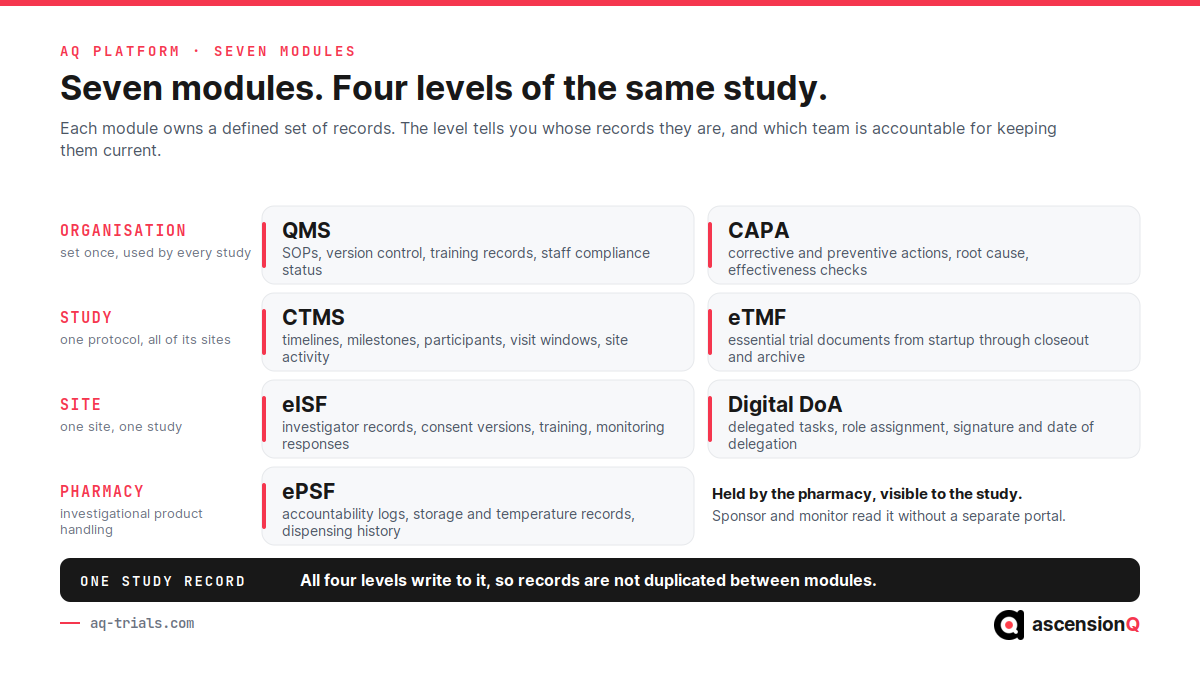
AQ Trials offers an end-to-end clinical research platform built to support the full operational lifecycle of a study through seven connected software modules. Each module can be deployed independently to solve a specific operational need or used together as one connected system to create complete oversight across study operations, research documentation, pharmacy control, quality management, corrective actions, and delegated responsibilities.
CTMS
AQ CTMS is the operational core of the AQ Platform. It gives clinical research teams one structured system to plan, run, and monitor study activity from setup through closeout. Built to support day-to-day trial execution, AQ CTMS centralises study planning, participant workflows, visit scheduling, site coordination, financial tracking, and operational reporting so research teams can manage study delivery with clearer control and visibility.
Notably, AQ CTMS replaces fragmented trackers, disconnected calendars, manual follow-up, and spreadsheet-led coordination with one controlled operational environment. Each study runs through a defined structure where teams can manage timelines, track participant progress, coordinate visits, monitor milestones, assign users, and review performance through a single operational record.
Research teams use AQ CTMS to:
- set up studies with structured timelines, milestones, and site details
- assign users, roles, permissions, and study access
- manage participant enrolment, status, and progression
- configure protocol-based visit schedules and appointment windows
- schedule visits through a central planner with capacity visibility
- automate participant communication through reminders and notifications
- track visit payments, study costs, and financial activity
- monitor recruitment, site activity, and operational performance
- review deviations, out-of-window visits, and study execution risks
- maintain real-time visibility across participants, sites, staff, and study progress
All this gives research teams a clearer view of what is happening across the study, what needs attention next, and where timelines, resources, or follow-up actions require closer control.
eTMF
AQ eTMF gives clinical research teams a structured electronic Trial Master File to manage essential study documentation within one controlled environment. Clinical teams use it to organise, review, and maintain trial records with clear filing structures, controlled workflows, and continuous visibility across the full study lifecycle. AQ eTMF replaces fragmented document storage across shared drives, sponsor portals, spreadsheets, and email chains with one connected system built for documentation control, completeness tracking, and inspection-ready oversight.
Every essential trial document stays organised, version-controlled, and fully traceable from study startup through closeout and archival. Clinical teams can monitor document completeness, review approval status, manage follow-up actions, and confirm record quality through one structured system instead of reconciling updates across disconnected tools.
Sponsors, CROs, TMF managers, and quality teams gain a clearer view of document status across studies, sites, and functions, which supports faster follow-up, stronger oversight, and continuous inspection readiness.
Research teams use AQ eTMF to:
- maintain structured trial master file documentation in one controlled system
- organise records across study, country, site, and pharmacy levels
- track document completeness, approvals, and outstanding follow-up
- manage document versions, metadata, and controlled filing structures
- route records through review, QC, approval, and signature workflows
- monitor missing, pending, and incomplete documents in real time
- maintain full audit trails across uploads, revisions, approvals, and access
- align sponsor, CRO, site, and pharmacy documentation within one shared structure
- support inspection readiness with traceable, review-ready study records
- reduce manual reconciliation across fragmented trial documentation workflows
eISF
AQ eISF gives clinical research sites a structured electronic Investigator Site File to manage site-level study documentation within one controlled environment. Clinical teams use it to organise, review, and maintain investigator records, regulatory files, training documents, consent records, and monitoring documentation with clearer control across day-to-day site operations. AQ eISF replaces paper binders, local folders, sponsor portals, and disconnected trackers with one study-scoped system built for document control, version traceability, and inspection-ready site oversight.
Every site document stays organised, version-controlled, and fully traceable throughout the study lifecycle. Site teams can manage document completeness, review approval status, track delegation-linked records, respond to monitor comments, and maintain document quality through one structured system instead of relying on parallel spreadsheets and manual filing work.
Research sites, study coordinators, investigators, CRAs, and sponsors gain clearer visibility into document status, study readiness, and outstanding site actions, which supports faster monitoring, stronger site control, and continuous inspection readiness.
Research teams use AQ eISF to:
- maintain structured investigator site documentation in one controlled system
- organise site records by study, category, and document type
- manage document versions, approvals, and signature workflows
- track document completeness, missing records, and outstanding follow-up
- maintain role-based access across investigators, coordinators, monitors, and sponsors
- review document history, audit trails, and activity logs
- respond to monitor comments and document review queries
- manage delegation-linked records with clearer accountability
- support remote monitoring and controlled document access
- maintain inspection-ready site documentation across active studies
ePSF
AQ ePSF gives clinical research pharmacies a structured electronic Pharmacy Site File to manage pharmacy documentation and investigational product records within one controlled environment. Pharmacy teams use it to organise accountability logs, storage records, dispensing documentation, temperature records, and pharmacy approvals with clearer control across day-to-day investigational product handling. AQ ePSF replaces paper logs, local folders, sponsor portals, and disconnected trackers with one study-scoped system built for pharmacy document control, accountability traceability, and inspection-ready pharmacy oversight.
Every pharmacy record stays organised, version-controlled, and fully traceable throughout the study lifecycle. Pharmacy teams can manage accountability status, review authorisation records, track investigational product handling, respond to oversight queries, and maintain pharmacy record quality through one structured system instead of relying on manual reconciliation and fragmented pharmacy logs.
Research pharmacists, pharmacy teams, sponsors, CRAs, and oversight teams gain clearer visibility into accountability status, pharmacy readiness, and outstanding record actions, which supports stronger investigational product governance, faster review, and continuous inspection readiness.
Research teams use AQ ePSF to:
- maintain structured pharmacy documentation in one controlled system
- organise investigational product records by study, category, and document type
- manage accountability logs, storage records, and dispensing documentation
- track document completeness, record status, and outstanding follow-up
- maintain role-based access across pharmacists, monitors, sponsors, and oversight teams
- review accountability history, audit trails, and activity logs
- manage authorisation workflows and traceable pharmacy approvals
- support investigational product governance with clearer accountability control
- support monitoring, audit, and inspection review through controlled access
- maintain inspection-ready pharmacy documentation across active studies
QMS
AQ QMS gives clinical research teams a structured quality management system to control documents, training, compliance, and quality actions within one governed environment. Quality teams use it to manage SOPs, acknowledgements, staff compliance, deviations, audit records, and controlled quality workflows with clearer oversight across day-to-day research operations. AQ QMS replaces fragmented trackers, disconnected quality records, spreadsheets, and manual follow-up with one connected system built for quality governance, traceability, and continuous audit readiness.
Every quality action stays visible, attributable, and fully traceable across the research lifecycle. Quality teams can manage document approvals, assign training, monitor compliance status, track deviations, review findings, and maintain audit evidence through one structured system instead of chasing updates across separate tools.
Quality managers, governance leads, research coordinators, and compliance teams gain clearer visibility into quality status, unresolved issues, and outstanding actions, which supports stronger oversight, faster follow-through, and more consistent compliance control.
Research teams use AQ QMS to:
- maintain controlled quality documents in one governed system
- manage SOPs, approvals, version control, and document access
- assign training, acknowledgements, and competency requirements by role
- track staff compliance across procedures, updates, and quality actions
- log deviations, findings, and nonconformances with structured follow-up
- manage CAPA workflows with root cause review and action tracking
- maintain audit trails, activity logs, and inspection-ready evidence
- monitor quality status, overdue actions, and unresolved compliance gaps
- connect quality processes with live study operations and staff activity
- maintain continuous audit readiness across clinical research operations
CAPA
AQ CAPA gives clinical research teams a structured corrective and preventive action system to manage findings, investigations, corrective actions, and preventive follow-through within one controlled environment. Quality and operations teams use it to capture issues, investigate root causes, assign actions, track ownership, and manage resolution with clearer accountability across day-to-day research operations.
Notably, AQ CAPA is built directly into the AQ Platform, which means findings can move into CAPA workflows from eTMF, eISF, QMS, CTMS, audits, and study operations without leaving the platform or rebuilding context across separate systems. Every CAPA record is thoroughly connected to the operational source behind the issue. A missing document in eTMF, an incomplete site record in eISF, a deviation in QMS, a missed milestone in CTMS, or an audit finding can move into AQ CAPA with linked study context, supporting evidence, assigned users, and full activity history already attached.
It helps quality leads, CAPA coordinators, investigators, and study teams gain clearer visibility into open issues, overdue actions, and resolution progress, which supports stronger ownership, faster follow-through, and more defensible CAPA closure.
Research teams use AQ CAPA to:
- capture findings, deviations, and quality issues in one structured CAPA record
- initiate CAPA directly from eTMF, eISF, QMS, CTMS, audits, and study workflows
- document investigations, root cause analysis, and supporting evidence
- assign corrective and preventive actions with clear ownership and due dates
- track action status, dependencies, overdue tasks, and follow-through
- maintain linked evidence, comments, decisions, and resolution history
- connect CAPA records to studies, sites, documents, audits, and staff activity
- review open issues, recurring risks, and CAPA trends across studies
- maintain full audit trails across findings, actions, approvals, and closure
- maintain audit-ready CAPA records across active clinical research operations
DOA
AQ Digital DOA gives clinical research teams a structured digital Delegation of Authority system to manage study roles, delegated responsibilities, and signature accountability within one controlled environment. Research teams use it to assign responsibilities, track role changes, maintain delegation records, and confirm authorised study activity with clearer control across day-to-day research delivery. AQ Digital DOA replaces paper delegation logs, static spreadsheets, disconnected signature records, and manual oversight with one connected system built for delegation control, role traceability, and inspection-ready accountability.
Every delegated responsibility stays linked to the study, staff member, role, approval history, and authorised activity it supports. Site teams can assign responsibilities, update role changes, manage signature records, review delegation status, and confirm who was authorised to perform each study task through one structured system instead of reconciling delegation logs across paper files, emails, and local trackers. Investigators, coordinators, sponsors, monitors, and governance teams gain clearer visibility into staff responsibilities, role coverage, delegation gaps, and signature status, which supports stronger accountability, cleaner oversight, and continuous inspection readiness.
Research teams use AQ Digital DOA to:
- maintain structured delegation of authority records in one controlled system
- assign study roles, responsibilities, and delegated tasks by user
- track role changes, access updates, and delegation history
- manage signature records and authorised approval status
- confirm staff eligibility and delegated responsibility before study activity
- link delegated roles to study tasks, documents, and operational actions
- maintain role-based accountability across investigators, coordinators, and site staff
- review delegation gaps, expired responsibilities, and outstanding approvals
- maintain full audit trails across delegation updates, approvals, and signatures
- maintain inspection-ready delegation records across active clinical research operations
Why Clinical Research Teams Use AQ Platform?
AQ Platform gives clinical research teams a more practical way to manage clinical data throughout each trial phase. It smartly combines modular flexibility, connected oversight, configurable workflows, and cost-conscious deployment in a way that fits how modern research teams actually work.
Global clinical teams use AQ because it removes the operational drag created by fragmented tools, manual trackers, and disconnected workflows while offering modules that are easier to adopt, control, and scale across active research environments.
Unified Yet Modular Deployment
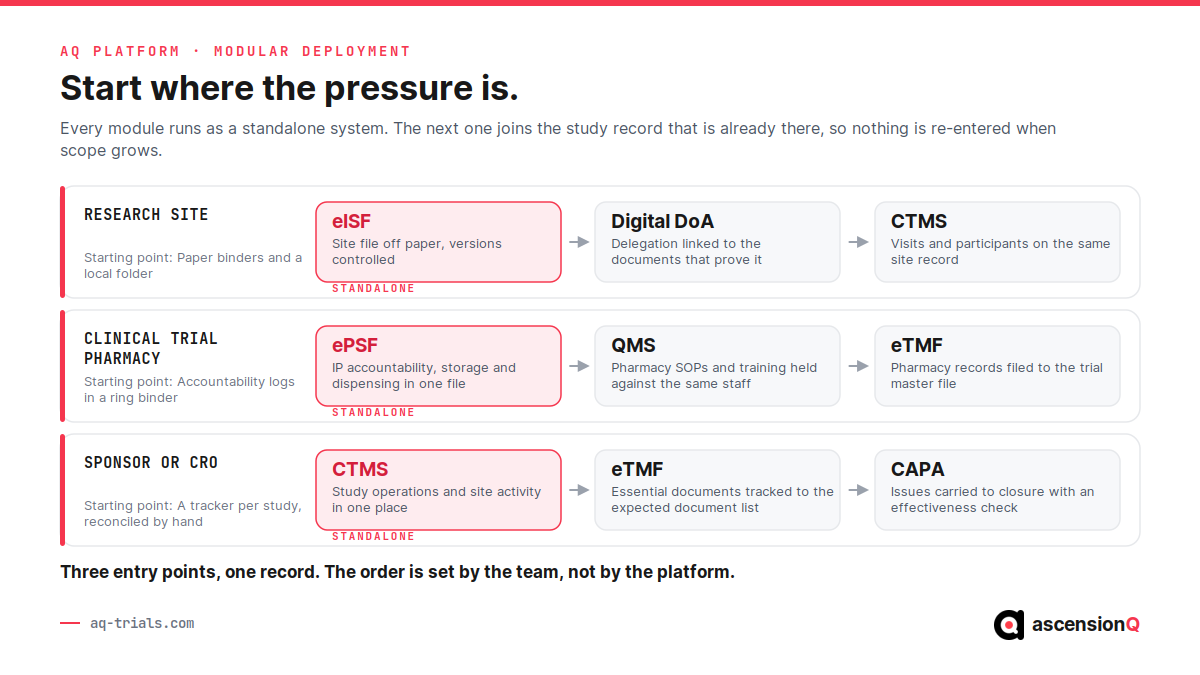
AQ Platform gives clinical research teams the flexibility to deploy one module for a specific operational need or connect all seven modules into one end-to-end research environment. Teams can start with CTMS, eISF, eTMF, QMS, CAPA, ePSF, or Digital DOA as a standalone system and expand into a fully connected platform as operational needs grow. This makes AQ easier to adopt in stages while keeping documentation, quality, compliance, and operational workflows connected through one scalable platform.
Configurable Around Real Research Workflows
AQ Platform adapts to the way research teams already work. Study structures, document hierarchies, user roles, permissions, workflows, approval paths, and reporting logic can be configured around site processes, sponsor requirements, and internal governance models. Research teams gain a system that fits existing operational workflows more naturally, which reduces friction during rollout and supports stronger day-to-day adoption.
Faster Adoption Across Research Teams
AQ Platform is designed for practical rollout across research sites, hospitals, academic centres, sponsors, and CRO environments. Teams can implement the platform without major operational disruption, long transformation cycles, or heavy technical dependency. A more intuitive structure, role-based workflows, and easier onboarding reduce training burden and help research teams move into controlled digital workflows faster.
Connected Oversight Across Clinical Operations
AQ Platform connects study activity, documentation, quality processes, pharmacy oversight, and delegated responsibilities within one operational environment. Research teams gain clearer visibility across what is happening in the study, what requires action, where risks are forming, and which records or workflows need attention. This connected oversight improves control across day-to-day delivery and reduces the blind spots created by disconnected systems.
AI-Powered and Continuously Improving
AQ Platform is built to support AI-assisted workflows across research operations, documentation, quality review, and compliance oversight. Intelligent automation supports faster document handling, clearer workflow guidance, earlier gap detection, and stronger operational visibility across the platform. Continuous product development also ensures AQ evolves with changing research workflows, regulatory expectations, and operational demands.
More Affordable Than Fragmented Enterprise Systems
AQ Platform gives research teams a more cost-effective alternative to expensive enterprise systems, disconnected point solutions, and layered operational workarounds. Teams can adopt only the modules they need, reduce reliance on multiple vendors, lower administrative overhead, and avoid the cost of managing fragmented systems across operations, documentation, quality, and compliance. This makes AQ easier to justify, easier to scale, and more practical for modern research environments.
AQ Platform Use Cases Across Clinical Research Environments
| Clinical Research Environment | How AQ Platform Is Used |
| NHS and Hospital Research Teams | Manage study operations, site documentation, pharmacy oversight, quality workflows, and governance controls within one connected research environment across active hospital-based studies. |
| Academic and University Research Centres | Standardise study delivery, documentation control, delegation oversight, and compliance workflows across distributed research teams, mixed processes, and multi-study academic environments. |
| Sponsors | Maintain connected oversight across study operations, documentation, site performance, quality actions, and inspection readiness across multi-site clinical programmes. |
| CROs | Coordinate study execution, site oversight, documentation review, quality follow-through, and sponsor reporting across complex multi-study and multi-site clinical trial portfolios. |
| Research Sites and Site Networks | Manage participant activity, investigator documentation, delegation records, monitoring readiness, and day-to-day site operations through one structured operational system. |
| Clinical Trial Pharmacies | Control investigational product documentation, accountability records, dispensing activity, storage oversight, and pharmacy governance through one connected pharmacy environment. |
Security and Regulatory Standards Behind AQ Platform
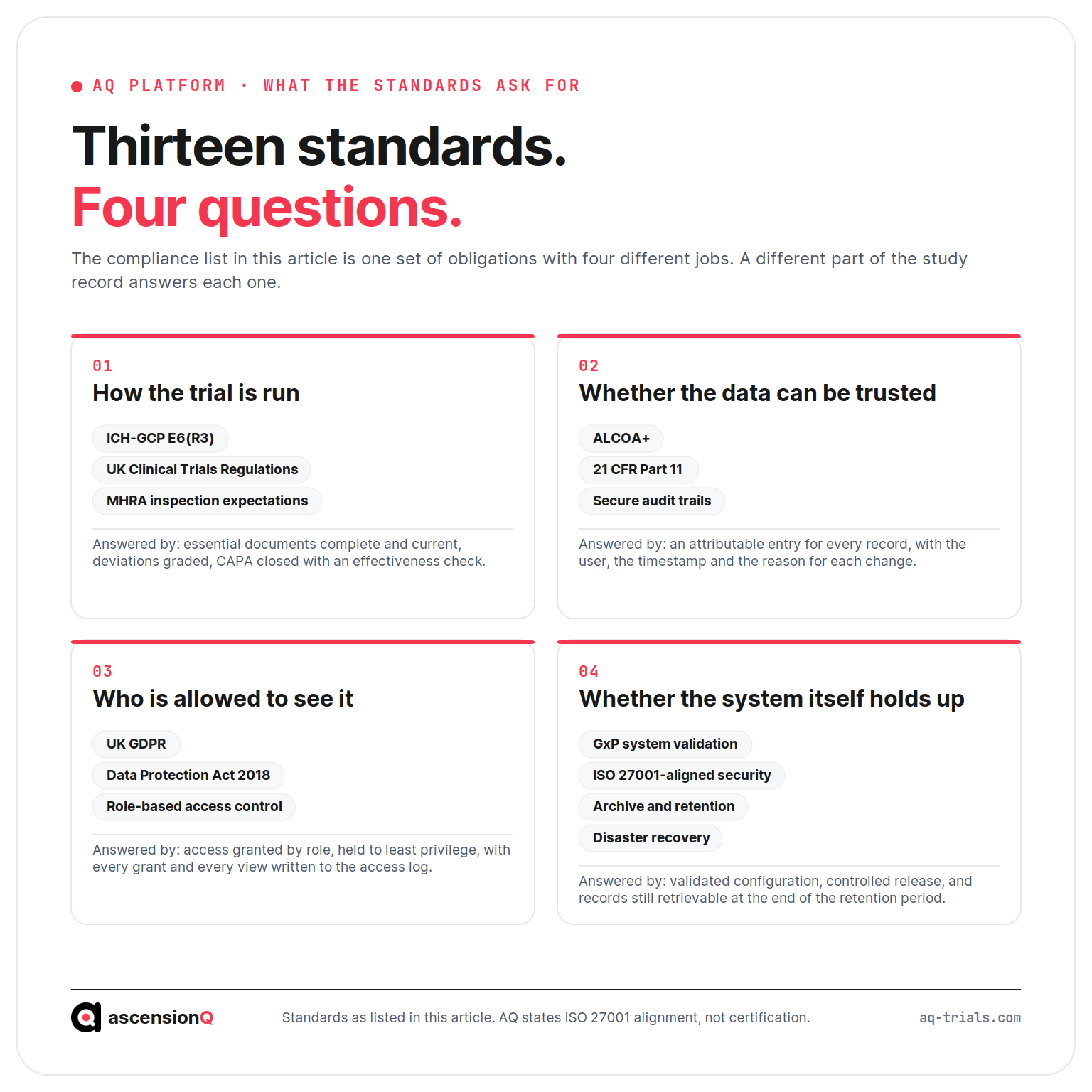
AQ Platform is built around the security, compliance, and validation standards clinical research teams need to manage regulated study activity with confidence. Every module across AQ supports controlled access, attributable records, secure audit trails, validated workflows, and long-term data integrity so research operations stay aligned with clinical trial regulations, inspection expectations, and modern data protection requirements. The platform is designed to support both day-to-day operational control and the deeper regulatory standards required for audit readiness, sponsor oversight, and regulated research delivery.
The clinical research software modules within AQ Platform are compliant with:
- ICH-GCP E6(R3) for clinical trial conduct, oversight, and essential records
- UK Clinical Trials Regulations for compliant study execution and record control
- MHRA expectations for inspection readiness, CAPA response, and record retention
- ALCOA+ principles for attributable, legible, contemporaneous, and traceable records
- 21 CFR Part 11 for electronic records, audit trails, and signature controls
- UK GDPR and Data Protection Act 2018 for secure research data governance
- role-based access control for secure permissions and least-privilege access
- secure audit trails for traceable user actions, approvals, and record history
- long-term archive and retention controls for regulated study records
- GxP computerised system validation for controlled configuration and release governance
- ISO 27001-aligned information security for platform and infrastructure assurance
- disaster recovery and business continuity controls for operational resilience
- CAPA lifecycle traceability for controlled issue resolution and audit defence
AQ Platform VS Other Clinical Research Software
AQ Platform stands apart from traditional clinical research software because it connects study operations, documentation, quality, pharmacy, and delegation inside one study-scoped environment instead of splitting them across separate systems.
The majority of clinical research platforms solve one operational problem at a time, then rely on integrations, duplicate records, manual reconciliation, and disconnected audit trails to hold the rest together. AQ removes that fragmentation by keeping CTMS, eTMF, eISF, ePSF, QMS, CAPA, and Digital DOA connected to the same study record from startup through closeout.
In fact, traditional clinical research software often separates study operations from document control, quality management from issue resolution, and site oversight from sponsor visibility. AQ brings every module inside one controlled operational structure, which gives research teams clearer visibility, stronger traceability, faster follow-through, and less administrative drag across active studies.
| Comparison Area | AQ Platform | Other Clinical Research Software |
| Platform Structure | One connected study-scoped platform | Separate tools connected through integrations |
| Module Deployment | Modular and unified | Usually point solutions or bundled suites |
| CTMS, eTMF, eISF, ePSF, QMS, CAPA, DOA | Native and connected in one environment | Usually split across separate systems |
| Study Record | One shared study record across all modules | Duplicate records across systems |
| eTMF and eISF | Same study environment with role-based access | Separate systems or synchronised layers |
| ePSF | Native pharmacy site file | Usually unavailable or external |
| CAPA | Built into study, quality, and document workflows | Usually separate CAPA tracker |
| Digital DOA | Native and linked to study activity | Usually paper-based or separate log |
| Audit Trail | One connected audit trail across all modules | Split audit trails across systems |
| Oversight | Shared visibility across teams and functions | Visibility split by tool |
| Implementation | Modular rollout with easier adoption | Heavier implementation and change effort |
| Configuration | Flexible around research workflows | Often rigid or vendor-defined |
| AI Support | Embedded across workflows and oversight | Limited or module-specific |
| Cost | More affordable and modular | Higher enterprise cost or multi-vendor spend |
So, research teams use AQ Platform to spend less time moving records between systems and more time managing study delivery through one connected research environment.
Request a Live AQ Platform Demo
Our live walkthrough will give your team a practical view of how AQ supports study operations, documentation control, quality oversight, pharmacy governance, and inspection-ready research delivery across one connected platform.
Book a live AQ Platform demo to explore how it:
- connects CTMS, eTMF, eISF, ePSF, QMS, CAPA, and Digital DOA through one shared study record
- centralises study operations, documentation, quality workflows, and delegated responsibilities
- reduces fragmentation across active clinical research workflows
- supports each module as a standalone system or part of one connected platform
- improves oversight across sites, staff, study activity, and operational risk
- maintains audit-ready visibility across documentation, compliance, and quality activity
- fits around your current research workflows, governance model, and operational structure