Clinical trials operate across two distinct responsibilities. CTMS supports study execution through participant management, scheduling, and site coordination. QMS supports quality and compliance through document control, training management, deviation tracking, and CAPA. Each system addresses a specific need within clinical trial data management.
Clinical research teams often assume that a traditional Clinical Trial Management System (CTMS) covers the full scope of trial operations, including quality management, documentation, and compliance. That assumption leads to gaps in how study execution and quality processes are handled across trials.
Both systems can operate independently or as an end-to-end unified system. However, not every CTMS includes QMS capabilities, and not every QMS connects directly with study execution.
It is important to have a clear understanding of CTMS vs QMS. Only then can you select the appropriate system and ensure stronger data integrity as well as consistent regulatory readiness under frameworks such as ICH-GCP, MHRA, and EMA.
This guide explains how CTMS and QMS differ, how each system supports clinical trial data management, and how standalone and connected approaches impact study operations and compliance.
Also Read: AQ’s Guide to DMS vs eQMS
Clinical Trial Data Management Requires Structured Execution and Controlled Quality
Clinical trial data takes shape through two parallel responsibilities that must remain aligned throughout the study. Study teams drive execution through participant visits, site coordination, and protocol-driven activities. Quality and regulatory teams maintain control through document governance, training compliance, deviation management, and audit readiness. Both responsibilities operate under frameworks such as ICH-GCP (E6 R2/R3), MHRA guidance, EMA expectations, ALCOA+ principles, and 21 CFR Part 11 for electronic records.
Alignment between clinical research execution and quality control ensures that each data point is not only generated on time but also created, reviewed, and maintained in a manner acceptable for regulatory scrutiny.
Let us walk you through how execution and control progress together across the study:
- Study setup begins with protocol configuration, where visit schedules, timelines, and workflows align with ICH-GCP requirements while controlled documents are approved and versioned within TMF standards
- Participant enrolment and scheduling follow protocol-defined windows, while access to procedures remains restricted to approved, current documents under document control processes
- Visit execution generates operational data across sites, while electronic records remain compliant with 21 CFR Part 11 and MHRA data integrity guidance
- Staff perform study activities based on assigned roles, while training completion and acknowledgement confirm compliance with GCP training requirements before task execution
- Data entry and updates reflect participant activity in real time, while ALCOA+ principles ensure data remains attributable, contemporaneous, and accurate
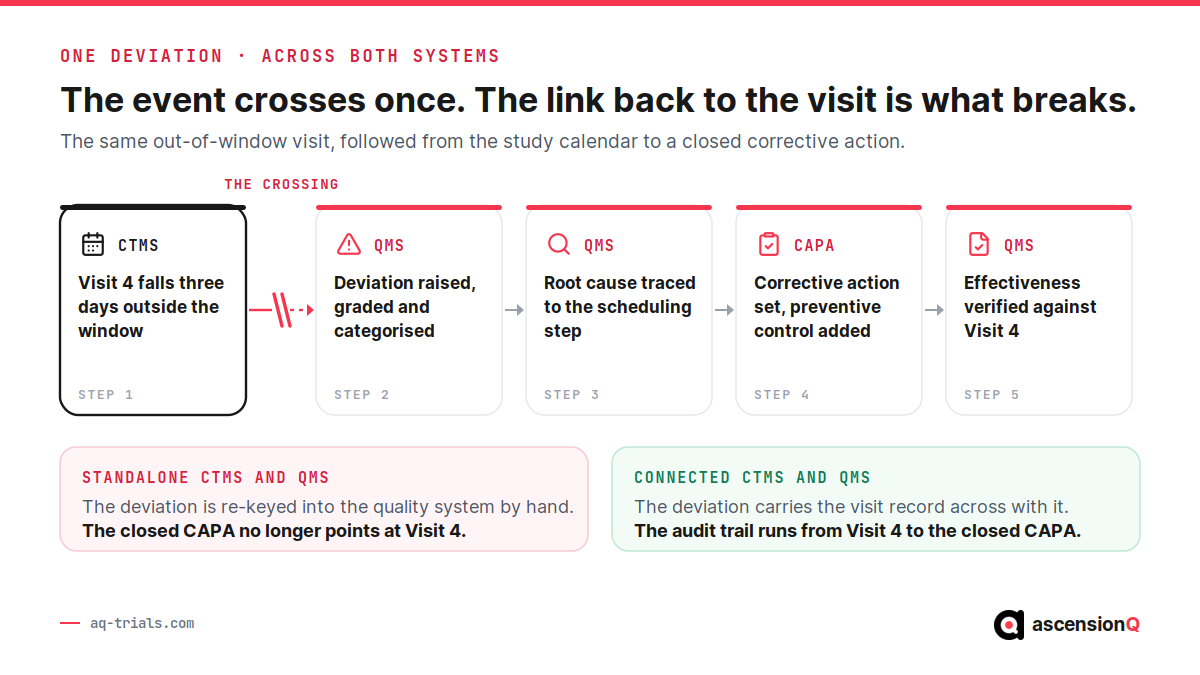
- Deviations such as out-of-window visits or missed procedures are recorded during execution, while quality review captures, categorises, and escalates events for compliance assessment
- CAPA processes investigate root causes, assign corrective actions, and implement preventive controls aligned with ICH Q9 quality risk management principles
- Audit trails record each action with user identity, timestamp, and context, supporting traceability required for MHRA inspections and sponsor audits
- Ongoing monitoring provides visibility into study progress and compliance status, ensuring readiness for EMA submissions and regulatory review
Notably, this coordinated flow ensures that clinical trial data is generated through structured execution and validated through controlled quality processes, maintaining consistency, traceability, and inspection readiness across the full study lifecycle.
CTMS Focuses on Study Execution While QMS Controls Quality and Compliance
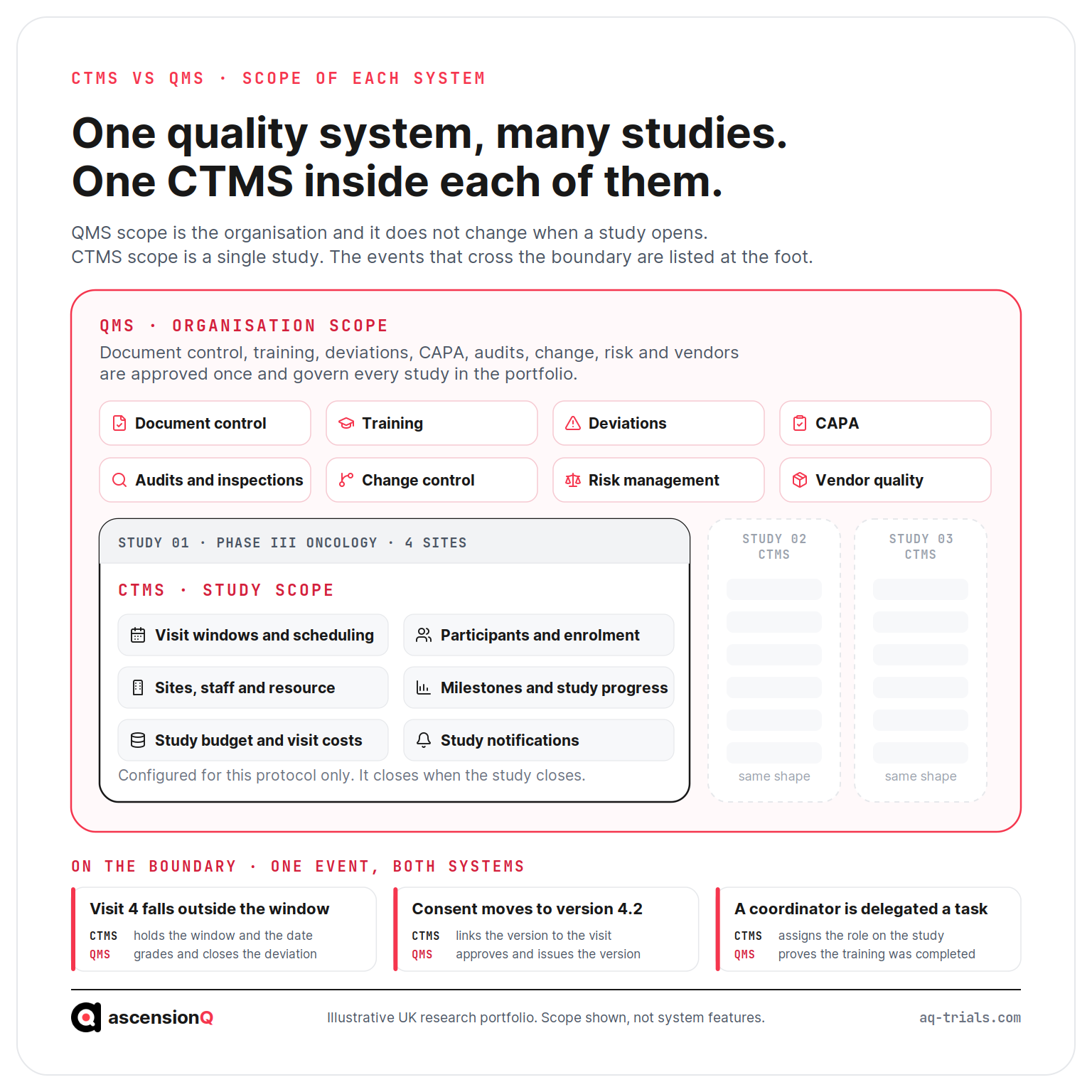
CTMS manages study activity, timelines, and coordination across sites whereas QMS manages how work is approved, performed, reviewed, and corrected. Each system uses distinct modules to handle specific responsibilities without overlap.
Break down both systems through their core modules:
CTMS Modules for Study Execution
CTMS modules support day-to-day trial operations, where study progress, participant activity, and site coordination remain visible and structured:
- Study Management. Defines study structure, timelines, milestones, and protocol-driven workflows
- Participant Management. Tracks enrolment, status, cohort allocation, and progression across visits
- Scheduling and Visit Management (E-Planner). Manages visit calendars, protocol windows, appointment slots, and visit adherence
- Site and Resource Management. Controls site allocation, staff roles, room capacity, and workload distribution
- Financial Management. Tracks study budgets, participant payments, visit costs, and financial performance
- Communication Management. Automates notifications, reminders, and study-related communication across participants and sites
- Operational Analytics and Reporting. Provides dashboards for recruitment, visit adherence, site performance, and study progress
- Audit Trails and Activity Tracking. Records operational actions across study execution for traceability
QMS Modules for Quality and Compliance Control
QMS modules establish controlled processes across documentation, training, compliance, and issue management:
- Document Control. Manages SOPs, protocols, consent forms, and controlled documents with versioning and approval workflows
- Training Management. Assigns, tracks, and validates role-based training, acknowledgements, and competency
- Deviation and Nonconformance Management. Captures protocol deviations, missed activities, and compliance gaps with structured review
- CAPA Management. Handles investigation, root cause analysis, corrective actions, and preventive measures
- Audit and Inspection Management. Tracks internal audits, regulatory inspections, findings, and follow-up actions
- Change Management. Controls updates to processes, documents, and workflows with approval and impact tracking
- Risk Management. Identifies, assesses, and monitors risks across study conduct and compliance
- Supplier and Vendor Quality Management. Monitors third-party performance, compliance, and quality agreements
- Compliance Monitoring and Dashboards. Provides visibility into training status, open issues, CAPA progress, and compliance gaps
- Audit Trail and Activity Logging. Maintains controlled records of quality events, approvals, and compliance actions
Also Read: What is ePSF in Clinical Research?
CTMS and QMS Differences Across Clinical Trial Data Management Responsibilities
Both CTMS and QMS systems manage a distinct type of data, responsibility, and outcome within clinical research operations.
| Aspect | CTMS (Clinical Trial Management System) | QMS (Quality Management System) |
| Primary Purpose | Manages study execution, coordination, and operational workflows | Manages quality control, compliance, and governance processes |
| Core Responsibility | Tracks what is happening across the clinical trial | Controls how activities are performed, reviewed, and validated |
| Focus Area | Participants, visits, timelines, sites, and study progress | Documents, training, deviations, CAPA, audits, and compliance |
| Type of Data Managed | Operational data such as enrolment, scheduling, visit status, and site activity | Quality and compliance data such as deviations, training records, audit findings, and CAPA |
| System Users | Study coordinators, investigators, operations teams, CRAs | Quality assurance teams, regulatory teams, compliance managers |
| Role in Workflow | Drives daily study activity and execution across sites | Governs processes, approvals, and compliance across activities |
| Scheduling and Visits | Manages visit planning, protocol windows, and participant schedules | Reviews deviations from protocol and ensures corrective action where required |
| Document Handling | Links documents to study activity and workflows | Controls document approval, versioning, and access |
| Training Control | Tracks role allocation and task assignment | Ensures training completion, acknowledgement, and competency validation |
| Deviation Handling | Identifies operational issues such as missed visits or delays | Captures, reviews, and manages deviations with structured workflows |
| Issue Resolution | Provides visibility into operational impact on study progress | Manages CAPA with root cause analysis and preventive actions |
| Audit Readiness | Maintains activity logs and operational traceability | Maintains audit records, findings, and inspection evidence |
| Regulatory Alignment | Supports protocol adherence and operational traceability | Ensures compliance with ICH-GCP, MHRA, EMA, and data integrity requirements |
| System Outcome | Ensures studies progress efficiently and according to plan | Ensures studies meet quality standards and regulatory expectations |
Also Read: Difference Between eTMF and CTMS
Standalone VS Connected CTMS and QMS Platforms
Clinical research organisations adopt CTMS and QMS in different ways based on operational structure, regulatory maturity, and system architecture. CTMS can operate as a standalone system focused on study execution, while QMS can function independently as an organisation-wide quality and compliance system. Both systems can also operate in a connected environment where execution, documentation, and quality processes remain aligned across the same workflows.
The choice between standalone and connected clinical research systems depends on how closely study activities need to link with document control, training, deviation handling, and audit readiness within day-to-day operations.
| Model | Standalone CTMS | Standalone QMS | Connected CTMS and QMS |
| System Scope | Focused on study execution and operational workflows | Focused on quality governance across organisation | Combines execution and quality processes within connected workflows |
| Primary Use | Manages scheduling, participants, sites, and study progress | Manages documents, training, CAPA, audits, and compliance | Aligns study activity with quality control and compliance processes |
| Data Coverage | Operational data such as enrolment, visits, and site activity | Quality data such as deviations, training, audit records, and CAPA | Unified view of operational and quality data across studies |
| User Groups | Study coordinators, investigators, operations teams | Quality assurance, regulatory, and compliance teams | Both operations and quality teams working within connected processes |
| Document Management | Links documents to study workflows | Controls document approval, versioning, and access | Documents remain linked to both study activity and quality control |
| Training Control | Limited to role assignment within study workflows | Manages training, acknowledgement, and competency tracking | Training requirements directly linked to study execution activities |
| Deviation Handling | Identifies operational issues such as missed visits | Captures and manages deviations with structured review | Deviations flow from execution into controlled quality workflows |
| CAPA and Issue Resolution | Tracks operational impact of issues | Manages root cause analysis and corrective actions | CAPA linked directly to study events and operational activity |
| Audit Readiness | Provides operational traceability through activity logs | Maintains audit records, findings, and compliance evidence | End-to-end traceability across execution, documents, and quality actions |
| Regulatory Alignment | Supports protocol adherence during execution | Ensures compliance with ICH-GCP, MHRA, EMA, and data integrity standards | Maintains continuous compliance across both execution and control |
| System Outcome | Efficient study execution with limited quality oversight | Strong quality governance without direct execution control | Aligned execution and compliance with full traceability and oversight |
Connected CTMS and QMS systems provide stronger alignment across study execution and quality control, while standalone systems serve focused needs within either operational management or organisational compliance.
Also Read: What is DOA: Delegation of Authority in Clinical Research
AQ Connects Study Execution, Documentation, and Quality Control Within One System
AQ brings study execution, document governance, and quality control into one connected environment where every activity remains linked across the clinical trial lifecycle. Study configuration, participant activity, document updates, training requirements, and quality processes operate within the same system, ensuring that execution progresses in line with controlled procedures and compliance expectations without fragmentation.
- Unified study configuration connects schedules, roles, and workflows across all CTMS modules
- Participant activity, visit execution, and site operations remain linked to protocol-defined structures
- Document control maintains approved, version-managed records aligned with study activity
- Training management connects staff responsibilities with required procedures and acknowledgements
- Deviation tracking links operational events directly to quality review and compliance workflows
- CAPA processes manage investigation, corrective action, and preventive control within the same system
- Audit trails capture all actions across execution, documentation, and quality processes with full traceability
- Real-time dashboards provide visibility across study progress, compliance status, and quality metrics
- Role-based access ensures controlled data visibility and accountability across teams
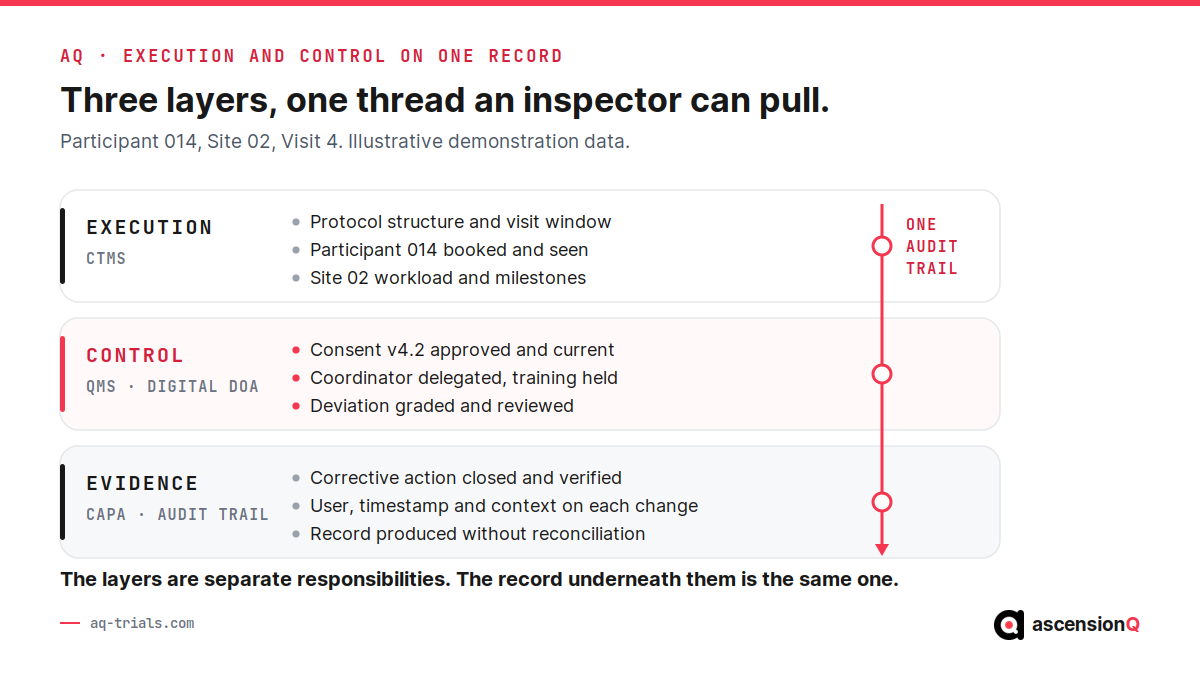
A live walkthrough shows study execution and quality control running off one record: visit activity linked to protocol structure, deviations routed into CAPA, and dashboards built from live study data rather than a monthly export. Book a 30-minute product tour to see how AQ connects CTMS and QMS across your operations.