The investigator site file structure is the arrangement of the essential documents a site holds, organised so that every record maps to a defined place. The clearest way to structure it is to follow the same taxonomy the sponsor uses for the Trial Master File: the DIA TMF Reference Model. Under that model, the electronic Investigator Site File is not a separate filing system. It is the site-held component of the same file, holding the records the investigator and institution own while the sponsor holds the rest.
This guide explains how the TMF Reference Model shapes the site file, which of its zones live at the site and which stay with the sponsor, who holds each copy, and how a shared structure lets a monitor reconcile the two files in minutes rather than days.
What Are the Key Takeaways?
- The ISF is the site-held part of one file, not a rival file. The electronic Trial Master File and the ISF share the same content model. The split is about ownership and location, not about two different taxonomies.
- The TMF Reference Model gives both files a common map. Its 11 zones classify every document, so a record filed at the site sits in the same zone the sponsor expects.
- Some zones are almost entirely site-held. Site Management is the ISF’s heartland. Others, such as Data Management and Statistics, stay with the sponsor.
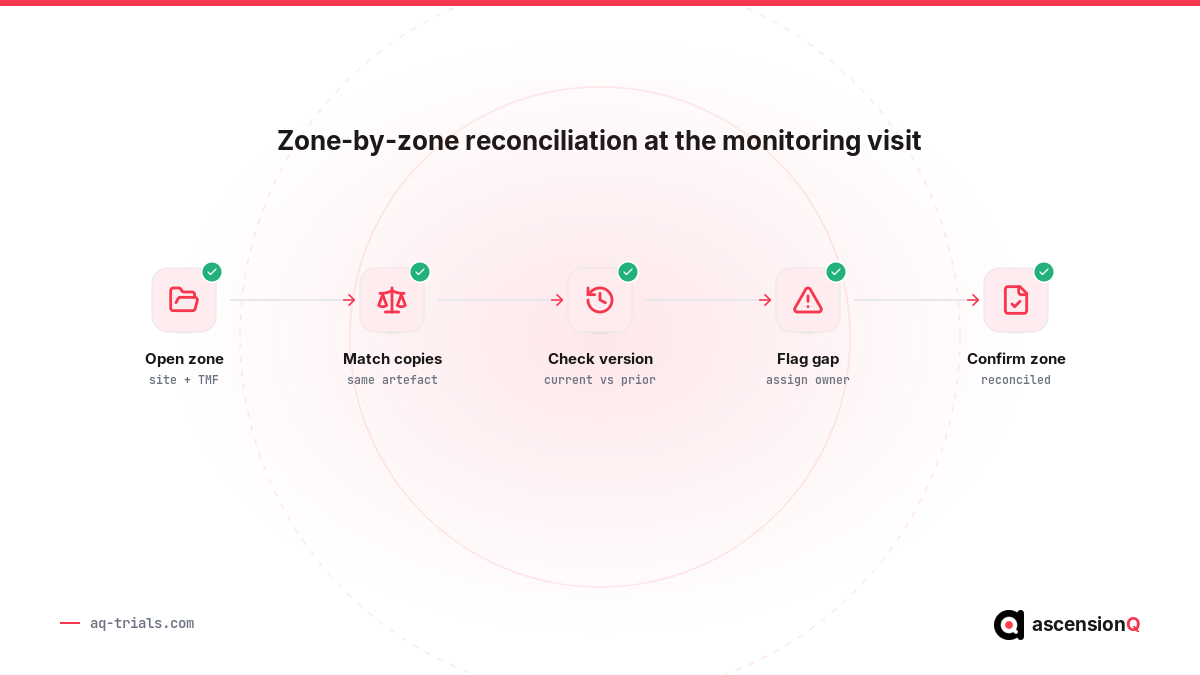
- Structure is what makes reconciliation fast. When the ISF follows the model, a monitor checks the site copy against the TMF copy zone by zone instead of hunting through local folders.
- A shared model does not file documents for you. It defines where each record belongs. Completeness and currency still need active tracking.
Why Does an Unstructured Site File Fail at the Monitoring Visit?
A site file drifts when it grows by local habit rather than by a defined structure. Each coordinator files to the logic that made sense on the day. The delegation log sits in a lever-arch binder, the ethics approvals live in an email folder, and the current protocol version is on a shared drive that only one person maintains. Every document may be present, yet no two people can find the same record the same way.
The cost of that drift shows up at the monitoring visit. The monitor arrives to verify that the site file matches the sponsor’s Trial Master File. A structured file lets that check run zone by zone. An unstructured file forces the monitor to map the site’s private folder logic onto the sponsor’s model on the spot, and any record that cannot be placed reads as a gap.
An inspector does not fault the folder names. An inspector faults the record that cannot be found in time.
Example. A monitor asks for the current investigator’s brochure acknowledgement and the delegation log entry that authorised the research nurse to take consent. In a file structured to the reference model, both sit in known zones and appear in under a minute. In an unstructured file, the acknowledgement is inside a superseded protocol PDF and the delegation entry is in a scanned binder page nobody has indexed. The documents exist. The structure does not, so the visit slows and the finding writes itself.
What Does the TMF Reference Model Actually Organise?
The DIA TMF Reference Model is an industry-standard taxonomy for trial documentation, maintained by the CDISC TMF Reference Model team. It organises every essential document into three levels: zones (the top-level grouping, such as Regulatory or Site Management), sections (a subject area within a zone), and artefacts (the individual document type, such as a signed delegation log). The current model uses 11 zones. Our practical guide to the 11 zones walks each one with example artefacts.
The model is deliberately neutral about who holds a document. It classifies the record, not the owner. That neutrality is exactly what lets the same structure serve both the sponsor’s TMF and the site’s ISF. Each document type carries guidance on whether the sponsor, the investigator, or both are expected to hold it, so the model already anticipates the site copy.
ICH-GCP is the regulatory backbone underneath the model. The ICH E6(R3) guideline sets the principle that the essential records must allow reconstruction and evaluation of how a trial was conducted. E6(R3) also shifts the language from a fixed list of “essential documents” to risk-proportionate “essential records”, which makes a shared structural map more useful, not less: the map stays constant even as the exact record set varies by trial. The MHRA good clinical practice inspection guidance confirms that inspectors test whether the records reconstruct how the trial ran, which is precisely what a structured file lets a site demonstrate.
How Does the ISF Relate to the TMF?
The Trial Master File is the complete file for the trial. The investigator site file is the portion of that file held at the site, covering the records the investigator and institution generate, receive, or must keep locally. The two overlap by design. A single artefact, such as the approved protocol, exists as a sponsor copy in the TMF and a site copy in the ISF, and both should be the same version.
The relationship is a mirror, not a division. The site does not hold a smaller, different taxonomy. It holds the same zones, populated with the subset of records that belong at site level. Some zones fill heavily at the site, some barely at all, and a few stay almost entirely with the sponsor. If you want the full picture of the sponsor side, our explainer on what an eTMF is covers it.
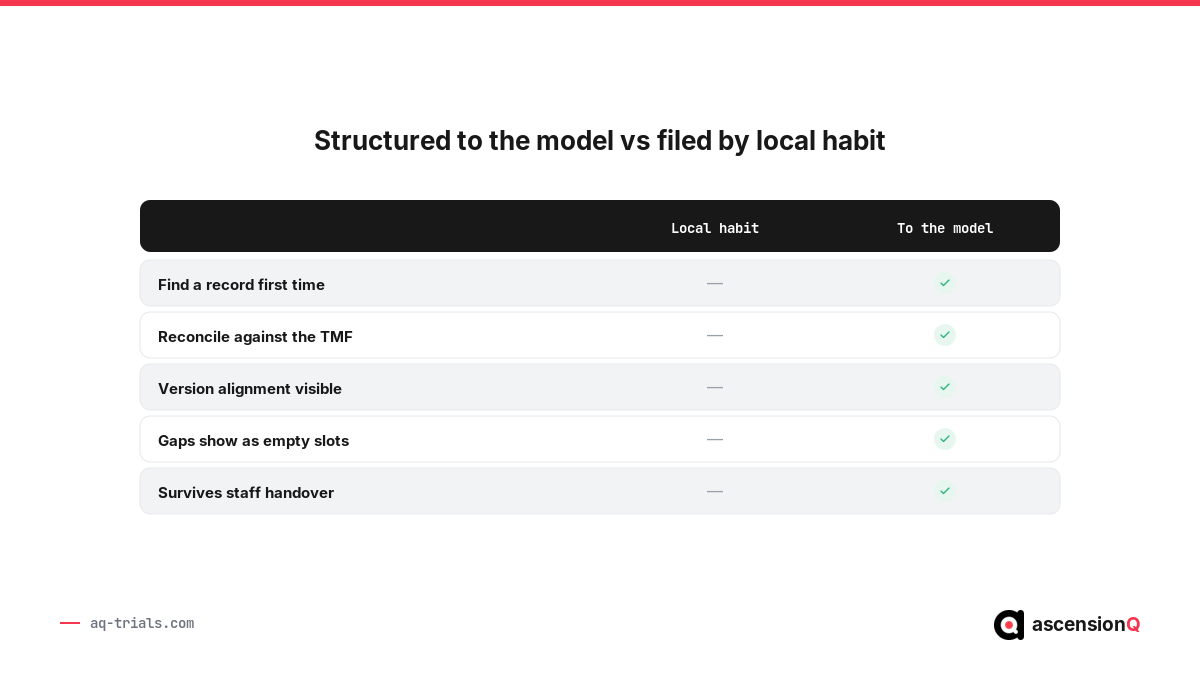
Structured to the Model vs Structured by Local Habit
The difference between a site file that survives inspection and one that stalls it is the structure, not the effort. Both files can hold every required record. Only one lets anyone else find it.
| Aspect | Site file by local habit | Site file structured to the model |
| Filing logic | Grows by whoever filed it that day | Every record maps to a defined zone and section |
| Finding a record | Depends on the person who filed it | Anyone locates it by zone, first time |
| Monitoring visit | Monitor maps local folders to the TMF on the spot | Monitor reconciles zone by zone against the TMF |
| Version control | Superseded copies linger in shared drives | Current version sits in its zone, prior versions archived |
| A missing record | Reads as absent because it cannot be placed | Shows as an empty, expected slot with an owner |
| Handover at staff change | Knowledge leaves with the coordinator | Structure holds; the next person reads the same map |
The paper-versus-digital question sits on top of this one. A structured paper file still beats a disorganised digital one for a monitor working through zones. Digital adds remote access, version control, and an audit trail once the structure is in place. Our comparison of eISF versus paper site files covers where the format itself changes the outcome.
Also Read: The Investigator Site File Essential Documents Checklist (ICH-GCP Chapter 8).
Which TMF Zones Live in the Site File?
The table below maps all 11 zones of the reference model to the site file. The holder column shows where the primary responsibility sits: sponsor, site, or both. The exact split varies by trial and by contract, and E6(R3)’s risk-proportionate approach means two trials on the same model may legitimately hold different records. The pattern below is the common case for an interventional trial.
| Zone | Primary holder | Typical site-held records |
| 01 Trial Management | Sponsor | Site-level communication and note-to-file logs |
| 02 Central Trial Documents | Both | Current protocol and amendments, investigator’s brochure, sample consent form |
| 03 Regulatory | Both | Site regulatory green-light, insurance and indemnity, clinical trial authorisation copy |
| 04 IRB / IEC and other Approvals | Site | REC favourable opinion, HRA approval, approved participant-facing documents |
| 05 Site Management | Site | Delegation log, CVs, GCP training records, financial disclosure, signature sheets |
| 06 IP and Trial Supplies | Both | Local accountability, receipts, temperature records (often in a separate pharmacy file) |
| 07 Safety Reporting | Both | Received safety letters, site SAE reports, SUSAR notifications |
| 08 Central and Local Testing | Both | Local laboratory accreditation, normal ranges, sample handling instructions |
| 09 Third Parties | Sponsor | Rarely held at site beyond local service agreements |
| 10 Data Management | Sponsor | Site copies of data clarification and query records where retained |
| 11 Statistics | Sponsor | Code-break or unblinding envelopes held at site where applicable |
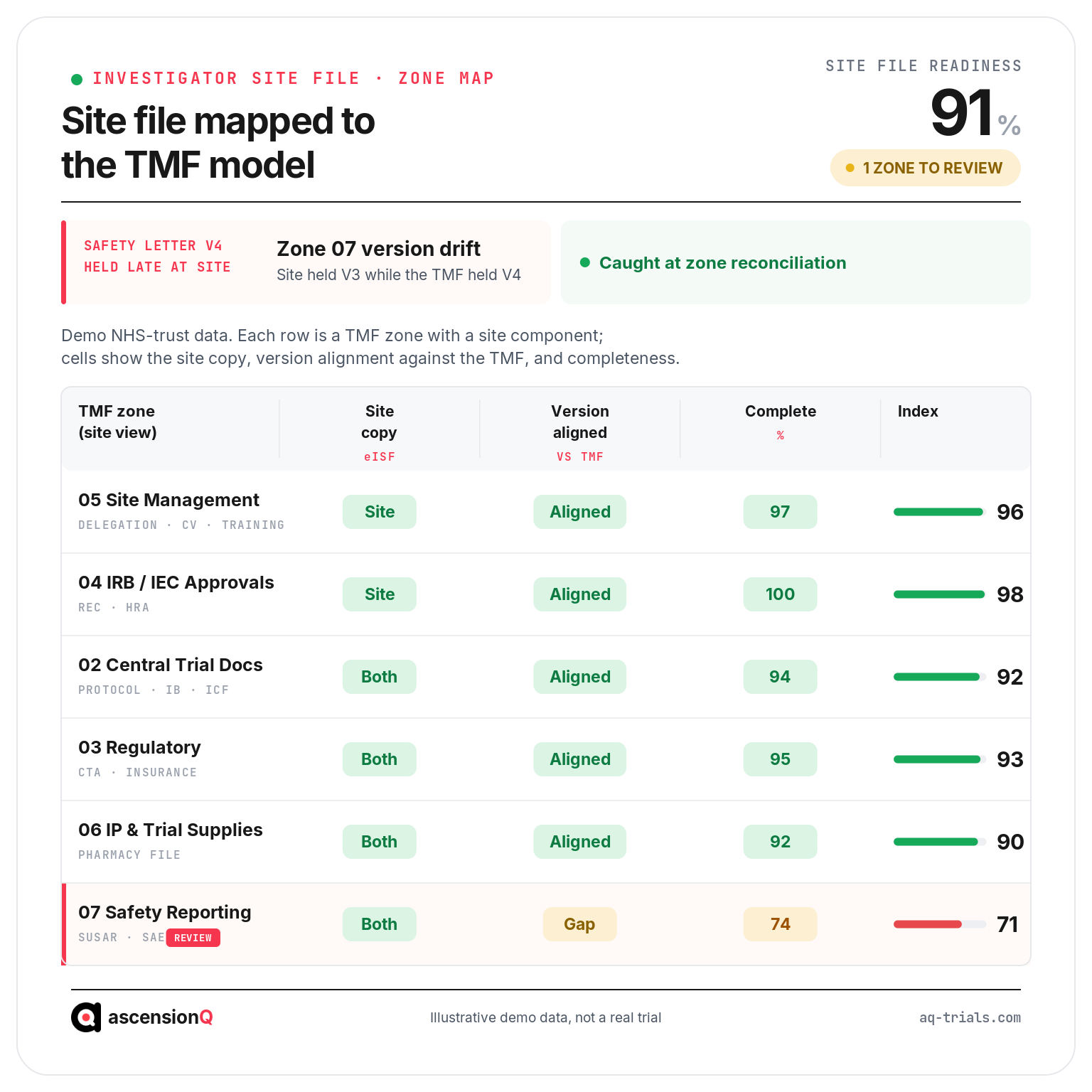
Two zones deserve a closer look because they carry most of the site’s weight and most of its inspection risk.
Zone 05, Site Management: the ISF’s heartland
Site Management holds the records that prove the right people did the right tasks with the right training. The delegation of authority log sits here, and it is the artefact inspectors reach for first. The log has to show who was delegated each task and from which date, and the date is what authorises the activity. An activity performed before the effective date is unauthorised regardless of a later signature. Our guide on why effective dates matter more than signatures works through that failure mode in detail.
This zone also holds the CVs, GCP training certificates, financial disclosures, and signature sheets that back the delegation log. Each record has to be current and each has to join up: a person on the delegation log needs a CV and training evidence dated before the task they were delegated. The join is the point an auditor tests, so the structure has to keep the linked records together.
Zone 06, IP and Trial Supplies: shared with the pharmacy file
Investigational product records belong in Zone 06, and much of the site copy lives with the pharmacy rather than in the general site file. Accountability logs, receipts, and temperature records are held where the product is stored and dispensed. Many sites keep these in a distinct pharmacy site file with its own owner and its own inspection. Our explainer on why the pharmacy site file stays separate from the ISF sets out where that line sits and why merging the two costs sites at inspection.
Also Read: TMF Completeness Tracking: How RAG Scoring Prevents Inspection Findings.
Who Holds Which Copy?
Overlap between the TMF and the ISF is normal and expected. The risk is not that a document appears in both files. The risk is that the two copies fall out of step, so the site holds a superseded protocol while the sponsor holds the current one. A shared structure reduces that risk because both parties file the same artefact in the same zone and can compare versions directly.
- Sponsor-only records. Data management plans, statistical analysis plans, and third-party contracts sit in the TMF and rarely at the site. The site does not need them to run the visit in front of the participant.
- Site-only records. Local REC and HRA approvals, site staff CVs, and the site’s own note-to-file entries originate at the site and may never need a sponsor copy.
- Shared records. The protocol, investigator’s brochure, consent form templates, and safety letters exist in both files. Version alignment between the two is the control that matters.
The question is never only whether a record exists. It is whether the site copy and the sponsor copy say the same thing.
How Does a Shared Structure Change Day-to-Day Work?
A site file built on the reference model changes several routine tasks, and each change ties a mechanism to an outcome.
- Filing follows a map, so new records land in the right place first time. A coordinator files against zones and sections rather than personal folders, which removes the guesswork that creates duplicates and orphans.
- Reconciliation runs zone by zone, so a monitor confirms the site against the TMF quickly. The two files share a spine, which turns a hunt into a checklist.
- Expected records show as empty slots, so a gap is visible before an inspector finds it. The model defines what should be present, which surfaces the missing artefact rather than hiding it.
- Version alignment is checkable, so a superseded copy at the site is caught early. Both files name the same artefact, which lets a direct version comparison replace a manual search.
- Handover survives staff change, so knowledge stays with the file. The structure carries the logic, which means the next coordinator reads the same map the last one did.
What Are the Risks Without a Shared Structure?
- Records exist but cannot be located in the time a monitor or inspector allows, which reads as absence.
- Site and sponsor copies drift apart, so the site works to a superseded protocol or consent version.
- Gaps stay invisible because nothing defines what should be present, so a missing approval surfaces only at inspection.
- Delegation, training, and CV records sit in separate places, so the join an auditor tests takes hours to assemble.
- Staff turnover erases the filing logic, and the new coordinator rebuilds it from memory.
How AQ eISF Supports a Structured Site File
The AQ electronic Investigator Site File is built on the DIA TMF Reference Model, so the site files into the same zones and sections the sponsor’s Trial Master File uses. That shared structure is what turns reconciliation into a zone-by-zone check rather than a folder-by-folder hunt. Each expected artefact has a defined place, and a record that has not arrived shows as an empty slot with an owner rather than as a silent gap.
AQ keeps the site copy and the sponsor copy aligned by holding versions against the same artefact, so a superseded document is visible against the current one. It links the Site Management records that inspectors test together, so a delegation entry, the person’s CV, and their training evidence stay connected. For NHS sites running several studies at once, AQ applies one structure across the portfolio, which our overview of clinical research for NHS hospitals sets out in more detail.
AQ structures the file and surfaces the gaps. It does not decide what belongs in the site copy of a given trial, and it does not replace the judgement of the site team or the sponsor’s oversight. The structure makes the work visible and reconcilable. The people still own the decisions.
To see how AQ maps the site file to the reference model in practice, book a 30-minute product tour.