TMF completeness tracking is the continuous measurement of whether every document expected in a Trial Master File is present, current and correctly filed at any point in the study. It answers one question that decides most inspections before the inspector arrives: if the Medicines and Healthcare products Regulatory Agency asked for the complete file today, could you produce it without a scramble? RAG scoring makes that answer visible. It grades each part of the file red, amber or green against what should be there, so a gap surfaces the day it appears rather than the week before an audit.
This guide explains what TMF completeness tracking is, why an incomplete file is the single most common area of GCP inspection findings, how RAG scoring works against the expected-document model, which metrics actually show completeness, and how a gap becomes an owned action rather than a flag no one clears. It is written for sponsors, contract research organisations and quality teams who carry the TMF and answer for it under inspection.
Key takeaways
- Completeness is a measured state, not a filing habit. The tracking layer compares what is filed against the full set of expected documents for each trial, site and phase, and reports the difference continuously.
- Record keeping is the largest inspection finding area. Missing essential documents, superseded versions filed as current, and late filings recur across MHRA GCP inspections year after year.
- RAG scoring turns a document list into a control. Green means present and current, amber means at risk or expected soon, red means missing or overdue, each attached to an owner.
- Real-time scoring beats periodic reconciliation. A quarterly hand-count lets a gap sit unnoticed for weeks. A live completeness model surfaces the same gap the day it opens.
- A flag is not oversight until it has an owner and a deadline. The strong control routes a persistent gap into a corrective and preventive action rather than leaving it amber forever.
What is TMF completeness tracking?
TMF completeness tracking is the process of measuring a Trial Master File against a defined list of expected documents and reporting, at any moment, which of those documents are present, which are missing, and which are filed but out of date. The electronic Trial Master File holds the essential records that prove a trial was conducted to Good Clinical Practice. Completeness tracking is the layer above the file that knows what the file should contain and checks the actual contents against that expectation.
The expectation comes from three inputs combined. The DIA TMF Reference Model defines the standard structure of zones, sections and artefacts. The protocol, study design and country footprint determine which of those artefacts apply to this trial. The study timeline determines when each document should exist, because a document is not missing before it is due and is overdue after. A completeness model holds all three and produces an expected-document set for every trial, site and milestone.
Completeness is distinct from volume. A file can hold thousands of documents and still be incomplete if the one signed delegation log for a site is absent. It can also look full while holding three versions of a protocol with no marker for which is current. The tracking layer measures the file against the expected set, so it reports the missing signed log and the ambiguous protocol as gaps, regardless of how many documents sit around them. The related guide to the electronic TMF explains how the file itself is structured.
Why does an incomplete TMF cause inspection findings?
Record keeping and essential documents is consistently the largest single category of GCP inspection findings. The MHRA inspects the TMF as direct evidence that a trial was run the way its records claim, and a file that cannot be produced readily, or is incomplete enough to obstruct the inspection, grades as a critical finding in its own right. The problem is rarely a single lost page. It is the absence of a system that shows which documents should be present and which are not.
Consider a multi-site oncology trial midway through recruitment. The coordinating team files diligently, but the file is reconciled by hand once a quarter. Between reconciliations, three gaps open at one site: a renewed insurance certificate is filed but the superseded version sits alongside it with no current marker, a laboratory certification lapses and the updated one is never requested, and a sub-investigator starts screening two days before the effective date on the delegation log. None of these is visible in the folder count. All three are exactly what an inspector looks for.
The finding is never the missing document alone. It is the weeks it stayed missing without anyone knowing.
These failures are process conditions, not individual carelessness. The coordinator filed everything they received. The system did not tell them what they had not received. That gap between filed and expected is what completeness tracking closes, and it is why the same finding areas appear across the published MHRA GCP inspection findings whatever the therapeutic area.
What is RAG scoring in a TMF?
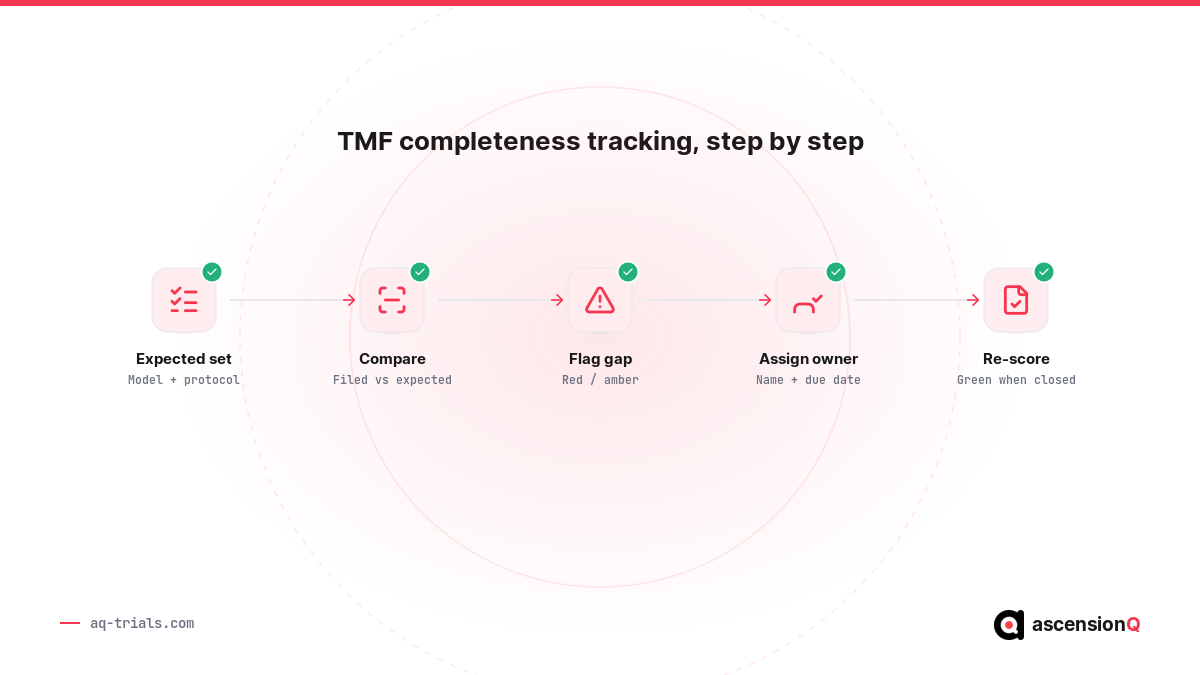
RAG scoring grades TMF completeness on a red, amber, green scale so that status reads at a glance instead of requiring a document-by-document audit. Each expected document, and each grouping of documents up to zone and trial level, carries a colour that reflects its state against the expectation. The scale converts a long index into a control that a study manager, a sponsor and an inspector can each read the same way.
| Grade | What it means | Example |
| Green | The expected document is present, current, and the correct version is marked as active. | Signed, in-date insurance certificate filed with no superseded copy presenting as current. |
| Amber | The document is expected soon, is approaching an expiry, or is filed but pending review. Action is needed but no rule is yet broken. | Ethics approval due for annual renewal in three weeks, not yet received. |
| Red | The document is missing past its due point, overdue, or superseded with no valid current version. This is what an inspector writes up. | Laboratory certification lapsed, no renewal filed, samples still being analysed. |
The value of the scale is that amber exists. A binary present-or-absent view only turns red once a document is already missing, which is often too late to fix quietly. Amber captures the window before a rule is broken: the certificate that expires next month, the report expected at the next milestone. A score taken at that stage converts completeness from a lagging record into a leading indicator, which is the difference between preventing a finding and documenting one.
Real-time scoring or periodic reconciliation: which prevents findings?
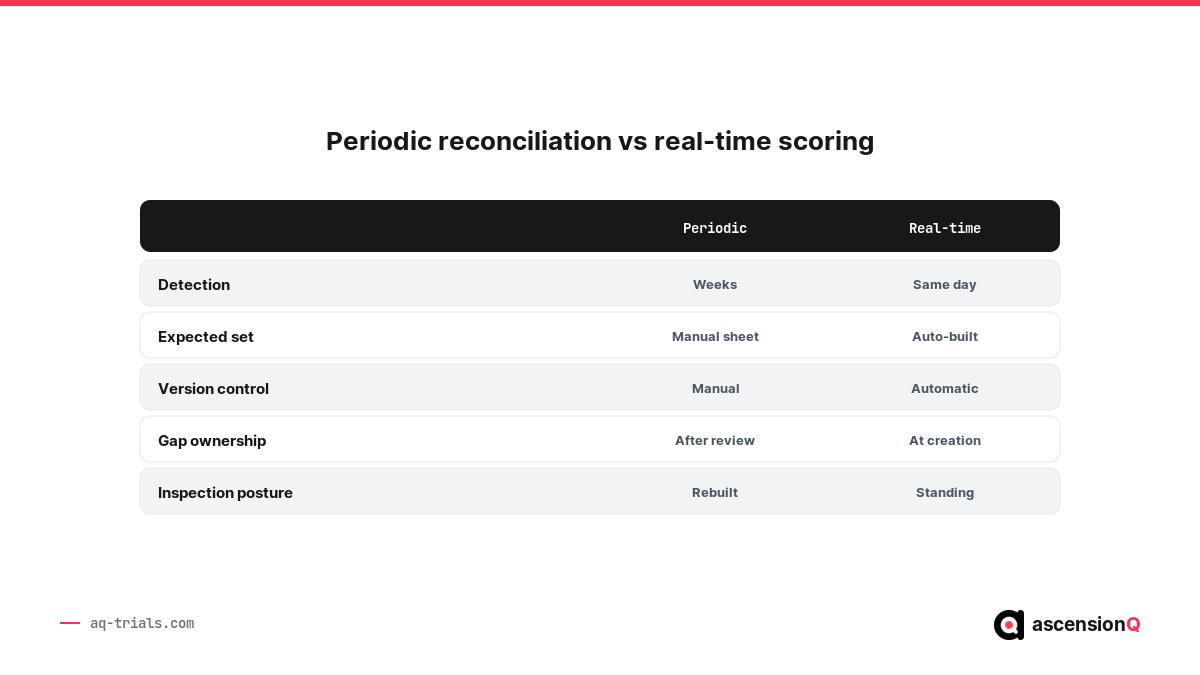
Most TMF gaps are not caused by documents that never existed. They are caused by the delay between a gap opening and anyone noticing. That delay is set by how the file is checked. A periodic reconciliation checks the file on a schedule. A real-time completeness model checks it on every change. The contrast decides whether a gap is caught in a day or discovered at inspection.
| Aspect | Periodic reconciliation | Real-time completeness scoring |
| Detection timing | A gap surfaces at the next quarterly or pre-audit review, weeks after it opened. | A gap surfaces the day the expected document fails to arrive or a version is superseded. |
| Expected-document set | Held in a spreadsheet, updated by hand, drifts from the protocol as the study changes. | Generated from the Reference Model, protocol and timeline, recalculated as the study changes. |
| Version control | Superseded copies can present as current until someone notices. | The active version is marked and superseded copies are demoted automatically. |
| Ownership | The reconciliation produces a list. Who closes each item is decided afterwards. | Each red or amber item carries an owner and a due date from the moment it appears. |
| Inspection posture | Readiness is rebuilt in the weeks before the visit. | Readiness is a standing state the visit simply confirms. |
Read also: What is inspection readiness in clinical trials? for how a standing completeness state fits into readiness across a research network.
Which metrics show TMF completeness?
Completeness is not a single number. A useful score reports several dimensions, because a file can be complete on count and still weak on currency or timeliness. Each metric below states a measure and the outcome it protects.
- Expected versus present. The share of expected documents actually filed, which shows raw coverage and is the headline completeness figure.
- Currency. The share of filed documents that are the active, in-date version, which catches superseded copies and lapsed approvals that a count alone hides.
- Timeliness. The gap between when a document became available and when it was filed, which shows whether records are contemporaneous or filed in retrospective batches.
- Placeholder resolution. The share of expected-but-absent slots that carry a placeholder with an owner, which shows whether known gaps are being managed or merely noted.
- Ageing of gaps. How long red items have stayed red, which separates a gap opened yesterday from one that has been overdue for a month.
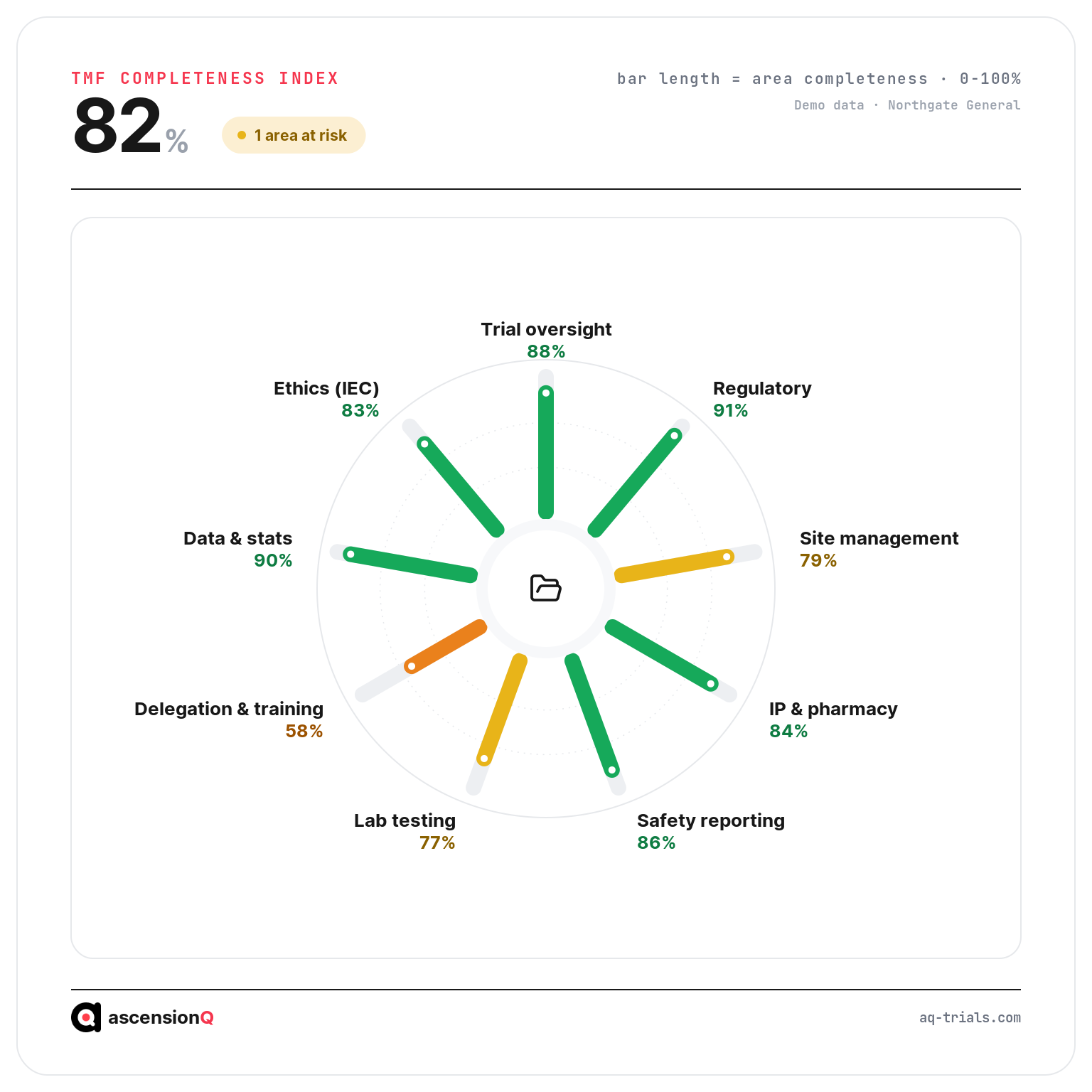
These dimensions, scored together and rolled up to zone level, produce a completeness index that a sponsor can read across sites at a glance. The visual below shows a single trial scored across its TMF areas, where a strong composite still hides one weak domain that would draw an inspector straight to it.
How does completeness scoring map to the Reference Model?
Completeness scoring works because the expected-document set has a defined shape. The DIA TMF Reference Model organises every essential record into standardised zones and sections, which gives the tracking layer a fixed skeleton to score against. Each artefact in the model maps to an expected slot, and each slot resolves to green, amber or red for a given trial. The full structure is covered in the guide to the TMF Reference Model zones.
The mechanism that makes an absent document visible is the placeholder. The completeness model creates an expected-but-absent entry for every artefact the trial should hold, so a gap becomes a visible object rather than an empty space that nobody sees. That placeholder is the object that carries a due date, a RAG grade and an owner. It is the difference between a folder that is silently short a document and a file that states, explicitly, that a document is expected, from whom, and by when.
- Zone-level scoring shows which areas of the file are strong and which lag, so effort goes where the risk is rather than being spread evenly.
- Artefact-level placeholders convert every expected document into a trackable item, so no gap depends on a person remembering it.
- Timeline awareness means a document is only red once it is genuinely due, which stops early-study noise from masking real overdue items.
This structure also travels across organisations. A standardised file lets a sponsor, its CRO and each site read the same completeness picture without reconciliation, which is why a shared model matters most on outsourced trials. The reasoning is set out in the guide on why CROs require a standardised eTMF.
How does a completeness flag become an owned action?
A RAG grade is only useful if a red item leads to a person and a deadline. A flag that no one owns is not oversight. It is a record that a problem was seen and left. The value of completeness tracking sits in what happens after a gap turns red, and the contrast between weak and strong handling is stark.
- Weak: a reconciliation lists twelve missing documents. The list is emailed to a shared inbox. Some items are cleared, others are not, and by the next review three of them are still open with no record of who was meant to act.
- Strong: each red item is assigned to a named owner with a due date at the moment it appears. Progress is visible, an overdue item escalates, and a persistent or recurring gap is routed into a corrective and preventive action rather than staying open indefinitely.
Escalation is where completeness tracking connects to quality management. A single missing document is a filing task. A pattern of the same document type going missing across sites is a systemic cause, and that belongs in CAPA management with a root-cause investigation, not in an ever-growing amber list. The essential-document expectations themselves are set out in the ICH-GCP Chapter 8 essential documents checklist, which defines what each site file must hold before, during and after the trial.
How does ICH-GCP E6(R3) change completeness expectations?
ICH-GCP E6(R3) reframes the evidence base from essential documents to essential records and places continuous, risk-based oversight at the centre of sponsor duties. Both shifts raise the value of live completeness tracking. Records that must be available for inspection at any time cannot be assembled retrospectively, and oversight that must be evidenced as continuous cannot rest on a quarterly reconciliation.
The guideline also rewards proportionality. A risk-based completeness model concentrates attention on the artefacts whose absence carries the most weight, such as consent documentation, delegation and safety records, rather than treating every slot as equally urgent. A score that reflects risk, not just raw count, is closer to what an E6(R3) inspection now expects to see.
How AQ supports TMF completeness tracking
Most TMF findings are readiness gaps that were present long before the inspector arrived. The AQ electronic Trial Master File is built to keep those gaps visible and owned. It holds an expected-document model derived from the Reference Model, the protocol and the study timeline, and scores every artefact, section and zone against it in real time. A document that is missing, superseded or overdue reads red the day it fails the expectation, not at the next review.
Each red and amber item carries an owner and a due date. AQ marks the active version and demotes superseded copies, surfaces every expected-but-absent artefact as a placeholder, ages open gaps so the oldest are visible, and routes a persistent or recurring gap into a CAPA with root-cause structure. Across a research network, a hub can read one completeness picture over every site and grant an inspector controlled, current access rather than reconstructing the file after a request.
AQ does not file documents for a team or decide what a trial requires. The completeness model is only as sound as the expected-document set a study configures, and the judgement about a gap’s impact stays with the quality team. AQ keeps the record complete, attributable and available, and aligns to ICH-GCP E6(R3), the UK Clinical Trials Regulations and ALCOA+, delivered under G-Cloud, DSPT and Cyber Essentials. The team owns the file; the platform makes sure it is inspection-ready every day, not just before a visit.
See it in context. Book a 30-minute product tour to see how AQ scores TMF completeness in real time across a connected research network.