A clinical trial programme takes 10 to 15 years or more to complete all three phases before the licensing stage, according to Cancer Research UK, which also states that there is no typical length of time for a drug to be tested and approved. That figure covers the research phases alone. Licensing sits after it and adds its own assessment period.
The decade divides into two kinds of time. Regulators publish short, fixed clocks: a UK combined review decision runs to 30 calendar days, a substantial modification to 35, and a lower-risk notification to 14. The intervals between those clocks belong to nobody, and the years accumulate there rather than inside the assessment periods.
This guide covers what sets the length of each phase, the UK approval clocks in force since 28 April 2026, where a UK study loses time after approval, how long licensing takes at the end, and which parts of the timeline a research site controls.
How Long Does Each Phase of a Clinical Trial Take?
The published decade covers three phases run in sequence, and each phase ends when its question is answered rather than when a calendar says so. Cancer Research UK publishes participant numbers for every phase and no duration for any of them individually. Phase length follows recruitment rate, endpoint maturity and follow-up, which is why two trials in the same phase at the same size finish years apart.
| Phase | The question it answers | Participant numbers | What sets its length |
| Phase 1 | Is the treatment safe, and at what dose? | Small, often about 20 to 50 people | Dose escalation waits for each cohort to clear, and recruitment runs slowly |
| Phase 2 | Does it work well enough to continue, and at which dose? | Medium, tens of people, sometimes over 100 | Eligibility criteria and the time an endpoint takes to mature |
| Phase 3 | Does it beat current standard care? | Large, hundreds or thousands of people | The number of sites opened, event-driven endpoints and follow-up duration |
| Phase 4 | What happens in routine use over the long term? | Medium to large, variable | The surveillance question itself, which runs on after licensing |
A programme may add a phase 0 exploratory study with very small doses ahead of phase 1. The sequence is additive, so a phase 2 trial that recruits slowly moves the phase 3 start date by the same amount. The four phases of clinical trials are covered separately, along with the objectives and design of each stage.
Cancer Research UK notes that patients join phase 1 trials very slowly, so a trial that recruits few people can still take a long time to complete. Participant count is a poor predictor of duration on its own.
Why Do Two Trials of the Same Design Finish Years Apart?
Two clocks run over every clinical trial. The published clock measures assessment, and a regulator starts it, stops it and reports against it. The elapsed clock measures the distance from the day a protocol reaches a sponsor to the day the last participant completes follow-up. Guidance describes the first clock in detail and the second one not at all.
| Stage | What the published clock measures | What the elapsed clock adds |
| Regulatory approval | 30 calendar days of combined review assessment | The sponsor’s own response time, up to 60 calendar days for each request |
| Site opening | 35 calendar days for capacity and capability confirmation | Contracting, costing, pharmacy set-up and staffing before that period starts |
| Protocol change | 35 calendar days for a substantial modification decision | Re-consent, re-training and re-scheduling at every site afterwards |
| Recruitment | Nothing. No clock is published. | The full distance from first participant to last participant |
| Licensing | A 150-day national assessment | Every clock stop inside it, including the six months an applicant may take to answer |
Regulators measure their own time. Nobody publishes yours.
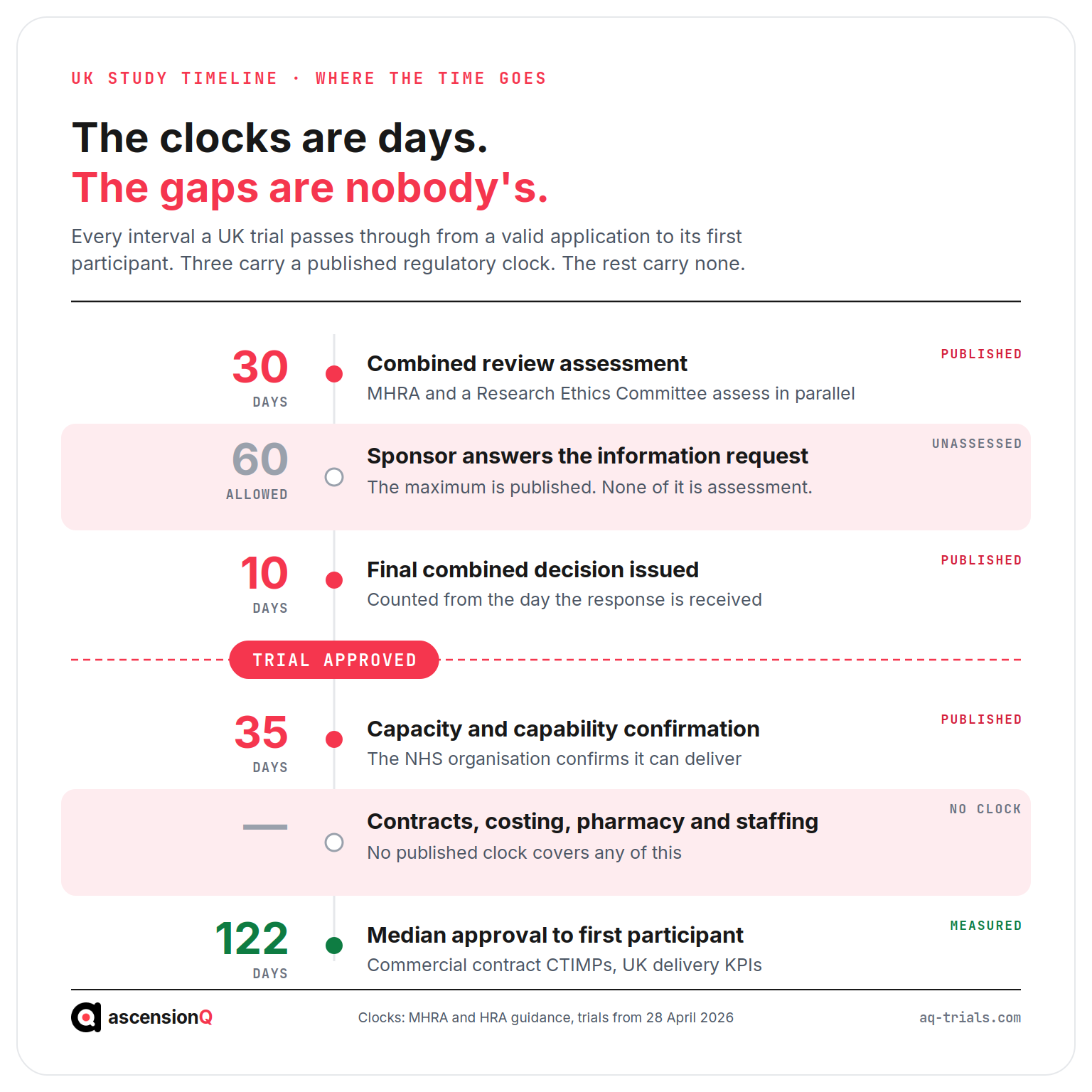
The distinction matters because a published clock has a named owner, a start date and a reporting line. An interval with no clock has none of those. It absorbs delay quietly and surfaces only when the end date moves.
How Long Does UK Approval Take Under the 2026 Rules?
The MHRA and a Research Ethics Committee decide a UK clinical trial application together through combined review. The European Medicines Agency has no role in authorising a UK trial. The amended UK Clinical Trials Regulations came into force on 28 April 2026 and set the clocks below.
| Step | Published clock | What it covers |
| Combined review, initial assessment | 30 calendar days from a valid application | The MHRA and the ethics committee assess in parallel and issue one combined decision |
| Response to a request for further information | Up to 60 calendar days for the sponsor | The sponsor’s own preparation time, which sits outside the assessment clock |
| Final combined decision | 10 calendar days from receipt of the response | The decision that allows the trial to proceed |
| Notification scheme for lower-risk trials | Automatic authorisation confirmed within 14 calendar days of validation | Trials meeting the published eligibility conditions, with the combined decision issued within 30 calendar days of validation |
| Substantial modification | 35 calendar days from validation | Both the licensing authority and the ethics committee approve before implementation |
| Modification of important detail | No review period | Notification to the authorities, with no approval step |
| Minor modification | No approval needed | Implemented immediately and recorded so it can be produced at inspection |
A trial that qualifies for the notification scheme still cannot start on the automatic authorisation alone. The combined decision has to arrive first. A site planning against the 14-day figure meets that condition in week three, so the 30-day figure is the one to put in a set-up plan.
The three modification categories carry very different operational weight. A minor modification costs a record. A substantial modification costs 35 days plus the work of implementing it at every site.
Also Read: NHS Clinical Research Software and ICH-GCP E6(R3): What the New UK CTR Requires
Where Does a UK Study Actually Lose Time?
Approval is the fast part of a UK study. The Health Research Authority reported in April 2026 that set-up time for commercial interventional trials had fallen to 122 days from 169 days, against a government target of 150 days for March 2026. The target was met. The distance between approval and a first participant still holds most of the delay.
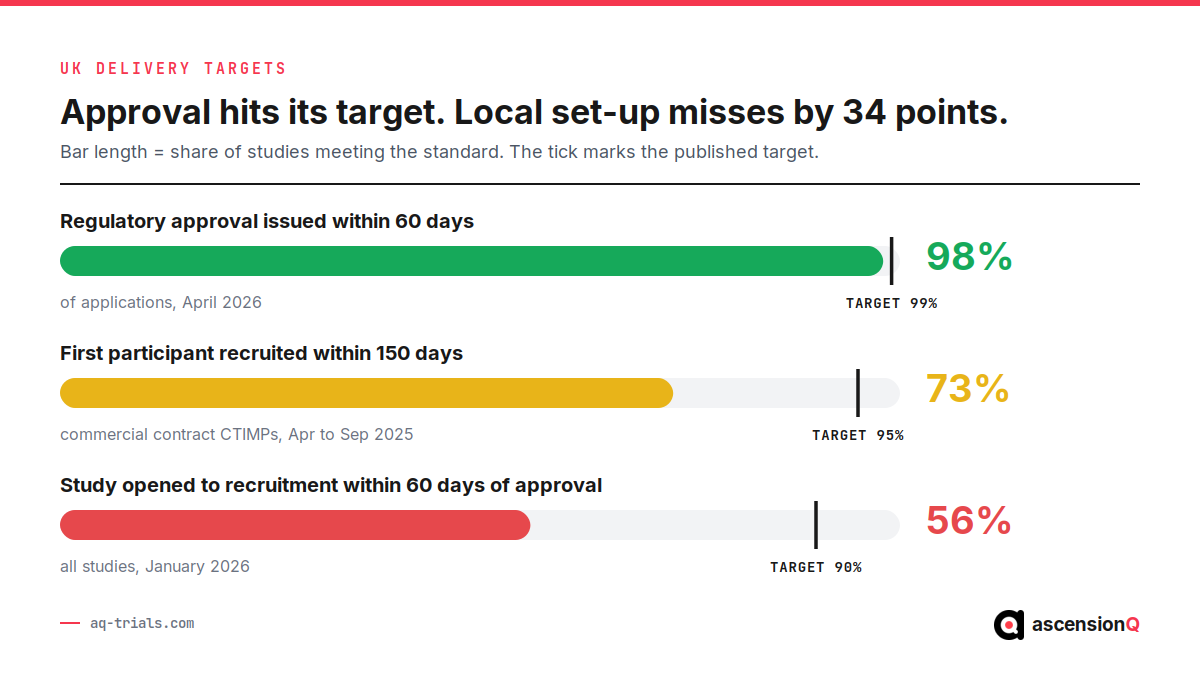
The UK clinical research delivery indicators show the split. Approval hits its standard almost every time. Local set-up misses its standard by a wide margin, and the same pattern appears in every release. Five things account for most of the local delay.
- The capacity and capability clock starts late. The 35-day confirmation period begins once a site holds a complete local information pack, which pushes the real delay upstream into document assembly.
- Contract signature waits on national costing. A commercial study priced through National Contract Value Review cannot reach signature until the costing template is agreed, so the two run in sequence rather than together.
- Pharmacy set-up depends on the final protocol version. A substantial modification landing mid-set-up restarts part of that work, which adds days that no plan allocated.
- Delegation and training must be complete before the first participant. A staffing change late in set-up removes days from a schedule that already assumed the team was fixed.
- First-participant readiness needs every item at once. The study opens on the slowest of them rather than the average, which is why most sites miss the 90-day set-up target even when four of five workstreams finish early.
National reporting changed shape in January 2026 as well. The Date Site Confirmed now ends the 60-day site set-up metric, so the two site measures no longer sum to elapsed time. A site tracking only the published metrics will understate its own duration.
Also Read: UK Clinical Research Delivery KPIs: What the Data Says About Trial Set-Up
What Did the April 2026 Regulations Change About Trial Timelines?
The amended regulations added deadlines that run against the study rather than against a regulator. Each one converts a date into a duty, and a study that loses the date loses either the approval or the compliance position behind it.
| New duty | The clock | What the study record has to hold |
| Recruit the first UK participant | Within 2 years of approval, with extensions available | The approval date and the first participant date per trial. The approval lapses without recruitment or an extension. |
| Register the trial publicly | Before the first participant signs the consent form | A registry entry and its reference against the study |
| Publish a summary of results | Within 12 months of the end of the trial | A reliable trial end date and the milestone history a results submission is assembled from |
| Register an older trial ending on or after 28 April 2026 | Within 90 calendar days of 28 April 2026 | Evidence that the trial was registered under the transitional arrangements |
| Offer participants a summary of results | Alongside publication | A record of what was offered, in what form, and to whom |
Terminology moved at the same time. An amendment is now a modification, and a subject is now a participant. Templates, SOPs and training materials written before April 2026 still carry the previous terms, and a review of those documents belongs in the same plan as the new deadlines.
How Long Does Licensing Take After the Trial Ends?
Licensing follows the trials and runs its own clocks. The MHRA operates three assessment routes for a UK marketing authorisation, and the published period for each excludes every clock stop inside it. Elapsed time is therefore longer than the headline figure in all three cases.
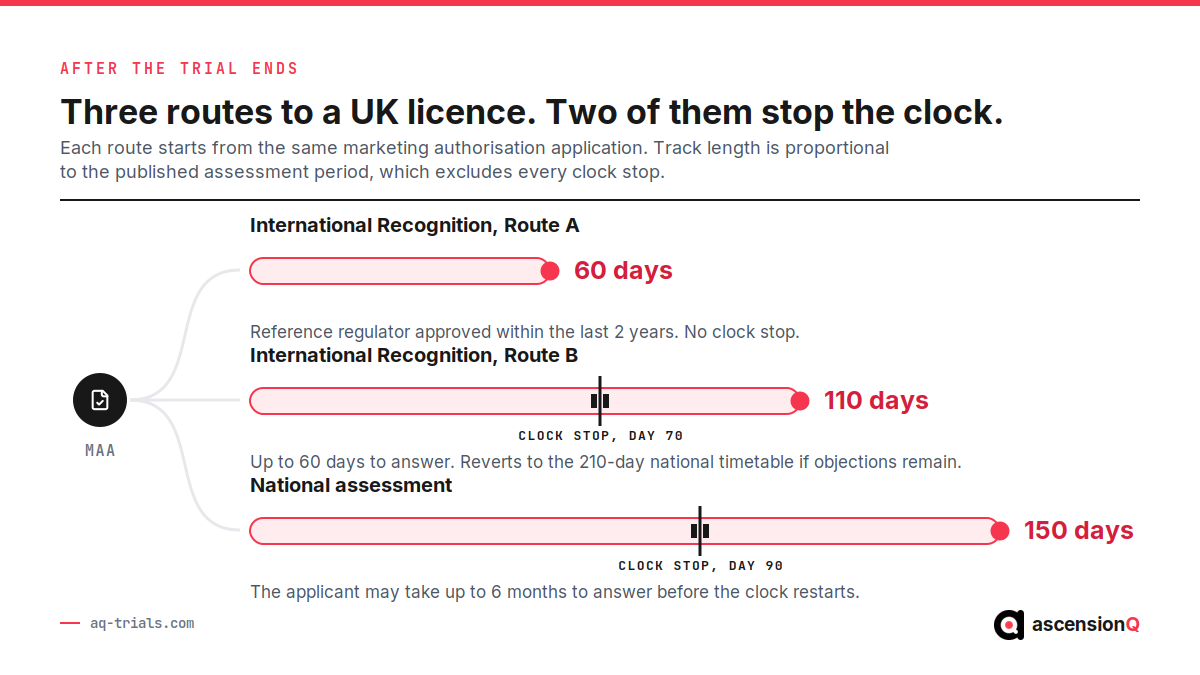
- International Recognition Route A runs to 60 calendar days and applies where the reference regulator granted approval within the previous two years. Route A carries no clock stop.
- Route B runs to 110 calendar days with one clock stop at day 70, and the applicant has up to 60 days to answer. Route B reverts to the 210-day national timetable if major objections remain at day 110.
- The national assessment reaches its 150-day milestone 60 calendar days after the procedure restarts. The clock stops at day 90 when the first request for information is issued, and the applicant may take up to six months to answer it.
- Validation precedes all three routes and completes within 14 days of submission.
The figure of one to two years often quoted for regulatory review describes elapsed time rather than assessment time. Both numbers are accurate, and they answer different questions. A programme plan needs the elapsed figure. A regulatory affairs plan needs the assessment figure.
Which Parts of the Timeline Can a Site Control?
A site controls almost none of the phase arc and most of the interval between approval and first participant. That interval carries the largest published gap against target, and a research office can manage it weekly.
A worked example makes the shape clear. Northgate General NHS Foundation Trust is a fictional site joining a phase 3 interventional study. Approval arrives on a Monday and the site opens to recruitment 104 days later. The delay divides as follows.
- 21 days waiting for the local information pack to be complete, before the confirmation clock starts.
- 34 days inside the capacity and capability confirmation period itself.
- 19 days for contract signature after the costing is agreed.
- 22 days for pharmacy set-up, which restarts when a substantial modification lands mid-set-up.
- 8 days to complete delegation and training records after two late staffing changes.
One of those five steps carries a published clock. The other four account for 70 of the 104 days and appear in no national figure until the end date moves. Four practices shorten them.
- One milestone record removes the reconciliation step. Approval dates, contract dates and first-participant dates sit against a single study rather than three trackers, which is also what CPMS and LPMS reporting needs at the end of the month.
- Visit windows measured at the point of booking prevent the deviation. A booking outside the protocol window is refused at entry rather than documented afterwards, which keeps recruitment moving.
- Delegation held as a live record keeps access aligned with authority. A staffing change costs an update rather than a rebuild, and the site retains proof of who held which task on which date.
- Document versions tied to the study record show which version was live when. That removes the search that follows every modification, and it supports the recruitment activity that depends on the current protocol.
Also Read: What Are the Best Practices for Selecting a Clinical Trial Site?
How Does AQ Shorten the Part of the Timeline You Control?
AQ holds study set-up, site activation, recruitment and the visit diary in one clinical trial management system, so the dates that decide a set-up timeline sit against a single study record. The modules of the AQ Platform share one access model, one audit trail and one study record, which removes the transfers and matches that separate systems create.
- AQ CTMS tracks approval, contract and first-participant dates against the study, which turns the 2-year recruitment condition and the 150-day set-up standard into milestones a research office reviews weekly rather than figures reconstructed at year end.
- The visit diary measures every booking against the protocol window at the point of booking, which prevents the deviation instead of documenting it.
- AQ eTMF and AQ eISF hold sponsor and site documentation in one structure, so a modification reaches the trial master file and every site file against the same index.
- AQ ePSF holds the investigational product chain from receipt to destruction, which ties pharmacy readiness to the protocol version that governs it.
- AQ QMS and AQ CAPA link SOP versions and training records to the findings raised against them, which shows the state of the system on the day of an event.
- AQ Digital DoA records delegated roles, qualifications and dates, so a late staffing change costs an update rather than the rebuild that ends a set-up plan.
AQ is aligned with Good Clinical Practice, UK GDPR and 21 CFR Part 11, and supplies validation, data security and governance evidence for NHS and sponsor procurement. Assurance covers G-Cloud, DSPT and Cyber Essentials.
Book a live demo and the walkthrough runs on your protocol structure, your site set-up and the milestone dates your research office reports against. Bring a study that is in set-up now and use the session to map where its days are going.