Every clinical trial moves through a series of controlled activities. Each stage adds data, decisions, documentation, and operational responsibility that directly affect participant safety, protocol compliance, and data integrity.
Unfortunately, completed study activity alone does not confirm compliant execution. Every critical step requires confirmation of correct execution, clear documentation, proper review, and controlled oversight. Clinical research audits provide that structured review.
Let’s discuss in detail. So, we can understand how the clinical research audit confirms compliant trial conduct, validates the strength of study records under sponsor or regulatory review, and assesses the control systems supporting safe, reliable, and inspection-ready clinical research.
What are Clinical Research Audits?
Clinical research audits are structured, independent reviews of clinical trial activities, systems, records, and processes performed to confirm that research is conducted in line with the approved protocol, Good Clinical Practice (GCP), sponsor requirements, standard operating procedures (SOPs), and applicable regulatory requirements. They verify that participant rights remain protected, study data stays accurate and traceable, and clinical trial operations maintain the level of control required for compliant, inspection-ready research delivery.
A clinical research audit typically covers:
- Protocol compliance and protocol deviation management
- Informed consent process and consent documentation
- Participant safety oversight and adverse event reporting
- Source documentation accuracy and ALCOA+ data integrity
- Case report forms (CRFs), EDC entries, and query resolution
- Investigator Site File (ISF) and Trial Master File (TMF) completeness
- Essential regulatory documents, approvals, and version control
- Investigator oversight, delegation of authority, and staff responsibilities
- Training records, qualifications, and GCP compliance
- Investigational product accountability and pharmacy controls
- Vendor, CRO, and third-party oversight
- CAPA, deviation, and incident management
- Electronic systems, audit trails, and system access controls
- Record retention, document traceability, and inspection readiness
Unlike routine operational oversight, clinical research audits assess the strength of the systems behind study execution. Notably, a clinical research audit examines whether research teams maintain clear documentation, controlled workflows, effective oversight, and consistent quality practices across the study lifecycle. The goal is not only to identify isolated compliance issues, but also to evaluate whether the broader research process can reliably support safe, accurate, and audit-ready trial conduct.
Read: AQ’s Guide to What is CTMS
Core Objectives of Clinical Research Audits
- Protect participant rights, safety, and wellbeing throughout trial conduct
- Verify compliance with the approved protocol, GCP, SOPs, and regulatory requirements
- Confirm data accuracy, completeness, consistency, and traceability across study records
- Evaluate the reliability of clinical trial processes, systems, and operational controls
- Identify protocol deviations, documentation gaps, and compliance risks early
- Assess whether delegated responsibilities, oversight, and role ownership remain controlled
- Verify that informed consent, safety reporting, and subject protections are consistently maintained
- Confirm that essential documents, approvals, and study records remain complete and inspection ready
- Evaluate sponsor, site, vendor, and CRO adherence to defined study responsibilities
- Detect process weaknesses that may affect data integrity, participant protection, or study quality
- Support CAPA development through clear identification of control failures and quality gaps
- Strengthen inspection readiness across study documentation, operations, and quality oversight
- Improve audit readiness through stronger process control, traceability, and accountability
- Drive continuous quality improvement across the clinical research lifecycle
Also Read: What is ePSF in Clinical Research?
Clinical Research Audits vs Monitoring vs Regulatory Inspections
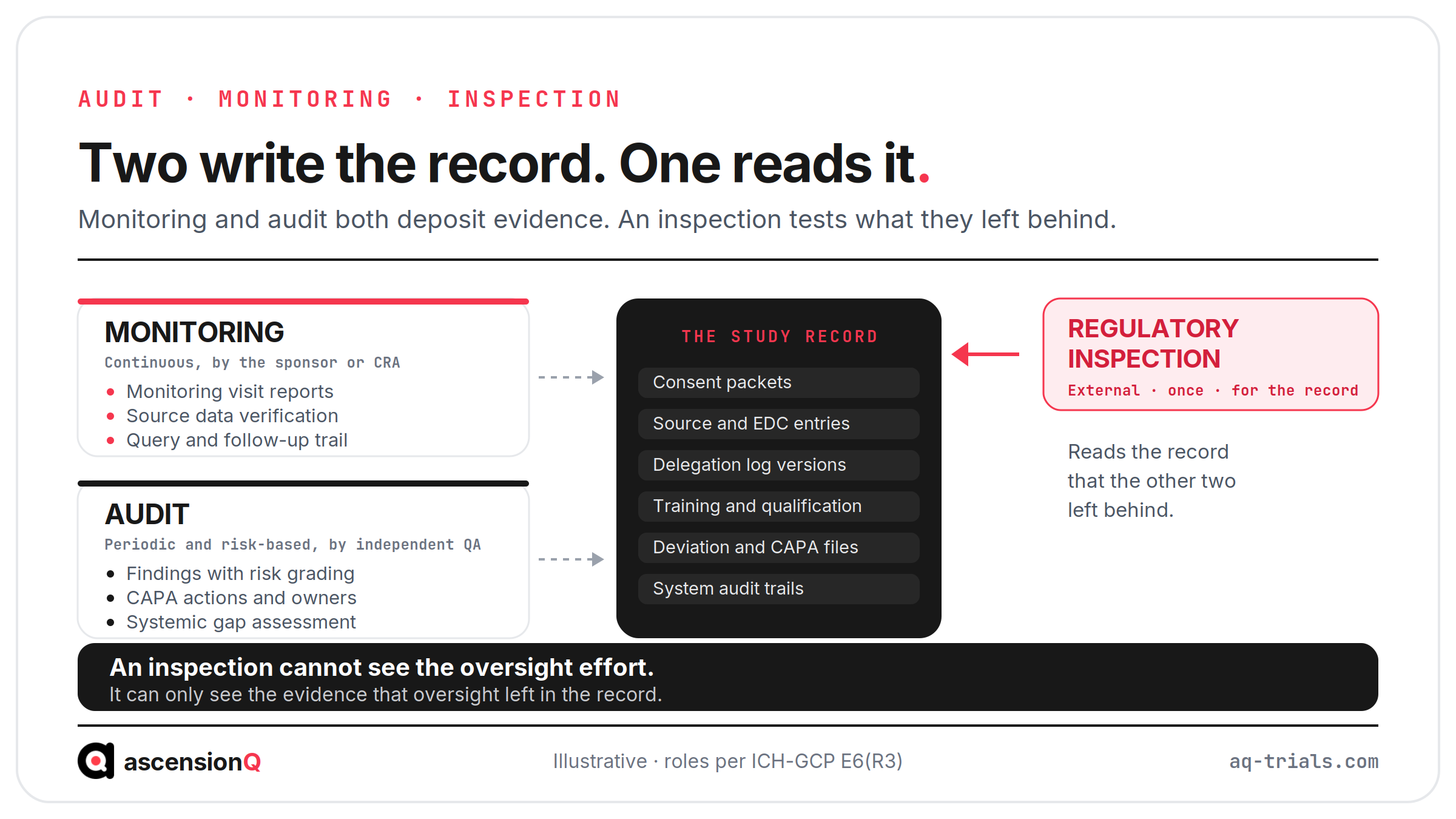
Audits and inspections of clinical trials are often used interchangeably, but they serve different functions within the same compliance system. The table below sets out how monitoring and auditing of clinical trials differ from each other, and from a regulatory inspection, in purpose, timing, and outcome.
| Area | Clinical Research Audits | Clinical Monitoring | Regulatory Inspections |
| Primary purpose | Independent quality assurance review of trial conduct, systems, and compliance | Ongoing study oversight to confirm day-to-day protocol adherence and data quality | Regulatory authority assessment of compliance with laws, GCP, and participant protections |
| Main focus | Quality systems, process control, compliance risk, and audit readiness | Study execution, source review, data verification, and site performance | Regulatory compliance, participant safety, data credibility, and inspection findings |
| Conducted by | Independent QA teams, sponsor QA, internal QA, or third-party auditors | Sponsor monitors, CRAs, or CRO monitoring teams | FDA, EMA, MHRA, IRBs, or other regulatory authorities |
| Level of independence | Independent from routine study operations | Operational oversight on behalf of sponsor or CRO | Fully external regulatory authority review |
| Timing | Planned at defined stages or triggered by risk | Continuous throughout the study lifecycle | Periodic, triggered, or for-cause |
| Frequency | Periodic, risk-based, routine, or for-cause | Ongoing and scheduled throughout study conduct | Less frequent, typically milestone-based or triggered |
| Scope | Broad review across systems, documentation, governance, and controls | Focused review of site conduct, source data, protocol adherence, and safety | Formal review of trial conduct, compliance, documentation, and regulatory obligations |
| Typical review areas | SOPs, TMF, ISF, CAPA, deviations, oversight, delegation, quality systems | Consent, source data, CRFs, safety reporting, protocol compliance, visit conduct | GCP compliance, protocol adherence, participant protection, data integrity, sponsor oversight |
| Output | Audit report with findings, risk grading, and CAPA actions | Monitoring report, action items, and follow-up requests | Inspection observations, findings, warning letters, or regulatory actions |
| Outcome focus | Identify systemic gaps and strengthen quality controls | Correct operational issues and improve study execution | Determine regulatory compliance and inspection readiness |
Also Read: CTMS vs QMS
Types of Clinical Research Audits
- Internal audits. Conducted by in-house quality or compliance teams to assess internal research processes, documentation controls, and operational readiness.
- External audits. Performed by independent third-party auditors to provide an objective review of trial conduct, systems, and compliance controls.
- Sponsor audits. Initiated by sponsors to evaluate investigator sites, vendors, CROs, and study processes against protocol, contractual, and regulatory expectations.
- Site audits. Focused reviews of investigator sites to assess protocol compliance, informed consent, source documentation, staff oversight, and subject safety.
- CRO audits. Performed to assess CRO oversight, monitoring quality, vendor management, documentation practices, and sponsor obligations.
- Vendor audits. Reviews of third-party vendors such as laboratories, ePRO providers, imaging vendors, central services, and technology providers involved in study delivery.
- Trial Master File (TMF) audits. Assess completeness, organisation, version control, and inspection readiness of trial master documentation.
- Investigator Site File (ISF) audits. Review site-level essential documents, delegation records, training files, approvals, and operational documentation.
- System audits. Assess validated research systems such as CTMS, eTMF, EDC, eISF, and eQMS for access control, audit trails, data integrity, and compliance.
- Process audits. Focus on specific operational workflows such as informed consent, safety reporting, CAPA handling, deviation management, or investigational product control.
- Routine audits. Scheduled audits performed at planned intervals as part of standard quality oversight.
- For-cause audits. Triggered by specific concerns such as serious deviations, repeated noncompliance, safety events, data concerns, or inspection findings.
- Pre-study audits. Conducted before study start to assess site, system, vendor, or process readiness before participant enrolment begins.
- In-study audits. Performed during active trial conduct to assess ongoing compliance, documentation quality, and operational control.
- Close-out audits. Conducted at study completion to review final documentation, data integrity, record completeness, and archival readiness.
- Mock inspection audits. Inspection-readiness exercises designed to simulate sponsor or regulatory inspection conditions and identify gaps before formal review.
When Clinical Research Audits are Conducted?
Clinical research audits are conducted at specific points in the study lifecycle to verify that trial execution remains controlled as operational risk changes. Audit timing is not based on calendar alone. In fact, it follows study risk, patient impact, protocol complexity, data sensitivity, and the likelihood of control failure.
For instance, a low-risk observational registry may only require limited quality review. However, a Phase II oncology study with dose escalation, safety-heavy visits, central imaging, and frequent amendments requires multiple audits across the study lifecycle. This is mainly because the risk to participant safety, protocol compliance, and data integrity is materially higher.
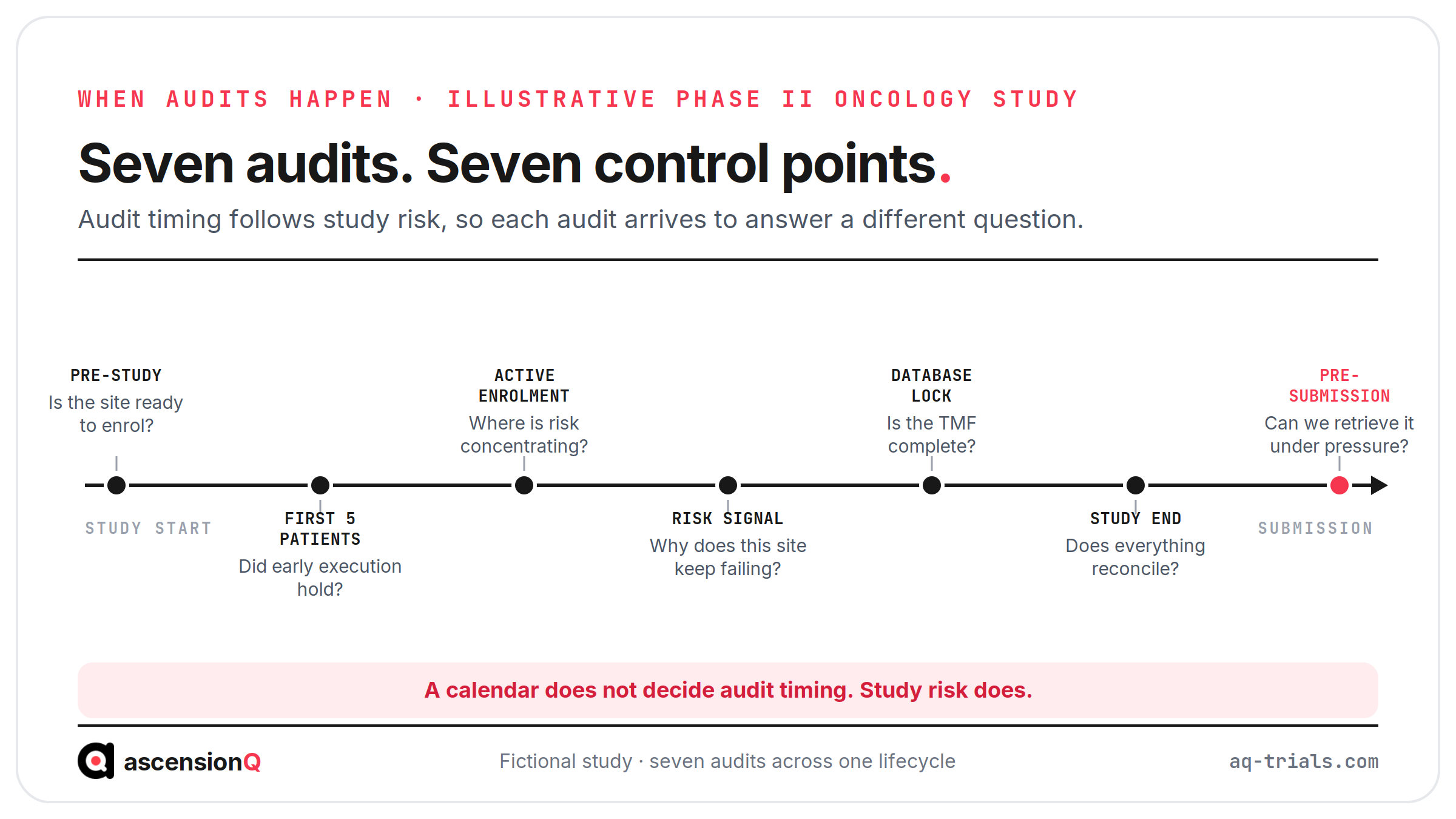
Let us walk through one example. A sponsor is running a Phase II oncology study across 12 sites to evaluate a new investigational therapy in patients with advanced solid tumours. The protocol includes strict eligibility criteria, tumour imaging every 6 weeks, SAE reporting within 24 hours, dose interruption rules, pharmacy-controlled investigational product handling, and central lab review. This study moves through several audit stages because each phase introduces a different control risk.
- Pre-study audit before first patient enrolled
The sponsor audits Site 03 before activation to confirm startup readiness. The audit reviews IRB approval, investigator qualifications, protocol training, delegation records, temperature-controlled drug storage, and system access for EDC and randomisation.
During review, the auditor finds the sub-investigator is listed on the delegation log but has not completed protocol-specific training, the pharmacy temperature excursion escalation process is undocumented, and the site has access to EDC but no documented role-based access review. The site is not failed, but activation is paused until training is completed, pharmacy escalation is documented, and user access is revalidated. This is a pre-study site audit focused on startup control.
- Routine in-study audit after first 5 patients enrolled
Eight weeks after activation, the sponsor performs a routine in-study audit at Site 03 to verify early study execution. The auditor reviews informed consent, eligibility confirmation, source documentation, first-dose administration, SAE handling, and source-to-EDC consistency for the first five patients.
The audit finds one patient was consented on the correct IRB-approved form, but the person obtaining consent signed the form one day later than the participant. Another patient was enrolled with borderline liver function values that required PI eligibility confirmation, but the source note does not document the PI decision. The auditor also finds two adverse events entered in source notes 3 days before they were entered in EDC. This is documented as an in-study routine audit with findings related to consent execution, eligibility documentation, and delayed transcription control.
- Risk-based process audit during active enrolment
At month four, the sponsor sees a pattern across three sites: frequent dose holds, delayed AE reconciliation, and repeated queries on tumour assessment windows. A focused process audit is opened on safety and efficacy-critical workflows. Auditors review dose modification decisions, AE grading, tumour imaging windows, and central imaging reconciliation.
At Site 07, the audit finds dose interruptions were clinically appropriate but not documented against protocol-defined toxicity thresholds. At Site 09, CT scans were completed on time, but one tumour progression assessment was entered into EDC 11 days late and missed central review cutoff. At Site 03, AE severity is documented in source but causality assessment is missing in two cases. This is a risk-based process audit focused on high-risk study procedures. The finding is not just delayed entry. The finding is that safety and endpoint-critical workflows are clinically executed but operationally under-controlled.
- For-cause audit triggered by repeated site risk
At month six, monitoring escalates Site 09 after repeated protocol deviations, three late SAE reports, and unresolved data queries older than 30 days. A for-cause audit is initiated. Auditors review the last ten enrolled patients, site staffing, monitoring follow-up, PI oversight, and deviation closure.
The audit finds the site coordinator has been performing safety follow-up and EDC reconciliation without documented backup coverage, deviation logs are maintained retrospectively, and the PI signed visit reviews in batch at month-end rather than during active oversight. This is logged as a for-cause audit. The core finding is not simply “late SAE reporting.” The actual control failure is weak PI oversight, single-person workflow dependency, and retrospective issue management.
- TMF audit before database lock
Before database lock, sponsor QA performs a TMF audit to confirm study documentation is complete for final analysis and submission readiness. Auditors review protocol amendment history, approval dates, monitoring follow-up letters, vendor oversight records, central lab documentation, and CAPA closure evidence.
The audit finds Amendment 4 was implemented at all sites, but site acknowledgment is missing in the TMF for two sites. A central lab deviation was escalated by email, but no formal vendor deviation record exists in the sponsor file. Three CAPAs are marked closed, but effectiveness review evidence is missing. This is a TMF audit and the findings relate to document completeness, vendor traceability, and incomplete CAPA closure.
- Close-out audit at study end
After last patient last visit, the sponsor conducts a close-out audit across selected sites and sponsor records. Auditors review final drug accountability, subject disposition, protocol deviation reconciliation, essential document completeness, and archive preparation. At Site 03, investigational product returns reconcile correctly, but one subject withdrawal reason differs between source and EDC. At Site 07, all records are present, but the final delegation log version was filed without documenting one staff end date. This is a close-out audit focused on final reconciliation and archival completeness.
- Mock inspection before regulatory submission
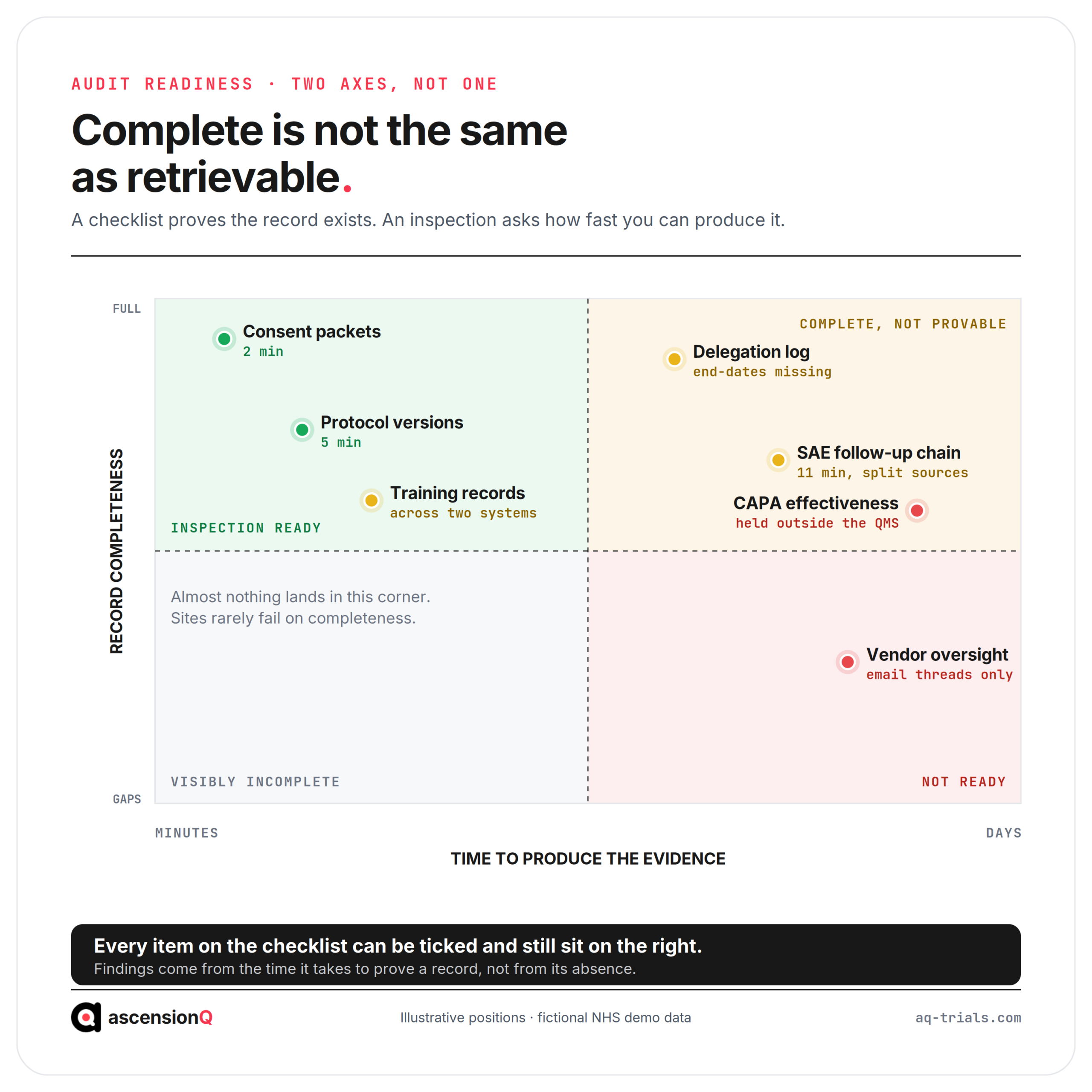
Before inspection readiness activities begin, the sponsor runs a mock inspection with QA acting as regulators. Staff are asked to retrieve one informed consent packet, one SAE follow-up trail, one dose reduction decision, one vendor escalation, and one closed CAPA with effectiveness evidence. The site retrieves the consent file in 2 minutes.
The sponsor retrieves the SAE chain in 11 minutes because follow-up correspondence is split across email and safety tracker. The CAPA is retrieved, but the effectiveness review is stored outside the quality system. This is a mock inspection audit. The finding is not missing documentation. The finding is fragmented retrieval control under inspection pressure.
This is how clinical research audits are actually conducted in practice. Each audit is introduced when the study reaches a different control point. Each audit reviews a specific operational risk. Each audit tests whether the process works under real study conditions.
This is what audit readiness looks like under real study pressure. Delegation, training, CAPA, and system access all have to hold together at once. See how AQ keeps that evidence connected in one record. Book a 30-min demo.
Who Conducts Clinical Research Audits?
| Audit Type | Conducted By | Primary Role in the Audit | What They Typically Assess |
| Internal audit | Internal QA or compliance teams | Evaluate internal study controls, process adherence, and operational quality | SOP compliance, internal workflows, documentation control, CAPA, training, and quality governance |
| Sponsor audit | Sponsor QA teams | Assess whether sites, CROs, and vendors are meeting sponsor and regulatory expectations | Site performance, protocol compliance, oversight quality, documentation, and inspection readiness |
| CRO audit | Sponsor QA or CRO quality teams | Review CRO execution, oversight quality, and delegated sponsor responsibilities | Monitoring quality, vendor oversight, issue escalation, documentation, and study delivery controls |
| Site audit | Sponsor QA, internal QA, or independent auditors | Assess site-level study conduct and participant-facing trial execution | Informed consent, eligibility, source documentation, PI oversight, safety reporting, and investigational product handling |
| Vendor audit | Sponsor QA or third-party auditors | Evaluate third-party service providers supporting trial execution | Laboratory controls, imaging workflows, ePRO systems, logistics, data handling, and service compliance |
| TMF audit | Sponsor QA, document control, or independent auditors | Assess trial master documentation quality and inspection readiness | TMF completeness, filing quality, version control, approvals, and document traceability |
| ISF audit | Sponsor QA, site QA, or independent auditors | Review site-level essential document control and investigator documentation | Regulatory binder, delegation, training records, approvals, consent documents, and site documentation |
| System audit | QA, validation, IT compliance, or independent auditors | Assess validated research systems used in trial operations | Access control, audit trails, validation, user permissions, electronic records, and data integrity |
| For-cause audit | Sponsor QA, internal QA, or independent auditors | Investigate specific concerns, escalations, or repeated compliance failures | Root issue patterns, deviations, safety events, unresolved queries, and oversight breakdowns |
| Mock inspection audit | Internal QA, sponsor QA, or external consultants | Simulate sponsor or regulatory inspection conditions | Retrieval readiness, inspection response, documentation traceability, staff preparedness, and CAPA evidence |
| Regulatory inspection | FDA, EMA, MHRA, IRB, or other authorities | Determine compliance with regulatory and ethical requirements | GCP compliance, participant safety, protocol adherence, data integrity, and sponsor oversight |
What Exactly Clinical Research Auditors Review?
Clinical research auditors review the records, systems, decisions, and controls that show how a clinical trial was actually conducted. The objective is to verify that study activity was performed as approved, documented as performed, and controlled in a way that protects participants, preserves data integrity, and supports regulatory compliance.
A clinical research audit typically reviews:
- Protocol compliance (whether the study followed the approved protocol exactly as written)
- Informed consent (whether participants were consented correctly, on time, and using the right approved forms)
- Participant safety oversight (whether adverse events, medical decisions, and subject protections were handled correctly)
- Source documentation (whether clinical records clearly support what happened during the study)
- CRF and EDC accuracy (whether reported study data matches source records and was entered correctly)
- Protocol deviation control (whether protocol deviations were identified, documented, and managed properly)
- CAPA and issue management (whether issues were investigated properly and corrected with effective follow-up)
- Investigator oversight (whether the principal investigator actively supervised study conduct and participant safety)
- Delegation of authority (whether tasks were assigned clearly to qualified staff with documented responsibility)
- Staff training and qualification (whether study staff were trained, qualified, and approved to perform their assigned tasks)
- Essential document control (whether study files, approvals, logs, and required records were complete and organised)
- Investigational product accountability (whether study drug was stored, dispensed, tracked, and reconciled correctly)
- Vendor and third-party oversight (whether CROs, labs, and external vendors were managed and documented properly)
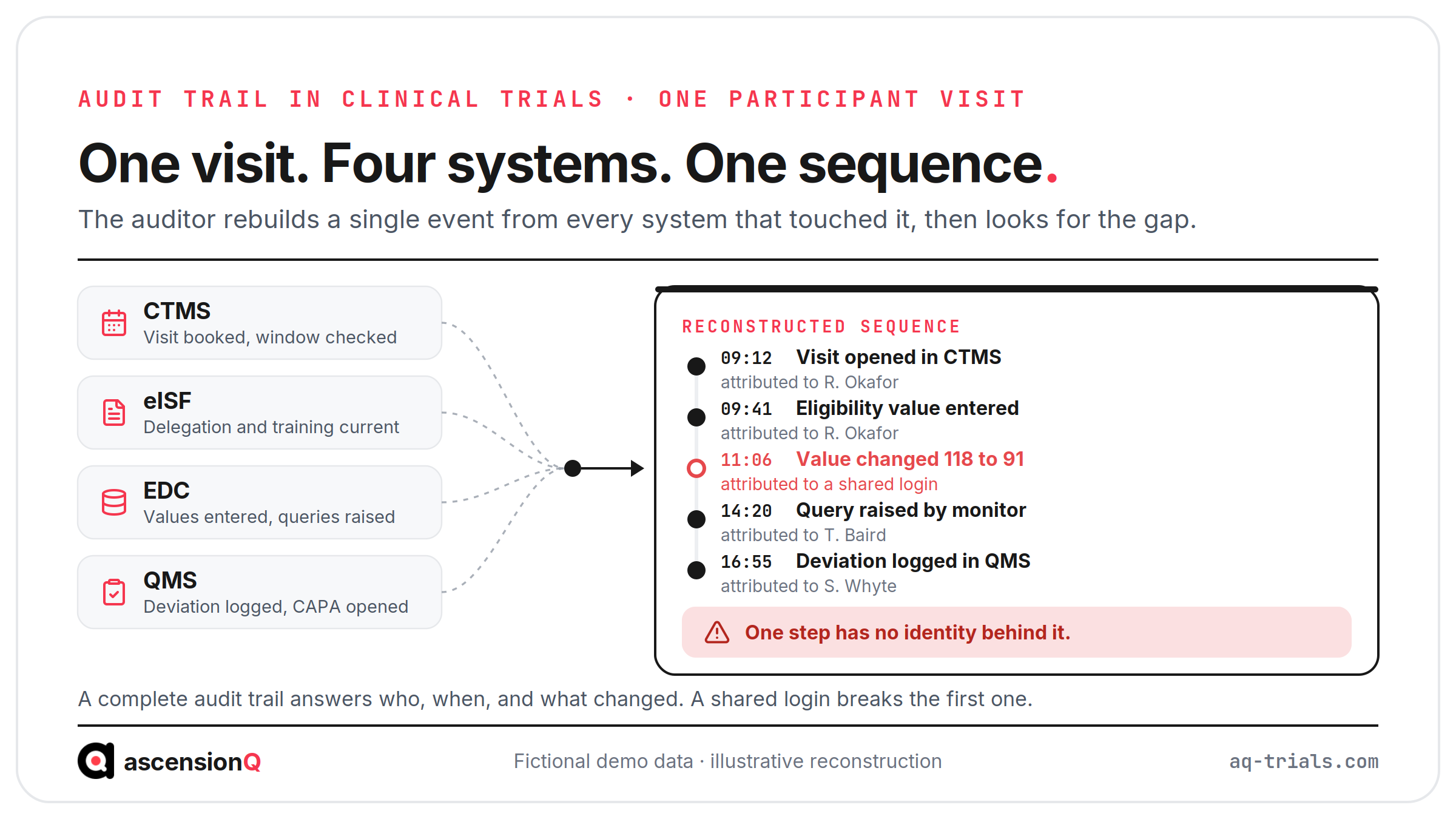
- Electronic systems and audit trails (whether every system supporting the trial, including CTMS, eTMF, eISF, and EDC, maintains a complete audit trail in clinical trials: who accessed what, when, and what changed, with no gaps or manual overrides)
- Data integrity and traceability (whether study data remained complete, consistent, accurate, and fully traceable)
The CRF, EDC, and source-documentation items above form the core of any clinical trial data management audit checklist. The auditor is checking that what the system records is what actually happened at the site.
Which Software is Used for Clinical Research Audits?
The question of how to use clinical trial audit software matters as much as the question of which software you pick. In practice, the strongest audit control comes from a unified clinical research platform where study operations, documentation, quality workflows, CAPA, and delegated responsibilities remain connected in one controlled system rather than fragmented across disconnected tools.
| Software Category | What It Is Used For in Clinical Research Audits | What Auditors Typically Verify |
| CTMS | Tracks study setup, site activity, visit schedules, milestones, enrolment, and operational oversight | Study progress, visit completion, oversight activity, milestone traceability, and operational control |
| eTMF | Maintains trial master documentation in a structured, controlled, inspection-ready format | Document completeness, filing quality, version control, approvals, and inspection readiness |
| eISF | Maintains investigator site documentation, regulatory files, delegation records, and site-level study documents | Site file completeness, training records, delegation control, approvals, and site readiness |
| EDC | Captures clinical trial data, CRFs, query resolution, and subject-level study records | Source-to-EDC consistency, data accuracy, query handling, audit trail, and data traceability |
| eQMS | Manages quality events, SOPs, deviations, CAPA, change control, and compliance workflows | Deviation control, CAPA closure, SOP governance, issue escalation, and quality oversight |
| CAPA management software | Tracks corrective actions, preventive actions, ownership, due dates, and effectiveness review | CAPA traceability, ownership, closure evidence, and effectiveness verification |
| Digital DoA | Maintains delegation of authority, responsibility assignment, signature control, and role traceability | Delegation accuracy, effective dating, role ownership, signature control, and staff accountability |
| LMS / training management | Tracks staff training, protocol training, GCP completion, and role-based competency | Training completion, role alignment, qualification evidence, and retraining control |
| Safety / pharmacovigilance system | Manages adverse event intake, SAE workflows, medical review, and safety reporting | Safety reporting timelines, case handling, escalation, and follow-up traceability |
| RTSM / IRT | Controls randomisation, subject assignment, investigational product allocation, and blinding workflows | Randomisation control, treatment assignment, access control, and blinding integrity |
| eConsent | Manages electronic informed consent workflows, signatures, version control, and consent traceability | Consent version control, signature sequence, timestamp traceability, and participant consent records |
| Document management system | Stores controlled SOPs, policies, training files, and governed operational documentation | Document version control, approvals, access restrictions, and controlled document governance |
| Audit management software | Plans audits, records findings, tracks responses, and manages audit follow-up | Audit trail, finding traceability, risk grading, response management, and closure control |
AQ connects CTMS, eTMF, eISF, QMS, CAPA, and Digital DoA in one platform instead of stitching these together. See AQ Platform.
Clinical Research Audit Process Step by Step
- Define the audit scope and objectives through CTMS, QMS, and audit management software to establish audit type, study coverage, ownership, and review priorities
- Perform risk assessment through QMS, CTMS, EDC, deviation records, and issue logs to identify high-risk sites, processes, systems, and study functions
- Build the audit plan through audit management software and CTMS to assign auditors, define timelines, schedule review activity, and control execution
- Issue audit notification through controlled audit workflows to confirm scope, agenda, participants, timelines, and required audit access
- Complete pre-audit document review through eTMF, eISF, CTMS, and document control systems to assess study records before active review begins
- Conduct the opening meeting through the controlled audit agenda to confirm scope, audit flow, stakeholder responsibilities, and evidence access
- Review study processes and operational workflows through CTMS, SOPs, Digital DoA, and study activity records to assess how trial activity is executed and controlled
- Review study documents and controlled records through eTMF, eISF, QMS, EDC, and regulated document systems to assess completeness, control, and compliance
- Verify source data, evidence trails, and traceability through source records, EDC, audit trails, and linked study systems to confirm consistency and data integrity
- Assess staff responsibility and oversight through Digital DoA, training records, qualification files, and role ownership controls to confirm execution authority and accountability
- Record findings and classify risk through audit management software and QMS to document observations, grade severity, and assign control impact
- Conduct the closeout meeting through the formal audit summary to review findings, evidence, risk level, and immediate response expectations
- Issue the audit report through controlled audit documentation to formalise findings, risk grading, required action, and response timelines
- Review CAPA responses through QMS and CAPA workflows to assess root cause, action ownership, remediation quality, and implementation timelines
- Verify CAPA effectiveness through controlled follow-up review, QMS evidence, and effectiveness checks to confirm that corrective action resolved the control failure
- Close the audit through audit management software, QMS, and controlled follow-up records to confirm closure, preserve audit history, and maintain traceable oversight
Risk-Based Auditing in Clinical Research
Risk-based auditing is the modern audit model used in clinical research to focus audit effort where study risk is highest. Instead of reviewing every site, process, and document with the same intensity, risk-based auditing prioritises the areas most likely to affect participant safety, protocol compliance, data integrity, and regulatory exposure. This approach allows audit teams to direct time and resources toward the parts of the study that carry the greatest operational and compliance risk.
In practice, risk-based auditing determines what should be audited, when it should be reviewed, and how deep the audit should go. Audit scope is prioritised through risk signals such as protocol complexity, safety burden, site performance, repeated deviations, delayed data entry, unresolved CAPA, vendor dependency, and inspection exposure. A low-risk process may receive limited review. A high-risk process with repeated control failures receives deeper audit focus.
In clinical research, risk-based auditing typically prioritises:
- High-enrolling or high-risk sites
- Complex protocols and amendment-heavy studies
- Safety-critical workflows and SAE reporting
- Protocol deviations and repeat noncompliance
- Source-to-EDC inconsistencies and data quality risk
- Investigational product handling and pharmacy control
- Vendor-managed activities with weak oversight
- CAPA delays, unresolved findings, and repeat issues
- Endpoint-critical processes affecting primary outcome data
- Studies approaching submission, inspection, or database lock
Risk-based auditing improves audit efficiency by reducing low-value review and increasing control over the areas most likely to fail under sponsor or regulatory scrutiny. It also strengthens audit impact because findings are tied to actual operational risk rather than generic document gaps. This makes audit outcomes more useful for CAPA, more relevant to study quality, and more effective for inspection readiness.
The PDCA Model in Clinical Research Audits
The PDCA model in clinical research audits is used to assess where a control failure occurred within the study process. PDCA stands for Plan, Do, Check, and Act. In clinical research auditing, this model helps auditors move beyond identifying what went wrong and determine where the underlying process failed. Instead of recording only the visible issue, auditors use PDCA to assess whether the failure originated in study planning, operational execution, oversight control, or corrective response.
This approach strengthens audit quality because it shifts the focus from isolated errors to process-level control failure. A protocol deviation, delayed SAE, or missing document is rarely the real problem on its own. The real issue is the control breakdown that allowed it to happen, remain undetected, or repeat. PDCA gives auditors a structured way to locate that breakdown and connect audit findings to the process that failed.
In clinical research audits, PDCA is applied as follows:
- Plan (was the study designed, documented, and assigned correctly before execution began)
- Do (was the study executed correctly in day-to-day trial operations)
- Check (was oversight in place to detect issues early and confirm control)
- Act (were issues corrected properly and prevented from recurring)
For example, a site misses the 24-hour SAE reporting window for two subjects. The audit finding is not limited to delayed reporting. The auditor uses PDCA to assess where the failure occurred.
- Plan identifies that the site had no documented SAE escalation workflow for after-hours reporting
- Do confirms the coordinator recorded the event but delayed escalation until the next business day
- Check shows the PI did not review SAE timeliness or active safety logs during oversight
- Act confirms the same delay had occurred previously, but no corrective control was implemented
The final audit finding is stronger because it identifies the process failure, not only the late report. The control weakness is not simply delayed SAE submission. The actual failure is incomplete safety escalation planning, weak oversight, and ineffective corrective follow-through.
This is why PDCA is valuable in clinical research audits. It helps auditors identify where control failed, helps quality teams investigate the right root cause, and leads to stronger CAPA at the process level rather than narrow correction of isolated errors.
Common Clinical Research Audit Findings
- Incomplete or inconsistent informed consent documentation
- Missing protocol-required eligibility confirmation
- Protocol deviations documented late or not documented at all
- Delayed adverse event or serious adverse event reporting
- Incomplete source documentation or weak source attribution
- Source-to-EDC inconsistencies and unresolved data discrepancies
- Missing investigator oversight documentation
- Outdated or incomplete delegation of authority records
- Training gaps or undocumented staff qualification
- Missing signatures, dates, or approval evidence in study records
- Incomplete ISF, TMF, or essential document filing
- Weak version control across protocol, consent, or controlled documents
- Poor investigational product accountability or reconciliation gaps
- Incomplete CAPA documentation or weak effectiveness review
- Repeated deviations without documented trend review
- Weak vendor oversight or missing third-party traceability
- Missing audit trail review or uncontrolled system access
- Incomplete record retention, archival, or inspection readiness control
CAPA in Clinical Research Audits
CAPA in clinical research audits refers to corrective and preventive action taken to address audit findings, resolve control failures, and prevent the same issue from recurring. Once an audit identifies a compliance gap, process weakness, or operational failure, CAPA is used to investigate what caused the issue, define what must be corrected, assign ownership, implement action, and verify that the fix was effective. CAPA is the formal mechanism that turns audit findings into controlled remediation and measurable quality improvement.
In clinical research, CAPA is not limited to closing an audit finding. It is used to determine whether the issue was caused by poor execution, weak process design, missing oversight, inadequate training, system failure, or ineffective control. A strong CAPA process addresses the source of failure, not only the visible error. This is what makes CAPA central to audit readiness, inspection response, and long-term quality control.
A clinical research CAPA process typically includes:
- Finding review and issue confirmation
- Root cause investigation
- Impact and risk assessment
- Corrective action definition
- Preventive action definition
- Action ownership and due date assignment
- Remediation execution
- Evidence collection and documentation
- Effectiveness verification
- CAPA closure and follow-up tracking
In practice, CAPA is considered effective only when the issue is corrected, the control gap is closed, and evidence confirms the same failure is no longer likely to recur.
Clinical Research Audit Readiness Checklist
Use this checklist to confirm clinical trial audit preparation is complete before a sponsor or regulator asks to see it. It works as a practical GCP audit checklist and TMF audit checklist rolled into one, covering consent, source data, delegation, and CAPA evidence. Audit-ready clinical documentation then exists throughout the study rather than assembled in the final week.
- Protocol version is current, approved, and in active use
- Informed consent forms are approved, complete, and signed correctly
- Eligibility decisions are documented and source supported
- Source documentation is complete, attributable, and contemporaneous
- CRFs and EDC entries match source records
- Adverse events and serious adverse events are documented and reported on time
- Protocol deviations are documented, assessed, and trended
- CAPA records are current, assigned, and supported by evidence
- Investigator oversight is documented and current
- Delegation of authority records are accurate and up to date
- Staff training records are complete and role aligned
- ISF and TMF files are complete, current, and inspection ready
- Essential approvals, logs, and study records are filed and controlled
- Investigational product storage, dispensing, and reconciliation are accurate
- Vendor oversight records are complete and traceable
- Electronic systems are validated, controlled, and audit trail enabled
- User access and signature controls are current and role appropriate
- Document version control is consistent across active study records
- Record retention and archive preparation are complete
- Study records are organised for rapid audit retrieval
How AQ Platform Improves Clinical Research Audit Readiness?
AQ improves clinical research audit readiness by keeping study operations, documentation, quality workflows, CAPA, and delegated responsibilities connected in one controlled clinical research platform. Instead of forcing research teams to reconcile fragmented records across separate systems, AQ maintains one connected study environment where operational activity, document status, quality actions, and ownership remain visible, traceable, and inspection ready in real time.
This strengthens audit readiness across the areas auditors review most:
- Centralised CTMS, eTMF, eISF, QMS, CAPA, and Digital DoA maintain one connected study record
- Structured filing, version history, and controlled ownership improve document control
- Linked operational records reduce manual reconciliation across study activity and documentation
- Role assignment, signature control, and delegated responsibility improve accountability
- Deviation tracking, CAPA workflows, and effectiveness review strengthen quality control
- Connected oversight improves visibility across investigators, coordinators, quality teams, and pharmacy
- Linked records and controlled workflows improve audit traceability and evidence retrieval
- Real-time document status and operational visibility improve inspection readiness
- Centralised access to study records, quality actions, and audit evidence improves response speed
- Unified control across documentation, operations, and quality reduces audit preparation burden
A live walkthrough shows audit evidence pulled straight from live records: document status by site, deviations linked to their CAPAs, and delegation history retrieved without manual reconciliation. Book a live demo to see how AQ supports audit readiness across your studies.
Clinical Research Audit FAQs
How should I audit a CRO to ensure GCP compliance?
Audit the CRO against the responsibilities the sponsor transferred in writing. Review the delegation schedule first, then test each transferred duty for evidence: monitoring visit reports, issue escalation records, and CAPA closure with effectiveness review. A CRO audit confirms the sponsor kept oversight of the duties it delegated. See how AQ supports CRO oversight.
How do I evaluate a CRO’s inspection readiness?
Test retrieval under time pressure. Ask the CRO to produce a named evidence set within an agreed window: one consent packet, one SAE follow-up chain, one delegation log version, and one closed CAPA with effectiveness evidence. Retrieval speed shows whether records are governed or assembled on request. Read more on inspection readiness in clinical trials.
What should I look for when selecting an external QA partner?
Look for auditors with therapeutic-area experience, MHRA or FDA inspection exposure, and a reporting format that grades findings by risk. Ask for a redacted sample report before you appoint. The strongest partners hand over findings your quality system can action directly, which is where CAPA tracking and effectiveness review carry the work forward.
How should I structure investigator site audits without disrupting operations?
Schedule around the visit calendar, request the document set in advance, and give the site a written agenda naming the artefacts you will review. Remote review of the site file before arrival removes most of the on-site burden. Sites running a controlled eISF grant access instead of preparing binders.
What is the difference between an audit finding and a regulatory inspection finding?
An audit finding comes from an independent quality review commissioned by the sponsor or the organisation itself, and it drives internal CAPA. An inspection finding comes from a regulatory authority and carries formal consequence, graded critical, major, or other. Read the most common MHRA GCP inspection findings.