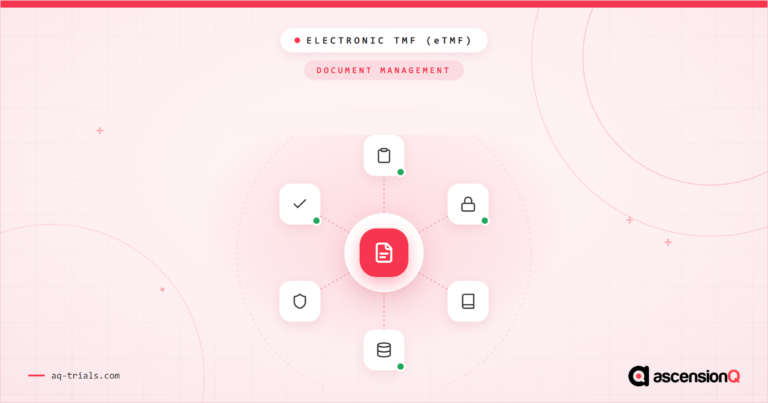
Sponsor portals, shared drives, email exchanges, local trackers — most eTMF systems on paper sound centralised and behave like none of it ever was. AQ eTMF actually centralises the trial master file: structured filing, completeness tracking, review workflows, and operational dashboards that give clinical operations teams direct insight into study records instead of a reconciliation exercise before every audit.
It’s built as connected trial master file software — part of the same platform as AQ’s document management (DMS) and QMS, not a bolt-on filing tool — so TMF documentation, site files, and quality findings stay linked across the study lifecycle.
Record visibility
QC + CAPA
oversight
Fragmented trial documentation across sponsor portals, shared drives, email exchanges, and local trackers delays understanding of record completeness and review progress — forcing additional operational effort and limiting consistent oversight of study records.
 With AQ
Operational teams rely on reconciliation reviews to confirm record presence, approval status, and outstanding follow up across studies and research sites.
Fragmented documentation structures reduce clear visibility of record completeness, approval progress, and unresolved documentation gaps.
Late confirmation of record status slows response to missing records, incomplete approvals, and unresolved follow up actions.
Operational teams spend time reconstructing documentation status instead of maintaining consistent oversight of study records and follow up activity.
AQ eTMF’s structured repositories, completeness tracking, review workflows, and operational dashboards give clinical operations teams direct insight into study records and follow-up activity across studies and research sites — so the focus stays on study execution instead of reconstructing record status.
Structured file architecture and completeness tracking present clear visibility into record presence, approvals, and outstanding follow up across studies.
Centralised repositories, automated record indexing, and activity dashboards remove the need for manual comparison of site submissions and shared records.
Completeness indicators, review workflows, and alert mechanisms highlight missing records and pending approvals earlier in the study lifecycle.
Operational dashboards and structured follow up workflows support faster resolution of record gaps during study start up and execution.
AQ electronic trial master file (eTMF) platform provides all the operational controls
required to manage clinical trial documentation within one structured research
environment.
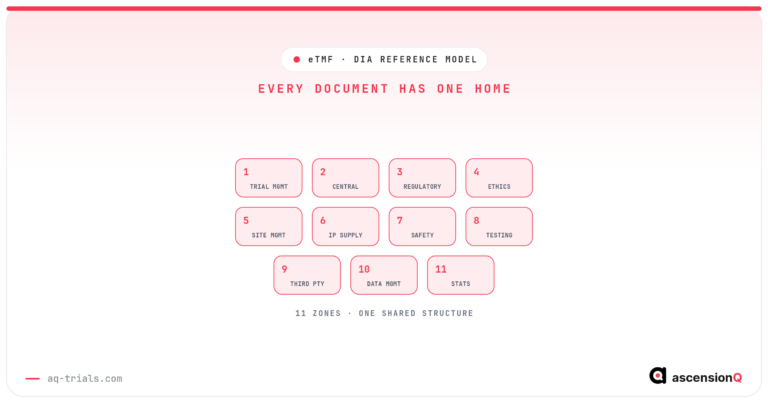
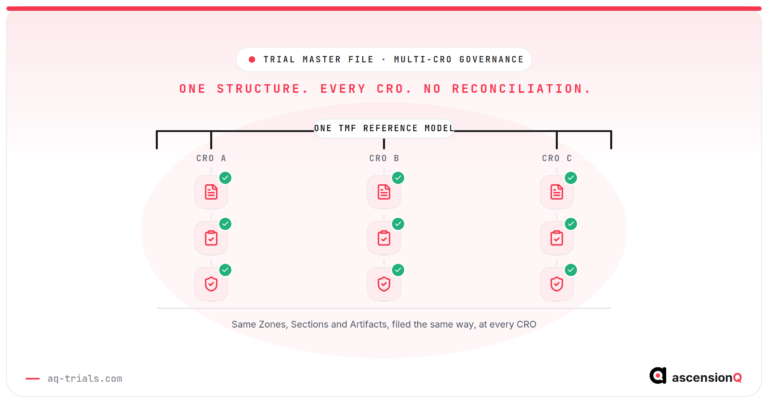
AQ eTMF is built on the DIA TMF Reference Model V3.x, all ten zones, sections, and artifact types in a structured filing hierarchy. Every document is scoped to zone, section, artifact, country, and site. Teams navigate by TMF structure or geographic hierarchy, with document counts and status at every level.
Upload individually or in bulk: drag-and-drop, multi-file, or API. Every upload triggers virus scanning, file validation, and mandatory metadata enforcement before a document enters the file. Bulk manifest upload handles high-volume filing. No document is accepted without a defined location, classification, and audit record.
Every document is indexed on upload — including OCR on scanned files. Search by content, metadata, artifact type, site, country, date, or status. Results return in under two seconds. Faceted filters narrow results without losing context. Navigate directly through the TMF tree or by country and site drill-down.
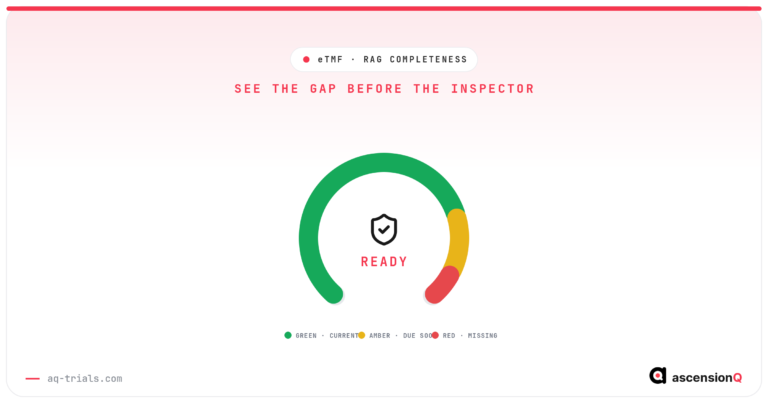
Completeness is tracked in real time at trial, country, and site level against milestone and event-driven expectations. RAG indicators surface status across every zone and artifact. ICH E6 essential documents are tracked and weighted separately. Teams see the precise gap between expected and filed at any point in the study.
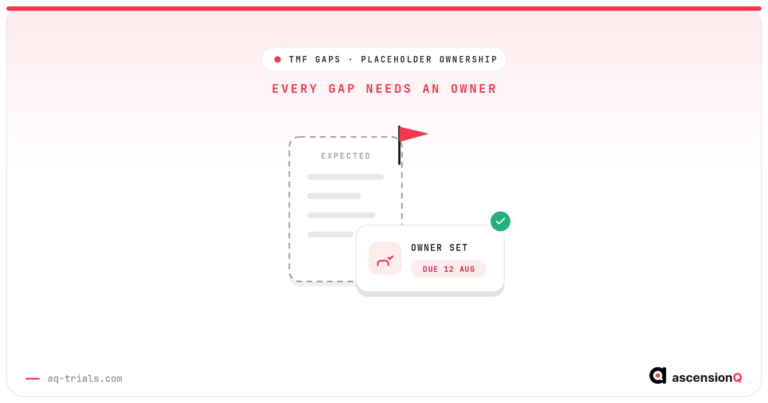
Placeholders are created for every expected document — manually, from milestone triggers, or automatically on study events. Overdue placeholders surface as dated gaps with owner assignment and resolution tracking. Critical gaps are flagged and weighted separately. Unresolved gaps escalate to AQ CAPA, keeping documentation failures in the quality governance record.
Every document follows a defined lifecycle — Draft, Pending QC, In QC, Final, Superseded. QC reviewers work from a personal queue with configurable checks: classification, legibility, metadata, and signatures. QC failures raise queries to the document owner with aging alerts. Final documents are locked. Quality findings feed into AQ CAPA for formal resolution.
Every action is captured. Upload, view, download, metadata change, status update, and deletion with user identity, UTC timestamp, old and new values, and reason for change. Records are immutable and exportable. Electronic signatures are aligned to 21 CFR Part 11 and EU Annex 11, with re-authentication and meaning capture on every signed document.
AQ eTMF generates a scoped, read-only inspector workspace with time-limited credentials and controlled download access. Readiness scores track completeness, QC pass rate, open queries, and overdue gaps — at trial and site level. Inspection findings link to AQ CAPA for tracked resolution. Every inspector action is logged in full.
Access is controlled by role, study, country, and site. Sponsors, CROs, monitors, site staff, and quality leads operate within permissions defined for their function. Shared workspaces support coordinated review without version conflicts. External users receive scoped, time-limited access. Every permission change is audited. Role authority stays aligned with AQ Digital DoA across the platform.
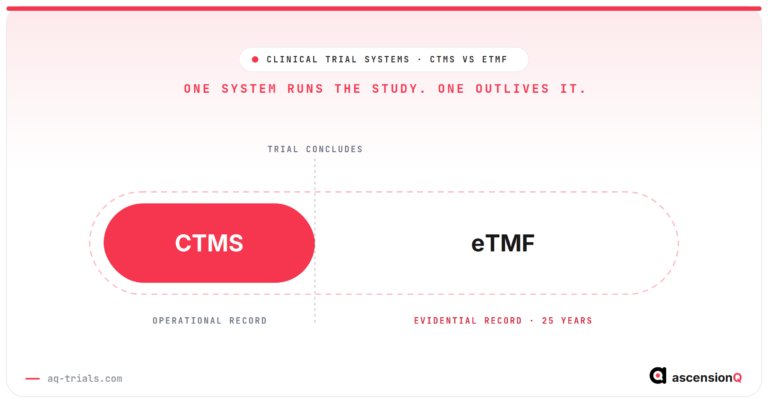
AQ eTMF connects across the AQ platform. Study data, sites, and milestones sync from AQ CTMS. Site documentation in AQ eISF feeds directly into the trial master file. Quality findings and unresolved gaps escalate into AQ CAPA. QMS governance informs document control. At close-out, AQ eTMF enforces gap resolution, QC completion, and final audit before archiving.
Clinical trial oversight requires timely access to study records during monitoring
visits, sponsor audits, and regulatory inspections — without reconstruction of
documentation status.
AQ eTMF maintains study records in predefined documentation structures. Oversight teams locate protocols, approvals, monitoring reports, and site documentation without manual searches.
Role-based access enables monitors, sponsors, and auditors to review required study records within the system — no document transfers or local file preparation needed.
Record history captures uploads, approvals, revisions, and review activity throughout the study lifecycle. Oversight teams confirm documentation integrity and traceability.
Operational teams respond to documentation questions within the eTMF environment. Record updates, follow-up actions, and supporting information remain connected to the relevant study records.
Coordinate documentation activity across studies and research sites while managing operational timelines. AQ eTMF consolidates trial documentation within one structured environment — track record completeness, review activity, and follow-up tasks without manual reconstruction of documentation status.
Maintain the structure and completeness of the trial master file throughout the study lifecycle. AQ eTMF provides predefined documentation structures, controlled record organisation, and completeness monitoring — quickly identify missing or incomplete documentation.
Review study documentation during audits, inspections, and internal quality checks. AQ eTMF maintains traceable record history, structured quality review workflows, and linked corrective action tracking — confirm documentation integrity and follow issue resolution clearly.
Review documentation across multiple studies and research sites. AQ eTMF provides structured access to trial documentation and coordinated review environments — examine record status, verify approvals, and follow documentation updates without repeated document requests.
Because AQ eTMF is evolving with clinical research standards and operational needs. Only to simplify the way clinical research organisations manage trial documentation, review activity, and oversight across studies.

Many eTMF systems operate as passive file storage where trial records accumulate without continuous oversight. AQ eTMF connects trial documentation with review workflows, operational monitoring, and follow-up coordination so clinical operations teams maintain active oversight of study records throughout the study lifecycle.
Operational teams often discover documentation gaps during reconciliation or audit preparation. AQ eTMF provides structured completeness monitoring and documentation tracking so teams identify missing records and unresolved follow-up earlier in the study lifecycle.
Documentation issues frequently require separate quality systems for investigation and corrective actions. AQ eTMF connects trial documentation with QC review processes and CAPA workflows so teams manage issue identification, resolution, and documentation updates within one environment.
AQ’s clinical trial management system continues evolving with AI-powered capabilities that support smarter coordination across study activity. Its intelligent signals and learning workflows are advanced enough to help research teams recognise operational pressure and respond earlier.
Operational teams require systems that support daily oversight of study documentation. AQ eTMF provides structured record organisation, guided review workflows, and operational dashboards that allow teams to assess documentation status quickly and coordinate follow-up activity across studies.
AQ eTMF adoption follows a structured process designed for real clinical
research environments — simple adoption without disruption to ongoing
studies.
AQ begins with an operational discussion with clinical operations teams, TMF managers, and quality teams. The team reviews how trial documentation is currently organised, how oversight activities take place, and where documentation gaps or operational pressure exist — to define the eTMF structure, user roles, and documentation categories required.
The AQ team configures the electronic trial master file according to study structures, documentation requirements, and organisational oversight processes. Trial documentation folders, record categories, user permissions, and review workflows are established so teams begin working with a structured documentation environment from the start.
AQ eTMF is introduced into the research environment with structured implementation support. Study records and documentation structures are organised within the system while ongoing research operations continue without interruption.
Clinical operations teams, TMF managers, and quality teams receive guided training sessions demonstrating how to organise trial documentation, conduct review workflows, and manage follow-up within the platform. Supporting guides and practical walkthroughs help teams adopt the system confidently.
AQ remains involved after implementation to assist teams as they begin using the electronic trial master file during daily research activity — supporting documentation organisation, workflow coordination, and operational questions so organisations maintain consistent oversight of trial documentation across studies.
We encourage you to explore how AQ eTMF works in practice. Our team will walk you through how the electronic trial master file fits within the broader AQ clinical research platform and how you can adopt the platform modules according to your operational needs. You can also review platform tutorials, implementation guidance, and practical workflows that show how AQ supports trial documentation oversight, quality follow-up, and operational coordination across studies.
Practical walkthroughs aligned with active research delivery.
We’ll only use your details to arrange your demo and
send relevant AQ updates. No spam.


Our Trial Master File finally reflects what’s actually happening at site level in real time, not a snapshot from the last update. Completeness tracking that used to be a quarterly scramble is just the state we’re in now.
Version control on sponsor-facing documents removed a recurring source of confusion with our CRO. Approvals and follow-up actions sit against each document, so nothing waits in limbo.
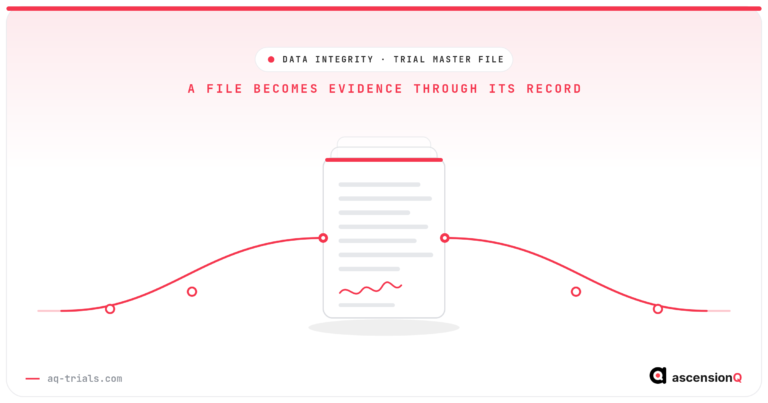
An electronic trial master file (eTMF) is the controlled record of essential documents that evidences how a trial is conducted. AQ eTMF structures filing across study, country, site and pharmacy levels, tracks completeness, controls versions and approvals, and maintains an audit trail, keeping the TMF current and review-ready throughout the study rather than assembled under pressure.
The eTMF is the sponsor-level master record of essential documents for the whole trial; the eISF is the site-level file held at each investigator site. They overlap but serve different owners and inspections. AQ runs both on one connected platform, so site documentation flows into the master file and completeness stays visible across both.
AQ eTMF tracks expected, missing, pending and complete documents across studies, sites, countries and functions, continuously rather than through periodic spreadsheet reviews. Teams see exactly what is outstanding, what needs approval and what requires follow-up. Document gaps can link to CAPA with study context attached, so issues are owned and resolved, not just noticed.
AQ eTMF maintains audit trails, version history, approval evidence and exportable review packs designed to support MHRA, FDA, sponsor and QA review. Completeness and quality stay visible throughout the study, so inspection preparation is continuous rather than a reconstruction exercise. The platform is built around ICH-GCP and ALCOA+ expectations for essential-document evidence.
Yes. AQ eTMF is structured for multi-site and multi-country complexity, with filing models across study, country, site and pharmacy levels. Sponsors, CROs and site networks get consistent completeness visibility across the whole programme, so no single site or country drifts out of sync and the master file stays defensible at portfolio scale.
Pick a module, your organisation type, or both — we'll match the guides and email them to you.
Try one filter at a time, or clear to see all guides.
✓ Written for first-in-human & Phase 1 sites
✓ Inspection-ready checklists & templates
✓ Aligned to MHRA, FDA & EU Annex 11