eSource and EDC differ by which record holds the original. eSource is the site’s first electronic capture of an observation, so the entry itself is the source record. EDC is the sponsor’s route for receiving protocol-required data from the investigator, so most of what it holds is a report of a record kept somewhere else.
This guide is written for UK research sites that need to know which record an inspector will ask for. It covers the boundary between a source record and a case report form (CRF), when the CRF becomes the source, what a transcription step adds, and which party controls each system. The wider context sits in our complete guide to eSource in clinical trials.
One observation has exactly one original. Everything downstream of it is a copy.
What Is the Difference Between eSource and EDC?
The difference is function rather than technology. eSource describes where an observation is first recorded in electronic form. EDC describes the route by which protocol-required data reaches the sponsor. A single electronic visit form can perform both functions at once, and that overlap is where sites lose the boundary.
ICH E6(R3) uses neither term. It defines source records as the original documents or data, including relevant metadata, or certified copies of them, in any media. It defines the case report form as one kind of data acquisition tool, a paper or electronic tool designed to collect data from a data originator and report it to the sponsor. The regulation separates the two by purpose: one holds the original, the other reports it.
| Aspect | eSource, the site’s source record | EDC, the sponsor’s data acquisition tool |
| Purpose | Record an observation at the point of first capture | Report protocol-required data to the sponsor |
| Term used in ICH E6(R3) | Source record | Data acquisition tool, of which the CRF is one |
| Who runs the system | The site or institution, or a site-facing tool | The sponsor, usually through a vendor |
| What it proves at inspection | What happened to the participant | That reported data is consistent with the source |
| Who retains the record | The party that generated it | Each party retains its own essential records |
Our explainer on what EDC is in clinical trials covers the sponsor’s side in full, and the forms the site’s own capture can take are set out in our guide to the types of eSource.
Where Does Source Data End and the CRF Begin?
The boundary sits at the first permanent record of the observation. Everything up to that point is the observation itself. Everything after it is a report of a record. The EMA guideline on computerised systems and electronic data in clinical trials states the rule directly: the first obtainable permanent data from an electronic data capture should be considered and defined as the electronic source data.
The boundary follows a declaration made before the trial starts. The software does not decide it. ICH E6(R3) requires the investigator to define what is considered a source record, the methods of data capture and their location before the trial starts. Our guide to what counts as source data in a clinical trial sets out the underlying definitions, and the eSource record lifecycle shows where that declaration is made.
Four questions settle the boundary for any single field:
- Where was this value first written down? The answer names the record an inspector will request.
- Does an earlier written or electronic record of the value exist? The answer decides whether the form field is an original or a copy.
- Which system holds the metadata for that first entry? The answer decides where the audit trail starts.
- Is the answer recorded per data point before first patient in? A written answer gives the monitor one place to look for every field.
A site records those answers in a source data location log and files it in the investigator site file.
When Is the eCRF Itself the Source Record?
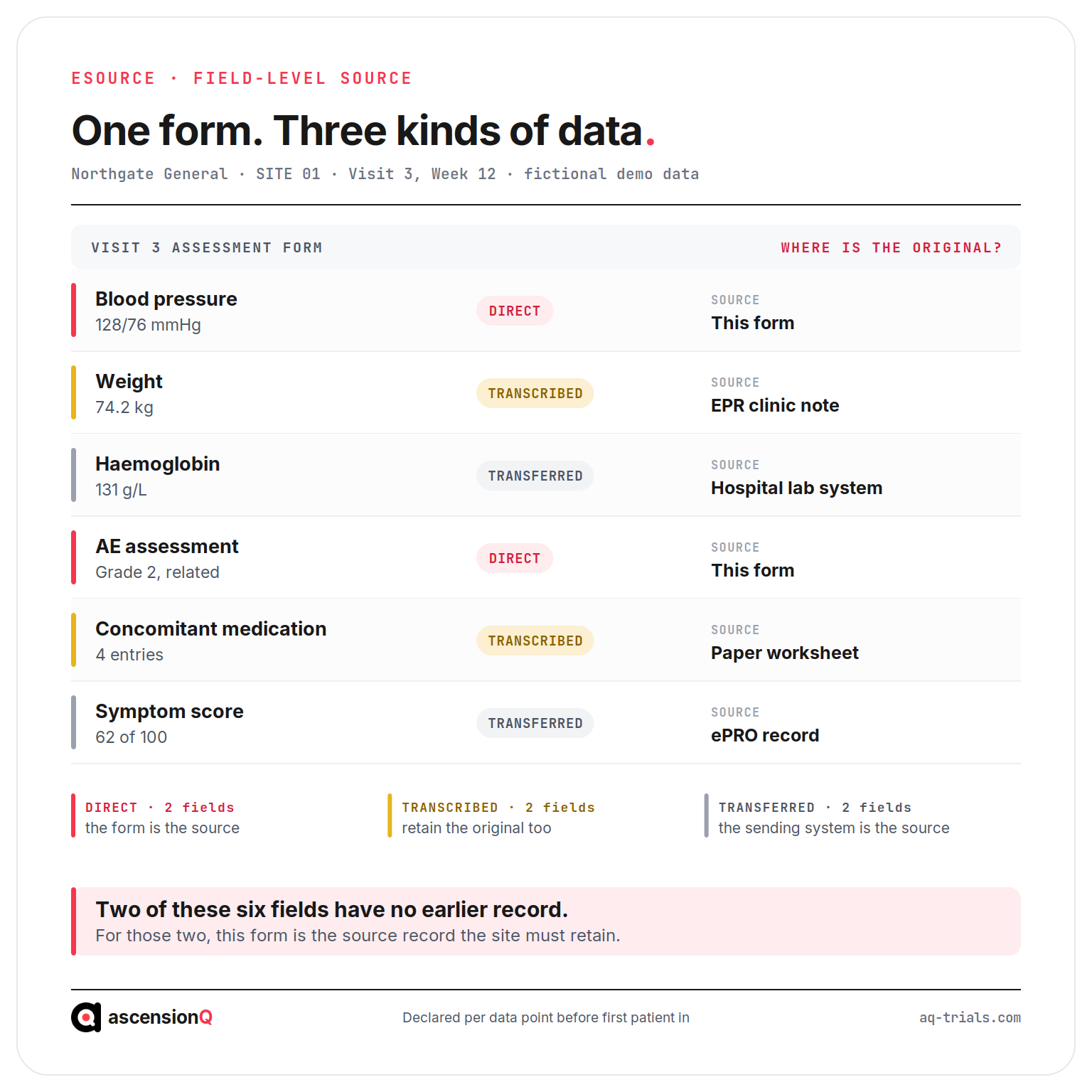
The eCRF is the source when the value is recorded straight into it and no earlier record of that value exists. ICH E6(R3) states the condition in its protocol contents, which require the identification of data to be recorded directly into the data acquisition tools, meaning no prior written or electronic record of data, and considered to be the source record.
FDA guidance on electronic source data reaches the same position by capture route. Direct entry by an authorised data originator makes the eCRF the source. Transcription from a paper or electronic document leaves that document as the source. An automated transfer out of an electronic health record leaves the health record as the source, because the transfer applies intervening processes such as the selection of data elements.
One eCRF page can therefore hold three kinds of data at once. The EMA guideline puts it plainly: an eCRF may contain source data directly entered, transcribed data, or data transferred from other sources, or any combination of these. The MHRA GCP Inspectorate applies the test to function: regardless of what you call your system, a system recording protocol-required information and providing it to the sponsor is also a CRF, and it needs the functionality of an eCRF.
Three duties follow once a form field is the source:
- The site retains that record, or a certified copy of it, for the full retention period, because no other original exists.
- The audit trail for the field starts in that system, so it must capture the first entry as well as every change.
- Corrections route back to the site as a query, so the investigator remains the author of the entry.
What Does a Transcription Step Add to the Record?
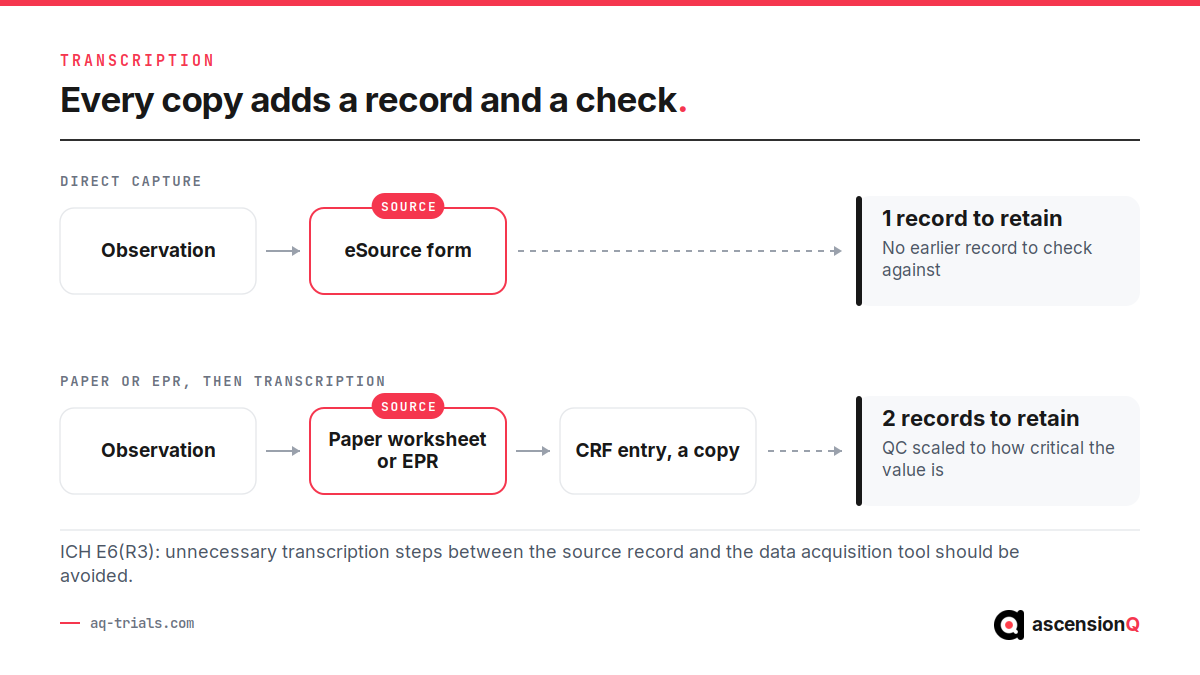
A transcription step adds a second record and a verification duty. The original stays where it was first written. The copy in the CRF becomes data that must be shown to agree with it. ICH E6(R3) asks sites to remove the steps that serve no purpose, stating that unnecessary transcription steps between the source record and the data acquisition tool should be avoided.
The same regulation scales the checking to the value. The need for data verification, and its extent, should take the criticality of the data into account where paper or electronic health record data is manually transcribed into a computerised system. EMA names the controls for manual transcription, which are double data entry, data monitoring, or both, selected on risk.
- Retain the original alongside the CRF entry, because the original remains the source record.
- Show that the CRF entry is consistent with the original, or explain the discrepancy.
- Apply a documented quality control to the entry step, proportionate to how critical the value is.
No regulator publishes a transcription error rate, so any error or efficiency figure a site relies on should come from peer-reviewed evidence.
The MHRA GCP Inspectorate describes a trial where this boundary collapsed. A sponsor’s clinical database was converted into an eCRF without a sufficient data integrity risk assessment. Staff at the sponsor’s clinical trials unit amended paper CRFs and later the eCRF without investigator authorisation, and no quality control of data entry was documented, so the accuracy of transcription could not be determined. The finding was classified as critical, and the sponsor had to assess the data integrity impact across every trial the unit ran.
The system changed. The controls that made it an investigator record did not.
Who Controls the Source Record and Who Controls the EDC?
The site controls its source records. The sponsor runs the EDC system. The investigator keeps control of the data the investigator entered, whichever party owns the software.
ICH E6(R3) sets two rules for the sponsor. The sponsor should not have exclusive control of data captured in data acquisition tools, in order to prevent undetectable changes. The sponsor should also ensure the investigator has access to the required data for retention purposes. The MHRA states the position more plainly still, holding that this data belongs to the investigator and should therefore be available to, and under the control of, the investigator rather than under the direct control of the sponsor.
- The source record stays with the party that generated it, which for a site observation is the site.
- The investigator authorises who holds editing rights in the eCRF, because entry into the CRF is a delegated duty.
- Corrections to an investigator entry route back as a query, so sponsor staff have no operational need for edit access to CRF form fields.
One point remains unsettled between the two versions of the guideline. ICH E6(R2) listed the completed CRF as an original held by the sponsor and a copy held by the site. ICH E6(R3) instead states that original records should generally be retained by the party that generated them, which points the other way for data the site entered directly. Sites should agree in writing which party holds the original of each CRF record.
Monitoring visit planning and the query workflow that follows belong to the site’s clinical trial management system. The file-level map of which system owns which study record sits in our comparison of CTMS, eTMF, EDC and eISF.
What Happens to the Site’s Data When EDC Access Ends?
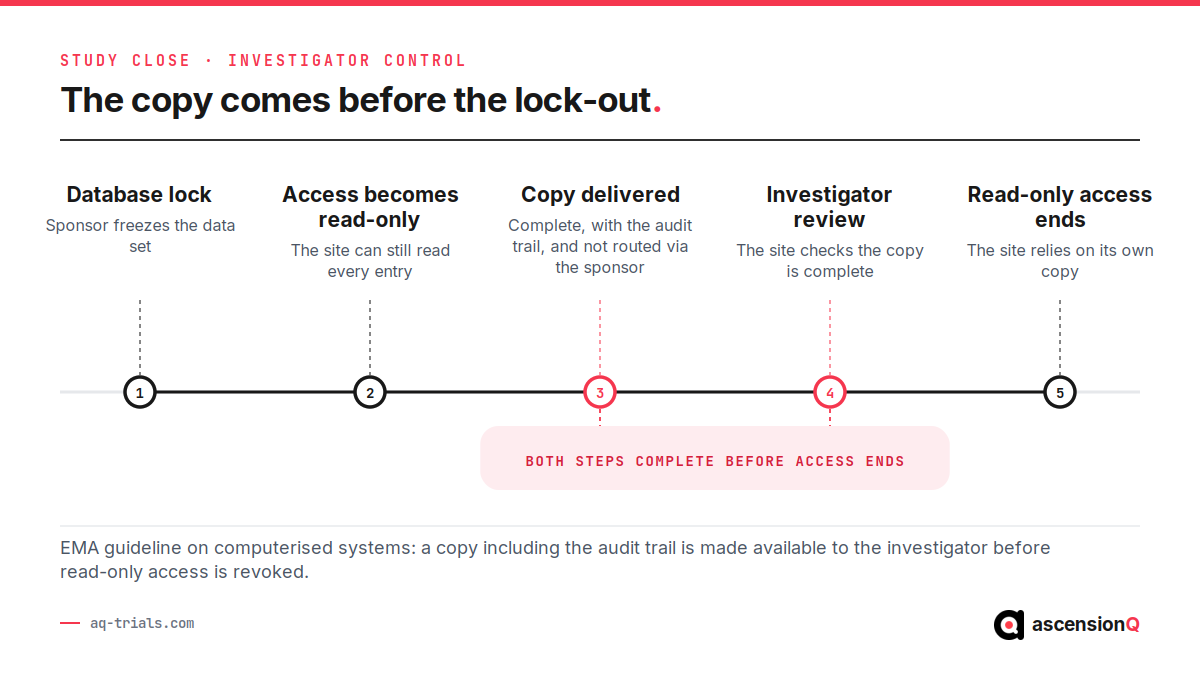
The site needs its own complete copy before access closes. Database lock usually reduces the investigator’s access to read-only, and read-only access is withdrawn later still. The EMA guideline sets the sequence that protects the site.
Data entered into data acquisition tools by the investigator should remain available to the investigator for the whole legally mandated retention period. EMA requires a copy including the audit trail to be made available, in a complete and comprehensive way, before read-only access is revoked. The copy should not be routed through the sponsor where a service provider hosts the data, because that arrangement hands the sponsor temporary exclusive control. The investigator should also have time to review the copy before access ends.
- Settle the export format at contract stage, because the record must stay readable for the full retention period.
- Confirm the copy carries the audit trail, because a static extract will not reconstruct the trial.
- Confirm which party delivers it, because delivery via the sponsor breaks the copy’s independence.
- Confirm the review window, because an unreviewed copy cannot be shown to be complete.
UK retention duties run far beyond the length of most system contracts, and the contract terms that decide what a site keeps at exit are covered in our comparison of CTMS and EDC.
Frequently Asked Questions
What is the difference between eSource and EDC?
eSource is where an observation is first recorded in electronic form, so the entry is the source. EDC is the sponsor’s route for receiving protocol-required data, so most of what it holds is a report of a record kept elsewhere.
When is the eCRF itself the source record?
When the value is recorded straight into the eCRF and no earlier record of it exists. ICH E6(R3) requires the protocol to identify any data recorded directly into the data acquisition tools.
What happens to the site’s data when EDC access ends?
Access usually becomes read-only at database lock and is withdrawn later. The site needs its own complete copy of the data it entered before access closes.
Every eSource evaluation eventually returns to this boundary and to the question of who holds the original. Book a live demo to see the AQ platform today.