The DIA TMF Reference Model is a standardised structure for organising a clinical trial’s essential documents. It sorts every Trial Master File (TMF) artefact into 11 high-level zones, each divided into sections and individual artefacts, so that a sponsor, a CRO, and a site all file the same document in the same place. It is not a regulation and not a piece of software. It is a shared reference (a common taxonomy, naming convention, structure, and set of metadata) that the industry maintains and agrees to file against.
The Trial Master File itself is the collection of essential documents that allows the conduct of a trial and the quality of its data to be evaluated. The Reference Model does not change what belongs in a TMF; it standardises where each document lives and what it is called, so that a Monitoring Visit Report, an investigational product (IP) release certificate, and a signed delegation log each have one agreed home, reachable by the same route on every study, by anyone who knows the model.
- Eleven zones organise the whole TMF; each zone breaks down into sections, and each section into individual artefacts.
- The model standardises four things: contents, naming, structure, and metadata, for both paper and electronic files.
- It is a structure, not a compliance guarantee. Completeness, timeliness, and quality of the file still have to be tracked separately.
- Adopting it removes the reconciliation cost that appears whenever sponsors, CROs, and sites share a TMF built to different structures.
Where did the TMF Reference Model come from?
The model was created in 2010 by a volunteer group under the Drug Information Association (DIA), drawing on a panel of industry stakeholders. It has since grown to a team of more than 350 representatives from over 170 organisations (sponsors, CROs, technology vendors, consultants, academia, and non-profits) who maintain it as a single, unified interpretation of the regulations and best practice around Trial Master Files.
It is deliberately not mandatory, and it does not endorse or require any specific technology. Version 3 is the current line, with v3.2.0 issued in November 2020 and later revisions published through the model’s ongoing stewardship. That independence is the point: because no single vendor owns it, the model can act as neutral ground that sponsors and CROs adopt without adopting each other’s systems.
What does the TMF Reference Model standardise?
The Reference Model works across four dimensions. Together they turn “file the essential documents” into a repeatable, checkable process.
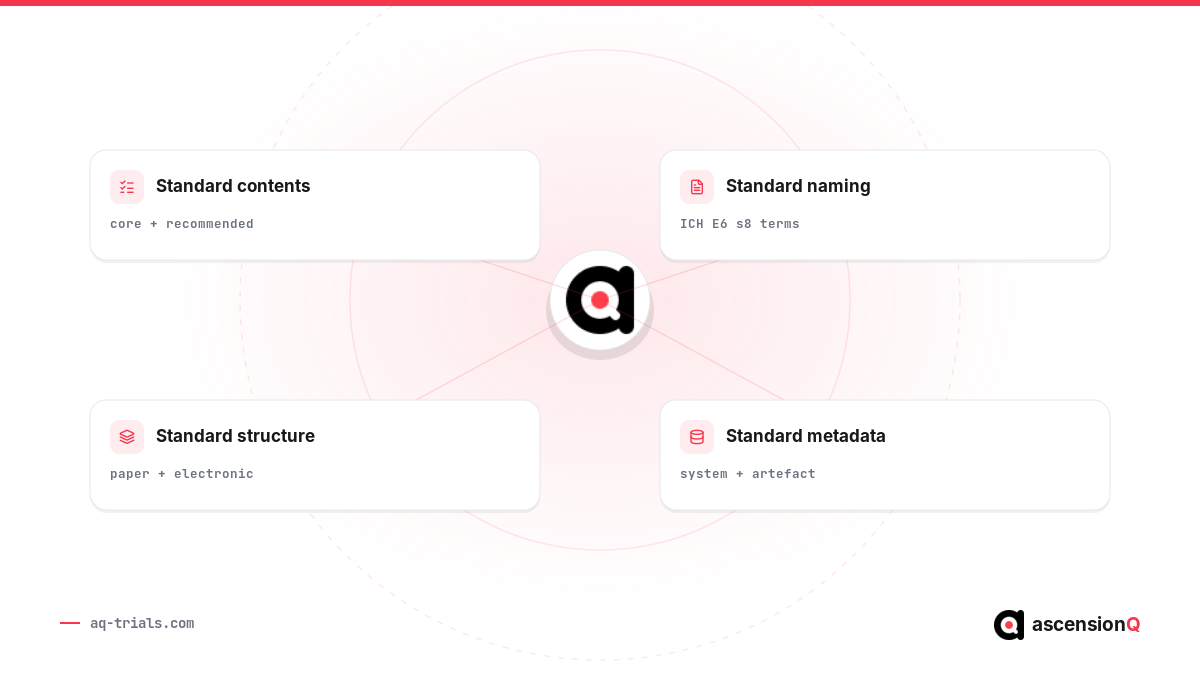
- Standard contents: an agreed view of what a TMF should hold. Each artefact is labelled core (expected under ICH-GCP or regulation) or recommended (filed if created), so a team knows which gaps are findings and which are optional.
- Standard naming: consistent artefact names based on ICH-GCP E6 Section 8 and accepted industry terminology, with alternate names supplied so the same document is recognised whatever a vendor called it.
- Standard structure: the zone / section / artefact hierarchy, designed to work for both paper and electronic files.
- Standard metadata: for an electronic TMF (eTMF), a minimum set of metadata at system and artefact level, including whether an artefact applies at study, country, or site level.
What problem does the TMF Reference Model solve?
Without a shared structure, every organisation invents its own. One CRO files monitoring documents under “Site Oversight”. Another files them under “Clinical”. A sponsor inherits three studies from three vendors and finds the same artefact in three different places. Nothing is technically missing, but nobody can prove that quickly.
The cost shows up late. An inspector asks for the current IP release documentation for a specific batch. The team knows it exists. They spend an afternoon working out which vendor’s folder logic put it where, because the structure was never agreed up front.
A document that cannot be found on demand is, for inspection purposes, a document that is missing.
When filing follows one agreed taxonomy, the location of any artefact is predictable before anyone goes looking for it. That predictability is what the model buys.
Zones, sections and artefacts
The 11 zones are the top layer of a three-level hierarchy. Each zone contains sections, and each section contains individual artefacts: the actual documents. Across those sections the model defines several hundred artefacts, each with a recommended name, a core-or-recommended status, alternate names, and supporting metadata.
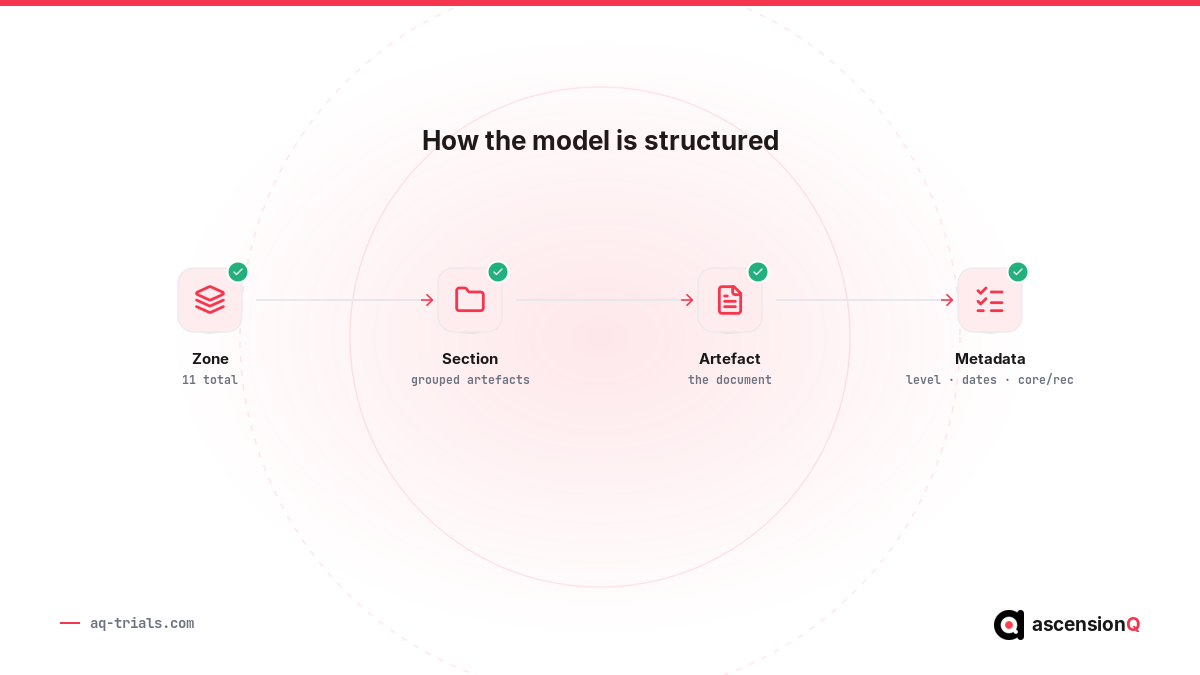
This granularity is the point. A delegation log and a monitoring visit report both sit in the Site Management zone, but they are distinct artefacts in distinct sections. The zone alone is too coarse to file against; the model gives every essential document a named, agreed position rather than a broad folder to be sorted later.
The 11 zones of the TMF Reference Model
Each zone is a major operational area of the trial. Together they cover the full lifecycle, from study set-up through to statistical reporting.
| Zone | Focus | Example artefacts |
|---|---|---|
| 1. Trial Management | Oversight and running of the trial. | TMF Plan, monitoring and oversight plans, meeting minutes, file notes. |
| 2. Central Trial Documents | Core study-defining documents. | Protocol and amendments, Investigator’s Brochure, sample case report form. |
| 3. Regulatory | Competent authority interactions. | Regulatory submissions, approvals, notifications and correspondence. |
| 4. IRB / IEC and other Approvals | Ethics and independent review. | Ethics submissions and approvals, committee composition, consent approvals. |
| 5. Site Management | Site-level conduct and oversight. | Delegation logs, CVs, training records, monitoring visit reports and follow-up. |
| 6. IP and Trial Supplies | Investigational product control. | Release/QP certification, shipping, accountability, storage, returns and destruction. |
| 7. Safety Reporting | Participant safety. | SAE reports, SUSAR notifications, safety letters, the DSUR. |
| 8. Central and Local Testing | Laboratory and technical. | Lab accreditations, normal ranges, sample handling manuals. |
| 9. Third Parties | Vendors and service providers. | Agreements, qualification and oversight documentation. |
| 10. Data Management | Clinical data handling. | Data management plan, database validation, coding, data reconciliation. |
| 11. Statistics | Analysis and reporting. | Statistical analysis plan, randomisation records, statistical report. |
Some zones carry far more traffic than others. Site Management and IP and Trial Supplies accumulate documents continuously throughout the trial, which is where filing discipline tends to slip first. Central Trial Documents and Regulatory are lower-volume but high-consequence: a superseded protocol version filed as current is the kind of error an inspector notices immediately.
A standardised TMF versus an idiosyncratic one
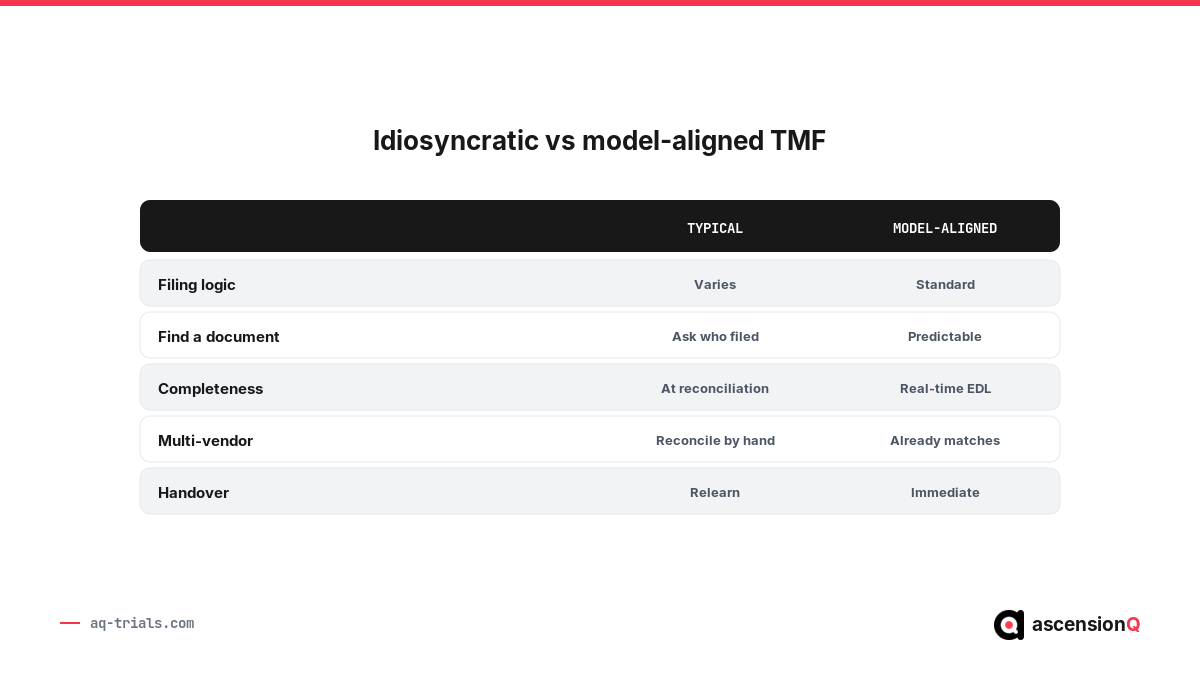
The difference between a TMF built on the Reference Model and one built on local habit is not cosmetic. It changes who can find what, and how fast.
| Aspect | Idiosyncratic TMF | Model-aligned TMF |
|---|---|---|
| Filing logic | Defined per organisation or per study; varies by vendor. | One agreed taxonomy across sponsors, CROs and sites. |
| Finding a document | Requires knowing who filed it and how they thought. | Predictable location from the zone and section. |
| Completeness | Judged at reconciliation, often near inspection. | Measured against a defined expected-document list. |
| Multi-vendor studies | Each vendor’s structure must be reconciled by hand. | Structures already match; no reconciliation tax. |
| Handover | New teams relearn the local logic. | Anyone who knows the model is immediately productive. |
How does a model-aligned TMF work in practice?
- An expected-document list is mapped to the model’s zones and sections, which allows the team to track required versus filed artefacts in real time rather than discovering gaps at reconciliation.
- Every artefact is classified to a named zone and section on filing, which allows any reviewer (sponsor, monitor or inspector) to reach it by the same route without asking who filed it.
- Core-versus-recommended status is carried on each artefact, which allows completeness to be judged against what is genuinely required rather than an undifferentiated document count.
- Artefact metadata records whether a document applies at study, country or site level, which allows completeness to be assessed correctly for multi-site and multi-country trials.
- A shared structure aligns the sponsor’s TMF with the site-held file, which allows the electronic Investigator Site File and the TMF to mirror each other instead of drifting apart.
Completeness, timeliness and quality
A structured TMF is judged on three things, and the model supports all three. Completeness is whether every expected artefact is present. Timeliness is whether each was filed close to when it was created, not reconstructed before an inspection. Quality is whether the filed document is the correct, current, legible version. A shared structure makes completeness measurable and timeliness visible; quality remains a review judgement, but a predictable structure makes that review faster.
The exchange problem the model also solves
Clinical trials rarely sit in one system. A sponsor runs an eTMF; a CRO runs another; documents move between them throughout the study. When both sides file to the same Reference Model structure, that transfer is structured rather than a manual re-mapping exercise, and it becomes easier to present a coherent TMF to an inspector regardless of which party produced each document. As interoperability standards between eTMF systems mature, this shared taxonomy is the foundation they build on.
Read also: How AQ eISF and ePSF support multi-site documentation governance across a CRDC network.
The risks of not adopting a shared structure
- Completeness is only ever known retrospectively, usually under inspection pressure.
- Multi-vendor studies carry a permanent reconciliation cost that grows with every added party.
- Staff turnover erases filing knowledge that was never written into a shared standard.
- Inspection readiness depends on individual memory rather than a predictable structure.
The Reference Model is aligned with regulatory expectations for essential-record management under ICH-GCP E6 and reflected in MHRA good clinical practice guidance. The model itself is maintained openly by the TMF Reference Model group.
How does AQ eTMF apply the TMF Reference Model?
The AQ eTMF is built on the DIA TMF Reference Model. Studies are structured against the model’s zones and sections from set-up, so filing follows the agreed taxonomy rather than a local convention that has to be reconciled later.
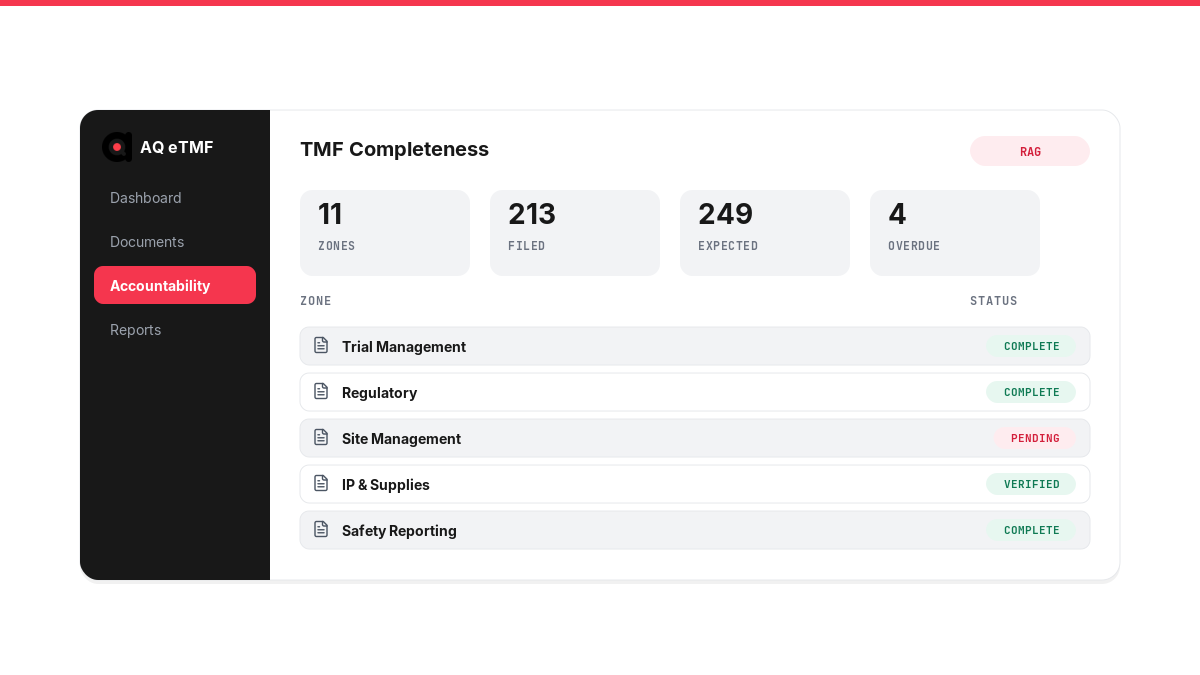
Because the expected-document list is mapped to that structure, completeness is tracked as work happens: filed, missing and expected artefacts are visible against each zone in real time, and gaps surface in daily operations instead of during inspection preparation. The structure stays consistent across every sponsor, CRO and site working in the same environment, which is where a standardised model earns its value.
The system organises and tracks the file; it does not decide what belongs in it. Classifying an artefact correctly and confirming a study is genuinely complete remains a human quality judgement. The model and the eTMF make that judgement fast and evidenced rather than manual.
Read also: Why Do CROs Require a Standardised eTMF? and What is an eTMF in Clinical Trial Research?
Book a live demo to see how AQ structures a Reference-Model-aligned eTMF and tracks completeness across every zone.