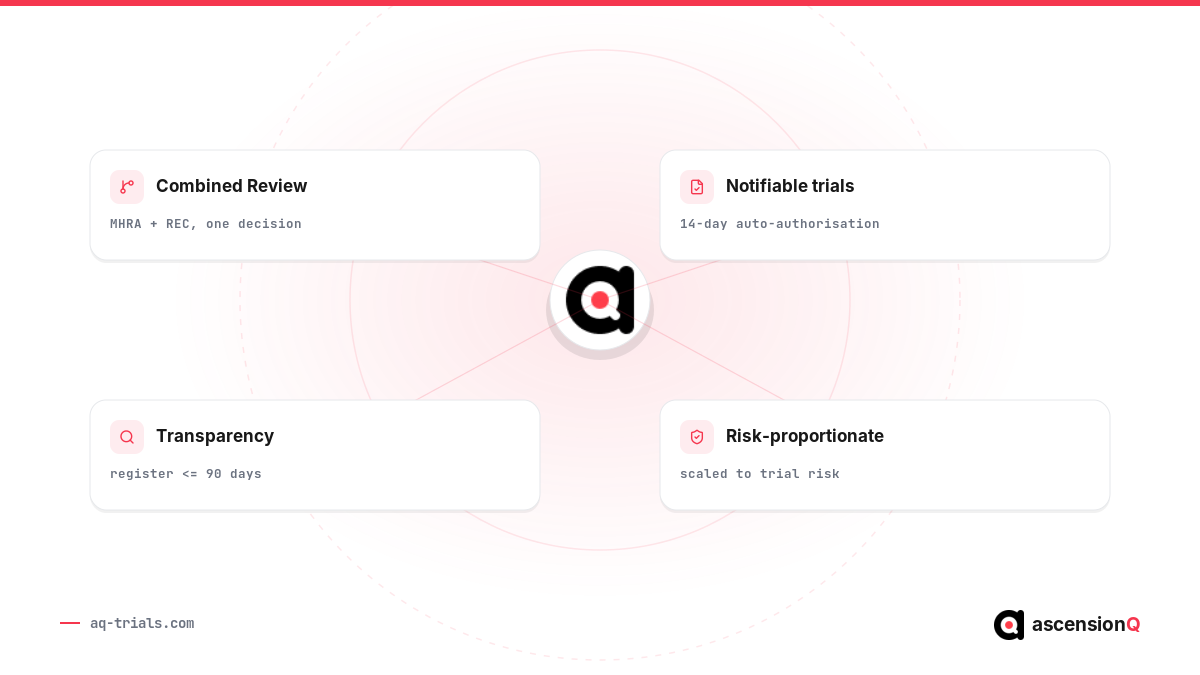
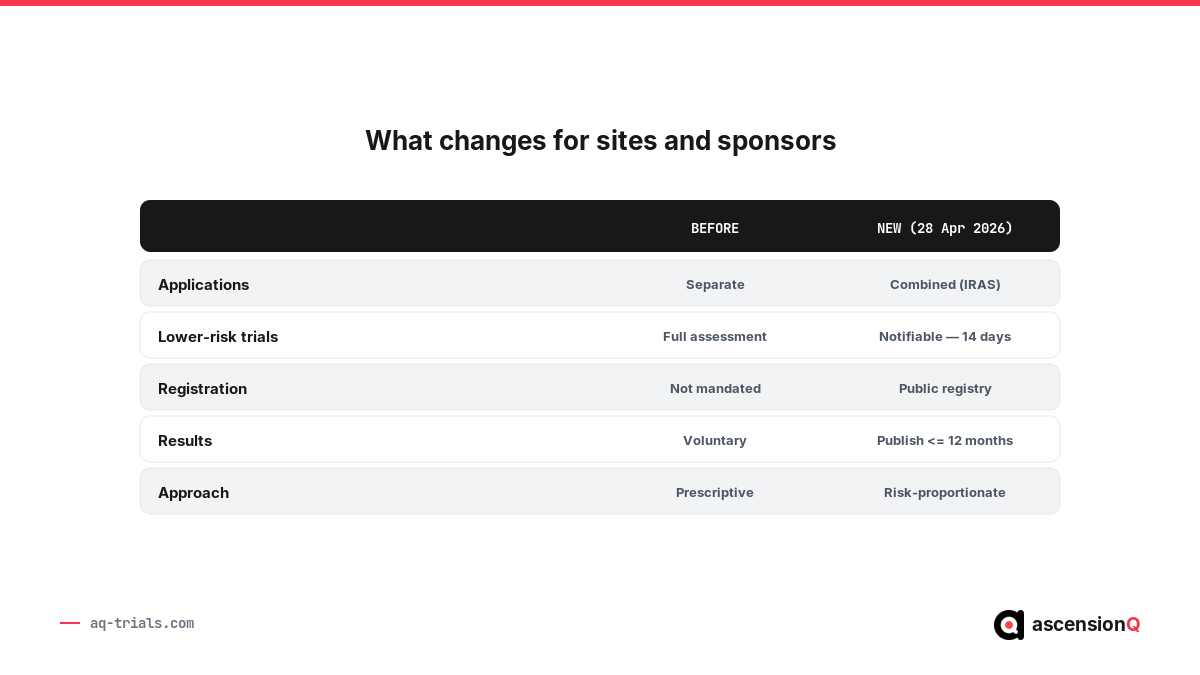
The Medicines for Human Use (Clinical Trials) (Amendment) Regulations 2025 came into force on 28 April 2026, after a 12-month implementation period. They are the biggest reform of UK clinical trials regulation in twenty years. The regulations keep the 2004 framework as the foundation and add four changes that matter to every site and sponsor: legislated combined review, a fast-track for lower-risk notifiable trials, statutory transparency and registration duties, and a risk-proportionate approach to oversight.
This guide does three things. It lists the full set of regulations that govern a UK clinical trial, so you can see where the 2025 reform sits. It explains each headline change in practical terms. It sets out what sites and sponsors must do now.
- The reform is in force from 28 April 2026, following a 12-month implementation period.
- Combined review is now the legislated standard route: one application via IRAS, one UK decision.
- Notifiable trials receive automatic authorisation within 14 days for lower-risk studies.
- New transparency duties require public registration and publication of a results summary within set deadlines.
- The regulations require sponsors and investigators to have regard to relevant guidance, which includes ICH-GCP E6(R3).
What are the new UK Clinical Trials Regulations?
The 2025 Amendment Regulations (SI 2025/538) update the Medicines for Human Use (Clinical Trials) Regulations 2004, the framework that has governed UK trials of investigational medicinal products for two decades. The MHRA and the Health Research Authority (HRA) developed the reform after a 2022 public consultation. Parliament signed it into law in April 2025 and gave the sector a 12-month runway to prepare.
The reform is risk-proportionate by design. Oversight scales to the risk of the trial, rather than one heavyweight process applying to every study. That single principle drives combined review, notifiable trials, and the flexibility sponsors now have.
Which regulations govern a UK clinical trial?
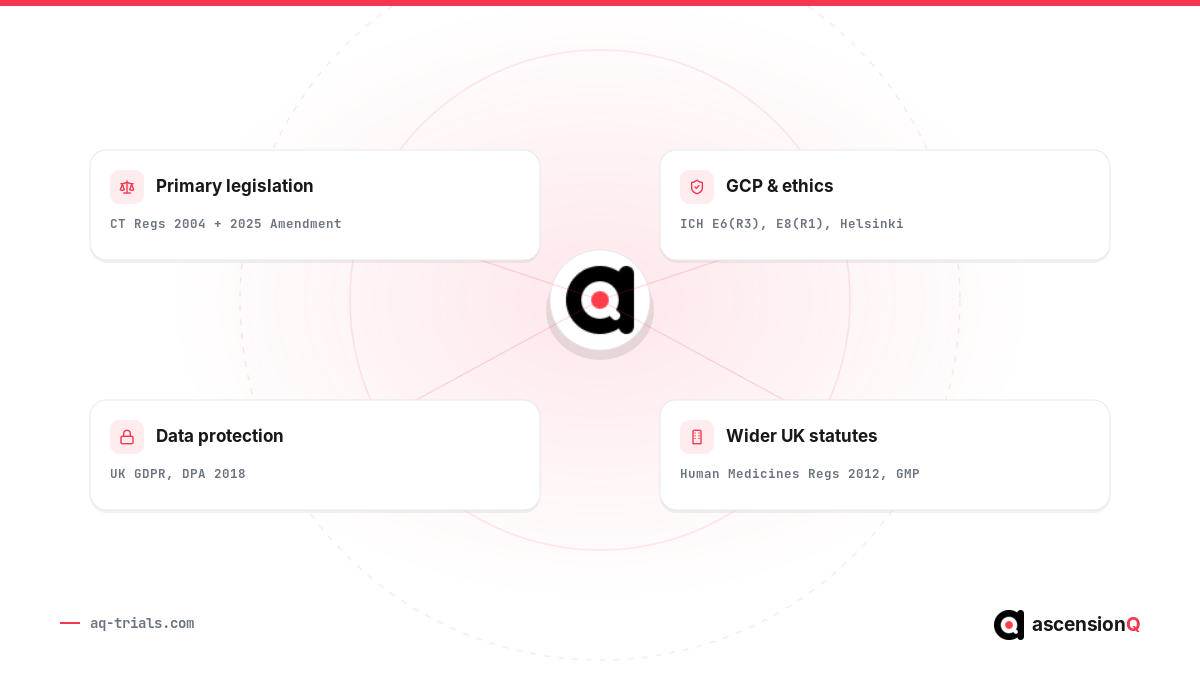
A UK clinical trial sits inside a stack of legislation and standards, not one regulation. The 2004 Regulations and the 2025 Amendment set the core rules. International standards, data protection law, and wider UK statutes complete the picture. The table below lists the framework in full.
| Regulation or standard | What it governs |
|---|---|
| Medicines for Human Use (Clinical Trials) Regulations 2004 | The core UK framework for trials of investigational medicinal products (CTIMPs). |
| Clinical Trials (Amendment) Regulations 2025 (SI 2025/538) | The 2026 reform: combined review, notifiable trials, transparency, risk-proportionate oversight. In force 28 April 2026. |
| ICH-GCP E6(R3) | The good clinical practice standard the UK regulations require sponsors and investigators to have regard to. |
| ICH E8(R1) | General considerations for clinical studies, including quality by design. |
| Declaration of Helsinki | Ethical principles for research on humans. A retained UK-specific principle requires compliance. |
| UK GDPR & Data Protection Act 2018 | Processing of participants’ personal data and privacy. |
| Human Medicines Regulations 2012 | Licensing, supply, and safety of medicines. |
| Good Manufacturing Practice (GMP) | Manufacture, labelling, and quality of the investigational product. |
| Human Tissue Act 2004 | Storage and use of human tissue, where the trial involves it. |
| UK Policy Framework for Health and Social Care Research | Governance, roles, and responsibilities across health and social care research. |
The 2025 reform also keeps three UK-specific principles from the 2004 Regulations:
- Compliance with the Declaration of Helsinki.
- Provision of insurance or indemnity for the trial.
- Regard to all relevant guidance on starting and running a trial, which is where ICH-GCP E6(R3) applies.
What is combined review?
Combined review is a single, coordinated application for MHRA regulatory approval and a Research Ethics Committee (REC) opinion. Teams submit it through the Integrated Research Application System (IRAS), and it produces one UK decision. Combined review operated as an administrative service before the reform. The 2025 Regulations put it into legislation as the standard route.
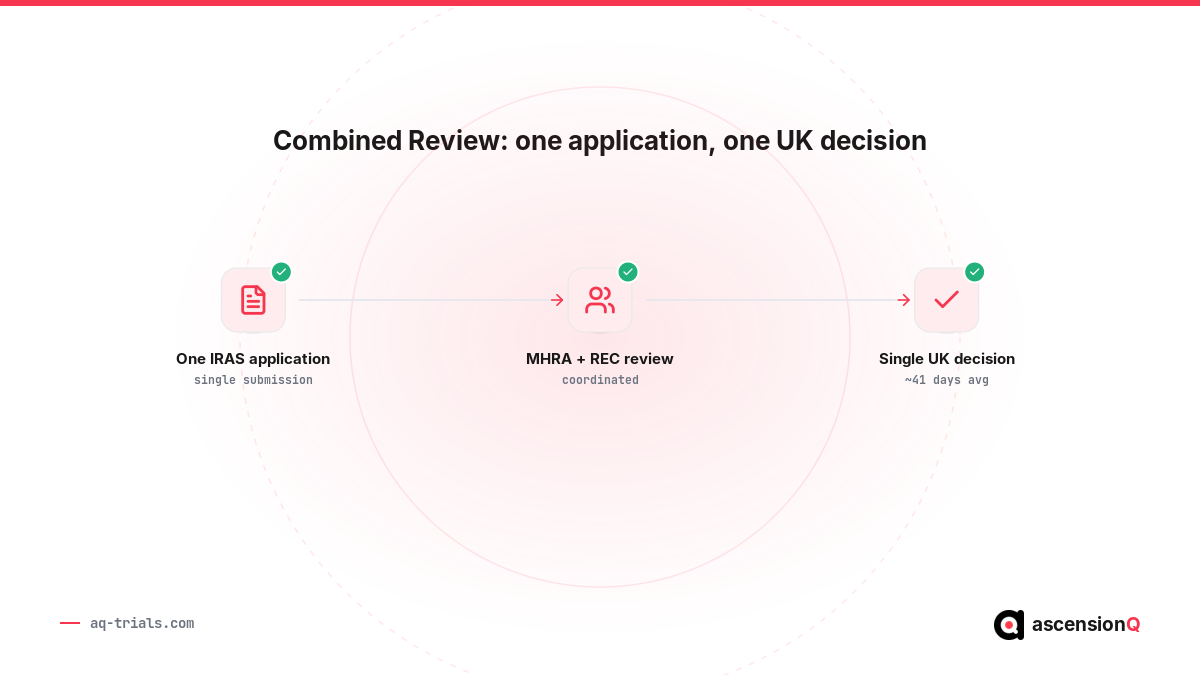
The effect is speed and coherence. One submission, one set of documents, and one decision, with an average turnaround of around 41 days. One application, one decision. The review stops being two processes stapled together.
What are notifiable trials?
Notifiable trials are lower-risk trials with no significant safety concerns about the investigational medicinal product, where the sponsor has made reasonable enquiries against defined conditions. These applications receive automatic authorisation within 14 days, without full regulatory assessment. The route gives lower-risk research a faster start.
The sponsor carries the responsibility. The sponsor assesses whether a trial qualifies, documents the justification, and includes the required statement and supporting form in the application package. The route excludes higher-risk scenarios. Trials involving children, pregnant or breastfeeding participants, or advanced therapy medicinal products fall outside it.
What are the new transparency and registration duties?
Transparency is now a statutory requirement. Sponsors must meet three duties:
- Register the trial in a WHO-recognised public registry, within 90 days of the regulations coming into force (by 27 July 2026) or before the first participant is recruited, whichever comes first.
- Publish a summary of results within 12 months of the trial concluding.
- Offer to share understandable results with participants.
Each duty produces a record that must exist, carry a date, and stay retrievable. Registration confirmations, the results summary, and evidence of the participant offer all belong in the trial file. A missing or late transparency record is a new category of inspection finding.
How do the reforms connect to ICH-GCP E6(R3)?
The UK regulations and ICH-GCP E6(R3) work together. The regulations set the legal duties. E6(R3) sets the good clinical practice standard for how a trial is run, and the retained UK-specific principle requires regard to it. The two changes also share a direction. Both moved to a risk-proportionate, quality-by-design approach in 2025, so a team that adopts one is already aligned with the other.
E6(R3) also renamed essential documents to essential records and emphasised data governance and technology in consent. Those shifts land in the same place as the new UK duties: the records a trial keeps. A guide to the MHRA position on ICH E6 covers the standard in detail.
What must sites and sponsors do now?
- Use combined review via IRAS as the default route for new applications.
- Assess whether a lower-risk study is notifiable, and file the sponsor justification and statement in the application package.
- Register the trial in a public registry on time, and keep the confirmation on file.
- Plan results publication and the participant results offer at set-up, well before close-out.
- Give every new record a defined home in the site file and the sponsor Trial Master File.
The full text sits at legislation.gov.uk (SI 2025/538), with implementation guidance from the HRA and the MHRA. The core discipline holds: inspection readiness depends on the right records being complete, current, and findable. The reform adds new records to that set.
How does AQ help sites stay ready for the reforms?
The AQ connected compliance platform is built around the UK regulatory context. The records the reforms create receive a defined place in the site file. Registration confirmations, notifiable-trial justifications, and transparency evidence sit against an expected-document list and stay tracked. A missing item surfaces in daily operations, before an inspection. For NHS research teams running several studies, that consistency keeps a growing portfolio inspection-ready.
AQ keeps clear boundaries. The sponsor submits the applications and decides whether a trial is notifiable. AQ makes the resulting records structured, complete, and evidenced, so compliance with the new duties is demonstrable rather than reconstructed.
Read also: What is Inspection Readiness in Clinical Trials? and What is a Clinical Research Delivery Centre (CRDC)?
Book a live demo to see how AQ keeps UK site documentation ready for the new regulations.