The National Contract Value Review (NCVR) is the UK’s standardised national process for agreeing what a commercial contract research study costs to deliver in the NHS. One national review fixes the study’s resource requirements. Each participating NHS organisation then applies its own published costs to those requirements, and the resulting site budget is adopted without local negotiation.
The effect is structural. A commercial study opening at forty sites once carried forty separate commercial negotiations over the same protocol. NCVR replaces those negotiations with one review and forty calculations.
The price is still site-specific. The argument about what the study requires happens once.
In this guide
- The problem NCVR was built to remove, and the national directive that mandates it
- The three components every NCVR price is built from, and which body owns each
- The process step by step, from Interactive Costing Tool submission to a locked site budget
- The review clock, and the removal of site escalations on 1 July 2026
- Which studies, phases and organisations fall in scope across the four nations
- What a participating site still decides, and what it is expected to accept
- Where NCVR sits inside the site set-up clock, and where the remaining time goes
Why does NCVR exist?
Commercial contract research reaches an NHS organisation as a costed proposal. Every organisation reviewed that proposal on its own terms before NCVR. Forty research finance teams read the same protocol, priced the same schedule of events, and negotiated the same financial appendix with the same sponsor, separately. Each negotiation produced a defensible local answer. Together they produced forty different answers to one question.
The operational cost of that model showed up in specific places:
- Sequential delay. Contract execution waited on a finance review that started from scratch at each site, so the last site to open set the study’s recruitment timeline.
- Unpredictable pricing. A sponsor planning a UK study could not forecast total delivery cost until the final site had settled, which weakened the UK against countries quoting a single national figure.
- Duplicated expert effort. The same clinical judgement about whether a protocol procedure exceeds standard care was made repeatedly by people who never saw each other’s reasoning.
- Line-item disputes late in set-up. A single contested pharmacy or imaging cost held an otherwise ready site at the contract stage.
The remedy arrived in stages. The National Directive on commercial contract research studies has required all NHS providers in England to use a common commercial contracting route since 1 October 2018. NCVR was introduced nationally in 2023 as the review process that gives the directive practical effect. NHS England reports that it has reduced the time taken to set up commercial research studies by 35%, and that over 1,500 studies have completed a study resource review.
What are the three mandated components of an NCVR price?
An NCVR price is an assembly. Three separate obligations combine, each owned by a different national body, and each fixing a different variable. A site budget is complete when all three have been applied.
| Component | Owned by | What it fixes |
| Model agreements | Health Research Authority | The contract wording, including the financial appendix the agreed costs are written into. Sites use the published agreement rather than drafting terms study by study. |
| The Interactive Costing Tool (iCT) methodology | NIHR | How resource is described and calculated: which activities are attributable to the study, how much staff time each takes, and which investigations sit above standard care. |
| Published provider-specific costs | The NHS organisation itself | What that organisation charges for the resource identified. The directive states that providers will not deviate from the published costs in place when the sponsor approached the site. |
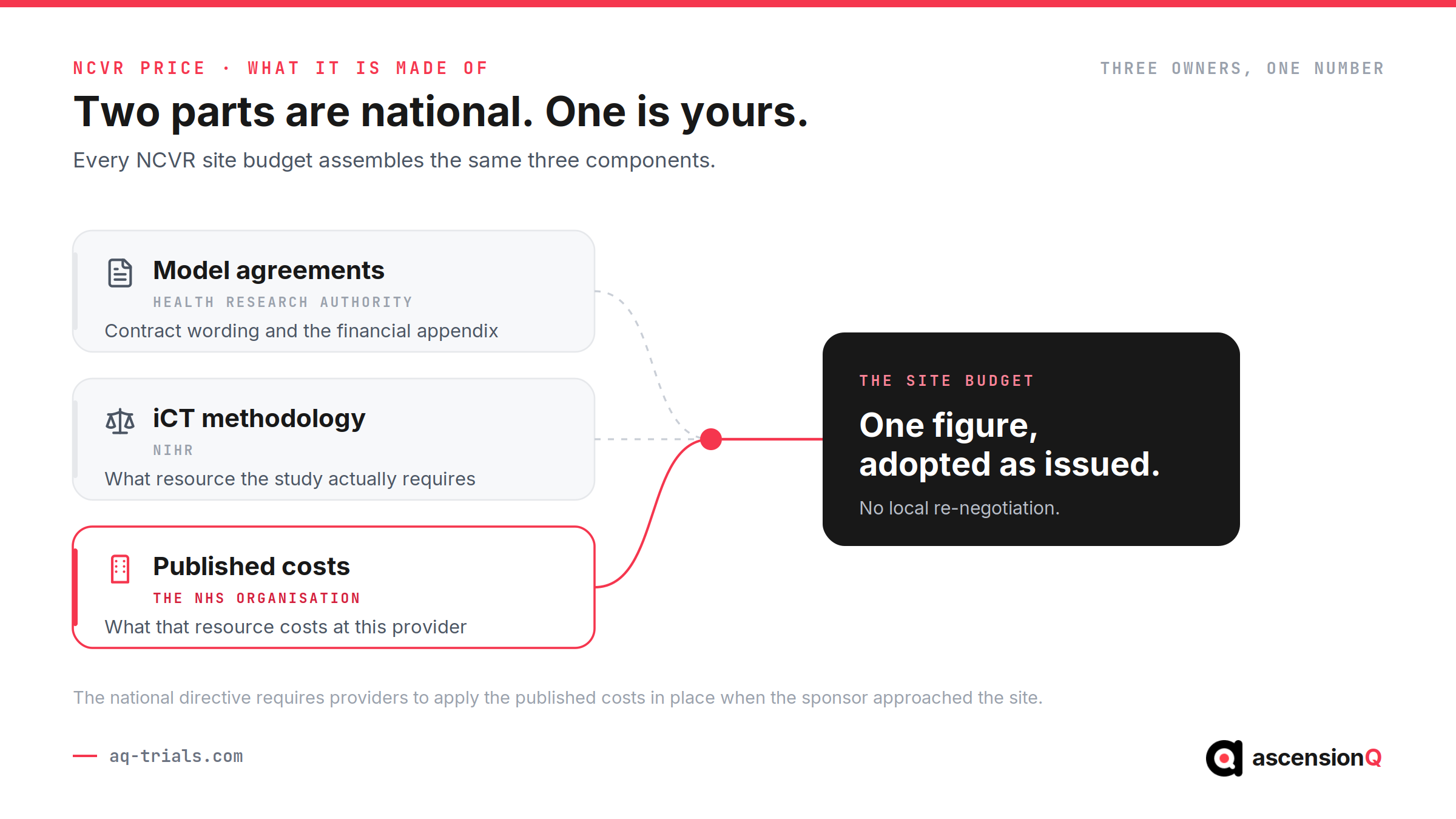
Two of the three are national and identical everywhere. The third is local and deliberately variable, because a tertiary centre and a district general hospital do not carry the same cost base. The national review settles what the study requires. Local tariffs settle what those requirements cost at that organisation.
That split explains the most common misreading of NCVR. Sites sometimes expect a single national price per participant. The process delivers a single national statement of resource, and prices remain site-specific.
How does the NCVR process run?
The sequence starts with the sponsor and ends with a locked budget at each participating organisation. A lead NHS site and a Chief Investigator must be confirmed before the review can begin.
- The sponsor populates the iCT. Resource requirements are entered against the protocol and schedule of events, and submitted alongside the parallel application for HRA and HCRW approval.
- The submission is validated and allocated. A national resource reviewer is identified and confirms whether they can take the review. Reviewers are expected to confirm acceptance within one day of allocation, and a review that cannot be accepted is reallocated within one day.
- The lead site conducts the study resource review. The reviewer works through the iCT against the protocol, deciding which activities are study-specific, how much time each requires, and which investigations exceed standard care. A secondary reviewer provides quality assurance inside the same period.
- The company representative reviews the outcome. The sponsor examines the reviewer’s changes and responds.
- The review is marked complete. The sponsor generates site-specific versions of the iCT, which apply each organisation’s own published costs to the nationally agreed resource.
- The locked site iCT reaches the site. The figures flow into the financial appendix of the model agreement, and the site moves to signature.
The review runs to a published clock. UKCRD sets the lead site review, including quality assurance from the secondary reviewer, at 20 days, followed by up to 5 days for the company representative to review and a further 5 days for company finalisation where it is needed. An overall 30 day measure applies in every case, including where the outcome is sitting with the sponsor.
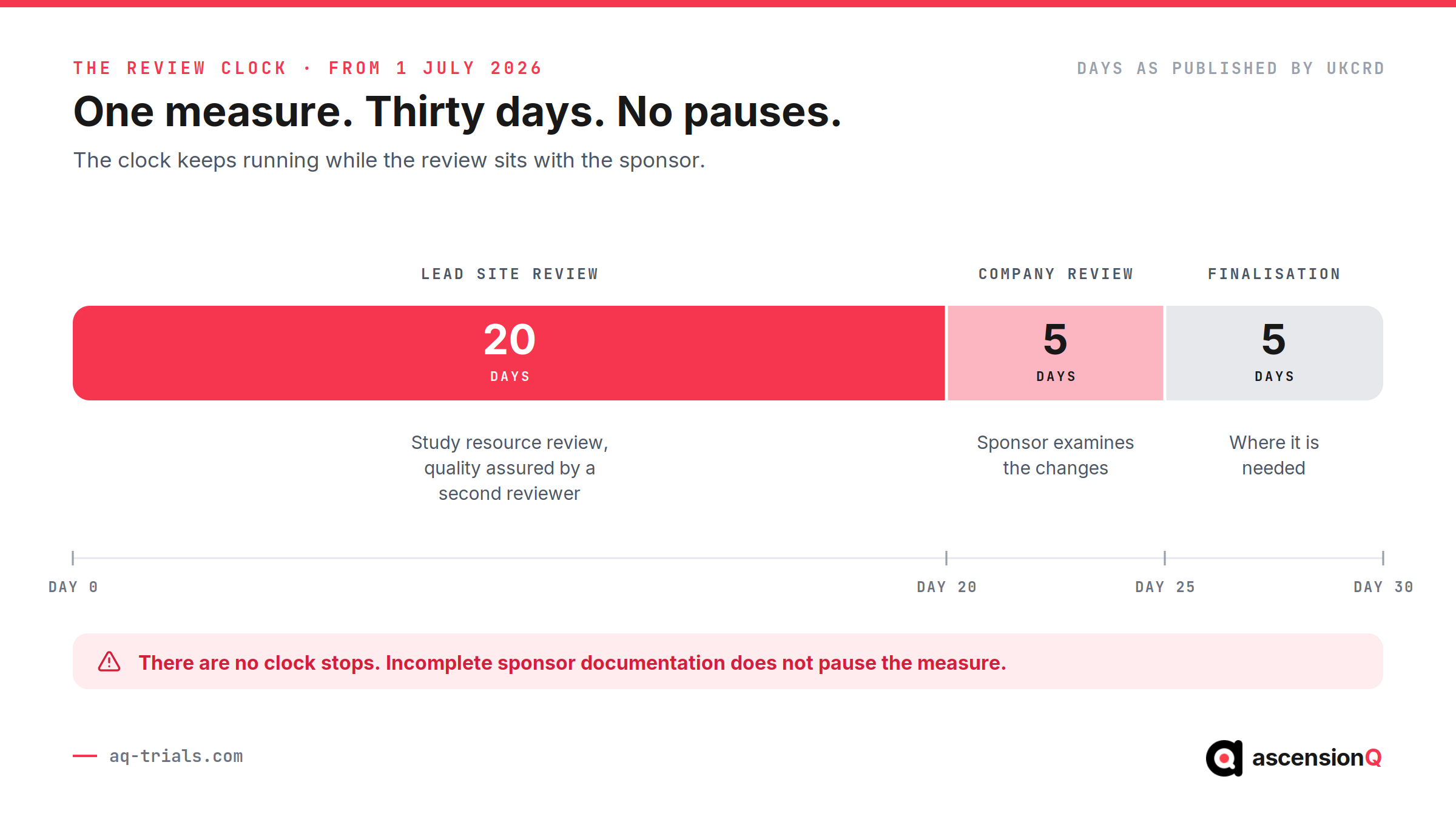
One detail matters more than the headline number. The clock has no stops. Incomplete sponsor documentation does not pause it, and reviewers are expected to work through what they can and flag anything critical inside the first five days. A site waiting on a budget should read the 30 days as elapsed time rather than as processing time.
The published note states these periods in days without specifying a working-day basis, while the standard operating procedure that preceded it measured the study resource review in working days. Teams building the dates into a set-up plan should confirm the basis with the NIHR Industry Hub rather than assume.
What changed on 1 July 2026?
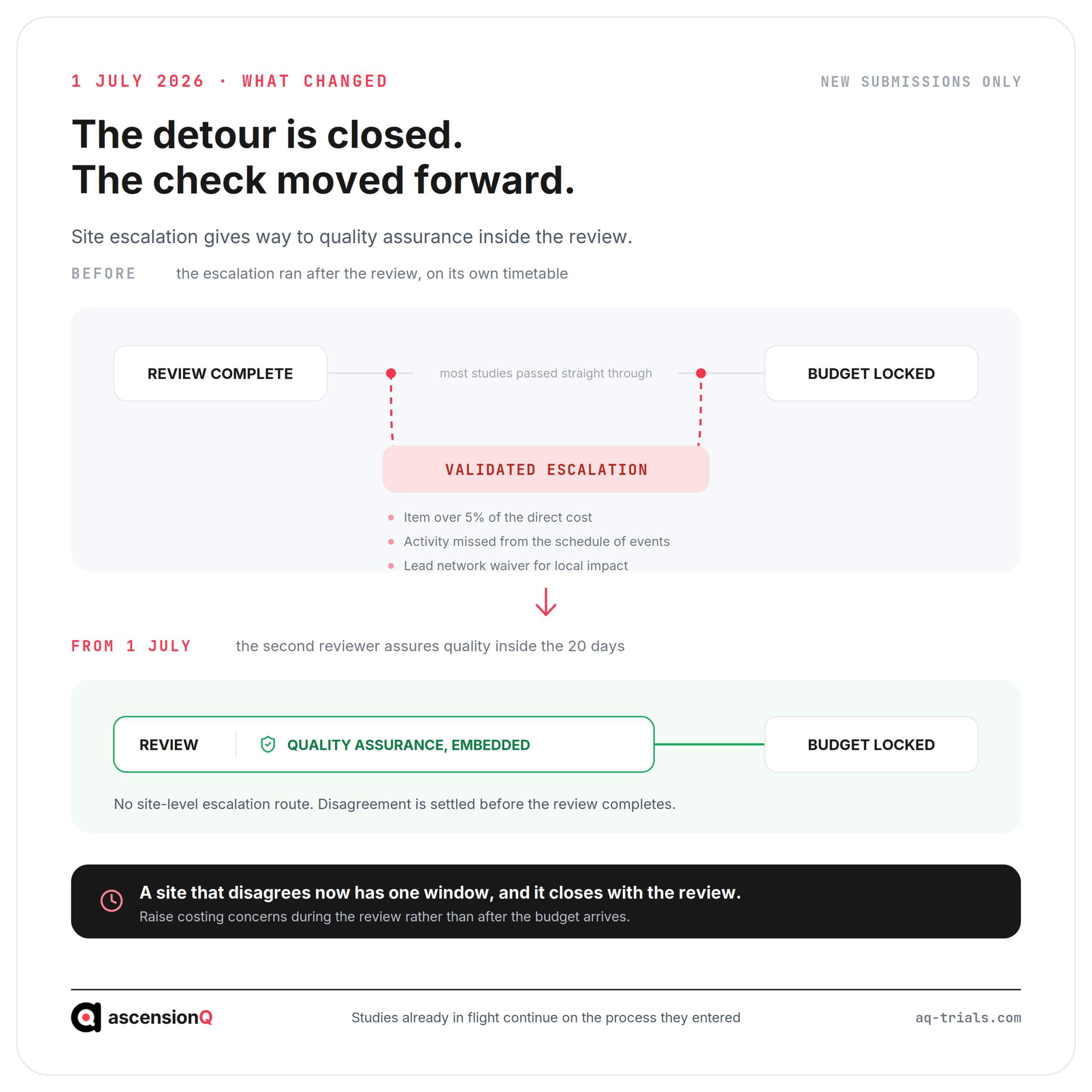
The most consequential recent change removes a route that sites had come to rely on. Under the earlier process, a participating organisation that disagreed with the national review could raise an escalation. The grounds were narrow. A site could escalate where a contested item exceeded 5% of the overall direct cost, where an activity appeared in the schedule of events but had been missed in the review, or where the lead network issued a waiver for significant local impact. Escalation carried its own timetable, and it added weeks to the sites that used it.
UKCRD confirmed on 29 June 2026 that individual site-level escalations end for studies submitted for study resource review on or after 1 July 2026. Quality assurance moves to the front of the process instead, carried by the secondary reviewer who now works alongside the lead site.
| Aspect | Before 1 July 2026 | From 1 July 2026 |
| Quality assurance | Applied after the review, by a site that objected | Applied during the review, by a secondary reviewer |
| Site disagreement | Raised through a validated escalation with defined thresholds | Handled before the review completes, with no site-level escalation route |
| Review period | Study resource review targeted at 30 working days | 20 days for review and quality assurance, then 5 plus 5 for the company |
| Clock behaviour | Escalation ran on its own separate timetable | One 30 day measure covering the whole review, with no pauses |
| Reviewer coverage | Single reviewer for the study | Reviewers from each care setting encouraged where a study spans primary and secondary care |
Transition is handled by submission date. Studies already in flight continue on the process they entered, and only new applications from 1 July 2026 follow the improved route. The change carries no additional funding for the organisations providing secondary review.
The rationale is a distribution argument. Most studies passed without escalation, so the route was consuming process time across the whole portfolio to serve a minority of cases. The check moves earlier, which keeps the scrutiny and removes the queue.
Also Read: Capacity and Capability Confirmation: Timelines and Delays
Which studies and organisations are in scope?
Scope has widened since national introduction, and the current position is close to comprehensive for commercial contract research.
- Study type. All commercial contract studies fall within NCVR. The published guidance confirms that commercial trials of investigational medicinal products are included.
- Phase. The review timeline applies to all commercial contract studies regardless of phase. From October 2024, NCVR incorporated advanced therapy medicinal products, next generation personalised treatments, and early phase studies including phase I and IIa trials.
- Secondary care. NCVR is mandated in secondary, specialist and mental health trusts.
- Primary care. General practices join through a voluntary register. NHS England reports that more than 270 GP practices have signed up.
- Geography. The process runs across England, Scotland, Wales and Northern Ireland, with reciprocal recognition of contract value reviews carried out by NHS organisations elsewhere in the UK. A review completed in one nation is recognised in the others.
Reciprocal recognition is the part sites most often overlook. A study reviewed by a lead site in Scotland arrives at an English trust already priced at national level, and the English trust applies its own tariffs to that review rather than commissioning another.
What does a participating site still decide?
NCVR narrows the site’s commercial discretion and leaves its operational judgement intact. The distinction is worth setting out precisely, because research teams frequently hold a study at the wrong gate.
| Question | Where it is settled | Basis |
| Should this organisation take part? | The site | Capacity, capability and patient population. Guidance states that sites are expected to assess participation on these grounds rather than wait to see the budget. |
| Can we deliver the protocol as written? | The site | Local feasibility, staffing, pharmacy and imaging capacity. |
| What resource does the study require? | The national review | Lead site study resource review, quality assured by a secondary reviewer. |
| What does that resource cost here? | The site’s published tariffs | Provider-specific costs, applied through the site iCT. |
| Can we reopen the agreed budget locally? | Settled nationally | Organisations are expected to adopt nationally agreed budgets and not undertake local review. |
A worked example makes the boundary concrete. Northgate General receives a locked site iCT for a phase III oncology study. The research team judges that the protocol’s imaging schedule will exceed the trust’s current scanner capacity. That is a capability question, and the trust may decline to participate or negotiate a lower recruitment target on delivery grounds. The team also believes the review under-costed pharmacy time. That is a resource question, settled by the national review, and the trust adopts the figure and proceeds to signature.
Feasibility remains local. Value does not.
Where does NCVR sit in the site set-up clock?
NCVR governs one bounded segment of a much longer sequence. A team that reads it in isolation overstates what it can fix. The national review produces a price. Everything that turns that price into an open, recruiting site happens locally and afterwards.
- Ahead of NCVR. Sponsor selection, protocol finalisation and the parallel HRA application. The costing submission runs alongside the approval application rather than after it.
- During NCVR. The 30 day review measure, ending with a locked site iCT.
- After NCVR. Capacity and capability confirmation, technical assurance for pharmacy and radiation, internal approvals, and contract signature.
- At the close of set-up. The Date Site Confirmed, which records the last contract signature across all organisations at a site and, from January 2026, ends the 60-day site set-up metric.
- Reported through. Site milestone dates entered against the study record, which feed national reporting. The relationship between CPMS and a local system determines whether those dates are captured accurately.
The wider context is a national target. The government committed to an average set-up time of 150 days for commercial interventional clinical trials by March 2026, and reported an average of 122 days in April 2026, down from 169 days the previous year. A 30 day costing review sits inside that figure alongside regulatory approval, local confirmation and contract execution. The UK clinical research delivery KPIs track how each of those segments is performing, and the split they show is consistent: national processes move faster than local ones.
Also Read: Why NHS Sites Miss the 90-Day Set-Up Target and How to Close It
Where is the time still lost after the price is agreed?
Sites that treat NCVR as the end of commercial set-up are surprised by what follows. The nationally agreed budget arrives, and the study then waits on internal steps that no national process reaches.
- Signature routing. The executed agreement requires an authorised signatory, and delegated signing authority is often held by one or two people whose availability sets the date.
- Internal finance sign-off. Some organisations run a local review of the nationally agreed budget before signature, which reintroduces the delay NCVR was designed to remove.
- Technical assurance. Pharmacy and radiation reviews run to their own timetables and frequently outlast the costing review.
- Handover gaps. The locked site iCT lands with research finance, and the operational team learns the study is ready days later.
- Milestone capture. Dates that were reached on time are recorded late, so the site’s reported performance understates its actual performance.
Each of these is a visibility problem before it is a capacity problem. A research office rarely knows, on any given morning, which studies are sitting at which internal gate and which of those gates is about to breach. The information exists inside the organisation. It sits in mailboxes, shared drives and individual spreadsheets, and nobody holds the whole sequence.
AQ Trials in commercial study set-up
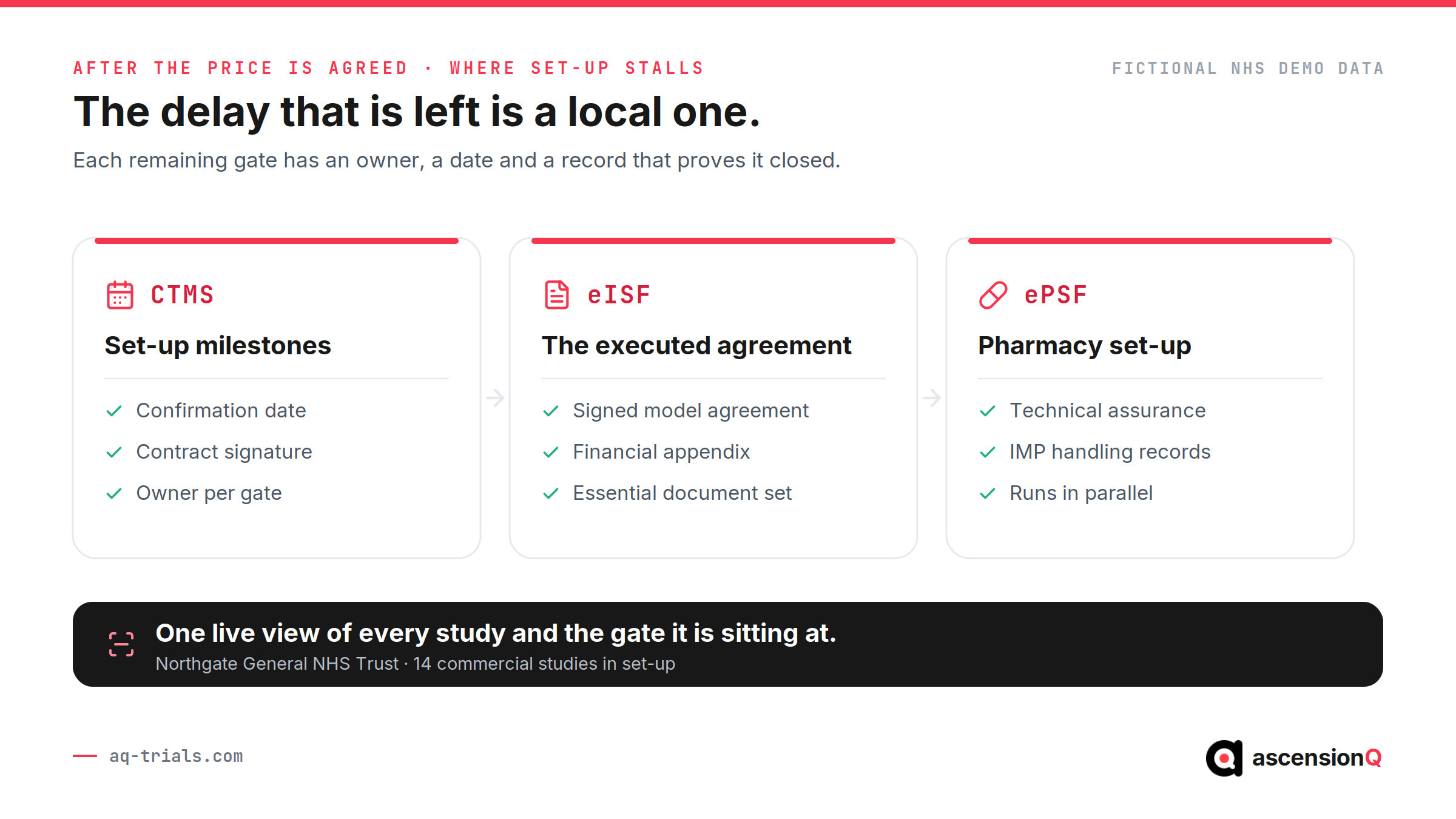
National processes have removed a large share of the negotiation. The remaining delay is local, sequential and largely invisible, which makes it a tracking problem. AQ Trials connects the set-up sequence so that each gate has an owner, a date and an evidence trail.
- The clinical trial management system holds every set-up milestone against the study and the site, including the confirmation date and the contract signature date, which gives the research office one live view of where each study has stopped.
- Milestone ownership is recorded against named roles, which removes the handover gap between research finance and the delivery team.
- The electronic Investigator Site File holds the executed agreement and its financial appendix in the study’s essential document set, which keeps the commercial record inspection-ready alongside the regulatory one.
- The electronic Pharmacy Site File carries pharmacy set-up evidence in its own governed file, which lets technical assurance progress in parallel with contracting rather than behind it.
- Milestone dates are captured at the point they occur, which makes the site’s reported set-up performance match what actually happened.
The platform supports NHS research offices, CROs and sponsors working across multiple sites, where the same set-up sequence runs many times in parallel and the delay is rarely in the same place twice.
To see how set-up milestones, contract records and site files hold together in one system, book a live demo.