Veeva Vault CTMS alternatives are the trial management systems an organisation considers when it needs enterprise-grade study oversight at a scale it can operate every week. Veeva describes Veeva CTMS as an enterprise trial management system that provides end-to-end study management and monitoring capabilities for insourced and outsourced trials, used across more than 200 sponsors and CROs. The capability is real and widely proven. The narrower question for a mid-market sponsor, a growing CRO or an NHS trust is this: which system holds the study record, and who inside the organisation keeps that system validated and current.
Alternatives fall into three groups. Other enterprise suites answer the same brief at the same scale. Enterprise research systems serve academic medical centres and health systems with large portfolios and administration shared across delivery roles. Connected mid-market platforms carry trial management alongside documentation, delegation and quality inside one record, scoped below enterprise scale. The right group follows from an organisation’s operating shape rather than from a feature count.
This guide sets out what Veeva publishes about its own clinical applications, the conditions that send mid-market and NHS teams looking, the named alternatives in each vendor’s published wording, the additional duties a UK trust carries, and the five commitments a replacement decision locks in. Every product statement here is quoted from the vendor’s own public materials.
Key takeaways
- Trial management is one application inside a published suite. Veeva names nine clinical operations applications and three clinical data applications. A team that replaces one of them still has to say where the other eleven jobs are done.
- Proportionality decides the category. Two variables settle it: active studies under your accountability, and the number of people who administer, configure and validate the system.
- The named alternatives serve different buyers. Medidata and Oracle answer the sponsor and CRO brief. Advarra OnCore states a fit for academic medical and cancer centres. Veeva SiteVault CTMS addresses the research site.
- Veeva itself publishes a lighter path. Veeva Basics covers the trial master file, quality documents and training, and submissions, which shows the vendor recognising a scale question rather than dismissing it.
- UK trusts carry duties beyond study tracking. The amended Clinical Trials Regulations took full effect on 28 April 2026 and bring a long records-retention duty with them.
- Record ownership is the first commitment. Settle which system holds the master study record before migration scope, validation, integrations or the exit route.
What does Veeva Vault CTMS actually cover?
Veeva CTMS sits inside a published family of clinical applications. The Veeva Clinical Operations page names nine applications alongside three clinical data applications, each with a stated job. A fair comparison starts by reading that list, because the phrase “Veeva alternative” means something different depending on which of those jobs a team is trying to move.
- Veeva CTMS provides end-to-end study management and monitoring for insourced and outsourced trials.
- Veeva eTMF is described as the leading trial master file application, used to ensure the quality, timeliness and completeness of a TMF.
- Veeva Study Startup manages feasibility, qualification and activation of research sites.
- Veeva Payments manages payments to research sites and tracks study budgets.
- Veeva Site Connect provides one application for sites and sponsors to work together across start-up, execution and closeout.
- Veeva Study Training manages GCP and study-specific training for research sites, CROs and sponsor personnel.
- Veeva RTSM, Disclosures and OpenData Clinical cover randomisation and supply, public registry disclosure, and investigator and site reference data.
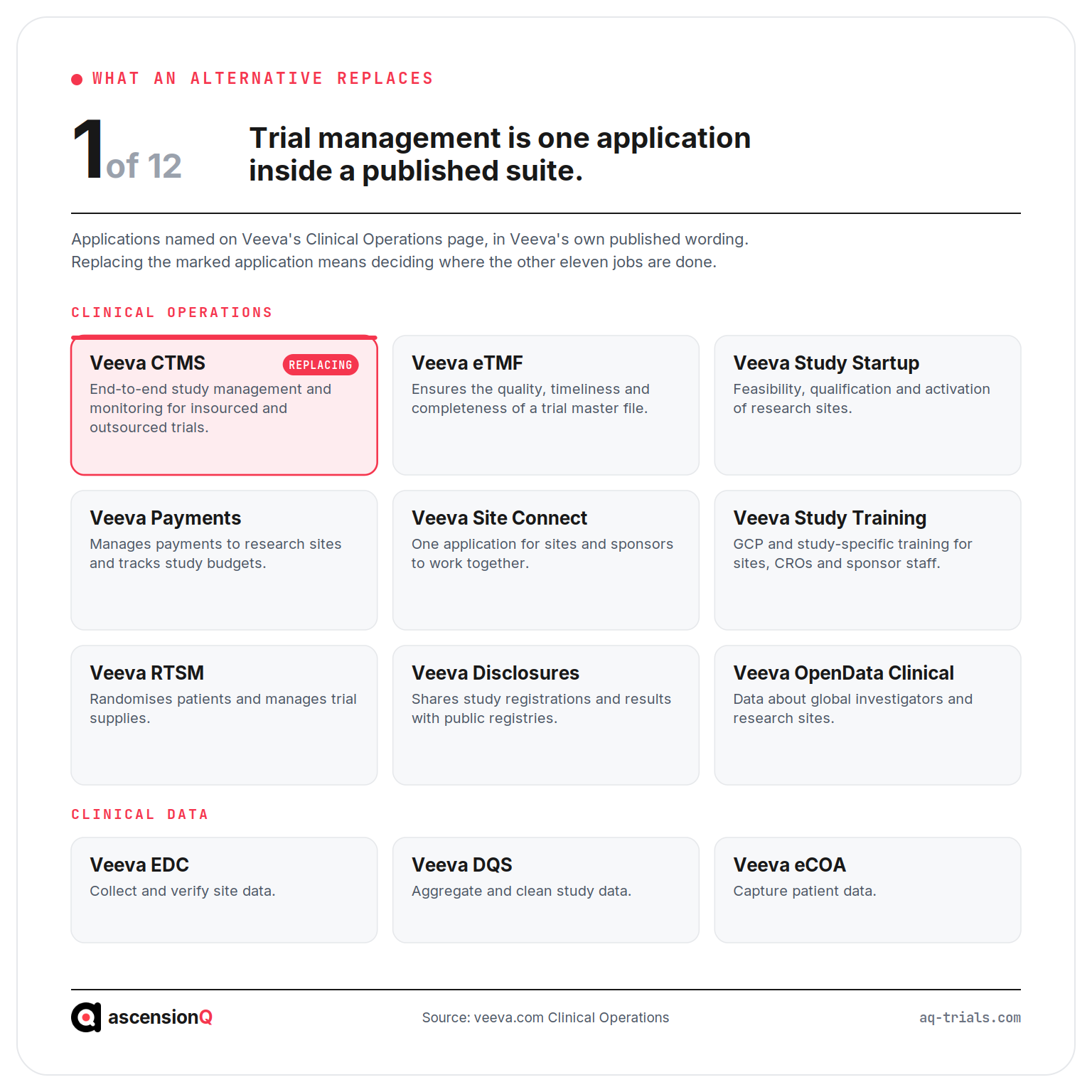
Two consequences follow for anyone shortlisting a replacement. A team that moves only the trial management application still has to place the other jobs somewhere, whether inside the alternative or across separate tools. A team that moves several jobs at once is comparing platforms rather than products. That distinction sets the scope of the whole evaluation, and it is the reason a clinical trial management system comparison so often widens into a platform comparison halfway through.
Why do mid-market and NHS teams look for a Veeva alternative?
The search is usually about proportionality rather than capability. An enterprise suite is specified, priced and implemented for enterprise operations, and it assumes an operating model to match. Four conditions send teams looking, and each one is a statement about the organisation rather than about the vendor.
- No dedicated systems function. Configuration, release testing and revalidation land on people who also deliver studies, which stretches the calendar for every upgrade.
- A portfolio below enterprise volume. A trust or a mid-market sponsor running a few dozen studies pays for administration capacity it never consumes.
- Evidence spread across several tools. A suite covers many jobs, and a partial deployment leaves the delegation log, the site file and the training record in separate systems that a person has to reconcile.
- A procurement route with its own tests. UK public bodies assess suppliers through framework and assurance requirements that sit outside a product feature list.
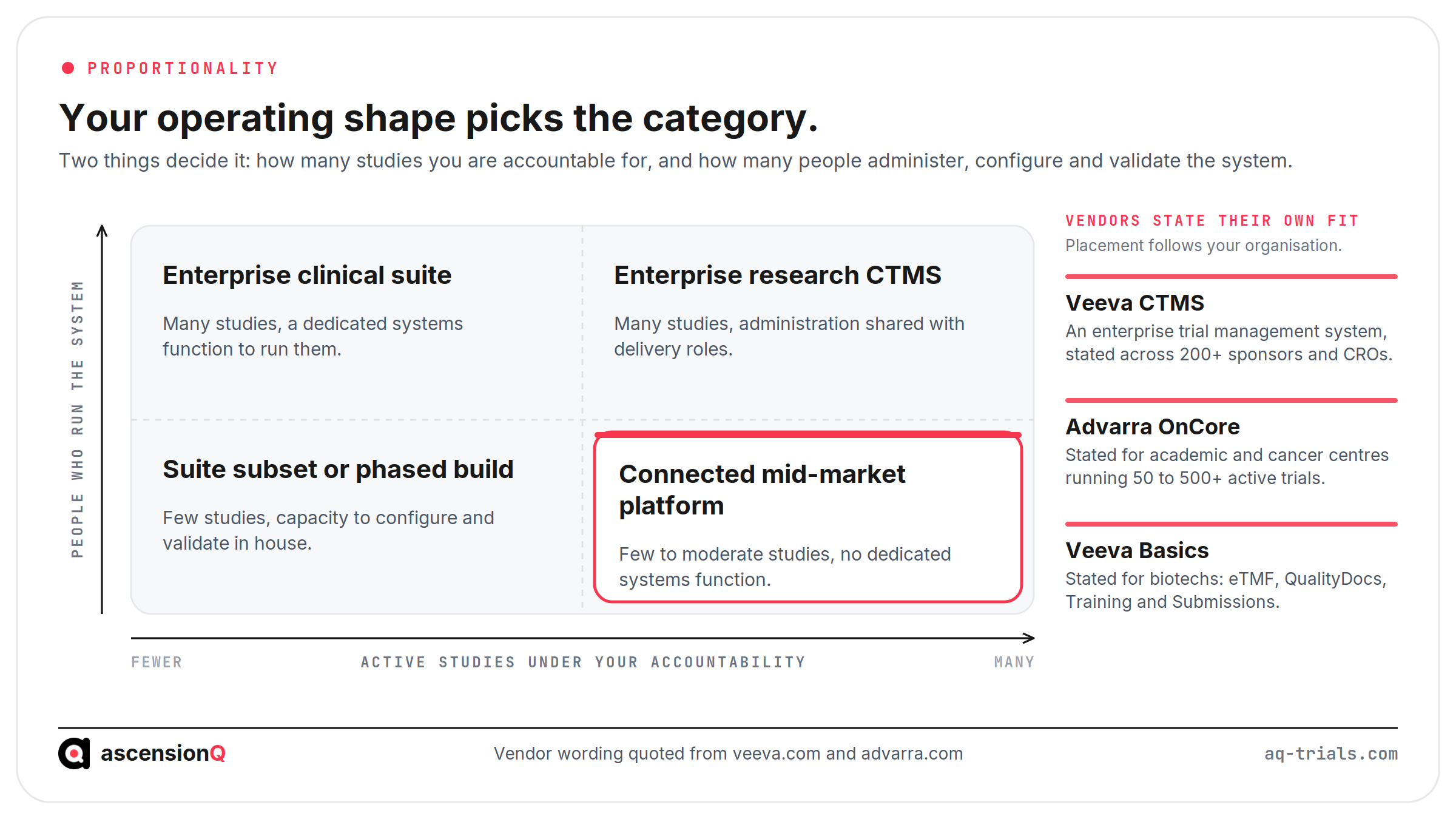
Veeva itself publishes a lighter path, which is worth stating plainly in a comparison of this kind. Veeva Basics is described as technology, training and support designed for biotechs, deployed with zero implementation and maintenance costs. The applications named in that announcement cover the trial master file, quality documents and training, and submissions. Trial management sits outside the announced Basics set, so a smaller sponsor evaluating Veeva specifically for CTMS is evaluating the full Vault application.
Scale is a cost as well as a capability.
Also Read: Clinical trial management system cost: what drives the total figure
What are the named alternatives to Veeva Vault CTMS?
Four named products and one platform category make up a realistic shortlist. Each description below uses the vendor’s own published wording, because a comparison built on inference rather than sources is worth very little in a procurement pack.
- Medidata CTMS brings clinical and operational activity into one connected, AI-enabled solution, and connects with Rave EDC and Medidata eTMF so data populates across those systems. It answers the sponsor and CRO brief at similar scale to Veeva.
- Oracle Life Sciences CTMS is published as a way to manage and monitor clinical trial operations with centralised tracking of study activities, site performance and regulatory documentation, serving sponsors, CROs and sites.
- Advarra OnCore states a fit that maps closely to UK trusts and academic centres. Advarra describes it as built in collaboration with leading academic medical centres and cancer centres, for organisations conducting fifty to 500 or more active trials, with billing compliance and EMR integration named as core.
- Veeva SiteVault CTMS addresses the research site rather than the sponsor. Veeva describes it as trial management across pre-award budgeting and visit scheduling through to post-award invoicing and payment reconciliation, unified with the site’s eISF and eConsent.
- Connected mid-market platforms hold trial management, documentation, delegation, pharmacy and quality in one governed record for teams below enterprise scale. AQ sits in this category, and the final section describes how.
The table sets these out on the dimensions that decide an evaluation. Read it as a map of fit rather than a scoreboard, because each of these products is strong inside the brief its vendor writes for it.
| System | Vendor’s stated scope | Stated buyer | What to settle before a move |
| Veeva CTMS | End-to-end study management and monitoring for insourced and outsourced trials | Sponsors and CROs, stated across 200+ organisations | Which of the other eleven suite applications you also adopt |
| Medidata CTMS | Clinical and operational activity in one connected, AI-enabled solution | Sponsors and CROs | Whether your EDC and eTMF stay in the same family |
| Oracle Life Sciences CTMS | Centralised tracking of study activities, site performance and regulatory documentation | Sponsors, CROs and sites | The integration surface you inherit with the wider estate |
| Advarra OnCore | Research management with billing compliance and EMR integration | Academic medical and cancer centres, 50 to 500+ active trials | How UK sponsorship and costing map onto a US billing model |
| Veeva SiteVault CTMS | Budgeting, scheduling, invoicing and reconciliation, unified with eISF and eConsent | Research sites | Where sponsor-level oversight across sites is held |
| Connected mid-market platform | Study management, documentation, delegation, pharmacy and quality in one record | NHS trusts, mid-market sponsors, CROs and sites | Whether the module set covers every job you are moving |
A structural comparison of these categories, including the site-file specialists and general document platforms that appear on the same shortlists, sits in the AQ, Veeva, Florence, RealTime and SharePoint comparison. Teams evaluating the site file specifically will find the same treatment applied to that layer in the guide to Florence eISF alternatives.
Which alternative fits which team?
The comparison resolves differently for each kind of organisation. A short mapping saves a great deal of demo time.
- Global biopharma with a systems team: an enterprise suite matches the scale, and the implementation footprint is affordable against the portfolio it supports.
- Academic medical centre or cancer centre with a large portfolio: an enterprise research CTMS such as OnCore states exactly this buyer, and the EMR integration usually decides it.
- NHS trust R&D office: the priority is connected oversight across departments and sites, which is the brief a proportionate platform for NHS and hospital research teams is built to meet.
- Mid-market sponsor: oversight across delegated execution matters more than module count, the need a platform for emerging and mid-market sponsors addresses without an enterprise build.
- Growing CRO: multi-sponsor separation inside one system is the deciding test, covered in the platform for CROs managing multi-sponsor work.
- Single research site: a site-first system such as SiteVault CTMS fits the daily work, with sponsor oversight held one level above it.
Also Read: CTMS for NHS R&D: choosing an inspection-ready platform
What do NHS research teams need beyond study tracking?
An NHS trust carries duties that a global product brochure treats as local detail. The amended UK Clinical Trials Regulations took full effect on 28 April 2026, and applications submitted on or after that date run under the new rules. ICH-GCP E6(R3) applies alongside them and sets expectations for the computerised systems that hold trial records. Four requirements shape a UK evaluation.
- Records that outlive the system. Trial records carry a retention duty measured in decades, so the export format and the custody arrangement matter as much as the interface. The detail sits in the guide to eISF requirements for NHS trusts.
- Sponsorship held by the organisation. A trust acting as sponsor answers for oversight across every study it sponsors, which makes the portfolio view a statutory need rather than a reporting convenience.
- Validation for intended use. A vendor validates the product. The organisation validates its configured instance for the way it runs studies, a split explained in the guide to GAMP 5 and computerised system validation.
- Assurance evidence at procurement. UK public buyers test suppliers against framework and security assurance before contract, so that evidence belongs in the shortlist stage rather than the implementation stage.
The regulatory picture behind these duties is set out in full in the guide to the UK Clinical Trials Regulations in 2026.
How should you evaluate a Veeva alternative?
Feature lists converge, and most systems on a shortlist tick most boxes. The differences that matter appear later, in what the decision commits the organisation to. Five commitments bind in sequence, and each becomes harder to reverse than the one before it.
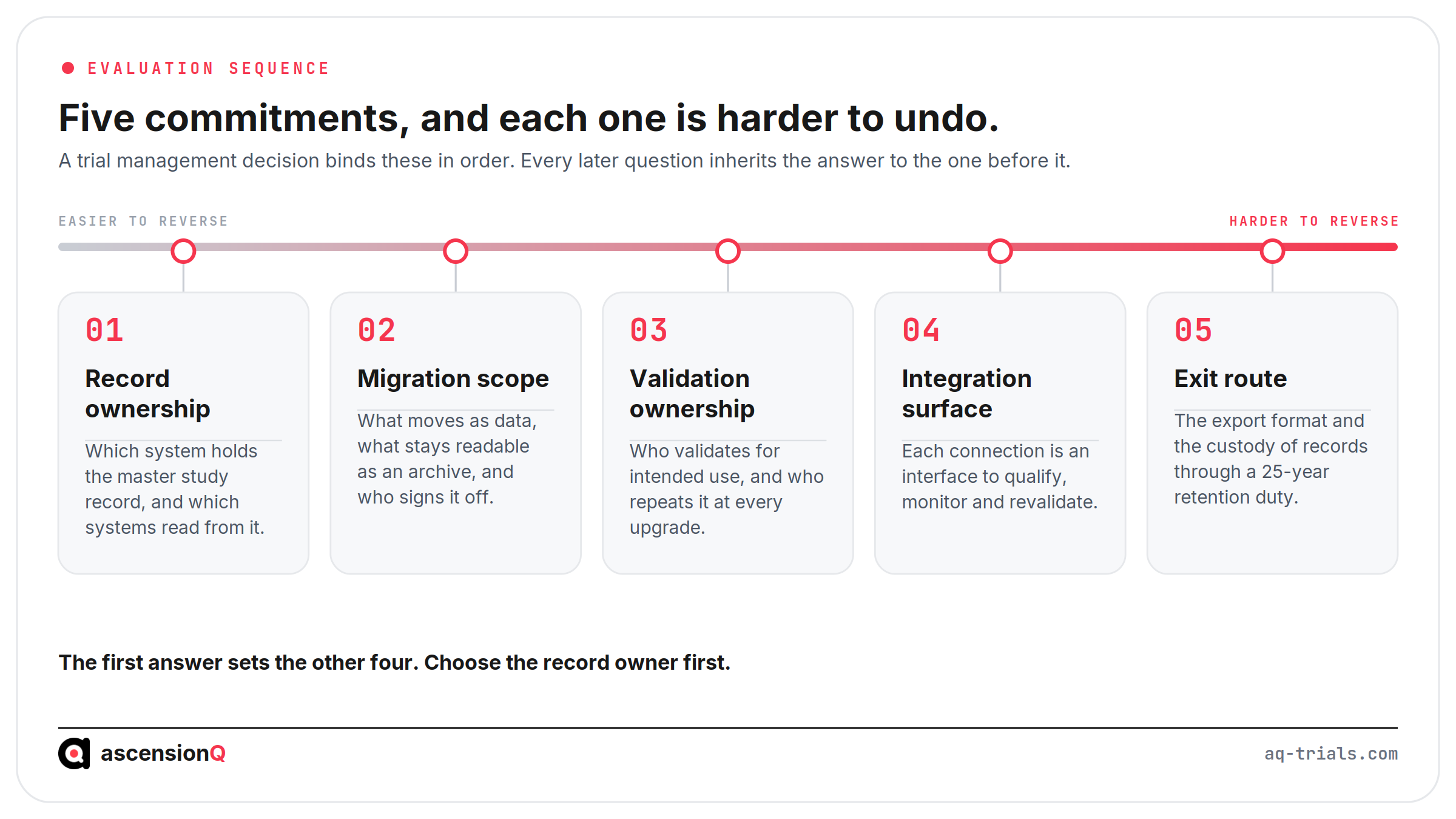
- Record ownership. Name the system that holds the master study record, and name the systems that read from it. This answer sets the other four.
- Migration scope. Agree what moves as structured data, what stays readable as an archive, and who signs the verification. A partial move leaves two versions of one study on the estate.
- Validation ownership. Confirm who validates for intended use and who repeats that work at every upgrade, so the cost appears in the business case rather than in year two.
- Integration surface. Treat each connection as an interface to qualify, monitor and revalidate, because integration count drives maintenance more reliably than module count does.
- Exit route. Establish the export format and the custody of records across the full retention period, before signature rather than at renewal.
Two further questions separate genuine oversight from tidy storage. Ask whether trial management, the trial master file, the site file, pharmacy and quality read from one source, so an update in one is visible everywhere. Ask where the audit trail lives, because a single connected record produces one continuous trail while integrated point tools produce several that a reviewer aligns by hand.
The reconciliation step is where findings are written.
Also Read: What is inspection readiness in clinical trials, and how does it work across a network?
Frequently Asked Questions
What are the alternatives to Veeva Vault CTMS?
The realistic shortlist is Medidata CTMS, Oracle Life Sciences CTMS, Advarra OnCore, Veeva SiteVault CTMS and connected mid-market platforms such as AQ. Medidata and Oracle answer the sponsor and CRO brief, Advarra OnCore states a fit for academic medical and cancer centres, and SiteVault CTMS addresses the research site.
Why do mid-market and NHS teams look for a Veeva alternative?
Usually for proportionality rather than capability. An enterprise suite is specified, priced and implemented for enterprise operations, and it assumes an operating model to match.
How do you know whether an enterprise CTMS is the right scale?
Two variables settle it: the number of active studies under your accountability, and the number of people who administer, configure and validate the system.
Does Veeva offer a lighter option?
Yes. Veeva Basics covers the trial master file, quality documents and training, and submissions, which shows Veeva recognising a scale question for smaller organisations.
What should be decided first when replacing a CTMS?
Which system holds the master study record. That decision comes before migration scope, validation, integrations and the exit route, because each later commitment is harder to reverse than the one before it.
How does AQ approach trial management at this scale?
AQ takes the connected-platform position for teams below enterprise scale. The connected platform holds trial management alongside the electronic Trial Master File, the electronic Investigator Site File, the electronic Pharmacy Site File, the quality management system, CAPA management and Digital Delegation of Authority. The modules share one record rather than exchange copies of it, so a delegation change is visible to the site file, the study record and the quality system at the moment it is made.
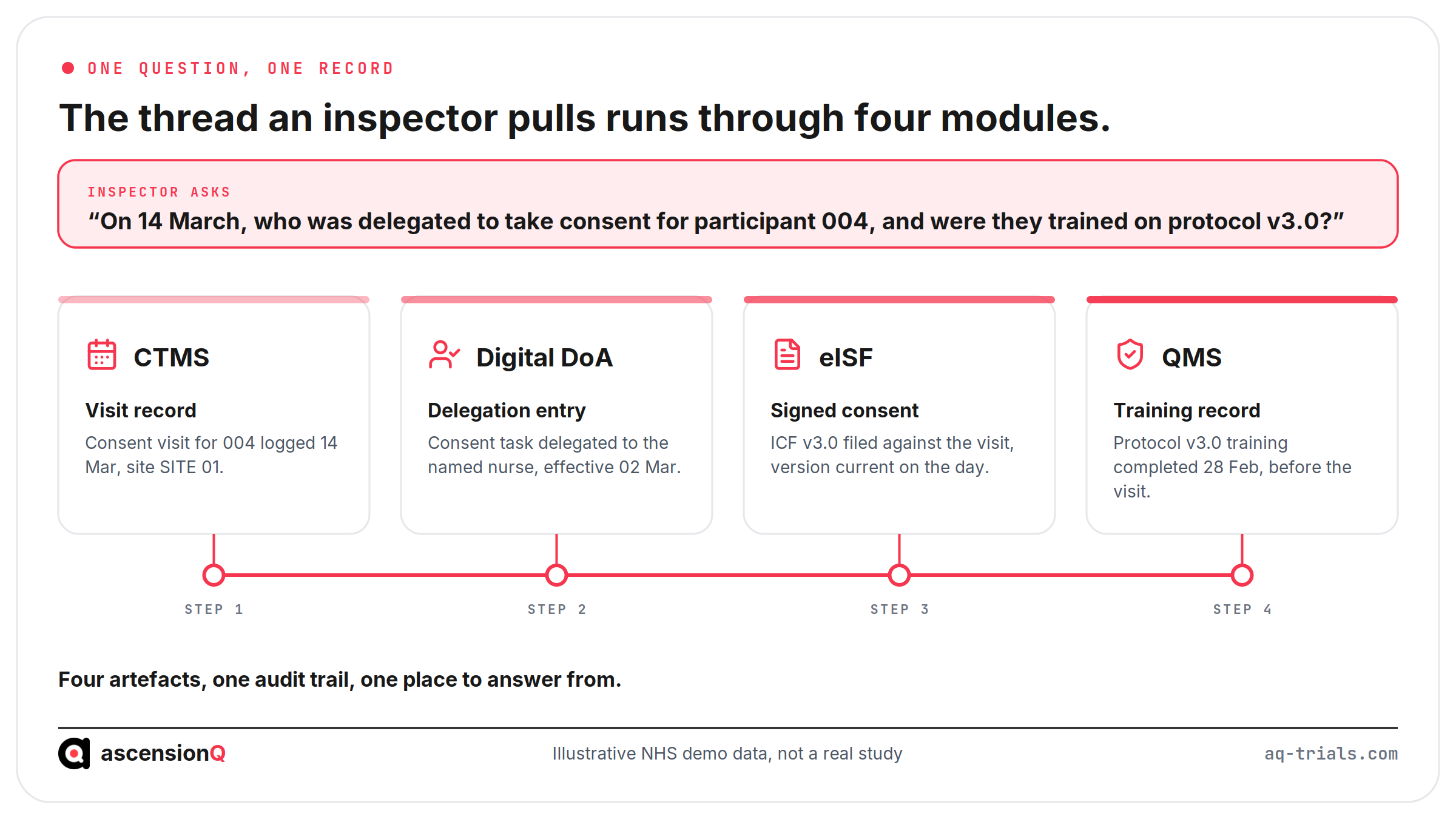
The design follows from mechanism. One shared record produces one continuous audit trail across the study, which supports inspection readiness rather than promising it. A connected quality layer links a deviation to its CAPA and its training evidence, so an inspector following a thread stays inside the system to finish it. The trial master file is built on the CDISC TMF Reference Model, aligning filing to the model sponsors and inspectors share. AQ meets the NHS Data Security and Protection Toolkit standard (Standards Met 2026), holds Cyber Essentials, and supports the ALCOA+ and 21 CFR Part 11 principles that regulated records require.
AQ suits an NHS trust, an academic centre, a mid-market sponsor, a CRO or a site that needs connected oversight scaled to its operation. A global biopharma running an enterprise systems function is better served by an enterprise suite, and that is the honest boundary of this comparison. The best system remains the one whose scale and structure match the accountability you carry.
See what one connected record looks like across study coordination, documentation, delegation, quality and pharmacy. Book a live demo and evaluate AQ against the systems on your shortlist.