eSource records must be kept for at least 25 years after the end of the trial, and they are archived by holding the entry, its metadata and its audit trail in a form that still opens and still means the same thing at the end of that period. The retention period is a legal duty. The archive is the capability that keeps the duty satisfiable.
This guide covers the UK retention clocks that apply to a clinical trial, which parts of an eSource record they cover, the difference between an archive and a backup, how a site keeps electronic records readable across decades, and what happens to the data when the system or the contract ends. It sits inside our wider guide to eSource in clinical trials for UK research sites.
A record you cannot open is a record you did not keep.
How Long Must eSource Records Be Kept Under UK Law?
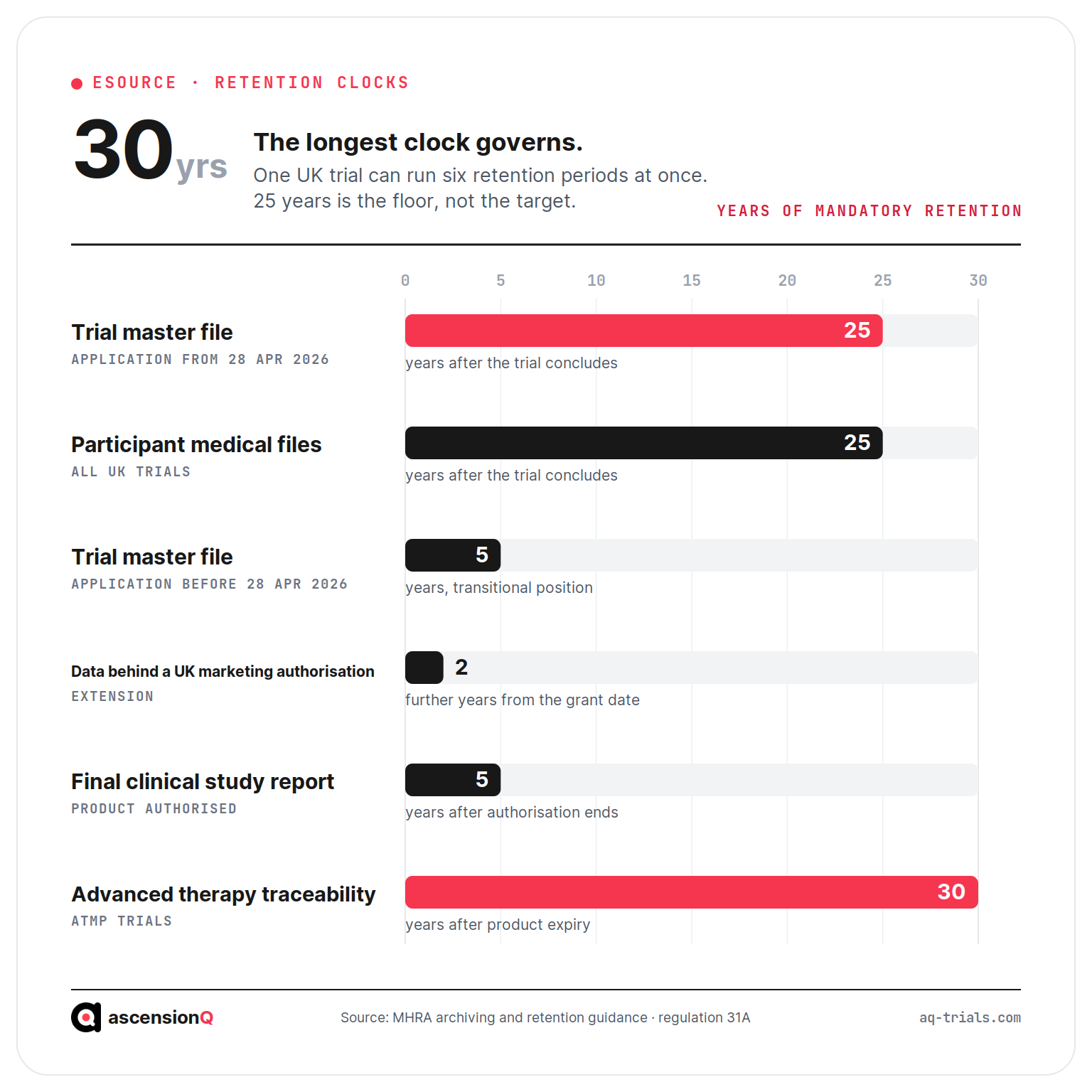
Regulation 31A of the Medicines for Human Use (Clinical Trials) Regulations 2004, as amended, sets the retention period for UK trials. Trials with an application submitted on or after 28 April 2026 retain the trial master file and participant medical files for at least 25 years beginning the day after the trial concludes. Trials applied for before that date keep the trial master file for at least 5 years, and participant medical files for 25 years.
One trial can therefore run several clocks at once. The MHRA sets them out in its guidance on archiving and retention of clinical trial records.
| Record | Minimum period | Clock starts |
| Trial master file and site file, application from 28 April 2026 | 25 years | The day after the conclusion of the trial |
| Trial master file, application before 28 April 2026 | 5 years | The day after the conclusion of the trial |
| Participant medical files, all trials | 25 years | The day after the conclusion of the trial |
| Trial data supporting a UK marketing authorisation | A further 2 years | The day after the authorisation is granted |
| Final clinical study report for an authorised product | 5 years | The day the product is no longer authorised |
| Advanced therapy traceability records | 30 years | Product expiry, or longer if the trial authorisation says so |
The longest applicable clock governs. A site running an advanced therapy study plans for 30 years after product expiry, and treats 25 years as the floor rather than the target.
Which Parts of an eSource Record Have to Be Kept?
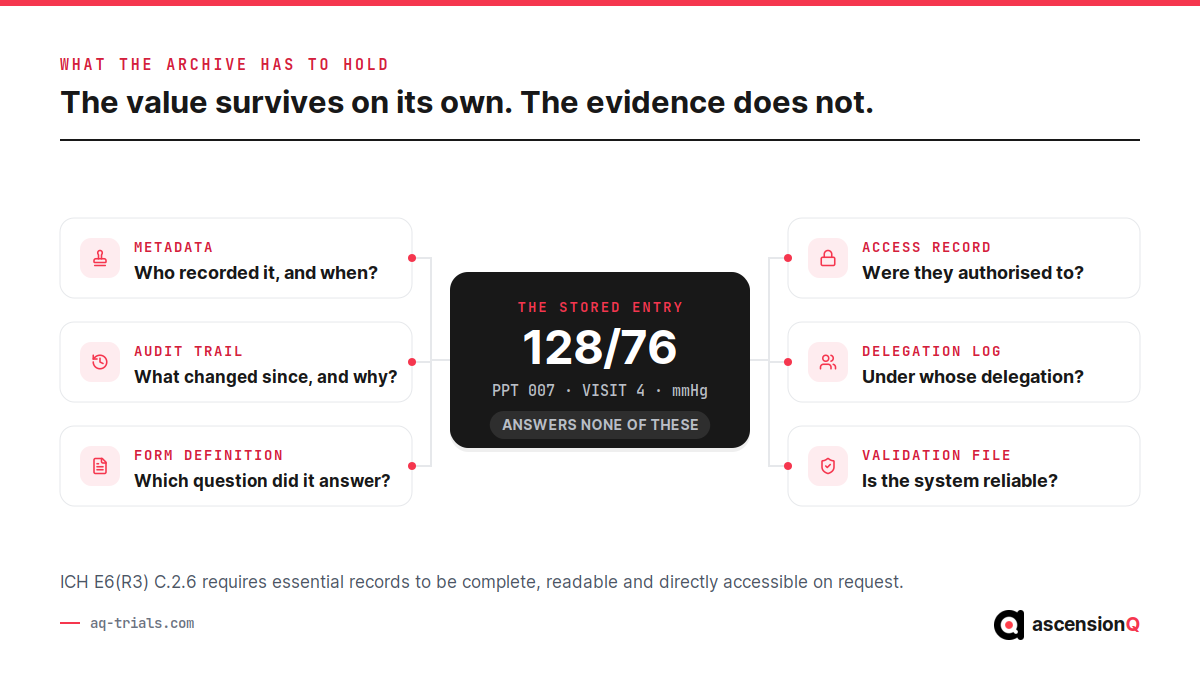
Retention covers the whole record, not the value alone. ICH E6(R3) Appendix C section C.2.6 requires essential records to be complete, readable and directly accessible on request by regulatory authorities, monitors and auditors. A stored number satisfies none of that on its own.
Six components have to survive together for an entry to remain evidence:
- The value itself, with the units and the participant, visit and field it was recorded against.
- The metadata, which names the user, the date, the time and the device, so the entry stays attributable.
- The audit trail of every change and deletion with its reason, so a reviewer can reconstruct the entry’s history.
- The form definition and edit checks in force on the day, so the question the value answered is still legible.
- The user access and delegation records, which show the entry was made by someone authorised to make it.
- The validation evidence for the system, which supports the claim that the record is reliable.
Validation evidence is retained alongside the data it supports. Our guide to how to validate an eSource system before first patient in covers the ten documents a site files at the start, and every one belongs in the archive at the end. A scan that replaced a paper original inherits the retention duty, and our guide to certified copies and when a scanned record can replace the original source covers the verification behind that substitution.
What Is the Difference Between an Archive and a Backup?
An archive holds final records for verification. A backup holds current records for recovery. The MHRA GXP data integrity guidance defines an archive at section 6.17.1 as a designated secure area or system for the long term retention of data and metadata for the purposes of verification of the process or activity. It defines a backup as a copy of current, editable data and system configuration kept for recovery.
The guidance is explicit that one does not substitute for the other. Backups for recovery purposes do not replace the need for long term retention of data and metadata in its final form.
| Aspect | Backup | Archive |
| Purpose | Restore the live system after failure | Produce the record for inspection years later |
| State of the data | Current and editable | Final and protected from change |
| Typical lifespan | Weeks or months on rotation | The full statutory retention period |
| Overwritten | Routinely, by the next cycle | Never, before the period ends |
| Tested by | A restore test | A retrieval and readability test |
| Fails when | The restore does not complete | The file opens and the meaning is gone |
A site relying on the vendor’s backup schedule as its archive has a recovery plan and no retention plan. The distinction belongs in the site’s archiving standard operating procedure, held in the quality management system.
How Does a Site Keep eSource Records Readable for 25 Years?
A site keeps records readable by treating readability as something to be tested, not assumed. The MHRA guidance expects archived electronic records to permit recovery and readability throughout the retention period, expects the archiving process itself to be validated, and expects accessibility of legacy systems to be verified periodically.
Format is the decision that carries the most risk. The guidance distinguishes a static record, which allows little interaction, from a dynamic record, which allows a user to query, sort and reprocess. Data must be retained in a dynamic form where that form is critical to its integrity or later verification. A PDF print of an eSource form is a static rendering, and it drops the audit trail behind each field.
Consider a hypothetical NHS trust in 2038. An inspector asks for the visit 4 blood pressure for participant 007 on a study that closed in 2031. The trust produces a PDF export.
- The value is present, and the correction made three days after the visit is not.
- The audit trail was held in a separate table the export never included.
- The vendor withdrew the product in 2034 and the archived database file has no software that reads it.
- Nobody tested a retrieval between 2031 and 2038, so the gap surfaced in front of the inspector.
Each failure there is a system condition rather than an individual error. The archiving strategy was written once and never exercised. Four controls close the gap:
- Record an inventory of what was archived, in which format, from which system, on which date.
- Schedule a periodic retrieval test, so a failure to open surfaces years before an inspection does.
- Validate any migration to a new format, and document that content and meaning survived it.
- Keep the reading software available, in a virtual environment where the original platform is unsupported.
Migration deserves particular care. The MHRA guidance notes that the challenges of migrating data are often underestimated, particularly regarding maintaining the full meaning of the migrated records. A date format that silently changes during a migration alters the meaning of every timestamp in the trail.
What Happens to eSource Records When the Contract or System Ends?
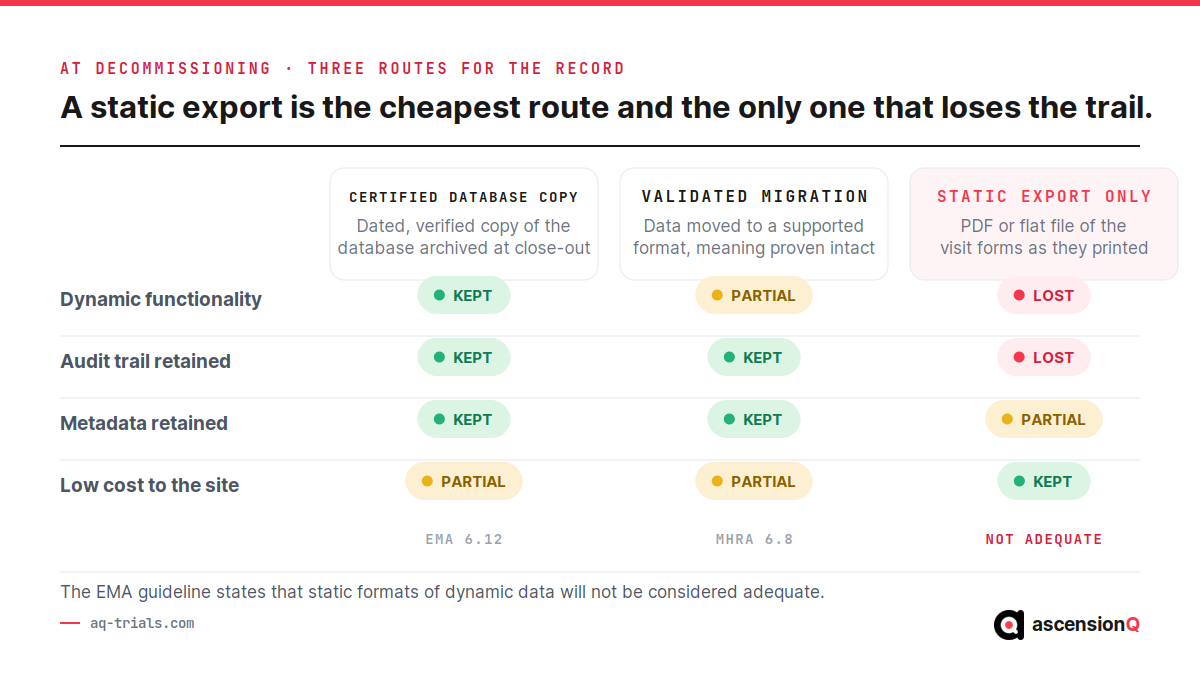
The records outlive the contract, so the exit route is agreed before the system goes live. The EMA guideline on computerised systems and electronic data in clinical trials addresses decommissioning at section 6.12. It requires a dated and certified copy of the database and data to be archived and available on request, and it states that static formats of dynamic data will not be considered adequate.
The same section expects archived formats to allow the database to be restored, including its dynamic functionality and all relevant metadata such as the audit trail, event logs, edit checks, queries and user logs. Annex 1 asks that written agreements secure continued and timely access to the data in the event of vendor bankruptcy, shutdown, disaster or discontinuation of the service. That guideline sits outside UK law, and UK sites use it as a detailed reference alongside MHRA expectations.
Six terms belong in the agreement before first patient in:
- An export specification naming the formats, so the site knows what it will receive rather than what it hopes for.
- Inclusion of metadata and audit trails in that export, which keeps the entry attributable after the move.
- A defined notice period and handover window, so the transfer happens while the vendor still has staff.
- A certified copy process for the exported database, which allows the copy to stand in for the original.
- Continuity terms covering insolvency and service withdrawal, so access survives events the site does not control.
- A costed statement of any export or long-term retention fee, so the price of the archive is known at signature.
Our guide to what the MHRA expects from electronic source systems under the 2026 UK regulations covers the inspection findings that follow when this evidence is absent.
Who Is Responsible for the eSource Archive at a UK Site?
Responsibility is named, not assumed. Regulation 31A(9) requires the sponsor to appoint a named individual within the organisation to be responsible for archiving the documents. ICH E6(R3) section C.2.7 adds that original records should generally be retained by the party who generated them, which leaves the site holding its own source records.
| Party | What they hold |
| Sponsor | The trial master file, and a named individual accountable for archiving it |
| Site and investigator | The source records the site generated, and the investigator site file |
| Chief investigator | The retention duty if the sponsor ceases to exist |
| NHS trust records service | Participant medical files, under trust retention policy |
| Vendor | Only what the written agreement says, for only as long as it says |
Two rules apply throughout the period. Documents must not be destroyed before it ends. Accidental loss is assessed for impact, and a loss that prevents the trial being presented at inspection may warrant a serious breach notification.
Most of this evidence is filed in the electronic investigator site file, which is where an inspector starts. A site that changed format part-way through a study keeps both halves of the record, and our guide to how to move a site from paper source to eSource mid-study covers the paper already collected.
Retention shapes the buying decision as much as the daily workflow, because the system a site chooses this year has to release a readable record decades from now. AQ is launching eSource soon as part of the AQ platform. Book a live demo to see the AQ platform today.