An SMO runs one of two operating models. In the first model the site management organisation owns the research site, employs the people in it and runs the premises. In the second model the SMO places its staff inside an institution somebody else runs, usually an NHS trust, and the host keeps control of the place. The dividing line is day-to-day responsibility for the location, and that one question decides which set of obligations the SMO carries.
This guide covers the two models, the role UK research policy assigns to the SMO in each, what changes on either side of the line, and the hybrid most SMOs actually run. It sits under the pillar guide to site management organisations and running research across multiple sites.
- The UK Policy Framework for Health and Social Care Research defines a research site by day-to-day responsibility for the place, which is the only test that separates the two models.
- An SMO running its own sites holds two sets of duties at once. An SMO placing staff holds one.
- The model changes who grants access and who controls the premises. The model never changes who signs the delegation.
What Are the Two SMO Operating Models?
The two models differ in who runs the place. Paragraph 9.14 of the UK Policy Framework states that research sites “are the organisations with day-to-day responsibility for the places where a research project is carried out”. That definition resolves differently in each model.
- Own sites. The SMO holds a dedicated research facility, employs the nurses and coordinators who work there, maintains the equipment and controls the systems. The SMO is the research site.
- Staff placed in host institutions. The SMO employs research staff and supplies them to clinics and wards run by an NHS trust or another care provider. The host is the research site.
ICH E6(R3) names neither model. It recognises one category of organisation, the service provider, and the boundary between that organisation and a contract research organisation is covered in SMO vs CRO: which one does what. The operating model is a commercial choice sitting beneath that boundary. An SMO is a commercial organisation in both models. It is not an NIHR-designated Commercial Research Delivery Centre, and it is not an NHS trust R&D office.
Which Role Does the SMO Hold Under UK Research Policy?
The UK Policy Framework assigns responsibilities by role rather than by organisation type. An SMO picks up one role in the placed-staff model and two roles in the own-sites model.
Paragraph 9.20 covers employers, defined as the organisations employing the chief investigator and members of the research team. It requires an employer to “ensure researchers understand and discharge their responsibilities”, to provide “written procedures, supervision and training that support accountability and effective collaboration”, and to give “assurances about researchers’ suitability”. An SMO meets that paragraph in both models, because it employs the staff either way.
Paragraph 9.14 covers research sites, and it lands only where the SMO runs the place. A research site is responsible for demonstrating that the location is suitable, for being aware of all research activity undertaken in or through the site, for ensuring the roles of individuals and collaborating parties are agreed and documented, and for satisfying itself that the research holds the approvals it needs.
One model makes the SMO an employer. The other makes it an employer and a site.
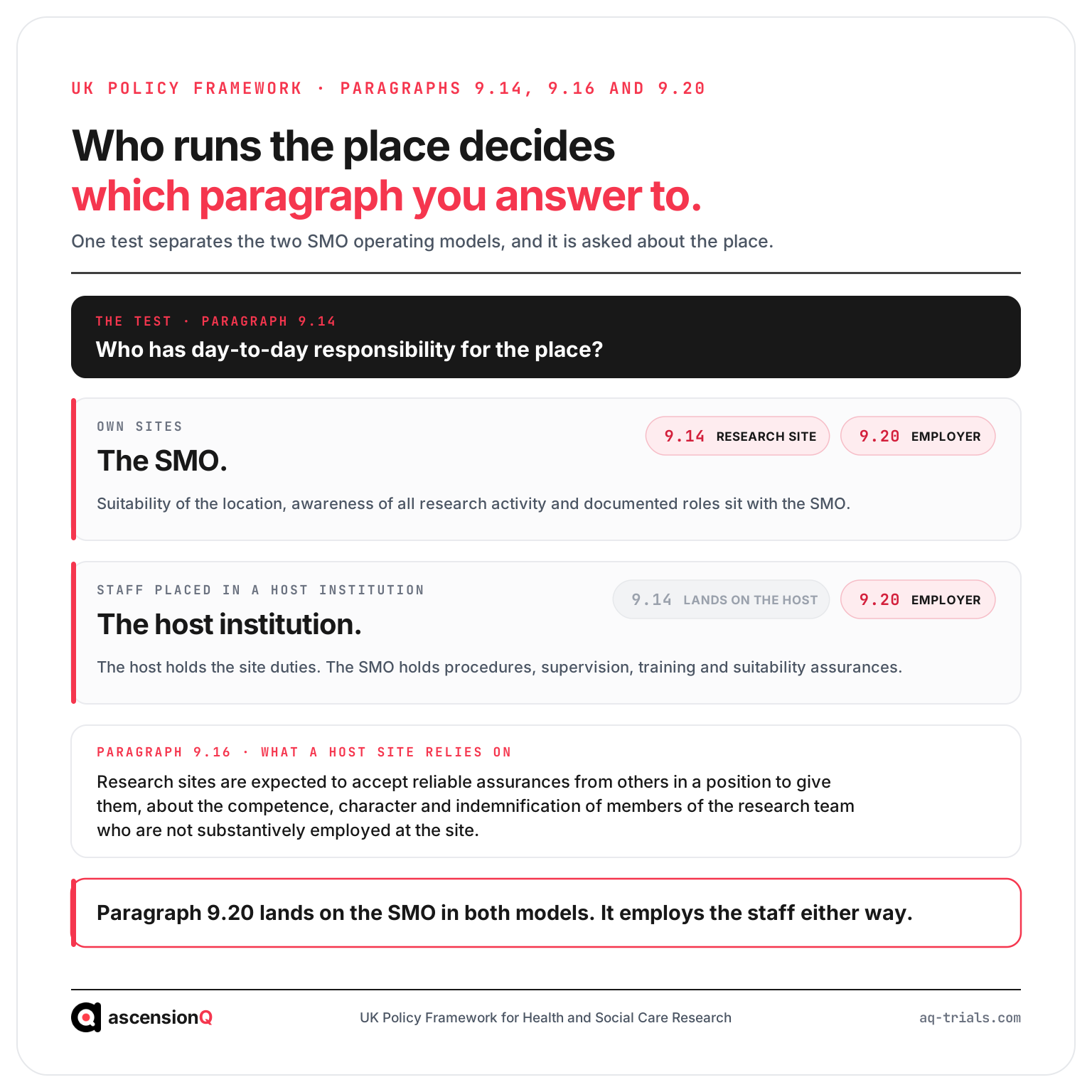
Paragraph 9.16 closes the loop between the two. It states that research sites “are expected to accept reliable assurances from others in a position to give them”, including assurances about “the competence, character and indemnification of members of the research team who are not substantively employed at the site”. That clause describes the placed-staff model exactly. The host relies on the SMO’s assurance, and the SMO has to produce the evidence behind it on request.
Also Read: Capacity and Capability Confirmation: What a Participating NHS Organisation Is Agreeing To
What Changes in the Own-Sites Model?
The own-sites model gives the SMO full control and the evidential burden that comes with it. ICH E6(R3) section 2.2.2 requires the investigator to have “sufficient time, an adequate number of available and qualified staff, and adequate facilities for the foreseen duration of the trial to conduct the trial properly and safely”. At an SMO-owned site, the SMO is the organisation that makes that true and proves it.
- The SMO owns the facilities evidence, which means equipment calibration records, temperature monitoring, clinical space and emergency arrangements sit in its own quality system rather than a host’s.
- The network procedure set applies without a host overlay, which allows one controlled SOP library to govern every activity at the site, with a local annex only where the premises genuinely require one.
- The SMO grants and revokes system access, which puts the leaver process entirely inside its own control and removes the delay of asking a host to close an account.
- A newly opened or acquired site starts outside the standard, which makes the first audit after opening the point where the network standard is tested rather than assumed.
The hardest thing to evidence here is consistency. A sponsor auditor selects one owned site and tests the procedure in force, the training behind it, the delegation and the site file. Every other owned site has to answer the same way.
What Changes When Staff Are Placed in a Host Institution?
The placed-staff model separates control from the SMO’s own obligations. The host controls the premises, the information governance regime and the incident reporting route. The SMO still carries its employer duties under paragraph 9.20 for every person it places, and discharges them inside somebody else’s building.
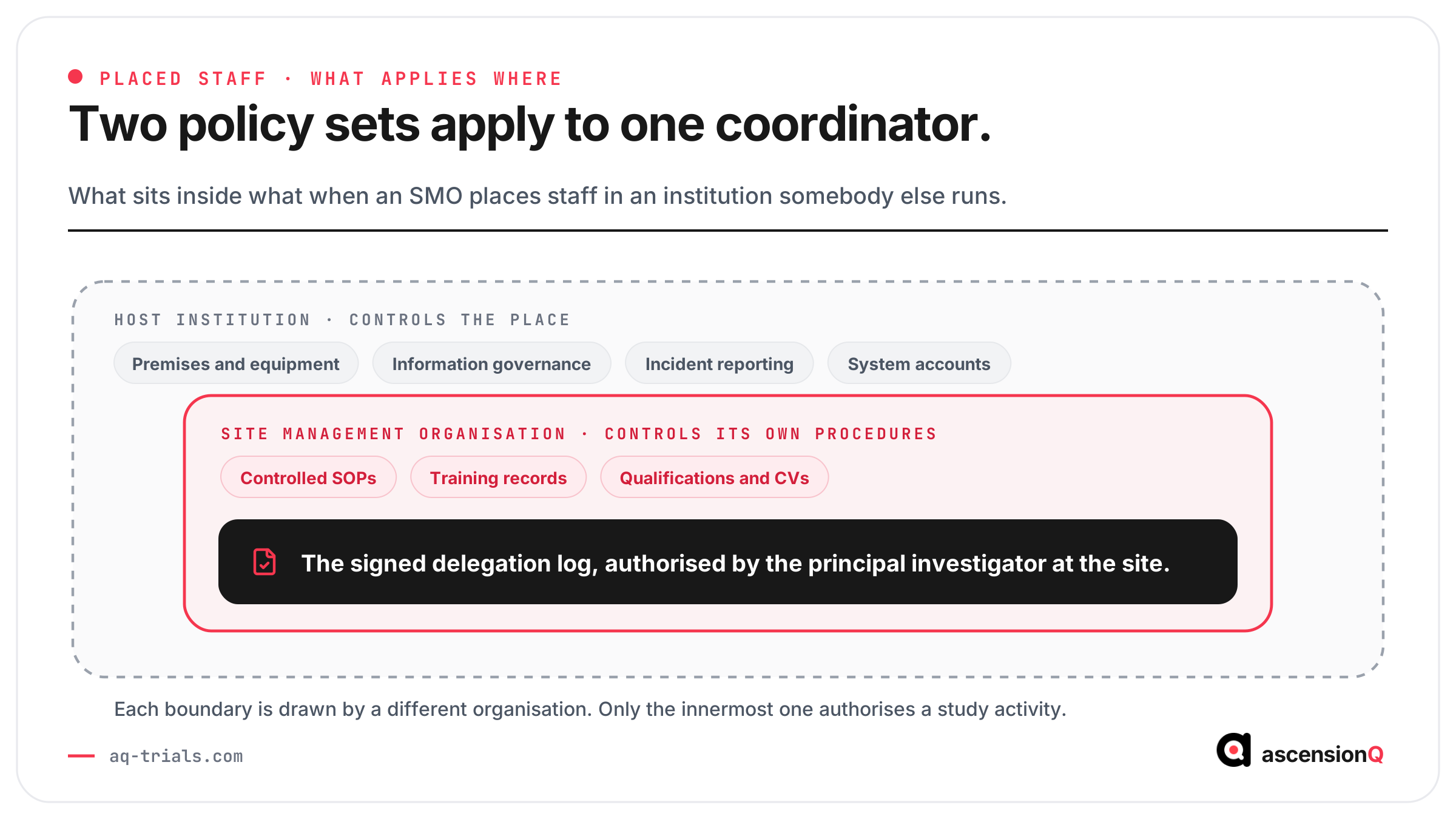
- Two policy sets apply at once, so the SMO’s procedures govern how its staff perform research activities and the host’s policies govern everything the host controls.
- Access is granted by the host, usually as a named account scoped to one study, which means a person can be contracted, trained and still unable to open a record.
- A route of access has to exist before the person attends, and the HRA research passport system is the mechanism by which non-NHS staff obtain an honorary research contract or a letter of access. Check the current HRA position before building a process on it.
- The same person appears in two record sets, the SMO’s and the host’s, and paragraph 9.14 obliges the host to hold its own documented position on the roles of collaborating parties at that site.
Access and delegation remain two separate gates here. A letter of access admits a person to the organisation. The signed delegation log authorises that person for a named study activity, and delegation of authority as a concept has its own guide. The equivalent problem inside a single trust is covered in NHS R&D site file governance.
What Does the Hybrid Model Look Like in Practice?
Most SMOs of any size run both models at once, and the hybrid is the arrangement the evidence has to survive. The two sit together because growth arrives by two routes, through opening or acquiring a facility and through winning a placement contract with a host.
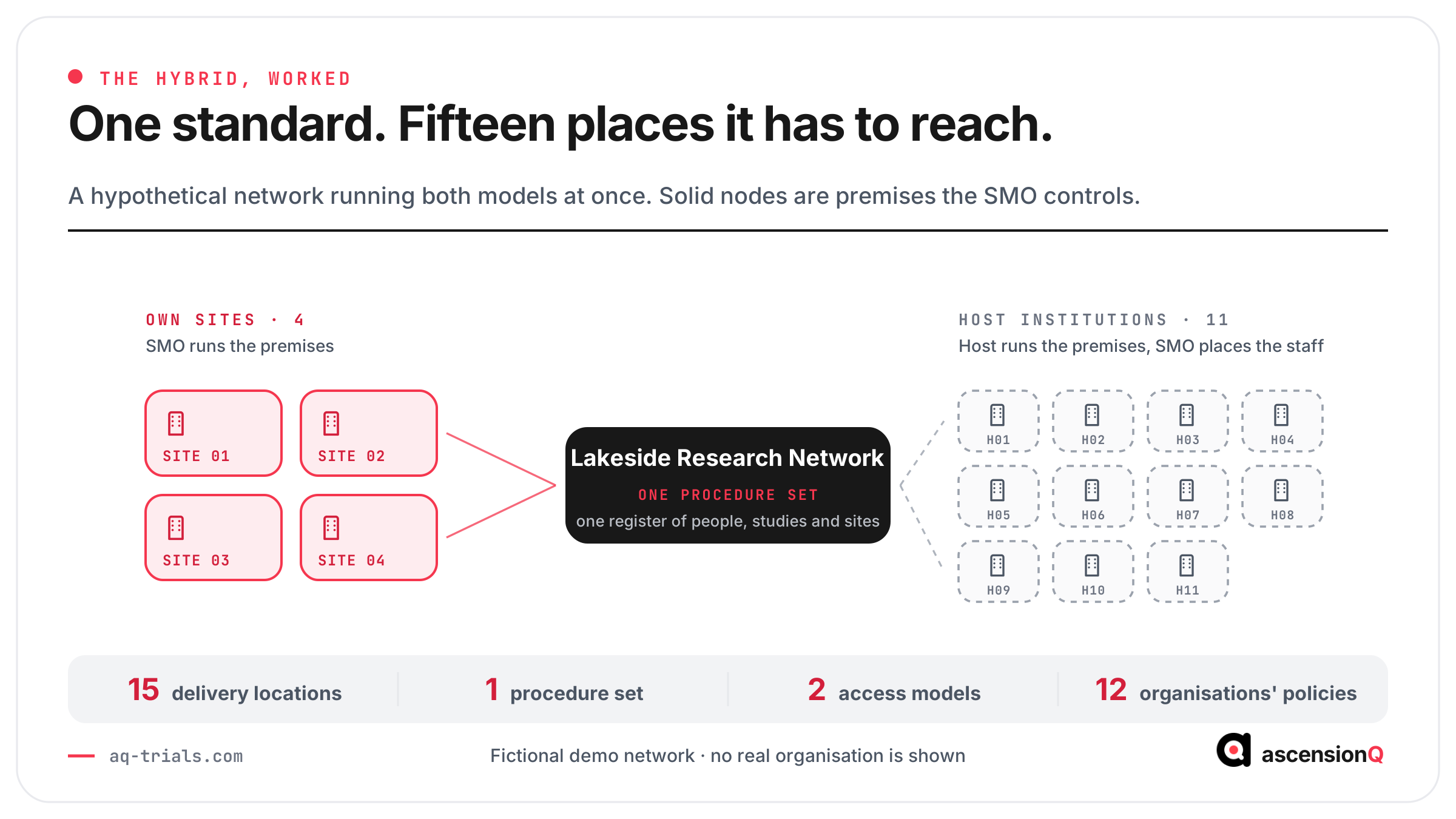
Take a hypothetical network as the worked example. Lakeside Research Network operates four research facilities of its own and places coordinators inside eleven NHS trusts. That is fifteen delivery locations, one procedure set, two access models and twelve organisations whose policies apply to part of the work. A sponsor question about training completion on the current SOP version has to be answerable across all fifteen in one report.
The standard is one. The number of organisations it has to travel through is not.
Two consequences follow for an SMO running the hybrid.
- The register has to be organised by person, study and site rather than by folder, because a coordinator placed at three hosts is one person with one training history and three sets of local arrangements.
- Reporting has to roll up without re-keying, because an owned site and a placed arrangement produce the same metric and arrive by different routes.
Which Records Change With the Model, and Which Never Do?
The test to run before a contract is signed is which of your records the model touches. Some move with the premises. Others stay with the SMO whichever model applies, and those are the ones a sponsor audit reaches first.
| Record | Does the operating model change it? |
|---|---|
| Premises, equipment and calibration records | Yes. They sit with whoever has day-to-day responsibility for the place. |
| System accounts and the leaver process | Yes. The SMO grants access at its own sites and requests it from a host. |
| Information governance and incident policy | Yes. The host’s regime applies to work performed on host premises. |
| Route of access for the individual | Yes. A placed person needs an access route into the host that an owned site never requires. |
| Employment contract, qualifications and CV | No. The SMO employs the person in both models. |
| Controlled SOPs and the version in force | No. One network procedure set governs the SMO’s own work either way. |
| Training assignment and completion | No. Paragraph 9.20 puts the training duty on the employer in both models. |
| The signed delegation log | No. The principal investigator at the site authorises each named person for each named activity. |
The bottom four rows answer the question most often asked about SMO operating models. The accountability picture is the same in both. The principal investigator keeps responsibility for work performed by people the SMO employs. The AQ page for SMOs and multi-site research covers the platform side of holding that evidence.
How Does AQ Hold One Standard Across Both Models?
AQ holds one administered record of users, roles, studies and sites, and every module works against it. Users, sites and departments are configured once in Admin, so an owned facility and a placed arrangement are two entries in one register rather than two systems.
- QMS holds controlled SOPs, training assignment and training completion, which gives the employer evidence paragraph 9.20 asks for, per named person rather than per location.
- Digital DoA holds duties signed by the principal investigator and linked to current training, which keeps the delegation record identical whichever organisation owns the premises.
- eISF holds investigator site files built from network templates, which shows file completeness per site across owned and host locations in one view.
- CTMS holds screening and enrolment against target, visit schedules and capacity, which produces the per-site figure and the network roll-up from the same record.
Access control scopes what a host institution, a sponsor or a CRO can open. Registers, reports and audit logs export for sponsors and inspectors. The AQ Platform overview covers how the modules connect.
Book a live demo and bring your current site list, both the facilities you own and the institutions you place staff into. We will run one workflow, such as rolling a new SOP version across all of them, against your own operating model.