A site management organisation (SMO) is a commercial organisation that supplies the people, procedures and site capacity a sponsor’s study needs at the point of delivery, either at research sites the SMO owns or through staff it places inside host institutions such as NHS trusts. The central team holds a single operating standard across those sites, and proves that standard holds for every person, every site and every study. The sponsor buys delivery capacity. The SMO is judged on the evidence behind it.
This guide covers what an SMO is, how it differs from a contract research organisation, the two operating models, who employs the staff and who stays accountable, how non-NHS staff reach an NHS site, the standard that has to hold at every site, start-up and amendments across a network, recruitment commitments, quality and audit, the metrics sponsors ask for, and what to compare before buying network-wide software. It sits above the AQ page for SMOs and multi-site research, which covers the platform side of the same work.
- An SMO is a service provider on the site side of a study. A CRO is usually a service provider on the sponsor side.
- The principal investigator keeps accountability for work performed by people the SMO employs.
- A network standard counts once the staff who follow it are trained, site by site.
What Is a Site Management Organisation?
A site management organisation is a commercial organisation that takes on the delivery work a study needs at site level, and sells that capacity to sponsors and contract research organisations. The SMO supplies research nurses, coordinators and sometimes investigators. It supplies the procedures those staff follow and the training records behind them. It carries the commercial risk of recruiting participants to a target it has agreed.
ICH E6(R3) does not name the site management organisation as a role. Its glossary defines a service provider as “a person or organisation (commercial, academic or other) providing a service used by either the sponsor or the investigator to fulfil trial-related activities”, and its entry for contract research organisation reads “see Service Provider”. One defined term covers both. The distinction that matters in practice is whose activities the provider discharges.
An SMO is a service provider to the site side of a study.
| What an SMO supplies | What it holds as evidence | What it never takes on |
|---|---|---|
| Research staff | Contracts, qualifications, CVs and training records per person | The investigator’s responsibility for the duties those staff perform |
| A procedure set | Controlled SOPs with a version in force per site | The host institution’s own policies where a placed arrangement applies |
| Site capacity | Clinic space, equipment records and staffing cover per study | Capacity and capability confirmation, which the participating organisation issues |
| Recruitment delivery | Screening and enrolment figures per site against an agreed target | The sponsor’s accountability for the trial as a whole |
| Quality management | Deviation records, corrective actions and effectiveness checks | Regulatory submissions and sponsor safety reporting duties |
An SMO is a commercial organisation. It is not an NIHR-designated Commercial Research Delivery Centre, which is an NHS hub-and-spoke arrangement with a lead NHS organisation at its centre. It is not an NHS trust R&D office, which governs research the trust itself hosts or sponsors. The three can appear in the same study and answer to different obligations.
How Does an SMO Differ from a CRO?
An SMO differs from a CRO in which party’s obligations it discharges. A CRO takes on activities the sponsor owns, such as monitoring, safety reporting, regulatory submissions and the trial master file. An SMO takes on activities the investigator and the institution own, such as staffing the visit, following the protocol at the bedside and holding the site file. Both sit inside the same E6(R3) definition of a service provider. The contract names a different principal in each case.
| Dimension | Contract research organisation | Site management organisation |
|---|---|---|
| Whose duties it performs | The sponsor’s | The investigator’s and the institution’s |
| Who it contracts with | The sponsor | The sponsor, the CRO, or the host institution |
| Typical scope | Monitoring, data management, safety, regulatory, TMF | Staff, procedures, training, delegated duties, site file, recruitment |
| Unit of delivery | The study | The site, and the person working at it |
| What a sponsor audits | Study-level process and oversight of the sites | Organisation-level quality system, then each site |
A sponsor engages both on one study often enough that the boundary has to be written down. The CRO monitors the site. The SMO staffs it. The full comparison, including which obligations sit with each party and what the rules provide when an agreement is silent, is covered in SMO vs CRO: which one does what. A monitoring finding raised against a visit performed by an SMO-supplied coordinator reaches the investigator first, because the investigator authorised that person for that duty. The practical effect of that split on delegation records is covered in the guide to why CROs need a centralised digital DoA system, and the AQ view of the CRO audience sits on its own page.
Also Read: UK Model Agreements for Clinical Trials: mCTA and mNCA
The Two SMO Operating Models
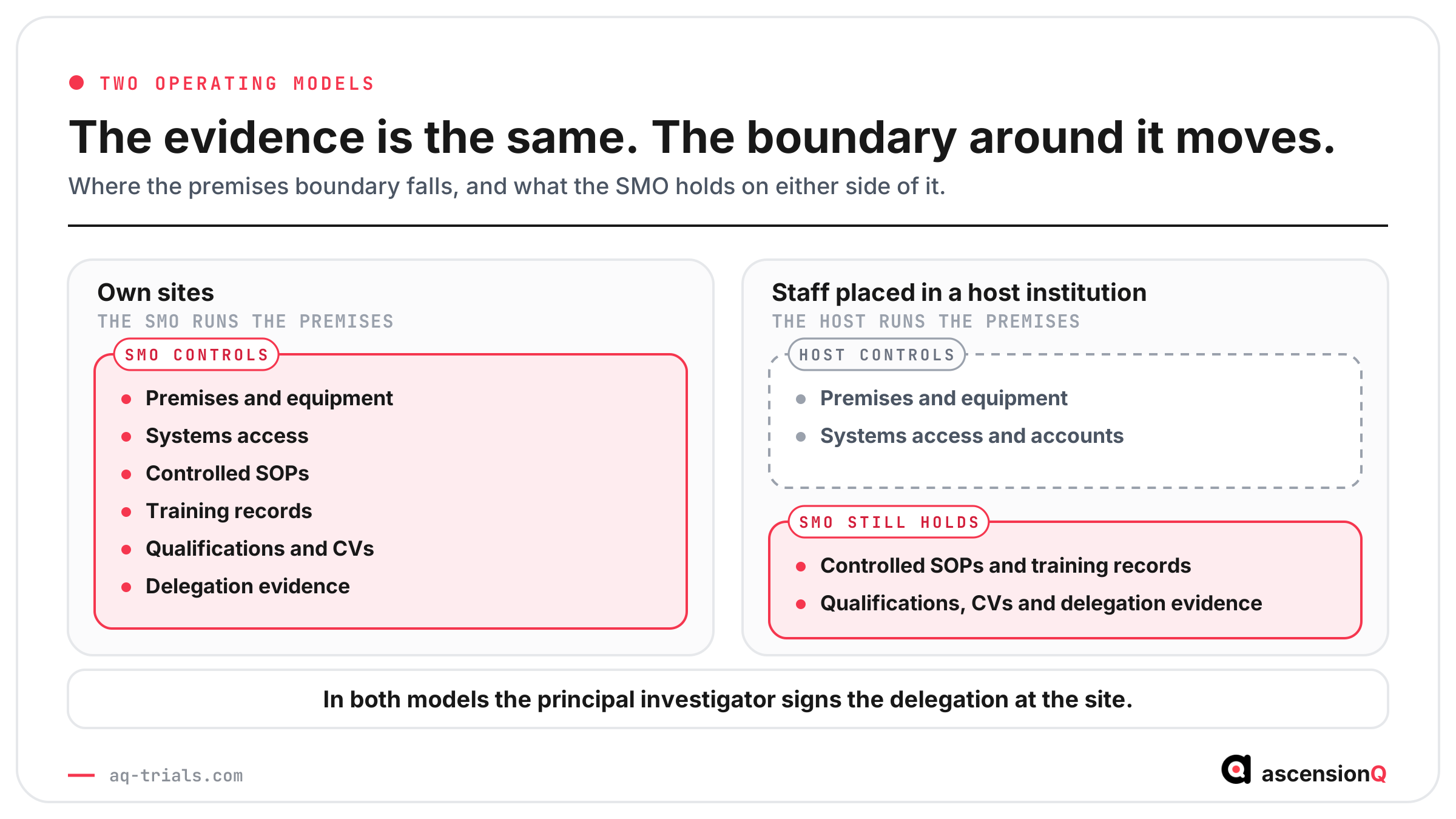
SMOs operate in two ways, and many run both at once. The first model places the research in sites the SMO owns and staffs. The second model places the SMO’s staff inside hospitals and clinics run by someone else. The obligation on the SMO is the same in both: show that every person on the study follows current procedures, holds valid training and works inside duties the investigator has delegated.
| What changes | Own sites | Staff placed in host institutions |
|---|---|---|
| Who controls the premises | The SMO, including equipment and its calibration records | The host, including its estates, information governance and incident policies |
| Whose SOPs apply | The network set, with a local annex only where the premises require one | The network set for the SMO’s own work, inside the host’s policies for everything the host controls |
| Access to records | Granted by the SMO under its own access control | Granted by the host, usually a read-only account scoped to one study |
| Who the participant meets | SMO staff throughout | A mixed team of host and SMO staff at the same visit |
| Hardest part to evidence | That a newly opened or acquired site reached the network standard | That the right route of access and the right delegation exist for each placed person |
The hybrid is the common case. An SMO with four owned sites and coordinators placed at eleven NHS trusts holds one procedure set, two access models and twelve sets of local arrangements. The record that survives this is a single register of people, sites and studies rather than a folder per site. What changes in each model, and the role UK research policy assigns to the SMO in each, is set out in the guide to the two SMO operating models.
Who Employs the Research Nurse, and Who Stays Accountable?
The SMO employs the research nurse. The principal investigator at the site stays accountable for the trial duties that nurse performs. These are two separate questions, and an SMO contract answers only the first. The full chain from sponsor to CRO to SMO to site, and which instrument carries which obligation, is set out in the contract chain in an SMO model.
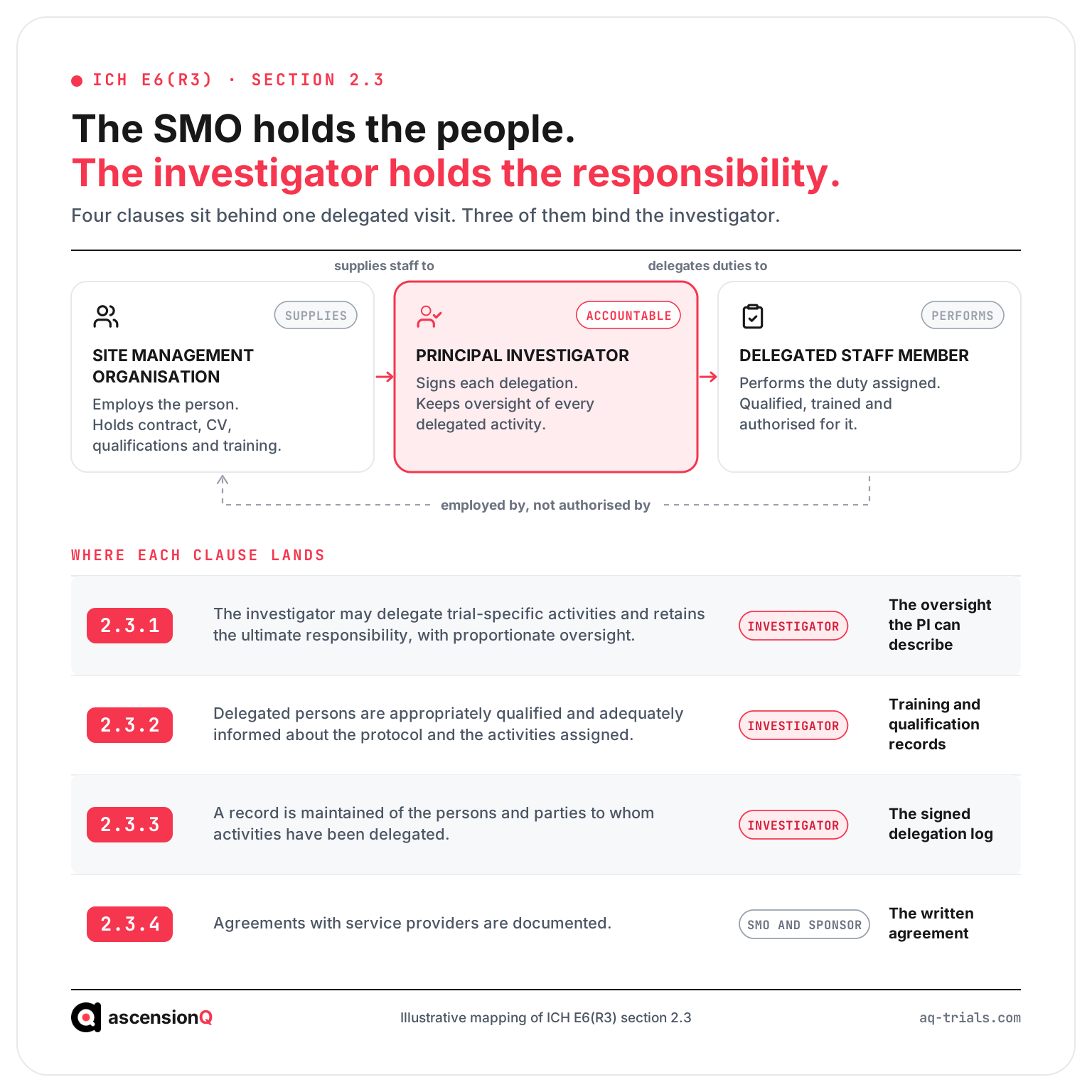
ICH E6(R3) section 2.3.1 sets the rule plainly. The investigator may delegate trial-specific activities to other persons or parties, and the investigator retains the ultimate responsibility, with oversight proportionate to the significance of the activity and the risk to participants. Section 2.3.2 requires delegated persons to be appropriately qualified and adequately informed about the relevant aspects of the protocol and the activities assigned to them. Section 2.3.3 requires a record to be maintained of the persons and parties to whom activities have been delegated. Section 2.3.4 requires agreements with service providers to be documented.
A delegation arrangement moves the task. It does not move the responsibility.
- The sponsor contracts for delivery, which fixes the study, the sites and the recruitment commitment.
- The CRO, where one is engaged, holds the delegated sponsor duties, which is why its monitor and not the SMO raises findings against the site.
- The SMO holds the employment relationship, which is why the contract, the qualifications, the CV and the training record for each person sit with the SMO.
- The host institution or the SMO’s own site grants access, which determines what systems and records that person may open.
- The principal investigator signs each delegation, which is the only step that authorises a named person for a named activity on that study.
The HRA guidance on roles and responsibilities takes the same position on the sponsor side. A sponsor may delegate specific tasks to others, and any such arrangement should be formally agreed and documented. The concept of delegation of authority, and the distinction between a signature and an effective date, are covered in what DoA means in clinical research and in why effective dates matter more than signatures. The Digital DoA module page covers how the record is held.
Contractual, employment and immigration questions behind these arrangements fall outside the scope of this guide. Take them to the primary source and to your own advisers.
How Do SMO Staff Reach an NHS Site?
SMO staff reach an NHS site through the research passport system. The HRA states that a research passport “is the mechanism for non-NHS staff to obtain an Honorary Research Contract or Letter of Access (LOA) when they propose to carry out research in the NHS”. The passport is one standard form, completed by the researcher and the employer, and validated by an NHS organisation.
The same guidance sets out who falls outside the system. A person already employed by an NHS organisation does not need a research passport. Nor does an independent contractor, a person holding an honorary clinical contract with an NHS trust, or a student on a healthcare placement.
| Element | What the HRA states | What the SMO holds |
|---|---|---|
| Research passport | The mechanism by which non-NHS staff obtain an honorary research contract or a letter of access | The completed form and the employer’s part of it |
| Honorary research contract | One of the two outcomes the passport leads to | A copy against the person’s record, with its expiry |
| Letter of access | The other outcome the passport leads to | A copy against the person’s record, with its expiry |
| Validation | Performed by an NHS organisation on the standard form | Evidence of which organisation validated it and when |
| Out of scope | NHS employees, independent contractors, honorary clinical contract holders, students on placement | A record of why no passport applies to that person |
Check the current HRA position before you build a process on it. The HRA research passport page carries a last-updated date of 29 May 2019, and these arrangements have been revised more than once. A dedicated guide to the routes of access, what each requires and who issues it, will sit under this pillar and will state the position as the HRA publishes it at that time.
Access and delegation are two gates, not one. A letter of access lets a person into the organisation’s systems. The signed delegation log is what authorises that person to perform a study activity. The electronic investigator site file is where the site holds the evidence for both.
The Standard That Has to Hold at Every Site
One standard has to hold at every site in the network, and it has five parts: the procedure in force, the training behind it, the delegation that authorises each person, the qualification evidence for that person, and the site file that holds it. A sponsor auditor tests all five at whichever site it chooses. The network average is not the answer to that question.
A new SOP version is the clearest case. It passes through four stages before an SMO can show it is in force everywhere, and each hand-off between unconnected systems is where one site falls behind.
| Stage | What has to be true | Where it breaks |
|---|---|---|
| 1. Reviewed and approved | The new version carries its approval and an effective date | An effective date set before the training can realistically finish |
| 2. Released, previous version withdrawn | Only one version is retrievable as current at each site | A superseded copy still sitting in a local folder or a printed binder |
| 3. Training assigned | Every person whose duties touch the procedure is on the assignment list | A placed coordinator at a host site missing from the list entirely |
| 4. Completion reported | Completion is visible per person and per site, with the outstanding names known | A spreadsheet that reports a network percentage and hides which site is short |
Take a hypothetical network as the worked example. Lakeside Research Network runs three owned sites and places staff inside two NHS trusts. SOP-QA-014 reaches version 4 with an effective date of 1 November. The assignment covers 48 staff. On 28 October, 41 have completed it and 7 have not, and all 7 work at the same host site. The network figure reads 85%. The answerable question is which site cannot follow the current procedure on 1 November, and the answer is one site, not a percentage.
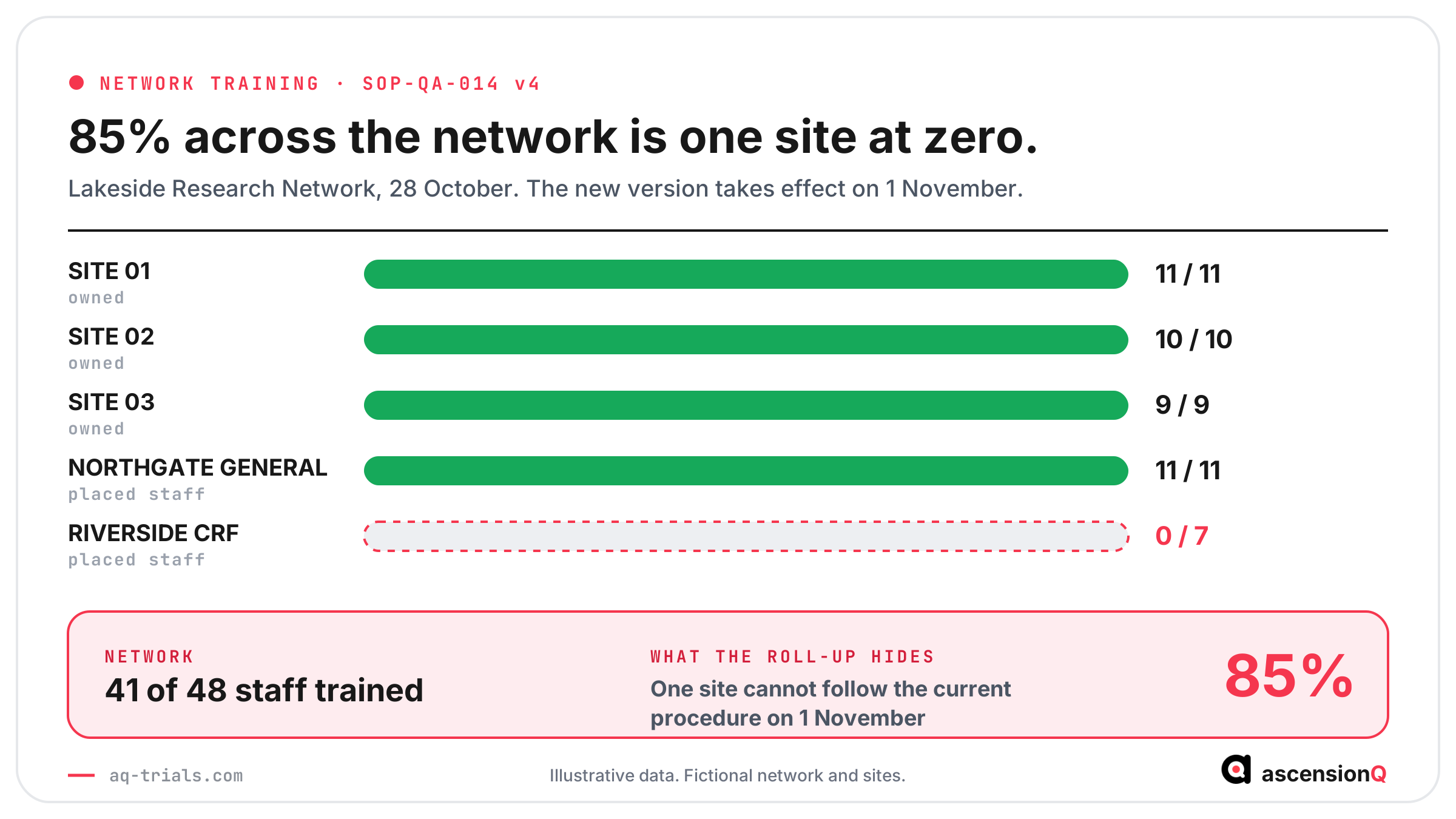
A version counts once the staff who follow it are trained.
The equivalent problem inside a single NHS trust, across the studies that trust hosts, is covered in governing site files across a trust’s studies. The monitoring consequence of a paper site file is covered in eISF vs paper site files. Controlled procedures and training sit on the QMS module page.
Start-Up and Amendments Across a Network
Start-up across a network runs in parallel, and parallel activation fails at the slowest site rather than the average one. Each site has its own critical path. The sixth site to activate rarely lags because its work is harder. It lags because the same small central team is the shared resource on every path at once.
The UK set-up clocks and the taxonomy of set-up problems are covered elsewhere on this site. The 90-day set-up target and the 150-day NHS R&D playbook hold the national measurement, capacity and capability confirmation holds the organisational step, and the operational problem taxonomy holds the causes. What follows is the part specific to running several of these at once.
- Sequence the central tasks, not the sites, because the bottleneck is the one team that drafts every local document.
- Hold one set of templates for local documents, so site five starts from an approved shape rather than from site one’s email.
- Track the critical path per site and the owner per step, because a step with a named owner at each site is the only one that moves without a prompt.
- Front-load the staffing and training work, so delegation can be signed in the week a site is activated rather than the week after.
A protocol amendment is the same problem in reverse. One change leaves the sponsor and fans out to every site, and the SMO has to confirm implementation site by site.
| Amendment step | Done once centrally | Done once per site |
|---|---|---|
| Receive and assess | Read the amendment and decide what it touches | Nothing |
| Local approval | Nothing | Each participating organisation records its own implementation date |
| Document revision | Revise the network templates and working instructions | File the new version and withdraw the superseded copy |
| Retraining | Build the assignment and the knowledge check | Complete it per person, with the outstanding names known |
| Delegation review | Identify which duties the amendment changes | The PI re-signs any duty whose scope has changed |
| Confirmation | Report the network position to the sponsor | Evidence the site can produce on request |
Each site reaches the amendment on its own implementation date. An SMO that reports a single network date to a sponsor is reporting the date it finished its own central work.
What Recruitment Commitment Does an SMO Make?
An SMO commits to a number of randomised or enrolled participants across a defined set of sites, inside a defined window. That commitment is a network figure. The delivery is a set of per-site contributions, and those contributions are never equal.
Real-time enrolment tracking belongs to how a CTMS tracks enrolment in real time, and recruitment strategy belongs to patient recruitment in clinical trials. The commitment itself is a contracting and management question.
- Allocate the network target per site before activation, so a shortfall is attributable rather than collective.
- Measure contribution against allocation, not against the other sites, because a site at 60% of its own allocation is a different problem from a site ranked sixth.
- Watch the screening-to-randomisation ratio per site, because a site with volume and a poor ratio has an eligibility or consent problem rather than an outreach one.
- Agree the reallocation rule with the sponsor in advance, so the conversation about moving target from one site to another is a contract term rather than a negotiation under pressure.
The hard conversation is the one about a site that will not deliver. It goes better with a per-site history and an agreed rule than with a month-end spreadsheet. A sponsor hearing that one site has recruited 3 against an allocation of 12, and that the network will still make 70 of 70 because two other sites absorb the gap, has a decision to make rather than a complaint to raise.
Quality, Deviations and Audit Across a Network
A sponsor audits an SMO at two levels. It tests the organisation’s quality system once, and it tests whichever sites it selects against that system. A finding raised at one site becomes a question about the other sites in the same visit.
| Asked at organisation level | Asked at site level |
|---|---|
| The SOP library, its approval route and its version control | Which version is in force here, and who is trained on it |
| The training model and how expiry is tracked | Which named staff have training outstanding today |
| How delegation is recorded and approved | The signed delegation log for this study and these people |
| The deviation and CAPA process, and its effectiveness stage | This site’s open deviations and the actions against them |
| How findings are read across the network | Whether a cause found elsewhere was ever tested here |
| Access control and the leaver process | Whether a departed coordinator still holds an active account |
The CAPA process, root cause method and effectiveness verification are covered in CAPA management software in clinical research and CAPA effectiveness verification. The network question those guides leave open is read-across. A cause identified at one site is either a local condition or a network condition, and the only way to tell is to test it at sites that never reported the issue. Effectiveness at network level means the deviation did not appear at the next site either.
A finding at one site is a hypothesis about the rest.
Also Read: A CAPA Example: Clinical Trial Deviation Walkthrough
What Metrics Do Sponsors Ask an SMO to Report?
Sponsors ask an SMO for a small, stable metric set, and they ask for it per site as well as rolled up. The roll-up answers whether the contract is on track. The per-site figure answers which site needs attention. A report with only the roll-up invites the sponsor to ask for the breakdown, and the delay in producing it is itself read as a finding.
| Metric | What the per-site figure shows | How the roll-up misleads |
|---|---|---|
| Screened and enrolled against allocation | Which sites are carrying the commitment | A network on target hides a site at zero |
| Screening-to-randomisation ratio | Whether volume is converting at that site | A healthy average absorbs one site’s eligibility problem |
| Time from site selection to first participant | Where the local critical path stalled | A mean start-up time tells you nothing about the slowest site |
| Training completion on the current SOP version | Which named staff cannot follow the current procedure | 85% across the network reads as nearly done, and may be one whole site |
| Open delegations awaiting PI signature | Who is working without authorisation for a duty | A small count looks trivial until it sits at one site |
| Protocol deviations by category | Whether a category clusters at one site | A rate per participant flattens a cluster into noise |
| Open CAPAs and overdue effectiveness checks | Which actions have been implemented and not yet proven | Closure counts rise while the same cause recurs elsewhere |
| Site file completeness | What a monitor would find missing today | A high average sits alongside three sites short of the same document |
Two metrics mislead more than the others. A network percentage on training completion hides a concentration, and that concentration is always the inspection risk. A CAPA closure count rewards closing records rather than removing causes, which is why effectiveness verification sits as a separate stage.
What Should You Compare Before Buying Network-Wide Software?
Compare network-wide software on nine points, and test each one against your own operating model rather than a demonstration script. An SMO buys a different shape of system from a single site, because the unit of the record is the network and the unit of the question is the site.
- One record across sites, so a person, a study and a site are each entered once and reused, rather than re-keyed per site.
- A staff and training model that fits placed staff, so a coordinator working at three host institutions is one person with one training history.
- Delegation linked to current training, so an expired qualification shows against the duty it affects rather than in a separate report.
- Per-site and roll-up reporting from the same record, so the breakdown is a filter and not a reconciliation exercise.
- Sponsor-facing export, so registers and audit logs leave the system in a format a sponsor and an inspector will accept.
- Access control across organisations, so a host institution, a sponsor and a CRO each see their own scope and nothing else.
- System qualification evidence from the supplier, so your own quality system can rely on documented testing rather than an assurance in a sales conversation.
- NHS assurance documentation, covering the Data Security and Protection Toolkit, Cyber Essentials and DTAC where a host institution will ask for them.
- Exit and archiving terms, so records remain readable for the full retention period after any change of supplier.
Which category of system holds which record is a prior question. CTMS vs eTMF vs EDC vs eISF sets out the four record owners, and what NHS procurement expects of research software covers the assurance pack. A dedicated buyer’s guide for SMO software will sit under this pillar.
How Does AQ Hold the Network Record Across Your Sites?
AQ holds one administered record of users, roles, studies and sites, and each module works against that record. Users, roles, sites and departments are set once in Admin and apply across every module, so a new site or a new module uses the same set-up rather than a second register.
- QMS holds controlled SOPs, training assignment and training completion, which shows which named staff at which site have training outstanding on the current version.
- Digital DoA holds duties signed by the principal investigator and linked to current training, which shows a delegation awaiting PI approval before the person starts work.
- eISF holds investigator site files built from network templates, which shows file completeness per site and the documents awaiting signature.
- CTMS holds screening and enrolment against target, visit schedules and capacity, which gives the per-site figure and the network roll-up from the same record.
- CAPA holds findings, actions and the effectiveness check, which shows where one root cause appears at more than one site.
- eTMF holds content filed against the DIA TMF Reference Model, which applies where a sponsor has delegated TMF content to the SMO.
Documents enter AQ by upload, including bulk upload, and registers, reports and audit logs export for sponsors and inspectors. Sponsor-mandated systems stay the record for the purposes the sponsor defines, and any further data exchange is scoped per study during implementation. The AQ Platform overview covers how the modules connect, and the page for SMOs and multi-site research covers the same work from the platform side.
Book a live demo and pick one workflow that costs your team the most time, such as bringing a new site onto your SOPs or rolling out a protocol amendment, and we will run it against your operating model.