The 150-day study set-up target is the UK commitment that a commercial contract clinical trial recruits its first participant within 150 calendar days of applying for regulatory approval. The Department of Health and Social Care measures it as a published indicator. The clock starts on the date an initial clinical trial authorisation application is submitted to the Integrated Research Application System, and it stops on the date of the first participant’s first study visit. The target is that 95% of eligible studies clear the window.
The most recent published release puts that indicator at 100%. The two indicators that describe the local half of the same journey sit at 56% and 61% against a 90% target. Both statements are true at once, and the gap between them is the reason an NHS R&D office still has work to do on a target the country has formally met.
This guide sets out what the 150-day clock measures and excludes, why the national figure reads as it does, how the 150 days divide into three published sub-clocks with different owners, what the national reforms have already settled, and what a trust should run differently to be the site a study clears its window on.
Key takeaways
- The 150-day clock runs from regulatory application to a first participant anywhere in the study. One site stops it for the whole trial.
- The indicator covers commercial contract CTIMP studies on the national portfolio, and it excludes rare disease, low recruitment and extension studies.
- The 150 days decompose into three published clocks of 60, 60 and 30 days. The regulatory clock runs at 98%. Both local clocks run below 61%.
- A trust is judged on every site it opens, so portfolio performance and the national headline can move in opposite directions.
- National reform has settled costing, contracting and specialist review. The remaining variation is local sequencing and local record keeping.
What Does the 150-Day Target Actually Measure?
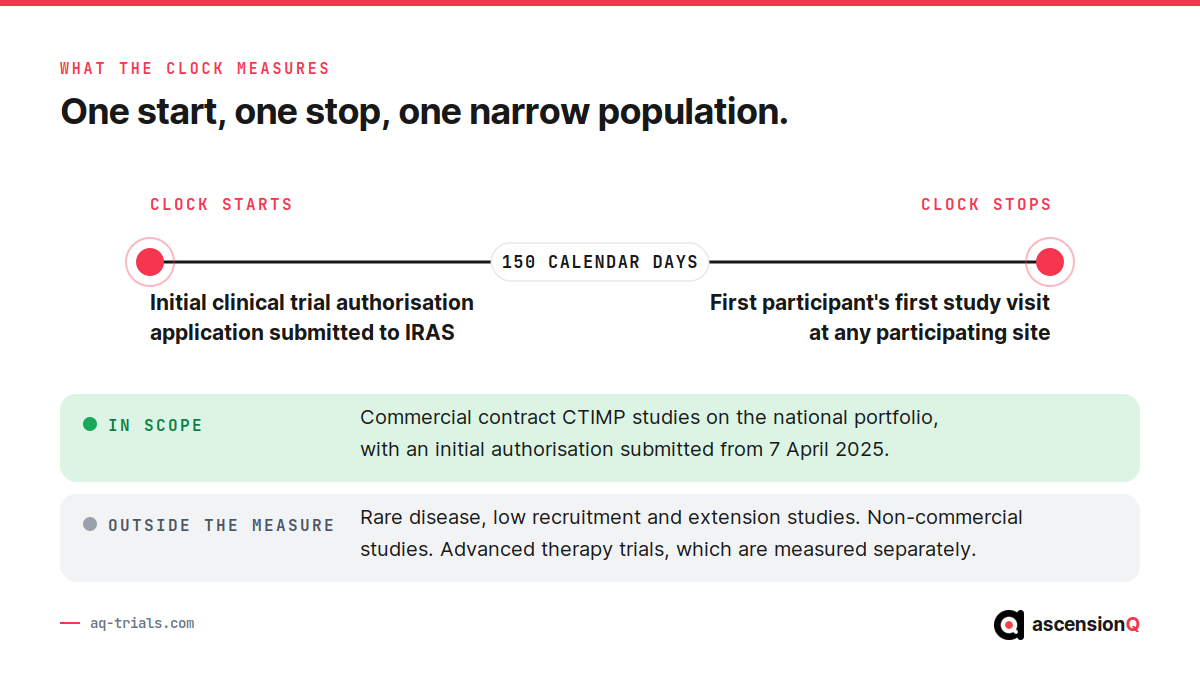
The indicator has a precise definition, and the precision matters because teams manage what they believe is being counted. The published methodology names one clock start, one clock stop and one eligible population.
- Clock start: the date an initial clinical trial authorisation application is submitted to the Integrated Research Application System.
- Clock stop: the date the first study participant is recruited, defined for interventional trials as the date of the first study visit.
- Population: commercial contract clinical trials of investigational medicinal products held on the national portfolio, with advanced therapy trials measured separately.
- Eligibility date: studies with an initial clinical trial authorisation submitted from 7 April 2025 onwards.
- Exclusions: studies where recruitment inside 150 days is not expected, covering rare disease, low recruitment and extension studies.
Two features of that definition shape everything a trust does about it. The measure is study-level, so a single participant at a single site stops the clock for the entire trial. The measure is also commercial, so the non-commercial portfolio a trust runs alongside it sits outside the number entirely.
One further definition affects sites brought into a study after approval. The UKCRD defines Date Site Selected as the date the sponsor emails the site following an expression of interest and its due diligence process. A site added later runs its own window from that email rather than from the study’s regulatory application.
Why Does the National Indicator Read 100%?
The Prime Minister set a commitment to get UK clinical trials up and running within 150 days by March 2026. Government reported in April 2026 that the average time to set up a commercial interventional trial had fallen from 169 days to 122 days. The monthly indicator now reports 100% against a 95% target. That result is real, and it carries three qualifications a research office should hold in mind.
- The sample is small. The most recent complete month in the published data covers nine studies, all of which recruited inside the window.
- The population is curated. Rare disease, low recruitment and extension studies sit outside the measure, so the indicator describes trials everyone expected to move at pace.
- The data source differs. The 150-day indicator combines portfolio data with sponsor intelligence to report quickly. The local indicators rely on portfolio data entry alone and publish six months in arrears.
The qualification that matters operationally is the first one in the previous section. The clock stops at the first participant anywhere in the study. A trial with twenty participating sites clears the target on the performance of whichever site gets there first, and the other nineteen contribute nothing to the result.
The national target is met by a study’s fastest site. A trust is judged on every site it opens.
Also Read: UK Clinical Research Delivery KPIs (June 2026): What the Data Says About Trial Set-Up.
Where Do the 150 Days Sit?
The UK clinical research delivery key performance indicators publish three further measures that describe consecutive segments of the same journey. Their targets add to the headline figure exactly, which makes the 150 days a chain of three clocks rather than one.
| Segment | Runs from | Runs to | Target | Latest published |
|---|---|---|---|---|
| Regulatory review | Application submitted | Combined review approval issued | 60 days, 99% of studies | 98% |
| Opening to recruitment | Approval letter | Study open in at least one site | 60 days, 90% of studies | 56% |
| First participant | Study open to recruitment | First participant recruited | 30 days, 90% of studies | 61% |
| End to end | Application submitted | First participant recruited | 150 days, 95% of studies | 100% |
The arithmetic is the argument. Sixty days of regulatory review, sixty days to open and thirty days to recruit produce the 150-day window. The regulator delivers its segment at 98% against a 99% target. The two segments that follow the approval letter sit 34 and 29 percentage points below their targets, and both have remained below target every year since 2017.
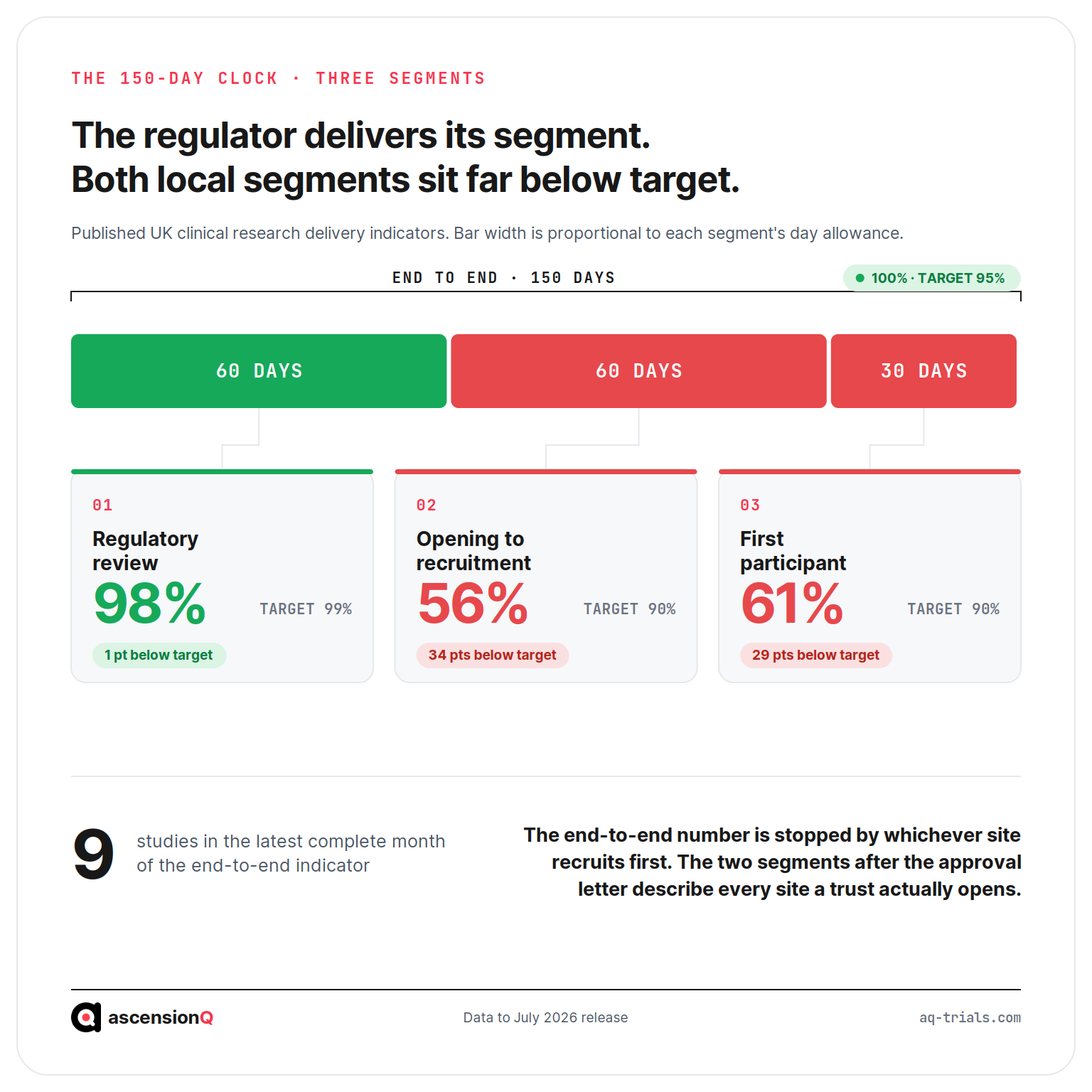
The practical reading is straightforward. Almost all recoverable time in the 150-day window now sits after the approval letter, in the ninety days a site controls. The 90-day site-level target measures precisely that portion, which is why the two targets are managed together rather than separately.
Also Read: Why NHS Sites Miss the 90-Day Set-Up Target and How to Close It.
What Have the National Reforms Already Settled?
Several delays that once explained a long set-up have been removed at national level. Each reform standardised a step that every site previously negotiated locally, and each one narrows the range of legitimate reasons for a slow window.
| National process | What it settles | What remains local |
|---|---|---|
| National Contract Value Review | One national price for a commercial study, agreed once | Responding inside the review clock and accepting the outcome |
| Model agreements | Unmodified contract templates, removing bespoke negotiation | Routing the agreement to signature and recording the date |
| HRA Technical Assurance | Pharmacy and radiation questions reviewed once for all sites | Acting on the assurance rather than repeating the review |
| SoECAT | Cost attribution for non-commercial studies under AcoRD | Authorisation lead time and internal costing sign-off |
| Capacity and capability confirmation | A defined assessment period and two confirmation routes | Assembling the assessment and confirming inside the period |
| CPMS milestone reporting | A national record of study and site milestone dates | Entering each date accurately and on time |
The right column carries the point. National reform removed the negotiation and left the coordination. A trust that responds to a contract value review in eleven days and a trust that responds in forty days now work from the same national price, and the difference between them is entirely local.
One date changed the arithmetic of local reporting. The set-up portion of the site metric now ends at Date Site Confirmed, the last contract signature across every organisation involved, rather than the sponsor green light it used to record.
Why Is a Trust Judged on More Than the National Number?
A sponsor selects sites, and it selects them again for the next study. The national indicator reports a study result, and the record that follows a trust is its own site-level history across every study it takes on. Three separate mechanisms now attach consequences to that history.
- Site-level reporting. Set-up performance is published trust by trust, so a sponsor evaluating a site has evidence rather than an impression.
- Policy expectation. The UKCRD position is that all participating sites for a study complete set-up within 90 days, which applies to every site rather than the first one.
- Funding alignment. The UKCRD states that the research delivery network funding model from 2026/27 aligns with the 150-day performance metrics and carries a performance-related element.
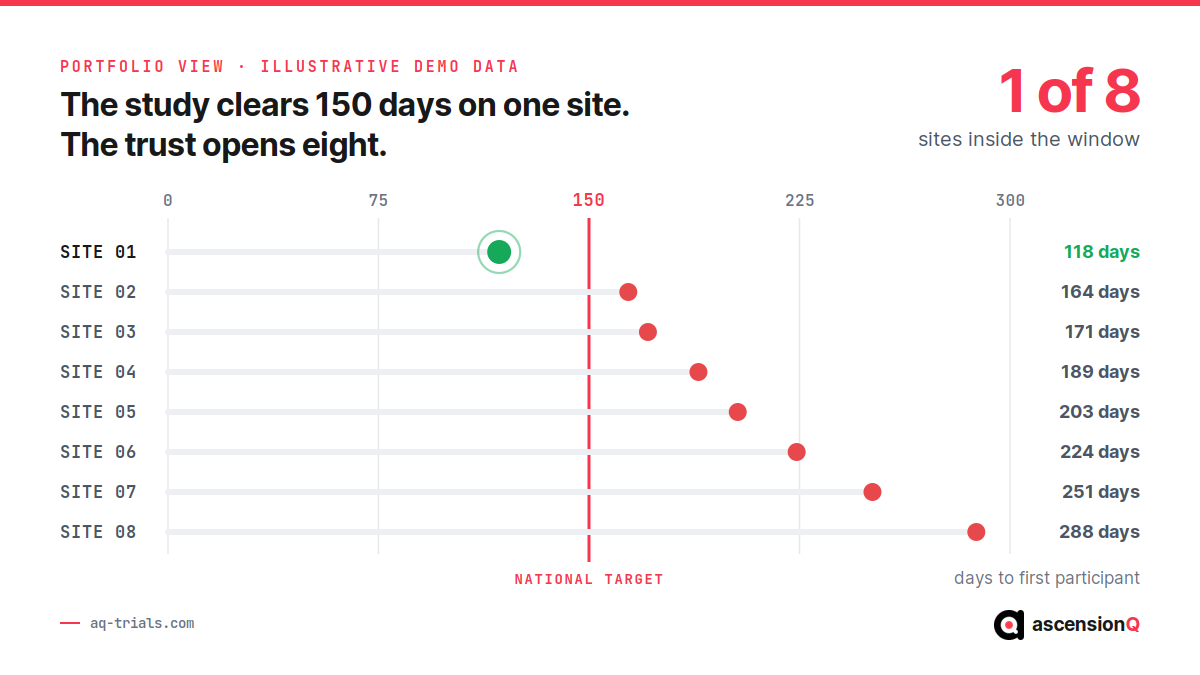
The figure above uses illustrative demo data rather than published trust results. It shows the structural point directly. A study clears the national target on its first site and still leaves most of a trust’s sites outside the window, and the number that reaches a sponsor’s site selection meeting is the second one.
Also Read: CTMS vs Spreadsheets: Why Site Capacity Planning Breaks Without One.
The Playbook: What Should an R&D Office Run Differently?
The published data locates the problem after the approval letter and inside the trust. Five practices follow directly from the definitions above, and each one addresses a specific way the window is lost.
- Start the clock at the sponsor’s email. A site selected after approval runs from Date Site Selected, so the window opens before the first internal meeting. Logging that email as a dated event stops a trust discovering three weeks later that it has already spent them.
- Manage the portfolio, not the study. A study-level view reports the fastest site and hides the rest. A portfolio view ranked by days elapsed shows which sites need attention this week, which is the number a sponsor will eventually see.
- Treat each national process as a clock with a due date. Contract value review, technical assurance and capacity assessment all have defined periods. Recording a due date against each one converts a queue of open items into a schedule.
- Hold your own dates. National reporting publishes six months after the activity it describes. A trust that keeps its own milestone dates can reconcile them against the national record and can act inside the window rather than reading about it afterwards.
- Separate the two halves when performance drops. A trust missing the 60-day opening segment has a costing, contracting or assessment bottleneck. A trust that opens on time and misses the 30-day segment has a screening or scheduling constraint, which is a capacity question.
Reform settled the price and the paperwork. The remaining variable is the waiting between them.
What Does a Trust Need to Be Able to Evidence?
Set-up performance and inspection readiness draw on the same underlying record. A date that supports a milestone report is the same date an inspector reads as evidence of controlled study conduct, and a trust holding both in one place answers two questions with one record.
- Milestone dates with an audit trail, covering site selection, capacity and capability confirmation, Date Site Confirmed, site open and first participant first visit.
- Delegation and training records current at green light, so the release to recruit rests on evidence rather than an assurance given verbally.
- Essential documents filed as they are produced, which keeps the investigator site file complete at the point a sponsor asks rather than at the point of a monitoring visit.
- Pharmacy set-up tracked on its own file, because the pharmacy site file runs a separate track and commonly gates the green light.
- One owner per open item, so a handover between finance, pharmacy and the research team is a dated transfer rather than an email nobody is counting.
Teams selecting a system for this work should test it against both demands at once. The 2026 buyer’s guide for NHS trusts covers the assurance and reporting questions in detail, and inspection-ready study management covers the evidence side.
How Does AQ Support the 150-Day Window?
AQ Trials holds study set-up as one dated record across every site an organisation runs, so the window a trust is measured on stays visible while a team can still act on it.
The CTMS records each set-up milestone with its date and owner, which makes days elapsed and days at current stage live figures rather than a quarterly reconstruction, and it presents them across the portfolio rather than one study at a time. The electronic Investigator Site File keeps essential documents, delegation records and training evidence current and shared, so a green light rests on a complete file. The electronic Pharmacy Site File tracks the pharmacy track that so often gates that decision. Live recruitment visibility carries the same record into the thirty days between opening and a first participant. Every one of those dates is the evidence an NHS research office reports upward and an inspector reads later.
AQ does not agree a contract value or complete a capacity assessment. It makes the position of every study at every site visible, dated and owned, which is the difference the published data keeps pointing at. Book a live demo to see how AQ tracks the 150-day window across a research portfolio.
Frequently Asked Questions
What is the 150-day study set-up target?
It is the UK target that 95% of commercial contract clinical trials of investigational medicinal products recruit their first participant within 150 calendar days of the initial clinical trial authorisation application being submitted. The clock stops at the first participant’s first study visit.
Has the UK met the 150-day target?
The most recent published release reports the indicator at 100% against a 95% target, from a sample of nine studies in the latest complete month. Government reported in April 2026 that average commercial set-up time had fallen from 169 days to 122 days.
How does the 150-day target relate to the 90-day target?
The 90 days is the site-level portion that follows the approval letter, made up of a 60-day segment to open and a 30-day segment to recruit. The 150 days adds the 60-day regulatory review that precedes it.
Which studies are excluded from the 150-day measure?
Studies where recruitment inside 150 days is not expected sit outside the measure, covering rare disease, low recruitment and extension studies. Non-commercial studies and advanced therapy trials also fall outside this indicator.
When does the clock start for a site added after approval?
The site window runs from Date Site Selected, defined by the UKCRD as the date the sponsor emails the site following an expression of interest and its due diligence process.
Sources
- UK Clinical Research Delivery key performance indicators: methodology (GOV.UK)
- UK Clinical Research Delivery key performance indicators: data to July 2026 (GOV.UK)
- UKCRD priority to streamline and reform the set-up and delivery of clinical trials: FAQs (UKCRD)
- Government drives forward its 150-day clinical trial target (GOV.UK)
- UK clinical trials reach 150 day set-up milestone (Health Research Authority)