Clinical trial capacity management is the practice of matching the study workload a site has committed to against the staff, rooms, equipment and time it actually has available. A spreadsheet records those commitments. A clinical trial management system controls them at the point where each commitment is made. That difference decides whether a capacity problem surfaces during feasibility or during a monitoring visit.
Site capacity fails through accumulation. Each study looks deliverable in isolation, and every study is assessed in its own document, by its own team, against its own timeline. The load only becomes visible once the visits collide.
Key Takeaways
- Capacity sits in the guideline, and the guideline is inspectable. ICH-GCP E6(R3) section 2.2 states the investigator should have sufficient time, adequate qualified staff and adequate facilities for every trial accepted.
- E6(R3) asks for recruitment potential to be shown from data. Clause 2.2.1 names retrospective or currently available data as the basis for the claim, which sets the evidence standard for a feasibility answer.
- Spreadsheets record capacity after it has been committed. The commitment happens in a feasibility questionnaire; the clash appears in a visit diary weeks later.
- The failure mode is cross-study, and the tracking is per-study. One workbook per trial gives a site no view of its total load.
- A CTMS moves the check to the point of booking. The system holds every study, visit window and delegated staff member in one record, so a conflict is refused rather than reported.
- Capacity failures surface as protocol deviations. Out-of-window visits and undelegated task performance are the two that recur at an overloaded site.
What Is Clinical Trial Capacity Management?
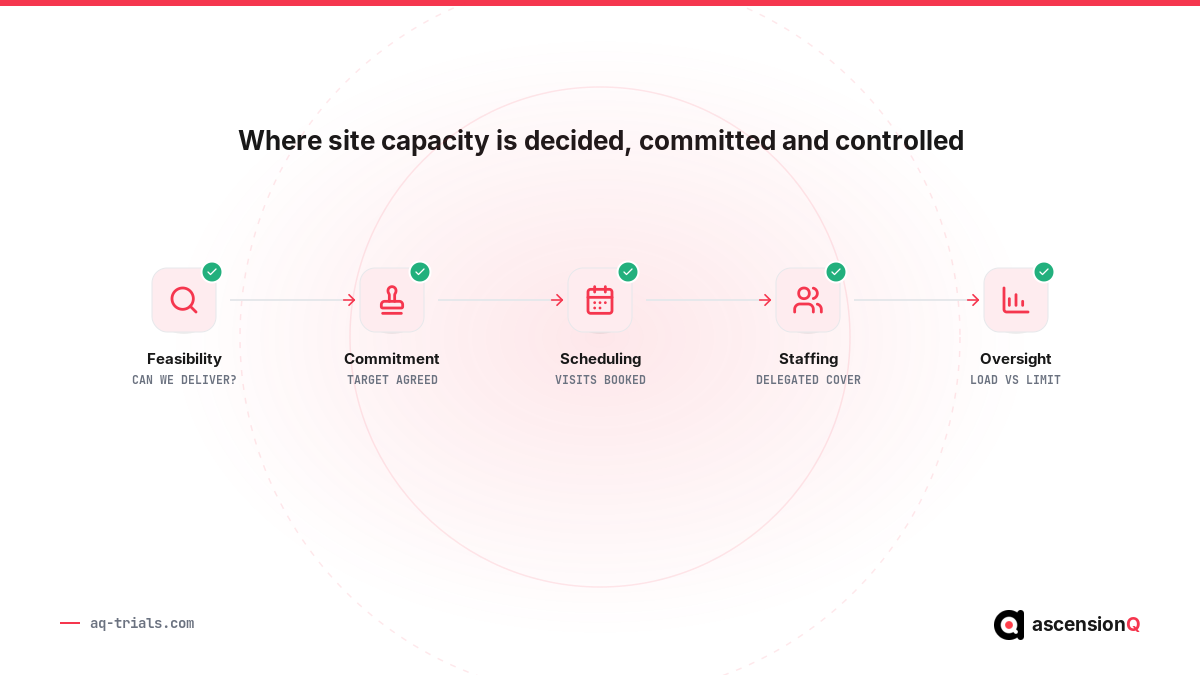
Capacity management covers five decisions, and each one commits the site further than the last. A site controls its capacity only where it controls all five together.
- Feasibility. The site answers whether it can deliver a protocol at a given recruitment target, with named staff and defined facilities.
- Commitment. The site signs to a target and a timeline, which converts an estimate into an obligation.
- Scheduling. Participants receive visit dates inside protocol-defined visit windows, against finite rooms and clinic slots.
- Staffing. Each visit requires a person who is trained, qualified and delegated for the task on that date.
- Oversight. The research manager compares actual load against the stated limit, across every open study, continuously.
Capacity is committed at feasibility and discovered at scheduling. The gap between those two moments is where sites lose control.
Why Does ICH-GCP Treat Capacity as an Investigator Obligation?
ICH-GCP E6(R3) places the resource question directly on the investigator, in section 2.2. Two clauses carry it.
- Clause 2.2.1. The investigator should be able to demonstrate, based on retrospective or currently available data, a potential for recruiting the proposed number of eligible participants within the agreed recruitment period.
- Clause 2.2.2. The investigator should have sufficient time, an adequate number of available and qualified staff, and adequate facilities for the foreseen duration of the trial to conduct it properly and safely.
Clause 2.2.1 sets the evidence standard, and it is the more demanding of the two. The guideline names the basis for the claim: retrospective or currently available data. A recruitment estimate produced from memory falls short of the standard the guideline describes, even where the estimate turns out to be correct.
Clause 2.2.2 covers time, staff and facilities. Each of those three is finite, each is shared across every open study at the site, and none of them appears in a single-study workbook. A site that accepts a ninth study without a view of the eight already running has asserted something it cannot evidence, and the assertion sits in a signed feasibility questionnaire.
E6(R3) reinforces this through its emphasis on risk-based quality management. Capacity is a quality risk with a predictable failure path: an overloaded site produces late visits, rushed source entries and delegated tasks performed by whoever is present. MHRA GCP inspection examines those consequences, and the consequences carry the site’s name.
Also Read: What are the Best Practices for Selecting a Clinical Trial Site?
Why Do Spreadsheets Break Site Capacity Planning?
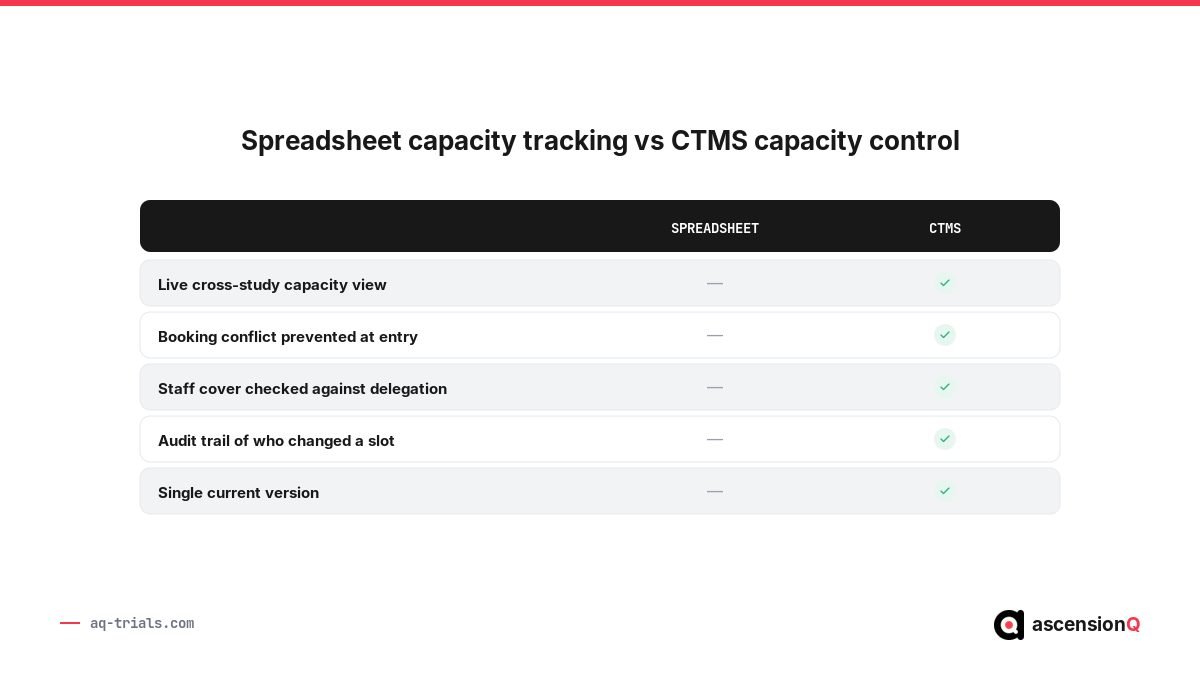
A spreadsheet is an excellent record and a poor control. It accepts whatever it is told, holds no relationship to any other workbook, and reports a conflict only when a person opens it and looks. Four specific properties cause the failure.
The single-study blind spot
Capacity is consumed across the site and tracked inside the study. A trial coordinator holds a workbook for their own trial, and that workbook is accurate. It carries no knowledge of the oncology study booking the same phlebotomist on the same Tuesday. The site has a total load and no total view.
The blind spot widens with every study added. Ten trials produce ten accurate workbooks and one unanswerable question: what are you actually carrying next week?
Conflict detection after the commitment
A spreadsheet cell accepts a booking that a room cannot honour. The clash exists from the moment of entry and surfaces when someone reads the diary, which is typically days later. The participant has a letter by then, and the visit window is fixed by the protocol.
The site is left with three options at that point, and each one costs something:
- Move the visit inside the window, which requires the participant to change plans at short notice.
- Move the visit outside the window, which creates a protocol deviation requiring documentation and sponsor notification.
- Cover the visit with an available staff member, which raises the delegation question below.
Staff cover checked for availability only
A visit needs a qualified person, and a spreadsheet knows only that a name is free. The check that matters lives elsewhere: the delegation of authority log records who is authorised to perform which task, from which effective date, on which study.
Cover arranged in a diary and delegation recorded in a separate log will drift apart. The person who covers an unexpected visit is authorised in principle and undelegated in fact. Inspectors read the delegation log and the source note together, and the gap between them is visible immediately.
Silent edits and competing versions
A shared workbook accepts a change from anyone with access and retains no reliable record of who made it or when. Someone emails a copy for a meeting, and a second version begins. The site now holds two answers to the same capacity question with no way to establish which one is current.
MHRA data integrity guidance applies the ALCOA+ principles to records of this kind, and the first of them is attributable. A workbook edited by four people over six months records the booking and loses the author, which is the attribute that a capacity dispute actually turns on.
What Does a Capacity Clash Look Like in Practice?
The following scenario is hypothetical and reflects a recognisable operational pattern at a busy NHS research unit.
A trust research unit runs nine open studies. In March the team completes a feasibility questionnaire for a tenth, a cardiology trial with twelve participants and monthly infusion visits. The questionnaire asks whether the site has adequate resources. The principal investigator considers the cardiology workload, finds it manageable, and signs.
The infusion room is the constraint, and no document states that. The room is already committed to an oncology study every Tuesday and Thursday, tracked in that study’s own workbook. In June the cardiology visits begin to land on Tuesdays because the participants were recruited in a block and their visit windows moved as a block.
The coordinator resolves the first two clashes by moving participants within their windows. The third participant has a window of plus or minus three days, and every day inside it is taken. The visit happens four days late. That is a protocol deviation, and the coordinator logs it and notifies the sponsor. The fourth clash is covered by a research nurse from the respiratory team who is trained and competent, and who is delegated on the respiratory study only. She takes the vital signs and signs the source note.
The MHRA inspector arrives eighteen months later and asks a straightforward question: on what basis did this site accept the cardiology study? The answer is a signed feasibility questionnaire and no capacity record behind it.
One finding sits in that scenario, and one near miss. The late visit was caught, logged and reported, which is the deviation process working as intended. The undelegated signature went unnoticed, and it is the one an inspector will find. Both trace back to a commitment made in March against data nobody held.
How Does a CTMS Change Site Capacity Planning?
A CTMS holds every study, participant, visit and delegated staff member in one structure. That single structure changes the timing of the capacity check. The system evaluates a booking against the site’s whole commitment set before the booking is accepted. Details of the module’s scope are covered in this guide to what a CTMS is. Four mechanics do the work, and they apply to the category rather than to any one product.
The protocol schedule becomes data
A CTMS stores the visit schedule from the protocol as structured data: visit names, day offsets and permitted windows. The system then derives each participant’s window from their own baseline date. A coordinator books against a calculated window instead of a column someone typed. Out-of-window dates become visible at the moment of booking, and the protocol does the calculation rather than the person under time pressure.
The room becomes a bookable object
Constrained resources exist in the system as objects with finite availability. An infusion chair, a centrifuge, a monitoring room and a phlebotomist each hold a defined capacity per day. Every study books against the same shared pool. The site’s real ceiling stops being an opinion held by an experienced coordinator and becomes a number the system enforces.
Delegation becomes a scheduling precondition
The delegation log and the visit calendar read from one record. Staff assignment checks the delegated task list for that person, on that study, on that date, before the assignment is accepted. The check that inspectors perform retrospectively runs prospectively instead, at the only moment where it can still prevent the finding.
Load becomes queryable
One record across every study makes the total answerable. A research manager queries committed visits per week, utilisation of the constrained resource, and open studies per coordinator. That query is what clause 2.2.1 describes as currently available data, and it converts a feasibility answer from a recollection into a position supported by evidence.
| Aspect | Spreadsheet tracking | CTMS control |
|---|---|---|
| Scope of view | One study per workbook, held by the study team. | Every open study at the site, in one record. |
| Timing of the check | When a person opens the file and reads it. | At the point the booking is entered. |
| Conflict handling | Reported after the fact, resolved by negotiation. | Refused at entry, with the competing commitment named. |
| Visit windows | Calculated by hand, held in a column. | Derived from the protocol schedule and enforced on booking. |
| Staff cover | Availability only, checked against a calendar. | Availability plus delegation status on that study, on that date. |
| Version control | Multiple copies, no authoritative current file. | One record, with prior states retained. |
| Audit trail | Absent or partial. | Attributable entry with user, timestamp and reason. |
| Feasibility evidence | A signed assertion. | A signed assertion with the load data behind it. |
The final row carries most of the regulatory weight. A site that answers a feasibility questionnaire from live load data meets the evidence standard in clause 2.2.1 as a by-product of how it schedules. A site that answers from recollection has an opinion, and an opinion is what the inspector eventually tests.
Also Read: CTMS vs QMS for Clinical Trial Data Management
Which Capacity Signals Should a Site Track?
Clinical trial capacity management becomes controllable once it is measured against a stated limit. Each signal below pairs a number with the decision it informs.
| Signal | What it measures | Decision it informs |
|---|---|---|
| Open studies per coordinator | Concurrent study load carried by each named person. | Whether a new study needs new staff. |
| Scheduled visits per week | Committed clinic activity across all studies. | Whether the next twelve weeks are deliverable. |
| Room and equipment utilisation | Booked hours against available hours for the constrained resource. | Where the real ceiling sits. |
| Visit window compliance | Visits completed inside protocol windows. | Whether the site is already running over capacity. |
| Delegated cover depth | Staff delegated per task, per study. | Whether a single absence creates a deviation. |
| Screening to enrolment rate | Actual recruitment against the committed target. | Whether the feasibility estimate held. |
Visit window compliance deserves particular attention. It is the earliest honest signal of overload. Deviations rise before anyone reports feeling stretched, which makes the metric a leading indicator.
What Are the Risks of Managing Capacity on Spreadsheets?
- Protocol deviations from out-of-window visits. Each one requires documentation, sponsor notification and, where the pattern repeats, a CAPA.
- Undelegated task performance. Cover arranged under pressure produces activity by staff outside their delegated scope on that study.
- Feasibility answers the site cannot evidence. Clause 2.2.1 names data as the basis for a recruitment claim, and a signed assertion with no data behind it is an inspection exposure.
- Recruitment shortfalls against committed targets. An overloaded site screens fewer participants and misses the number it promised the sponsor.
- Reputational cost with sponsors. Sites that miss committed targets receive fewer studies, which affects the research portfolio a trust can sustain.
- Staff attrition. Sustained overload falls on the coordinators absorbing it, and experienced research staff are difficult to replace.
These risks compound. A deviation pattern triggers a finding, the finding triggers a CAPA, and the CAPA lands on the same team that was already at its limit. Inspection readiness depends on a site operating inside its capacity for the whole study. Documentation assembled once an inspection is announced arrives too late to change what happened in the clinic.
Also Read: The New UK Clinical Trials Regulations (2026): What Sites and Sponsors Must Do
Frequently Asked Questions
What is clinical trial capacity management?
The practice of matching the study workload a site has committed to against the staff, rooms, equipment and time it actually has available.
Why do spreadsheets break site capacity planning?
A spreadsheet is a good record and a poor control. It accepts whatever it is told, holds no relationship to other workbooks, and shows a conflict only when someone opens it and looks.
Is site capacity an investigator obligation?
Yes. ICH-GCP E6(R3) places the resource question directly on the investigator, in section 2.2.
How Does AQ CTMS Support Site Capacity Planning?
AQ CTMS implements the four mechanics above in one connected record, which gives a site a single capacity control point rather than a workbook per study.
- Cross-study visit scheduling. The system books every visit against one shared calendar of staff, rooms and equipment, which surfaces a clash at entry instead of in the following week’s diary.
- Protocol-derived visit windows. Windows come from the study schedule and apply on booking, which keeps out-of-window dates visible before they are offered to a participant.
- Delegation-aware staffing. Visit assignment reads the Digital DoA record, which shows whether a covering staff member is delegated for that task on that study on that date.
- Live load dashboards. Open studies, weekly visit counts and utilisation sit in one view, which lets a research manager answer a feasibility question from data.
- Attributable audit trail. Every scheduling change records user, timestamp and reason, which supports the ALCOA+ expectations applied to operational records.
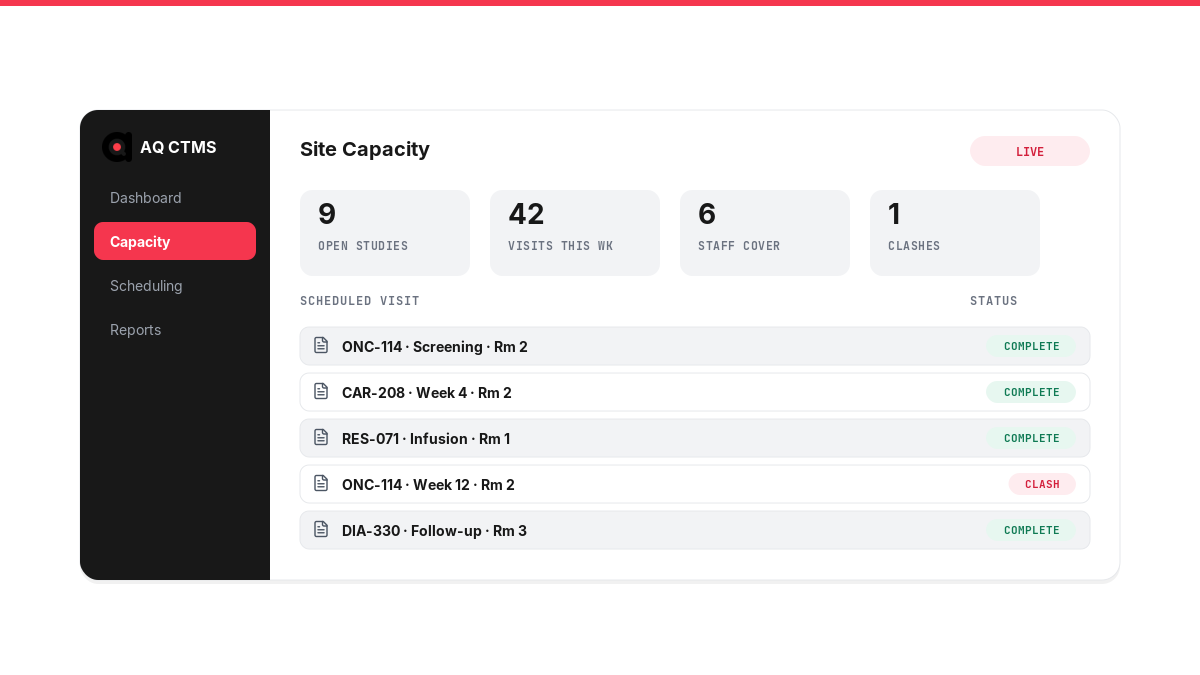
AQ CTMS forms part of a connected clinical research platform, which is what allows the scheduling record and the delegation record to read from the same source.
Where the system stops and the site decides
The system holds the constraint and applies it. The judgement stays with the site.
- It does not set the site’s capacity limit. A research manager defines what the site can carry. The system enforces that number and reports against it.
- It does not decide whether to accept a study. Feasibility remains a judgement by the principal investigator, made with better evidence.
- It does not create staff. A site short of a qualified phlebotomist stays short of one. The system makes the shortage visible in advance rather than on the day.
- It does not repair an inaccurate delegation log. Cover checks read the DoA record, so the control depends on that record being current.
A capacity system moves the discovery of a problem from the clinic to the calendar. The decision, and the accountability for it, stays with the site.
See how AQ CTMS handles cross-study scheduling, visit windows and delegated cover at your site. Book a live demo for a 30-minute product tour with our team.