A CAPA effectiveness check is the final verification stage of CAPA management software: a planned, dated test that proves the corrective and preventive actions actually stopped the problem. The actions being complete is a statement about effort. Effectiveness is a statement about outcome. A CAPA record should close only when the outcome has been measured against criteria agreed before closure, over a defined observation window, using a stated method.
This guide covers when verification criteria should be set, what makes a criterion testable, how to match the verification method to the action type, how long the effectiveness window should run, and what a failed check must trigger. It applies the expectations of ICH-GCP E6(R3) on quality management and the continual-improvement model of ICH Q10.
Key Takeaways
- Verification criteria are set before closure, at action-plan approval. A criterion written after the actions finish tends to describe whatever the actions achieved.
- A testable criterion names four things: the metric, the threshold, the observation window, and the method.
- The method must match the action type. A retrained person, a rewritten SOP, and a new system control each need a different form of evidence.
- The window must include real exposure to the failure conditions. Thirty quiet days prove nothing if the triggering situation never occurred.
- A failed check reopens the analysis. The record returns to root cause, and the effectiveness window restarts after the revised fix.
What Is a CAPA Effectiveness Check?
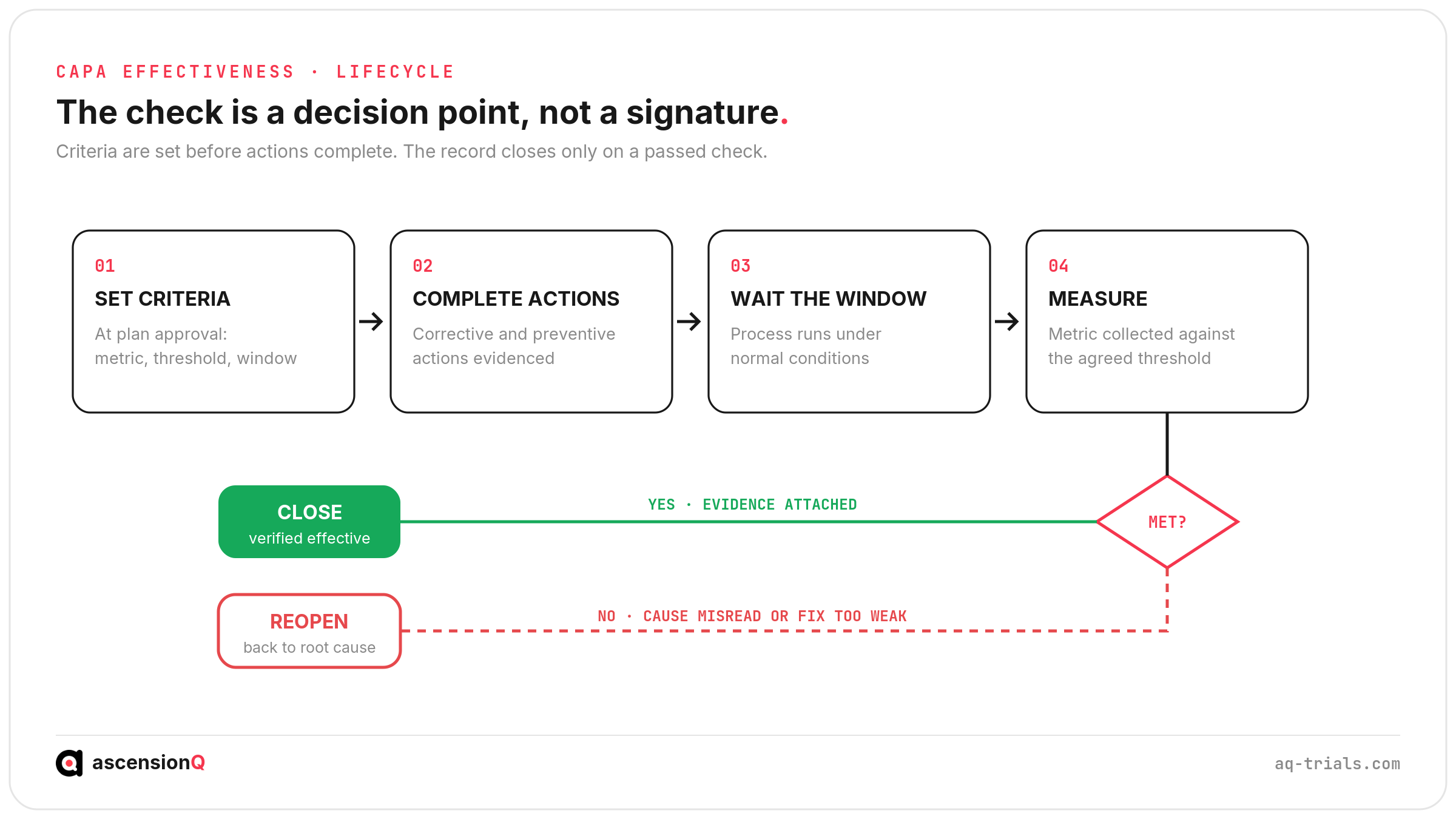
An effectiveness check answers one question: did the fix hold once normal operating pressure returned? It is a distinct lifecycle stage with its own owner, due date, and evidence, positioned after action completion and before closure. The CAPA management lifecycle runs from detection through investigation, root cause analysis, action planning, implementation, and finally verification. Each earlier stage produces a plan or an activity. Verification is the only stage that produces proof.
A complete effectiveness check has four components:
- A metric: the countable thing that shows recurrence, such as out-of-window visits, unsigned delegation entries, or temperature excursions.
- A threshold: the value that counts as a pass, agreed in advance. Zero recurrences is common. A reduced rate can be defensible where the event has background frequency.
- A window: the dated observation period during which the process runs under normal conditions.
- A method: how the metric will be collected, such as a re-audit, a monitoring review, a system report, or a spot check.
Why Do Closed CAPAs Reoccur?
Most repeat findings trace back to closure without verification. The team completes the actions, uploads the evidence of activity, and the QA Lead signs the record closed on the same day. Three months later the same event appears again, and the organisation now holds a worse position than before: a documented claim that the problem was fixed, sitting next to proof that it was not. The CAPA action plan may have been well designed. Without a verification stage, nobody ever tested it.
Example: a site logs a deviation for a consent version error. The corrective action is retraining, delivered and documented within two weeks. The CAPA closes on the training certificate. At the next monitoring visit the same error appears with a different staff member. The certificate proved attendance. It never proved the process now prevents the error.
The record said fixed. The process said otherwise.
The distinction between completed and verified runs through every element of the record:
| Aspect | Completed actions | Verified effect |
| What it proves | The team did the work | The work changed the outcome |
| Evidence | Training records, revised SOPs, new controls | Measured recurrence data over a window |
| Timing | Ends at the action due date | Ends when the window closes and the check passes |
| Who signs | Action owner | QA, against pre-agreed criteria |
| Inspection value | Shows responsiveness | Shows the quality system works |
When Should Verification Criteria Be Set?
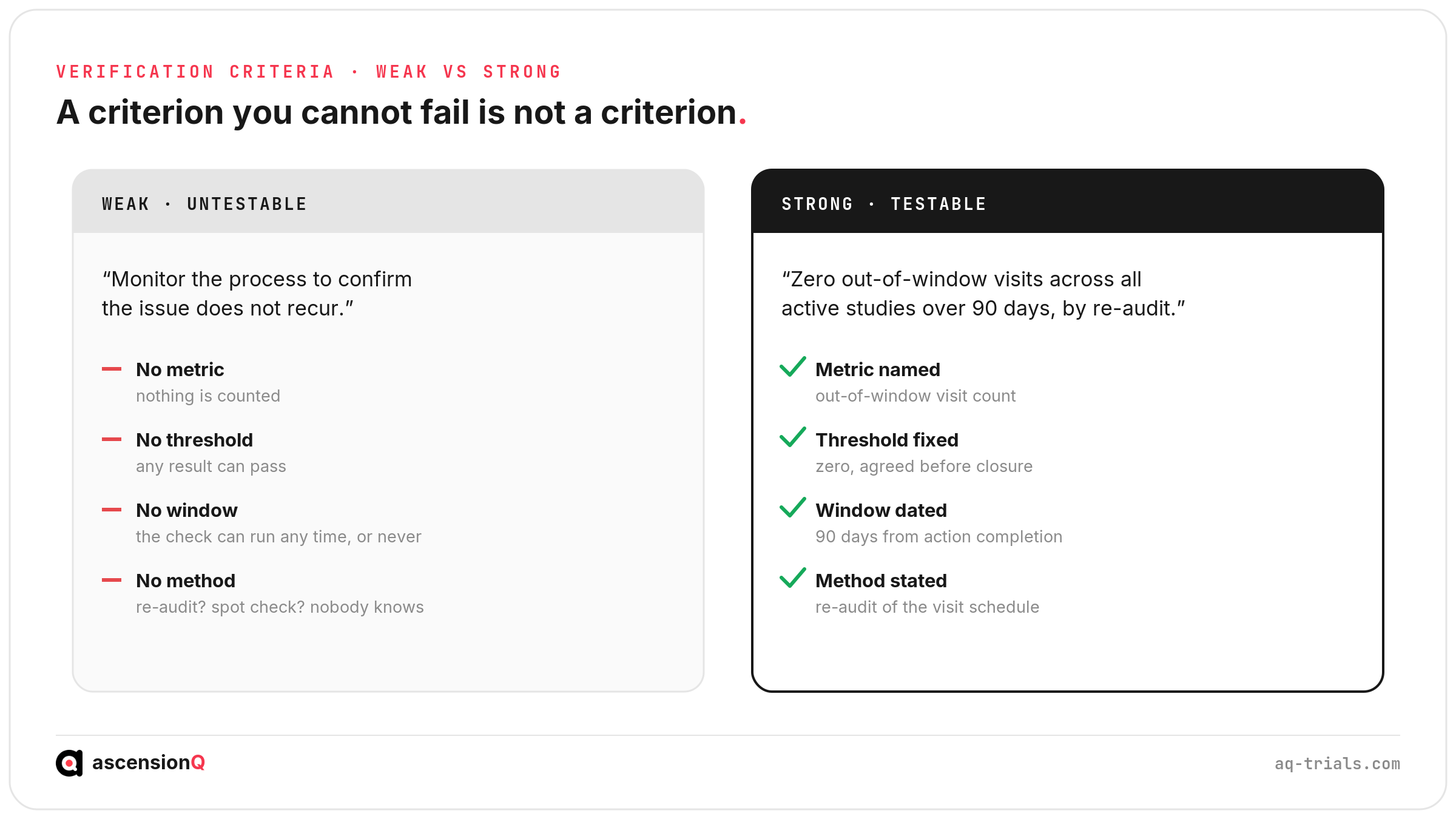
Criteria belong in the action plan, agreed at the same review that approves the actions. The reason is independence. A criterion defined before the actions run is a genuine test the fix can fail. A criterion written at closure, with the results already visible, drifts towards whatever the evidence happens to support. Where the criteria come from is settled earlier, when the action plan is designed against the root cause statement. The worked CAPA example on this site shows criteria being fixed at plan approval and tested months later.
The test of a good criterion is simple: could it fail? “Monitor the process to confirm the issue does not recur” cannot fail, because it names no metric, no threshold, no window, and no method. “Zero out-of-window visits across all active studies over 90 days, verified by re-audit” can fail, which is exactly what makes passing it meaningful.
Also Read: CAPA Example: A Clinical Trial Deviation Walked Through Step by Step
Which Verification Method Fits Which Action?
The method follows from what the action changed. Evidence that satisfies one action type says nothing about another. A re-audit tests a record set. A system report tests a control. An observed practice session tests a person. Choosing the wrong pairing produces a check that passes without testing the fix.
| Action type | Fitting verification method | Evidence produced |
| Retraining on a procedure | Observed practice or competency assessment after an interval, plus recurrence count | Demonstrated behaviour, zero repeat events |
| Rewritten SOP or work instruction | Re-audit of records created under the new version | Records that follow the revised steps |
| New system control (validation, alert, hard stop) | System report over the window, attempted-breach test | Control fired every time conditions met it |
| Role or delegation change | Review of the delegation of authority log against activity dates | No task performed outside authorised dates |
| Process redesign across teams | Scheduled re-audit plus metric trend at 30, 60, 90 days | Sustained performance under the new process |
The pairing also decides who can verify. An action owner can collect the data. The pass or fail judgement belongs to someone independent of the actions, normally QA, recorded in the quality management system.
How Long Should the Effectiveness Window Be?
The window must be long enough for the failure conditions to genuinely recur. Calendar time is the wrong measure on its own. Exposure is the right one. A fix to a monthly reconciliation process needs at least two or three reconciliation cycles. A fix to a screening-visit error at a site recruiting two participants a week meets its test conditions within a month. The same fix at a site recruiting two a quarter does not.
- 30 days suits high-frequency processes: daily logs, dispensing, data entry. The process meets its failure conditions many times within the window.
- 60 to 90 days suits periodic processes: monitoring cycles, monthly reconciliations, batch documentation reviews.
- Beyond 90 days suits rare-event processes, and a scheduled interim check keeps the record moving rather than silent.
- Event-based windows (“the next three protocol amendments”) suit processes triggered by occurrences rather than dates.
Example: a pharmacy CAPA fixes a fridge-temperature recording gap discovered on night shifts. The site sets a 30-day window because the log is completed daily, so the window contains roughly 30 exposures, including every night shift rotation. A neighbouring site copies the same CAPA for its weekly research clinic. The same 30-day window there contains only four clinic days, so the check is moved to an event-based window covering the next twelve clinics. Same fix, same metric, different window, because exposure differs.
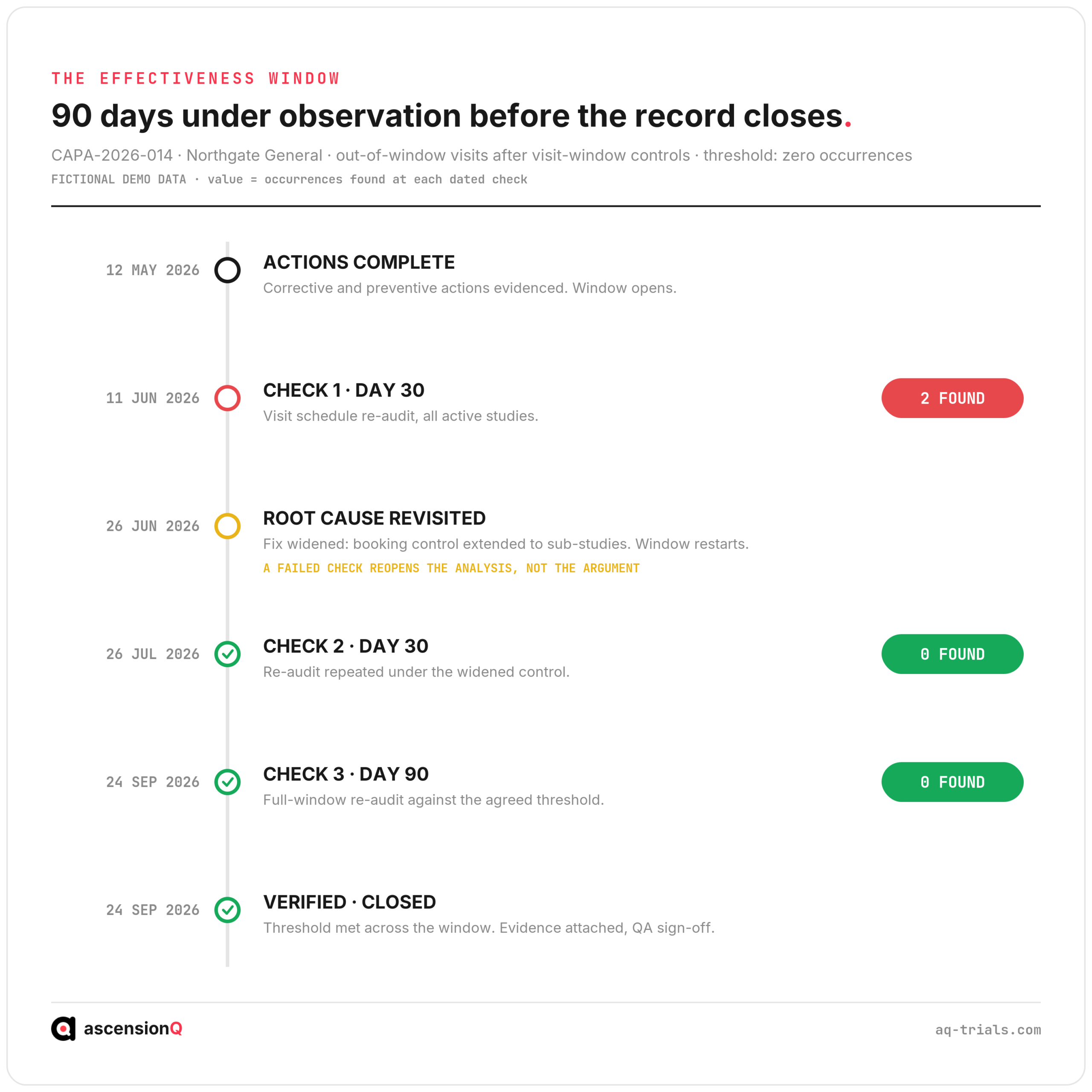
The timeline below shows a fictional record moving through its window, including a failed first check. The dates matter: each check is planned, each result is recorded against the threshold, and closure waits for the evidence. This dated discipline is what inspection readiness looks like at the level of a single record.
What Happens When an Effectiveness Check Fails?
A failed check is the quality system working, and the response is structured rather than improvised. Recurrence within the window means the root cause was misread, the fix was too narrow, or the fix was right and unevenly applied. Each conclusion sends the record somewhere specific:
- Root cause misread: reopen the investigation. The original analysis stopped at a symptom, and a deeper cause is still producing events.
- Fix too narrow: keep the root cause, widen the action. A control applied to one study or one team leaves the same gap open everywhere else.
- Fix right, application uneven: address implementation. The control exists, and part of the process still bypasses it.
- In every case: the window restarts after the revision. Verification against the original dates would test a fix that no longer exists.
The failure is a property of the system, never of the person who reported the recurrence. Repeat findings in the same area are a pattern MHRA GCP inspectors specifically look for, and a documented reopen-and-revise trail reads far better at inspection than a string of quietly re-raised CAPAs for the same event. MHRA guidance on good clinical practice expects quality systems to demonstrate exactly this kind of closed-loop control.
Also Read: MHRA GCP Inspections: What to Expect and the Most Common Findings
What Evidence Should the Verification Record Hold?
The verification record is what an inspector reads two years later, long after everyone involved has moved on. It must stand alone. A signature and a date prove someone was present at closure. The record needs to prove what was tested, what was found, and why the result justified the decision. A defensible verification record holds six elements:
- The criteria as originally agreed, unedited, with the approval date showing they preceded the actions.
- The measured result: the actual count or rate found, with the source data attached or referenced, aligned to ALCOA+ expectations for original, contemporaneous records.
- The window dates: when observation started, when it ended, and any restart with its reason.
- The method actually used, which should match the method planned, with any change explained.
- The pass or fail decision, made by someone independent of the actions, with name, role, and date.
- The onward action on a fail: the reopen reference, so the trail from failed check to revised fix stays unbroken.
Corrective and preventive actions also verify separately. The corrective action addresses the event that occurred, so its check measures recurrence of that event in that process. The preventive action addresses the potential for the same failure elsewhere, so its check measures whether the extended control took hold in the other studies, teams, or sites it was applied to. One passed check on the corrective side says nothing about the preventive side. A record that closes both on a single measurement has verified half of its own plan.
How Does AQ Support CAPA Effectiveness Verification?
AQ’s CAPA module treats verification as a required lifecycle stage rather than an optional note. The record structure enforces the discipline this guide describes:
- Criteria fields sit in the action plan, which means the metric, threshold, window, and method are recorded before the actions start, and the closure form displays them unchanged.
- The verification stage has its own owner and due date, which means the check appears in dashboards and overdue reports instead of relying on someone remembering a diary note.
- Closure is gated on a recorded pass or fail, which means a CAPA cannot silently skip from actions-complete to closed.
- A failed check routes the record back through investigation, which means the reopen decision and the restarted window stay on the same audit trail as the original event.
- Because CAPA sits inside a connected platform, the verification evidence can draw on live records: visit data from the CTMS, document status from the eTMF, delegation dates from Digital DoA.
The honest limit: AQ structures the verification stage and holds the evidence. The system does not decide whether a criterion is well chosen, whether the window gave real exposure, or whether a marginal result is a pass. Those judgements belong to the QA Lead. The system’s job is to make sure they are made, dated, and kept.
See how gated CAPA closure works in practice: book a live demo for a 30-minute product tour.