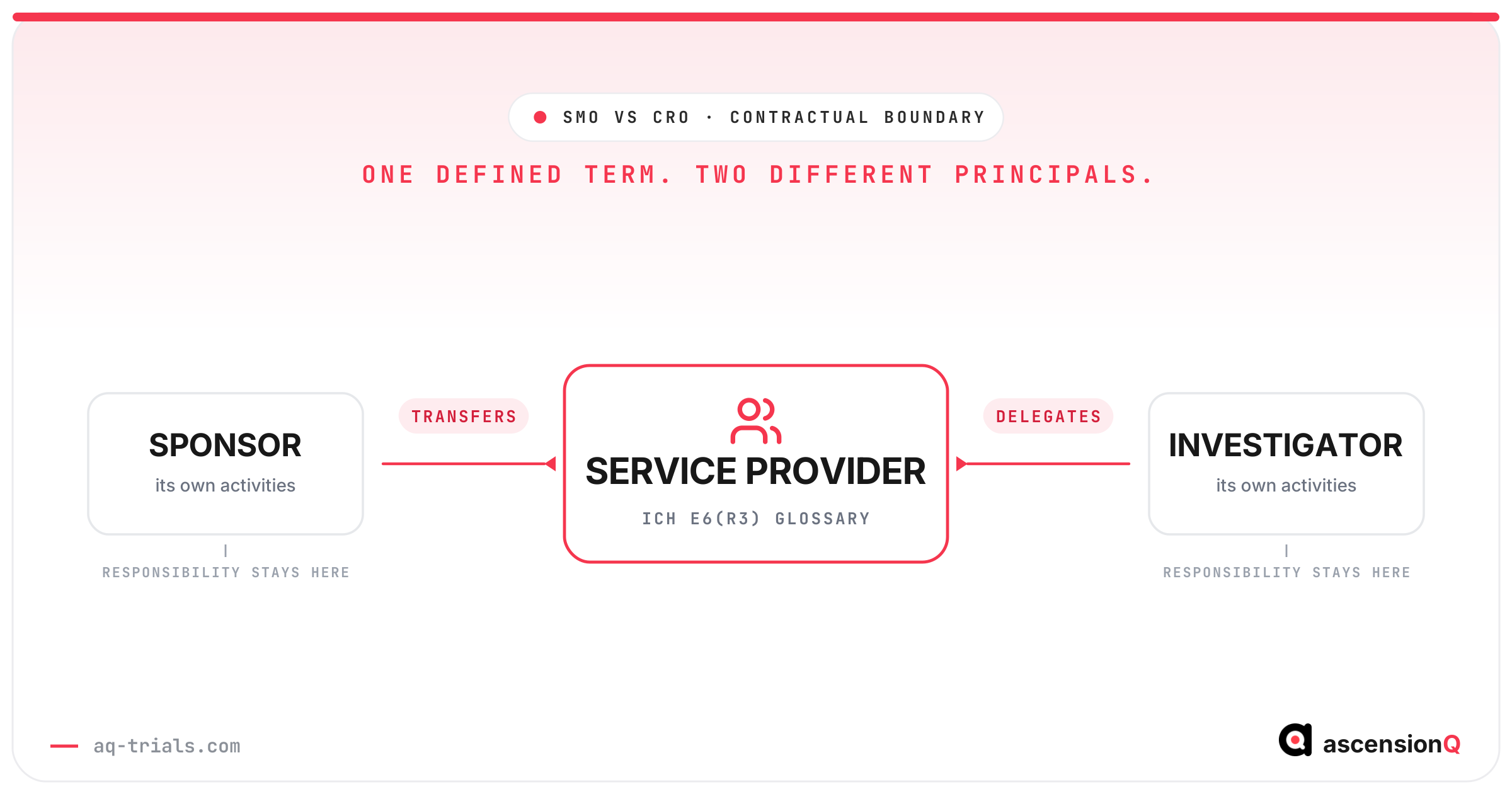
An SMO performs the activities the investigator is responsible for, and a CRO performs the activities the sponsor is responsible for. That one sentence settles the boundary. ICH E6(R3) places both organisations under a single defined term. The difference between them is the principal whose activities they take on. The sponsor transfers. The investigator delegates. Each principal keeps overall responsibility for its own activities after the handover.
This guide covers the functional and contractual boundary between the two, which obligations sit with each, what the rules provide when an agreement says nothing, and how accountability runs when a sponsor engages both on one study. It sits under the pillar guide to site management organisations and running research across multiple sites.
- ICH E6(R3) recognises one category, the service provider. Its glossary entry for contract research organisation reads “See Service Provider”.
- A sponsor selects its own CRO. An investigator holds the final decision on a service provider intended to support them.
- A sponsor activity left out of an agreement stays with the sponsor. A delegated activity has no equivalent fallback rule.
What Is the Difference Between an SMO and a CRO?
The difference is the principal, rather than the size or the service list. ICH E6(R3) defines a service provider as “a person or organisation (commercial, academic or other) providing a service used by either the sponsor or the investigator to fulfil trial-related activities”. Its glossary entry for contract research organisation reads, in full, “See Service Provider”. One defined term covers both, so the guideline draws no structural line between them.
The line appears instead in the principles. Section 10.1 states that “the sponsor may transfer or the investigator may delegate their tasks, duties or functions (hereafter referred to as activities), but they retain overall responsibility for their respective activities”. Two verbs sit in that sentence, and they belong to two different parties. A CRO receives transferred sponsor activities. An SMO receives delegated investigator activities.
The sponsor transfers. The investigator delegates. Neither hands over the responsibility.
Three practical points follow.
- The label on the organisation decides nothing, which is why an agreement has to name the activities rather than the category of supplier.
- One organisation can be both on one study, which happens where a provider monitors for the sponsor at some sites and staffs the clinic at others.
- The retained responsibility follows the principal, which means a question about a transferred activity reaches the sponsor and a question about a delegated activity reaches the investigator.
AQ covers the two audiences on separate pages, one for CROs and one for SMOs and multi-site research.
Which Obligations Sit With Each?
The obligations divide along the same line. ICH E6(R3) sets them out in two separate places. Sections 3.6.1 to 3.6.10 govern what the sponsor does with a service provider. Sections 2.3.1 to 2.3.4 govern what the investigator and the institution do with one. The table maps the questions a contract manager asks onto the clause that answers each.
| Question | Contract research organisation | Site management organisation |
|---|---|---|
| Whose activities does it perform? | The sponsor’s | The investigator’s and the institution’s |
| Which clauses govern the handover? | E6(R3) 3.6.4 and 3.6.6 | E6(R3) 2.3.1 to 2.3.4 |
| Who decides it is suitable? | The sponsor assesses suitability and selects the provider (3.6.7) | The sponsor may identify one, and the investigator retains the final decision (2.3.1) |
| Who keeps the responsibility? | The sponsor (3.6.6) | The investigator (2.3.1, confirmed at 3.6.5) |
| What has to be documented? | An agreement covering each activity transferred (3.6.4) | An agreement with the provider (2.3.4), plus a record of the persons delegated (2.3.3) |
| What quality duty does it carry? | Appropriate quality management, and reporting to the sponsor of incidents affecting participant safety or trial results (3.6.6) | Appropriate quality management as a service provider (3.6.6), with the investigator required to ensure its people are qualified and informed for their assigned activities (2.3.2) |
The suitability row carries the asymmetry most often missed in a contracting conversation. The sponsor selects its own CRO outright. A sponsor may also propose an SMO to a site, and section 2.3.1 gives the investigator the final decision on whether that provider is appropriate. Section 3.6.5 then places responsibility for those activities with the investigator.
The documentation row has a quieter consequence. Section 2.3.4 requires the investigator and institution to document their own agreements with service providers. An SMO arrangement can therefore require a document the sponsor never signs and never holds.
Also Read: UK Model Agreements for Clinical Trials: mCTA and mNCA
What Happens When the Agreement Is Silent?
Silence produces opposite results on the two sides of the boundary. On the sponsor side the rule is a fallback. Section 3.6.4 states that “the sponsor’s trial-related activities that are not specifically transferred to and assumed by a service provider are retained by the sponsor”. The UK Policy Framework for Health and Social Care Research puts the same rule in UK terms at paragraph 9.13: “Any activity not specifically delegated to and assumed by a CRO is retained by the sponsor.” Note the verb. ICH E6(R3) reserves “transfer” for the sponsor and “delegate” for the investigator, and the UK framework uses “delegate” for both. The principal named in a document settles the question, rather than the verb.
The investigator side carries no equivalent rule. Section 2.3.3 requires the investigator to ensure a record is maintained of the persons and parties to whom activities have been delegated. The same clause scales that documentation to the significance of the activity, and removes the requirement where the activity is performed as part of clinical practice. No clause returns an undocumented delegated activity to another party. That record is where the delegation is evidenced. Delegation of authority as a concept is covered in what DoA means in clinical research.
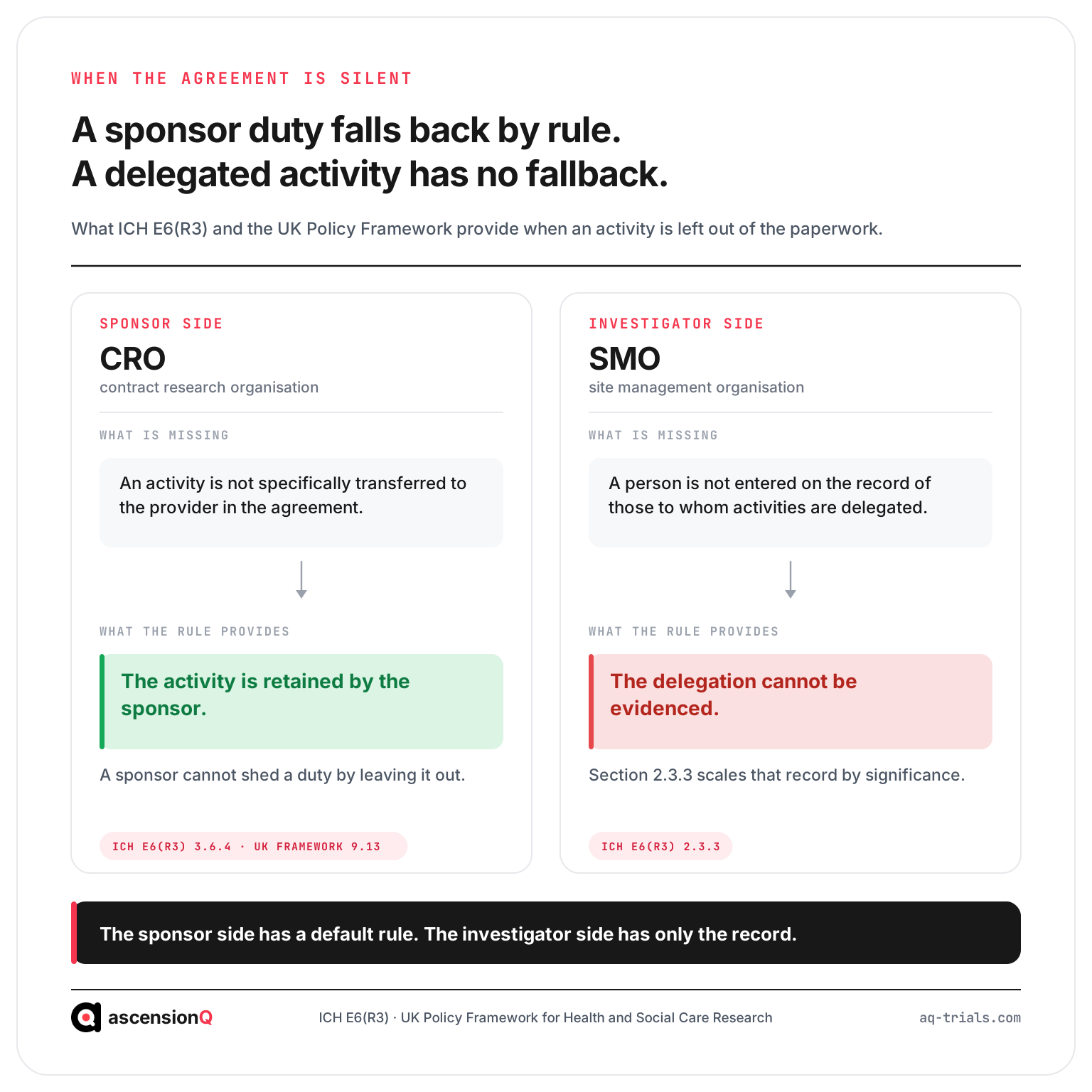
Take a hypothetical study. A sponsor engages a CRO under an agreement listing monitoring, data management and safety reporting, and says nothing about trial master file archiving. The archiving duty stays with the sponsor under 3.6.4. The sponsor can be asked for it at any point. On the same study, Lakeside Research Network supplies a coordinator to Riverside CRF. That coordinator performs a study assessment while absent from the record of delegated persons. The investigator has no way to evidence the delegation, and no clause moves the activity to anyone else.
A transferred duty falls back to its owner. A delegated activity does not.
When Does a Sponsor Engage Both on One Study?
A sponsor engages both on a commercial study that needs central oversight and local delivery capacity. The CRO monitors the sites and holds the sponsor’s data and safety work. The SMO staffs the clinic and supplies the procedures those staff follow. Both appear at the same site, in the same week, on the same protocol.
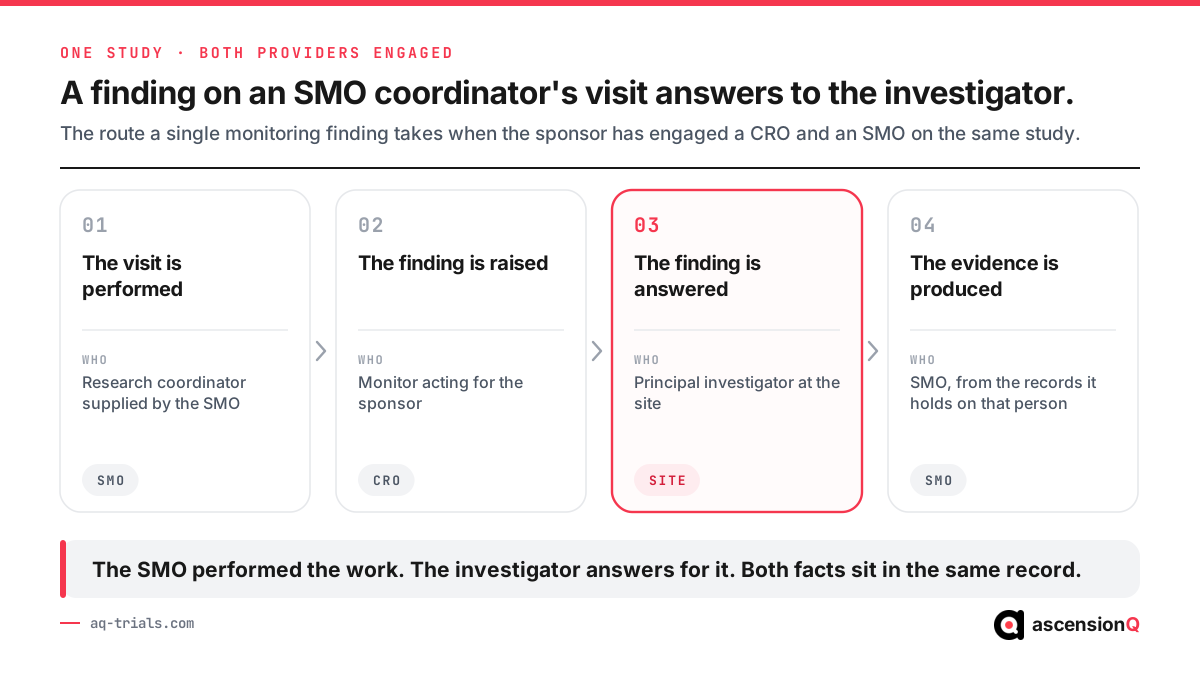
Four points decide whether the two arrangements hold together.
- Each activity needs a named home in one of the two agreements, because 3.6.4 and 2.3.4 both require the handover to be documented, and an activity in neither has no documented owner.
- Route findings to the principal rather than to the performer, because a finding on work performed by an SMO coordinator reaches the investigator who authorised that person for the activity.
- The qualification and training evidence has to reach the site, because 2.3.2 puts the investigator under a duty to be satisfied that each delegated person is qualified and adequately informed.
- Keep the sponsor’s nomination separate from the investigator’s decision, because section 3.6.5 leaves responsibility with the investigator whichever party proposed the provider.
The record of who was authorised for what is the artefact both agreements lean on. The CRO view of that problem is covered in why CROs need a centralised digital DoA system.
Which Terms Does UK Research Policy Name?
UK research policy names the contract research organisation and gives it a section of its own. Paragraph 9.13 of the UK Policy Framework defines a CRO as “a person or an organisation (commercial, academic or other) contracted by the sponsor to perform one or more of the sponsor’s activities”, and sets out the delegation rule quoted above. The framework carries no equivalent entry for the site management organisation.
An SMO is read through two other parts of the same system instead.
- The research site responsibilities at paragraph 9.14, which make the site responsible for “ensuring that the roles and responsibilities of individuals at the site and any collaborating parties are agreed and documented for individual research projects”.
- The investigator delegation rules in ICH E6(R3) section 2.3, which carry the qualification, training, record and agreement duties for every person the investigator authorises.
Paragraph 9.14 lands a duty on the host organisation that an SMO contract does not discharge. The host holds its own documented position on the roles of collaborating parties at that site. A placed coordinator therefore appears in two sets of records, the SMO’s and the host’s. The two have to agree.
An SMO is a commercial organisation. It is not an NIHR-designated Commercial Research Delivery Centre, which is an NHS hub-and-spoke arrangement, and it is not an NHS trust R&D office, which governs research the trust hosts or sponsors itself. The organisational step each participating NHS organisation takes is covered in capacity and capability confirmation.
Also Read: Delegation of Authority Logs: Why Effective Dates Matter More Than Signatures
How Does AQ Show Which Activities You Discharge?
AQ holds one administered record of users, roles, studies and sites. Each module works against that record. Every audit asks an SMO the same question: which activities it discharges, and what evidence stands behind each. That becomes a report once the activities, the people and the authorisations sit in one place.
- Digital DoA holds duties signed by the principal investigator and linked to current training, which is the 2.3.3 record of persons delegated, held per activity and per site rather than per binder.
- QMS holds controlled procedures, training assignment and training completion, which shows whether the people an SMO supplies are trained on the version in force.
- eISF holds the investigator site file, qualifications and CVs, which puts the 2.3.2 evidence in front of the investigator who has to be satisfied by it.
- CTMS holds expected documents, milestones and enrolment against target per site, which gives the per-site figure and the network roll-up from the same record.
Registers, reports and audit logs export for sponsors and inspectors. Access control scopes what a host institution, a sponsor or a CRO can open. Sponsor-mandated systems stay the record for the purposes the sponsor defines.
Book a live demo and bring the activity list from one study where both a CRO and an SMO are engaged. We will map it against your delegation and training records.