The site management organisation employs the research nurse. The principal investigator at the site delegates the trial duties that nurse performs. These are two separate relationships, carried by two separate instruments, and an SMO arrangement answers to both at once.
This guide covers the chain from sponsor to contract research organisation to SMO to site, which UK model agreement names which party, what employment and engagement each carry, and which instrument carries which obligation. It sits under the guide to site management organisations and running research across multiple sites.
- The SMO holds the employment relationship. The investigator holds the duty.
- The UK model agreements name the sponsor, the CRO and the trial site. None of them names an SMO.
- A contract puts a person at the site. Only a signed delegation authorises that person for an activity.
Who Employs the Research Nurse in an SMO Model?
The SMO employs the research nurse in both of its operating models. The employment relationship follows the organisation rather than the building. A coordinator working three days a week inside an NHS trust remains an SMO employee, and the SMO carries the employer expectations the UK Policy Framework for Health and Social Care Research sets out at paragraph 9.20.
Paragraph 9.20 expects employers of research staff to do four things.
- Encourage a high-quality research culture, which includes holding employees to account for conducting research professionally.
- Ensure researchers understand and carry out their responsibilities, which is the basis for any assurance a site accepts about a person it does not employ.
- Follow good human resources practice, including written procedures, supervision and training that support accountability.
- Take proportionate, effective action on errors and breaches, which is the employer end of a site finding.
Paragraph 9.21 adds competence. Employers should ensure appropriate individual learning and competence, with measurable learning outcomes. That duty follows the SMO to every site it places staff in. The site duties at paragraph 9.14 sit with whichever organisation runs the place, as set out in the two SMO operating models.
The Two Chains That Meet at the Site
Two chains run into a research visit, built from different materials. The study reaches the site down a chain of commercial agreements starting with the sponsor. The person reaches the same visit down a chain of employment, access and delegation starting with the SMO. The two touch at one point, and that point is the delegation log.
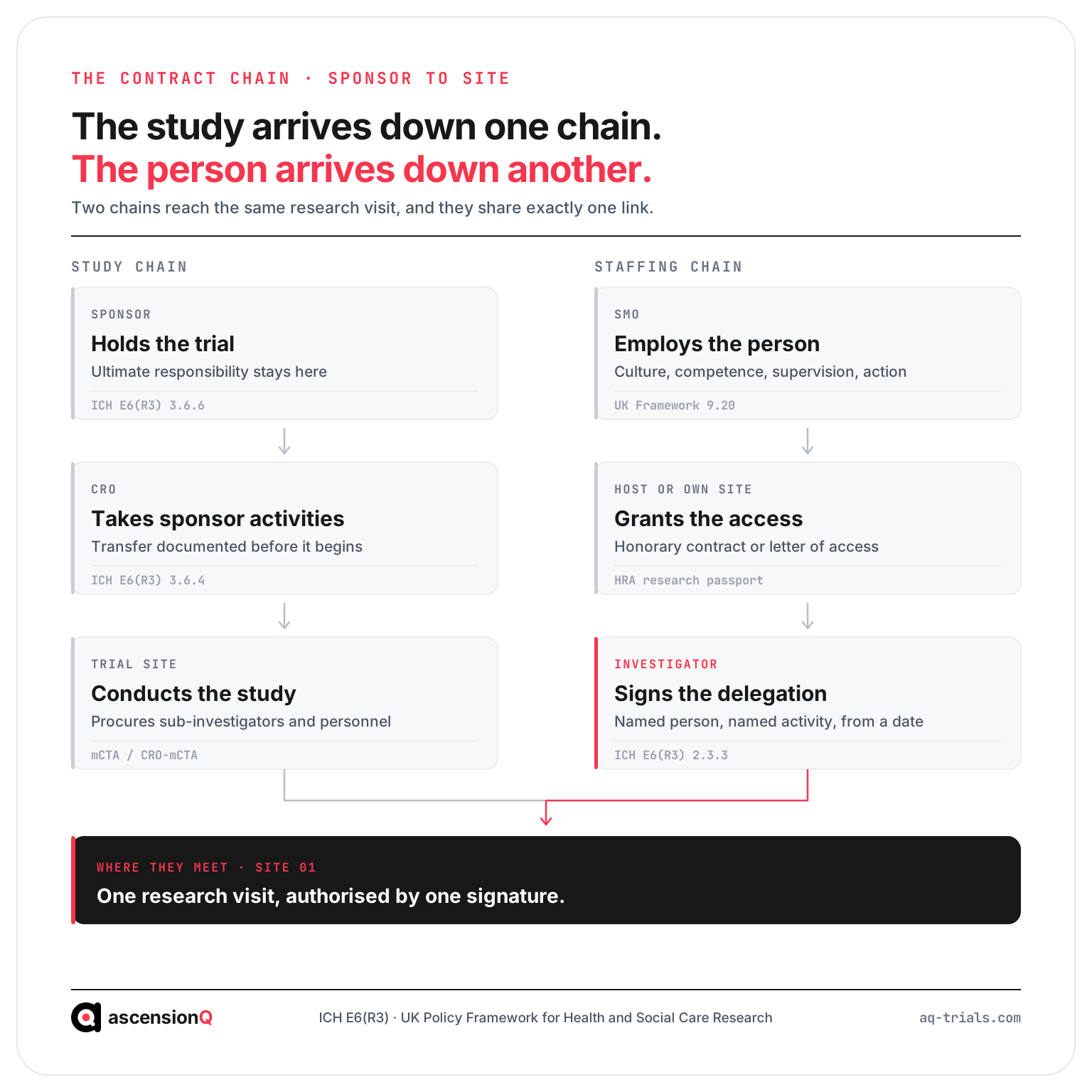
The contract puts the person in the room. The delegation lets them do the work.
The study chain is well documented. ICH E6(R3) section 3.6.6 provides that a sponsor may transfer any or all of its trial-related activities to a service provider, and that ultimate responsibility resides with the sponsor. Section 3.6.4 requires a transferred activity to be documented in an agreement, and section 3.6.1 requires that agreement to exist before the activities begin. Paragraph 9.13 of the UK Policy Framework takes the same position for a CRO and states that the delegated activity should be specified in writing. The pillar guide to running research across multiple sites covers how the chain behaves across a whole network.
Which Agreement Names Which Party?
The UK model agreements name three parties between them: the sponsor, the CRO and the trial site. The published guidance describes the model clinical trial agreement as the standard form contract for industry sponsors and NHS trial sites. The CRO version adds the CRO as a party where the sponsor has contracted one for aspects of trial management at the site.
| Agreement | Parties named | Used when |
|---|---|---|
| mCTA | Sponsor and NHS trial site | The sponsor contracts the site directly, with any CRO reflected as an Agent of the Sponsor |
| CRO-mCTA | Sponsor, CRO and trial site | The sponsor has contracted a CRO for site management responsibilities and wants it on the face of the agreement |
| PC-mCTA, bipartite | Sponsor and NHS primary care independent contractor trial site | The site is a primary care independent contractor rather than an NHS organisation |
| PC-mCTA, tripartite | Sponsor, trial site and the principal investigator | The principal investigator is to be a signatory, which the bipartite version excludes |
| Model commercial hub and spoke agreement | Lead trial site and other trial sites | A lead site holds the head agreement and subcontracts the work other sites will conduct |
No published UK model agreement names a site management organisation. The guidance states that the suite is intended for NHS organisations rather than independent contractors of primary care NHS commissioned services, and that it is not designed for trials performed by private institutions with patients recruited independently of their NHS treatment. An SMO arrangement therefore sits in bespoke contracting at one or both ends of the chain. The suite itself is covered in UK model agreements for clinical trials.
One published case shows how a third party supplying staff is handled. The guidance addresses a home health care visit provider contracted separately by the sponsor, and states that the principal investigator is still responsible for oversight of all activities at the investigator site. The same logic reaches an SMO supplying a coordinator. The supply route changes and the oversight stays where it was.
Also Read: SMO vs CRO: Which One Does What?
Employment and Engagement: What Each One Carries
Employment and engagement answer different questions about the same person. Employment settles who pays, who supervises and who holds the qualification file. Engagement settles which study that person works on, which activities they may perform, and from what date. An SMO contract with a sponsor creates the second relationship and leaves the first untouched.
| Question | Settled by employment | Settled by engagement on a study |
|---|---|---|
| Who holds the CV and qualifications | The SMO, as employer | The site file holds a current copy for each delegated person |
| Who assigns general training | The SMO, under paragraph 9.21 | The protocol-specific training the investigator requires before an activity starts |
| Who supervises day to day | The SMO line manager | The principal investigator, for the trial activities delegated |
| Who may perform an activity | Nobody, on the strength of employment alone | The named person, for the named activity, from the effective date |
| Who answers a monitoring finding | The SMO, for the employer end of the cause | The investigator, for the conduct of the activity at the site |
ICH E6(R3) section 2.3.1 provides that the investigator may delegate trial-related activities to other persons or parties, and that the investigator retains the ultimate responsibility with proportionate oversight. Section 2.3.2 requires delegated persons to be appropriately qualified and adequately informed about relevant aspects of the protocol. Section 2.3.3 requires a record of the persons and parties to whom activities have been delegated. The concept itself is covered in what delegation of authority means in clinical research, and the record is held in Digital DoA.
Employment law, immigration status and contract terms fall outside the scope of this guide. Take those questions to the primary source and to your own advisers.
Which Contract Carries Which Obligation?
Each link in the chain carries one obligation and produces one piece of evidence. An auditor asks for that evidence in order, and a gap shows as a link with nothing behind it. Five instruments carry the whole arrangement.
| Instrument | Obligation it carries | Who holds the evidence |
|---|---|---|
| Sponsor and CRO agreement | Which sponsor activities the CRO performs, documented before they begin | Sponsor and CRO, under ICH E6(R3) 3.6.1 and 3.6.4 |
| Site agreement | What the trial site will conduct, and the duty to procure the services of sub-investigators and other personnel | Sponsor, CRO where party, and the trial site |
| SMO service contract | Which staff the SMO supplies, to which sites, with which procedures and training behind them | The SMO and whichever party contracted it |
| Employment contract and training record | Competence, supervision and conduct of the individual | The SMO, under UK Policy Framework 9.20 and 9.21 |
| Access route and delegation log | Entry to the organisation’s systems, then authority for a named activity | The host organisation issues access. The site file holds the signed delegation |
Access and delegation are two gates rather than one. The HRA research passport is the mechanism by which non-NHS staff obtain an honorary research contract or a letter of access, and those routes open the door to the organisation. The signed delegation permits a study activity once the person is through it. Both sit in the electronic investigator site file for their study.
Where the Chain Breaks
The chain breaks in the gap between two dates. A placed coordinator receives a letter of access on one date and a signed delegation on another. Work performed in between has access behind it and no authority. The gap is usually days, and it stays visible to a monitor for the life of the study.
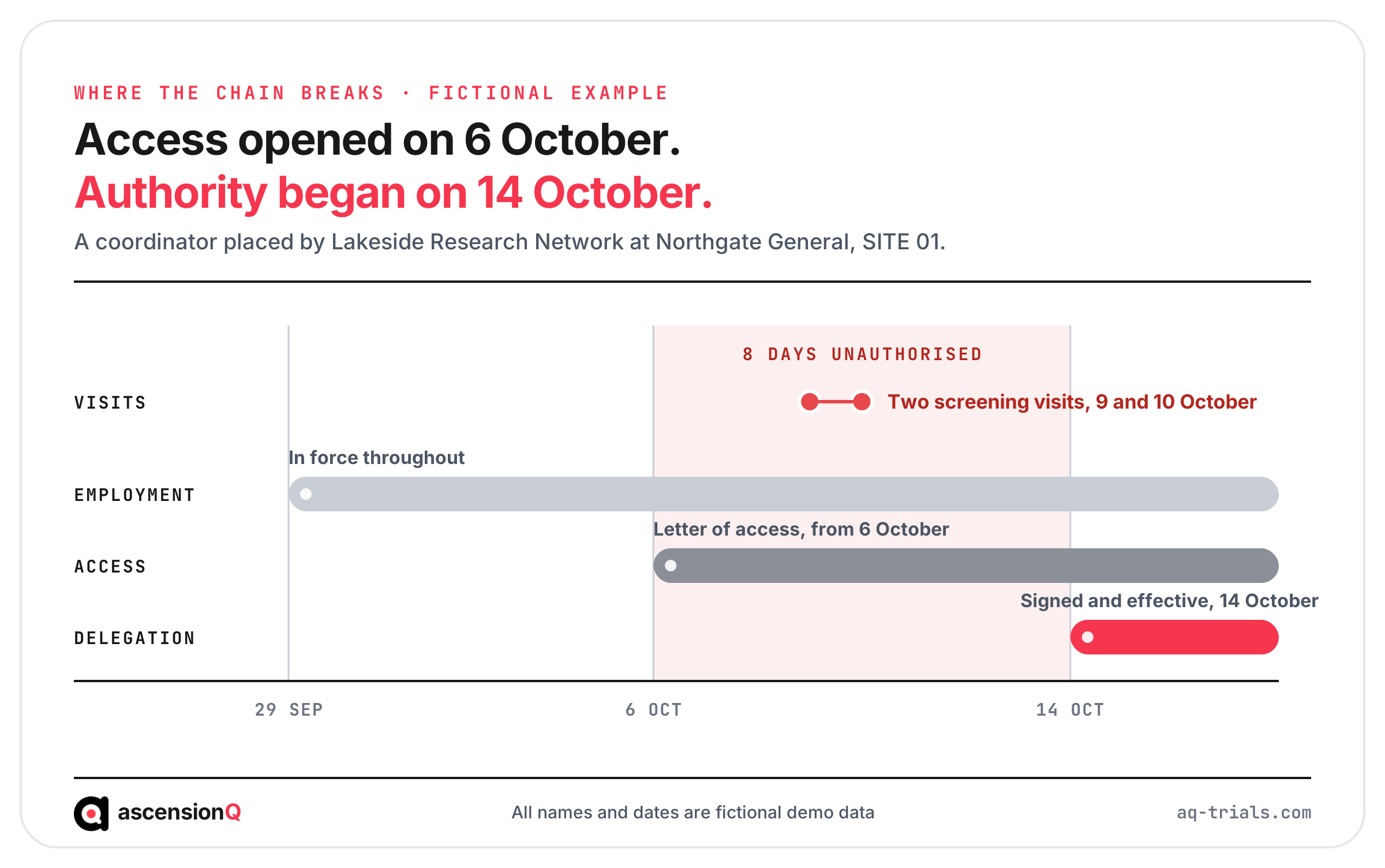
Take a hypothetical arrangement as the worked example. Lakeside Research Network places a coordinator at Northgate General, recorded as SITE 01. The trust issues a letter of access effective 6 October. The coordinator attends two screening visits on 9 and 10 October. The principal investigator signs the delegation on 14 October, effective the same day. Two screening visits now sit outside the delegation that authorised them.
- The SMO holds a complete employment file, which answers the competence question and none of the authority question.
- The trust holds a valid access record, which proves entry to the system and not entitlement to perform the activity.
- The site file holds a delegation with a later effective date, which is the document a monitor reads against the visit dates.
- The three records sit in three systems, which is why the gap surfaces at a monitoring visit rather than on the day it opened.
The cause is structural rather than individual. The person was competent, the trust was satisfied and the investigator intended to delegate. Three systems held three dates, and no single view compared them. A chain with an unread link fails quietly.
Also Read: The Two SMO Operating Models: Own Sites and Placed Staff
How Does AQ Hold the Chain as One Record?
AQ holds users, roles, studies and sites once in Admin, and each module works against that record. A coordinator placed at three host institutions is one person with one training history and one set of delegations, rather than three entries to reconcile.
- QMS holds controlled procedures, training assignment and completion per person, which shows whether the competence behind a duty is current on the date the duty starts.
- Digital DoA holds duties signed by the principal investigator and linked to current training, which shows a delegation awaiting approval before the person begins work.
- eISF holds the site file for each study, which is where the access evidence and the signed delegation sit together for the site they apply to.
- CTMS holds visits, sites and study status, which puts the visit date and the delegation date in one record.
Registers, reports and audit logs export for sponsors and monitors. The AQ page for SMOs and multi-site research covers the same work from the platform side, and the AQ Platform overview covers how the modules connect.
Book a live demo and bring one placed coordinator and one study. We will walk the chain from employment record to signed delegation against your own operating model.