Which clinical trial platforms use AI for compliance and inspection readiness? Most major trial platforms now advertise one, so a vendor list settles little. A platform qualifies when its AI reads across the connected record, routes every flag to a named owner, and leaves the proposal, the model version and the human confirmation in one audit trail.
That standard is harder to meet than the marketing suggests, and it is the one a UK site should buy against. This guide sets out where AI contributes across an inspection, what a vendor is actually selling when the word appears on a slide, and what to make a supplier prove before the contract is signed.
Which Clinical Trial Platforms Use AI for Compliance and Inspection Readiness?
Vendors publish little technical detail about these features, so a brand ranking would rest on marketing copy rather than evidence. Three structural tests separate a platform that supports readiness from one that displays it.
- Breadth of the record it reads. A check confined to one module compares documents against documents. A check spanning the site file, the delegation log, the training record and the pharmacy ledger can find a contradiction between them, which is where findings sit.
- Ownership of the output. Every flag carries a named owner, a due date and an attributable resolution, so the flag becomes a control rather than a count on a dashboard.
- Limits on what the feature can change. The permission set, the configuration and the audit trail together show which actions need a human confirmation first.
The detection mechanism behind the first two tests, and the evaluation questions that go with it, are covered separately. How AI Finds Documentation Gaps in an Investigator Site File works through how a check compares an expected set of records against a filed one, and what a flag does and does not prove.
AQ meets the third test by configuration: its AI proposes, flags and drafts, and a named person reviews and confirms.
A platform that counts documents reports. A platform that reasons across records controls.
Where Does AI Fit Across an MHRA Inspection?
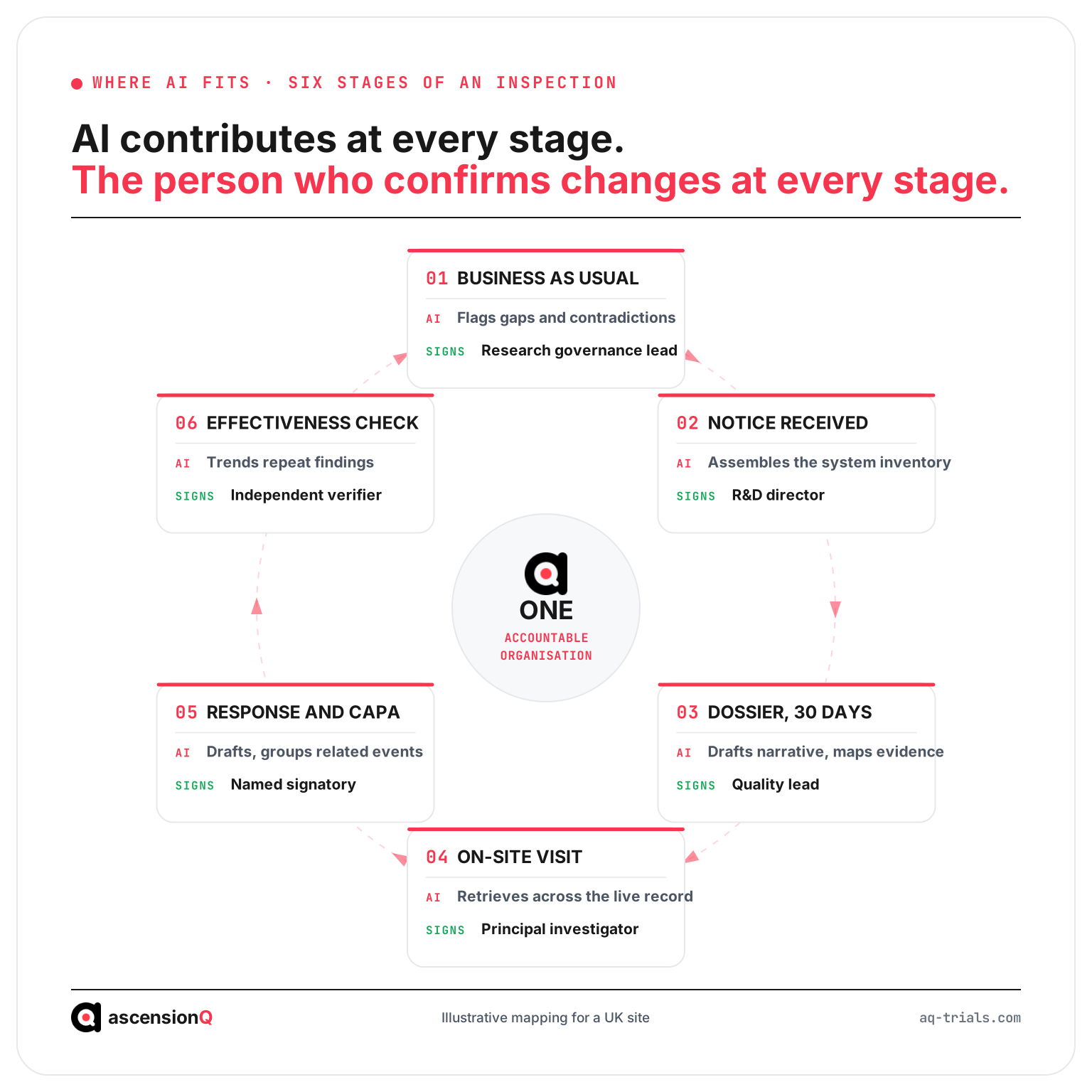
Most AI buying conversations stay on detection, which is one point in a cycle with six: the long quiet period, the notice period, the documentation window, the visit, the response and verification. The value of a feature changes at each one. The stages, the grading of findings and the pattern of what inspectors write up are set out in MHRA GCP Inspections: What to Expect and the Most Common Findings.
Two of the six stages carry a fixed external clock. The MHRA notifies an organisation it is considering for inspection and requests a GCP inspection dossier and a clinical trials spreadsheet, which the MHRA GCP inspections guidance states “must be provided within 30 days”. The response stage then runs on dates the inspector sets. A feature that saves a week in the quiet period is a convenience. A feature that saves a week inside the thirty days changes the outcome.
Also Read: What is Inspection Readiness in Clinical Trials and How Does It Work Across a CRDC Network? sets the standard any tool is measured against, including why a record assembled during the notice period fails the contemporaneous test.
What Are Vendors Selling When They Say AI?
One word covers seven capabilities with very different evidence burdens. Ask which of these a demonstration is showing, because the cheapest claims to make are the ones that need the least proof, and the most valuable ones are the hardest to evidence.
| Claim | What the vendor usually means | Evidence proportionate to it |
| Search and retrieval | Natural-language search across filed records | A relevance test on your own document set, and the permission model that governs who sees what |
| Extraction | Reading dates, names and version numbers off a document into fields | Accuracy per document type, and the threshold that routes a low-confidence read to a person |
| Classification | Placing a document into the right slot in the file structure | Acceptance rate per document type, and whether a misfile is reversible and visible in the audit trail |
| Cross-record reasoning | Comparing records and flagging a contradiction | Which records it reads across, and a worked example on records you supply |
| Drafting | Producing narrative text, a deviation description or a response paragraph | Review workflow before the text becomes a record, and controls against unverifiable citations |
| Prioritisation | Scoring and routing findings by risk | The scoring logic in writing, and the routing rules that attach an owner and a due date |
| Autonomous action | Closing, filing, signing or approving without a person | Validation of the action as a decision-making function, and a documented accountability chain |
The first six are assistance. The seventh changes the regulatory character of the system, and a site that buys it inherits the burden of proving it.
“We’re Looking for a Trial Platform with AI Features”: Writing That Into a Specification
“We’re looking for a trial platform with AI features.” That sentence starts most of these procurements, and on its own it invites a demonstration rather than a comparison. Five requirement lines convert it into something suppliers must answer the same way.
- Name the records. State which record sets the AI must read across, by name: essential documents, the delegation log, training records, deviations, the investigational medicinal product (IMP) accountability record. A supplier answering for two of five has answered honestly, and you can score it.
- Name the checks. Presence, identity, currency and consistency are four different capabilities. Specify which you require rather than asking for gap detection.
- Specify the confirmation step. Require that no AI output becomes a record without a named person confirming it, and require the configuration that enforces this to be demonstrable.
- Specify the audit trail contents. Require the input, the proposed output, the model version, the confirming person and separate timestamps for proposal and confirmation.
- Specify notification of model change. Require written notice before a model behind a feature changes, with release notes, so the change enters your own change control.
Requirements four and five rest on the general computerised-systems rules, which reach an AI feature exactly as they reach any other function. ICH E6(R3), which reached Step 4 on 6 January 2025, states at Principle 9.3 that “computerised systems used in clinical trials should be fit for purpose”, and the ICH E6(R3) guideline sets the investigator’s duties for computerised systems at section 2.12.10. The MHRA GxP data integrity guidance, published 9 March 2018 and updated 27 September 2021, carries the audit trail and validation expectations those requirements draw on.
Also Read: Is It Safe to Use AI in GxP Clinical Trial Systems? What MHRA Expects gives the permissibility answer in full, the activity-by-activity line between what a model may propose and what it must never do, and the compliance questions to put to a vendor.
Which AI Claims Move Risk onto the Buyer?
A feature that assists a reviewer and a feature that claims to decide carry different costs, and the difference is commercial before it is regulatory. The MHRA position on AI-assisted work is about oversight and outcome rather than tooling. Its Inspectorate stated on 29 June 2026 that “our concern isn’t whether you use AI”, while requiring that submissions be “technically reviewed by appropriately experienced people” and “signed off by someone with authority and accountability”.
Three consequences follow for a buyer.
- Validation scope widens with autonomy. A feature that proposes is validated as an aid to the person who confirms. A feature that acts is validated as the control itself, which pulls more test scripts and more of your staff time into every release.
- Revalidation cost follows model updates. A model that improves behind an unchanged screen is a change to a validated function. Settle in the contract who pays for the regression testing that follows, and how much notice you get.
- Capability is a risk even when switched off. A feature able to close a record autonomously needs configuration and permissions you can evidence, so ask to see the setting rather than accepting an assurance.
The model has no accountability. The person who confirms does.
How Should a Site Score Two Shortlisted Platforms?
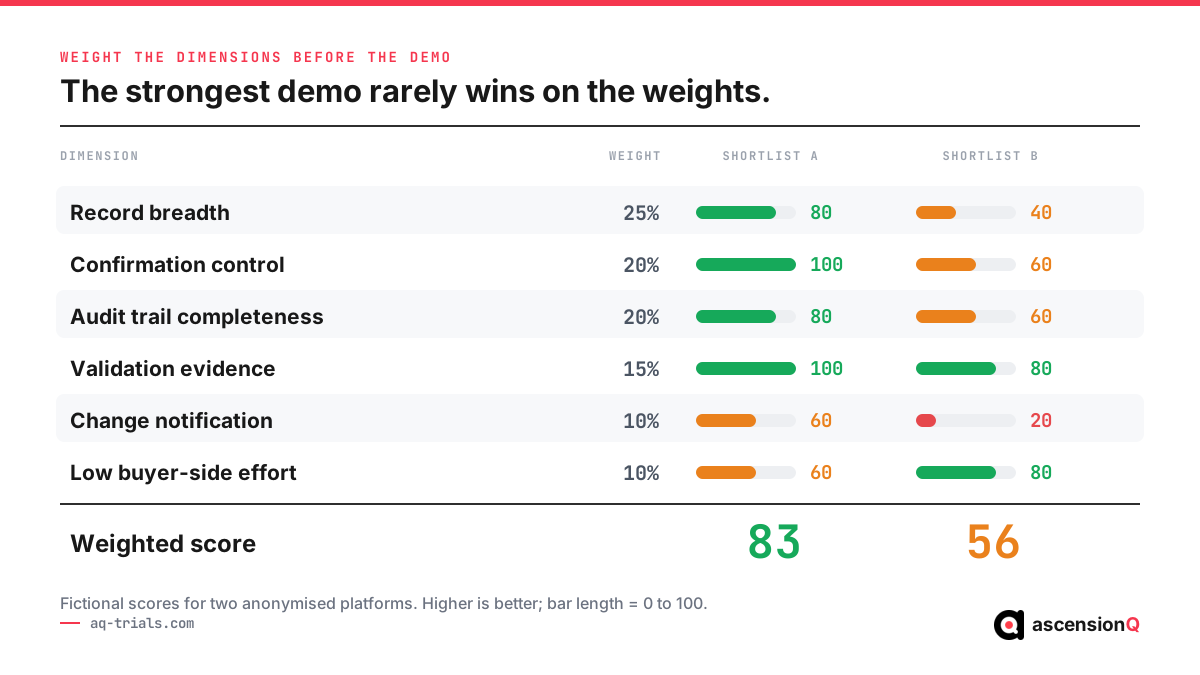
Weight the dimensions before any supplier presents, so the weights reflect your portfolio rather than the strongest demo. Six dimensions carry most of the difference between two credible platforms.
- Record breadth: how many of your named record sets the feature reads across.
- Confirmation control: whether the human step is enforced by configuration rather than policy.
- Audit trail completeness: scored against the five contents in your specification.
- Validation evidence: whether the AI features are named in the release validation documentation.
- Change notification: the notice period written into the agreement.
- Buyer-side effort: the user acceptance testing, standard operating procedure changes and training your team supplies in year one.
The last dimension is the one most often left out of a business case. Validation for intended use is work a site cannot delegate to a supplier, and the method is set out in GAMP 5 and computerised system validation. Readiness criteria that apply whether or not a platform carries AI are covered in CTMS for NHS R&D: Choosing an Inspection-Ready Platform.
What Should a Vendor Prove in a Live Demo?
A scripted demonstration shows the feature working on the supplier’s data. These five requests show it working on the conditions you care about, and each one rules something out.
| Ask them to do this live | A good result looks like | What it rules out |
| Load a small set of our own records, including one we have deliberately broken | The seeded contradiction is found and described in a quality lead’s terms | A feature tuned to demonstration data |
| Open the audit trail entry for the AI action we just watched | Input, proposed output, model version, confirming person and two timestamps all present | An audit trail that records the save and omits the proposal |
| Show the setting and permission that stop the feature closing a record | A named configuration and a permission set, shown on screen | A verbal assurance with nothing behind it |
| Show what happens when the model is unsure | The item routes to a person with the confidence visible, rather than guessing | Silent low-confidence decisions entering the record |
| Name the model version running today and show the release note that introduced it | A version identifier and a dated release note | An unversioned model you cannot bring under change control |
Which Marketing Claims Are Red Flags?
Certain phrases signal that a capability has been described by a marketing team rather than a quality team. Each one has a question that resolves it.
- “Automated inspection readiness.” Ask which records it touches and who confirms each output.
- “AI-powered compliance.” Ask which of the seven capabilities above is being sold.
- An unnamed or unversioned model. Ask for the version identifier that appears in your system inventory.
- “We use your data to improve the product.” Ask for the contractual prohibition or the documented opt-out.
- A readiness percentage with no underlying records. Ask which records the score counts and what moves it.
- AI features outside the validated release. Ask whether the feature appears in the validation documentation for the version you will run.
- Claims of regulatory approval for the software itself. No platform is approved or certified by the MHRA, and a supplier saying otherwise has misread the regime.
What Belongs in the Contract and Who Approves the Purchase?
Answers given in a meeting have no evidential standing. Four belong in the agreement itself: the processing-location statement in the data processing agreement, the prohibition on training models with your data, the notice period for a model change, and the commitment that a named person confirms every AI output. Related data protection obligations are covered in UK GDPR for Clinical Trial Sites: What Your Systems Must Do.
The evidence pack a supplier hands over, and the cell of the regulator’s own template each document answers, is a separate exercise. Version 7.0 of the GCP inspection dossier carries a dedicated artificial intelligence and machine learning item, and what it asks of every tool a site uses is set out in How to Complete the MHRA Computerised Systems Inspection Dossier. The templates themselves sit on the gov.uk good clinical practice guidance, last updated 22 September 2026.
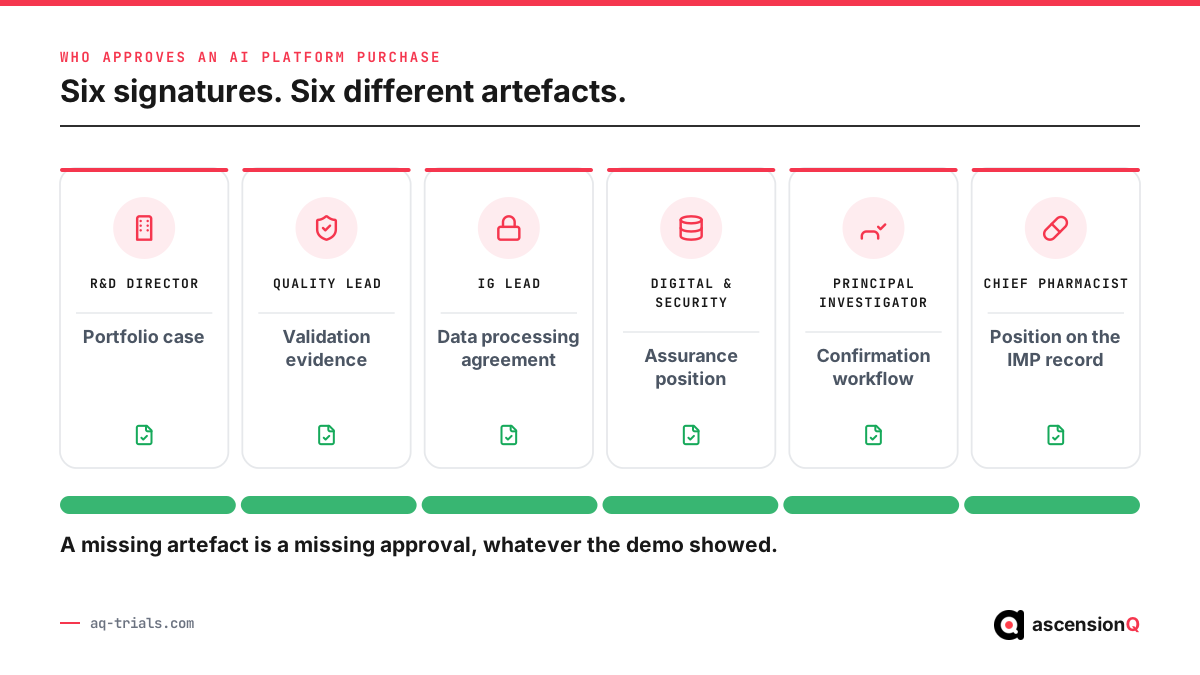
Six people usually hold a veto over this purchase, and each needs a different artefact before approving it.
- Research and development director: the portfolio case.
- Quality lead: validation evidence naming the AI features.
- Information governance lead: the data processing agreement.
- Digital and security: the assurance position, covered in DSPT and Cyber Essentials for NHS research software.
- Principal investigator: the confirmation workflow.
- Chief pharmacist: the position on the IMP record.
AI for Compliance Inside the AQ Platform
AQ answers these tests from one connected record rather than a module at a time. Connected Intelligence is the AI capability across the platform, and AQ Assist is the in-platform assistant a user works with directly.
- AQ’s AI proposes, flags and drafts, and a named person reviews and confirms, which keeps the accountable decision with the individual the delegation log authorises.
- Every AI action is written to the audit trail, so the proposal and the confirmation are both retrievable for an inspector.
- Checks run across the electronic investigator site file, the quality management system, CAPA and the clinical trial Pharmacy record, which is what allows a contradiction between two record sets to surface at all.
- AQ is validated to GxP standards with every release, covering IQ, OQ and PQ with a 21 CFR Part 11 and EU Annex 11 assessment, so the AI features sit inside the validated scope of the version a site runs.
- The platform is UK-hosted, holds NHS DSPT Standards Met for 2026, is Cyber Essentials certified and runs ISO 27001-aligned controls.
AQ was built by Phase 1 trial doctors and has been in continuous daily NHS use for six years, with 13 sites on one connected record and more than 150 studies run on the platform. It supports MHRA compliance and is built for MHRA GCP inspection, and the judgement in every record stays with the research team. Book a live demo to run the five requests above against the platform.
Frequently Asked Questions
Which clinical trial platforms use AI for compliance and inspection readiness?
Most established trial platforms now offer AI features aimed at compliance, and published technical detail is thin enough that a brand ranking would rest on marketing copy. Judge a platform on three things instead: how many of your record sets the AI reads across, whether every flag carries a named owner and an attributable resolution, and whether the configuration stops the feature changing a record without a human confirmation.
We’re looking for a trial platform with AI features. Where should we start?
Start by converting the want into five requirement lines: the record sets the AI must read across, the checks it must run, the confirmation step before any output becomes a record, the contents of the audit trail entry, and the notice you get before a model changes. Suppliers then answer the same questions, which makes a comparison possible. A demonstration booked before the specification exists tends to set the criteria for you.
Does an AI feature in a trial platform need validation?
Yes. An AI feature is a computerised system function, and ICH E6(R3) Principle 9.3 requires computerised systems used in clinical trials to be fit for purpose. Validation is for your intended use of the feature, so a supplier’s validation package supports your work without replacing it. The depth of testing is proportionate to what the feature affects.
Can a platform’s AI make a site inspection-ready on its own?
No. A flag narrows where a person must look, and the record only becomes complete when someone with authority acts on it. Readiness is a continuous operating condition held by the research team, and the platform’s contribution is making the evidence retrievable and the gaps visible early enough to act.
Who is accountable when an AI feature misses a gap?
The organisation remains accountable for the completeness and accuracy of its records. The MHRA Inspectorate has stated that organisations have always been responsible for the accuracy of their responses, and a drafting or detection tool does not move that responsibility. This is why the confirmation step and the audit trail entry behind it matter more than the detection rate.
Should a site tell an inspector that AI helped prepare a response?
Disclosure is voluntary. The MHRA Inspectorate wrote on 29 June 2026 that “this isn’t mandatory, but we believe transparency benefits everyone”, and suggested a brief statement identifying the AI-assisted sections and confirming human verification and approval. It added that inspectors will consider this positively when assessing organisational compliance.