How can AI identify documentation gaps in trials? A check compares the records a trial should hold against the records actually filed, reads each document to confirm what it is, and compares dates across related records for contradictions. Every flag then goes to a named person, who decides what it means.
This guide covers the expected set a check runs against, how classification works, four site file contradictions it catches, how a flag is scored and routed, the signals behind quality risk detection, and what a flag proves.
- A list check answers one question: is the expected record present? A reading check compares records with each other, and catches the file that is full and self-contradictory.
- A flag is a statement about the record. The decision about the conduct behind it belongs to a named person, and that confirmation is the quality check.
How Can AI Identify Documentation Gaps in Trials?
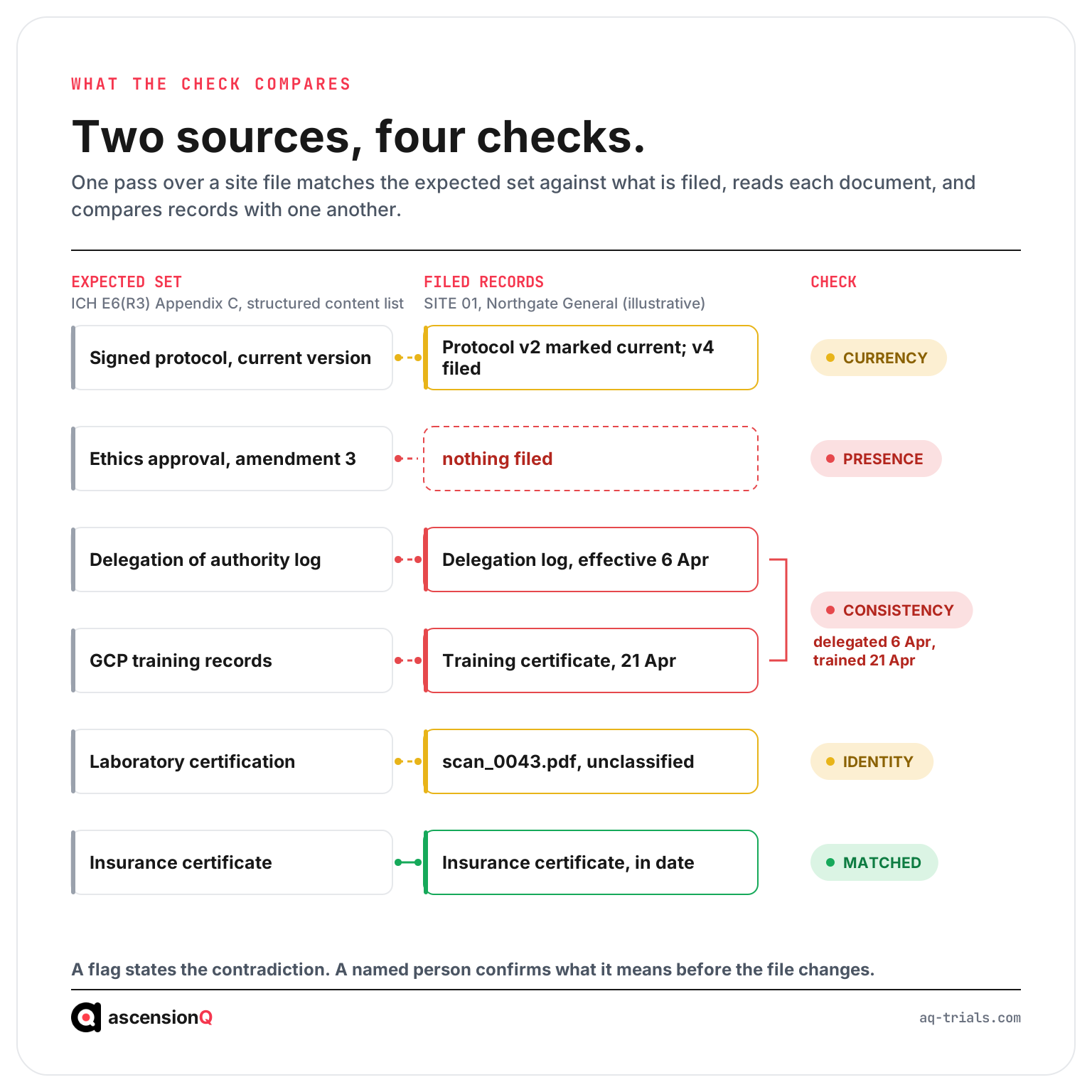
Gap detection runs four checks over the same file, each answering a different question. One compares the expected set against what is filed. Two read each document to establish what it is and what it says. The fourth compares records with one another to find statements that cannot both be true.
- Presence. Each expected record is matched against the filed set, turning an empty slot into a named absence rather than a folder nobody opened.
- Identity. The document is classified from its content, catching a certificate filed under the wrong heading and counted as present.
- Currency. Version numbers and effective dates are extracted, separating the active protocol from the superseded copies filed beside it.
- Consistency. Dates and names are compared across related records, which surfaces a delegation that started before its training, or an amendment in force before its approval.
Most teams already run the presence check, and completeness scoring against an expected-document set is covered in the guide to TMF completeness tracking and RAG scoring. The value AI adds sits in the other three, which require reading a document rather than counting it.
A count finds what is absent. Only a reading finds what disagrees.
Where Does the Expected Set Come From?
A gap exists only against an expectation, so the expected set decides what a check can find. ICH E6(R3) Guideline for Good Clinical Practice, Step 4 and adopted on 6 January 2025, moved the essential records guidance into Appendix C and replaced the fixed list with criteria. Section C.1.1 states that the nature and extent of records depend on “the trial design, its conduct, application of risk proportionate approaches and the importance and relevance of that record to the trial”.
Section C.3.1 sets out the criteria for essentiality, and adds the sentence that makes automated checking possible: “A structured content list for storage repository(ies) may be used to prospectively identify essential records.” That list is the expected set: decided in advance, checked against every day.
- The criteria generate the list. The twenty-eight criteria at C.3.1 cover approvals, trial-specific procedures, delegation and training evidence, consent, system validation and product traceability, giving a defensible basis for every slot.
- The protocol narrows it. Section C.3.3 states that the presence of some listed records depends on trial design and conduct, so records tied to procedures a trial never performs stay out of the set.
- The timeline dates it. Section C.3.2 marks with an asterisk the records that should generally be in place before the trial starts, and every other record becomes expected when the activity it evidences occurs.
- The location register bounds it. Section C.2.4 requires a record of where essential records are located, telling the check whether an absent document is missing or held elsewhere.
The starting set for a UK site file is the ICH-GCP essential documents checklist, and the site-held share of the wider structure is mapped in the guide to the TMF Reference Model and the investigator site file. A list a site cannot justify produces flags nobody acts on.
How Does Document Classification Work at a Site?
Classification assigns an incoming document to a slot in the expected set, and extraction pulls the fields the later checks need. Both run on upload. A delegation log arrives as a scan named “scan_0043.pdf”, and the check identifies it as a delegation of authority log and extracts the study code, the site, each signatory and each effective date.
- The slot comes first. A classification places the document against an expected record, closing the presence gap for that slot and leaving every unmatched slot visible.
- The fields come second. Extraction captures the dates, versions, names and signatures that the currency and consistency checks compare.
- Low confidence routes to a person. An uncertain classification is presented for confirmation rather than applied, and a named person accepting, amending or rejecting the proposal is the act that files the document.
Accuracy varies by document type. A templated record such as an ethics approval letter classifies reliably. A free-text item such as correspondence documenting a trial-related decision under criterion C.3.1(c) depends on judgement. A site that measures its acceptance rate per type learns where to place the confirmation effort.
Also Read: ICH-GCP Essential Documents: The Investigator Site File Checklist
Which Site File Gaps Does a Reading Check Find That a List Check Cannot?
A list check reports a file as complete once every slot holds a document. The four cases below pass that test and still carry a finding, because the contradiction sits between two records rather than inside one. Each is set at a hypothetical UK site, SITE 01 at Northgate General.
| What the file shows | The records compared | What the check flags | The human decision |
|---|---|---|---|
| Training completed after delegation Delegation effective 6 April. Training certificate dated 21 April. Screening visits on 9 and 14 April. | Delegation log, training file, visit records | A delegated activity performed with no training record in force, scored high for participant-facing work | Principal investigator confirms whether the activity fell within the person’s usual role, and raises a deviation if it did not |
| Expired GCP certificate Certificate filed correctly, valid to 30 September. Study still recruiting in October. | Training file, study status, delegation log | A currency failure on a present record, with the delegation it supports still active | Research governance lead requests the renewal, dates the gap, and decides whether delegated activities pause |
| Amendment filed without its approval Amendment 3 filed and marked current, dated 2 June. No ethics or regulatory approval for it in the file. | Protocol versions, approval records, visit records | A record in force with no approval, cross-checked against the dates the amended procedures began | Study manager confirms whether the approval exists elsewhere unfiled, or the amendment went live early, which is a serious breach question |
| Superseded protocol still marked current Three versions filed. Version 2 carries the current marker. Version 4 has a later approval date. | Protocol versions, approval dates, version markers | Two records claiming currency, resolved by comparing approval dates with the marker | Document owner demotes the superseded copies and confirms which version the site actually worked to |
The delegation case tests two records against a third. Section 2.3.2 of ICH E6(R3) requires delegates to be “adequately informed” and trained for activities beyond their usual experience, and section 2.3.3 requires a record of who was delegated what. Each satisfies its own slot. The dates between them are where the finding lives, and the expectations behind both sit in the guide to delegation and training records.
Inside AQ, the flag arrives with both records side by side and the conflicting dates highlighted, and a named person confirms what it means before anything in the file changes. The pattern holds across all four cases: the check states the contradiction, the person supplies the explanation.
Every one of these files would pass a document count.
How Is a Flag Scored and Routed to a Person?
A check that reports every anomaly at one weight produces a list nobody works through. Scoring separates the flag that stops a visit from the one that waits for the next file review, and the weight follows what the record protects. Section 3.10 of ICH E6(R3) requires a proportionate, risk-based approach to quality management, the same ordering principle applied to a queue of flags.
- Participant safety and consent rank first. A consent record that postdates a trial procedure reaches the principal investigator the same day, because the question concerns a participant.
- Authority to act ranks next. Delegation, training and signature gaps carry the weight of every entry made under them, so one flag can put a month of records in question.
- Approval and version gaps follow, housekeeping last. A record in force without its approval has a defined answer: the approval sits in another system, or it does not exist. A misfiled but present document is corrected in the ordinary course, and a persistent pattern of either belongs in a governed CAPA record.
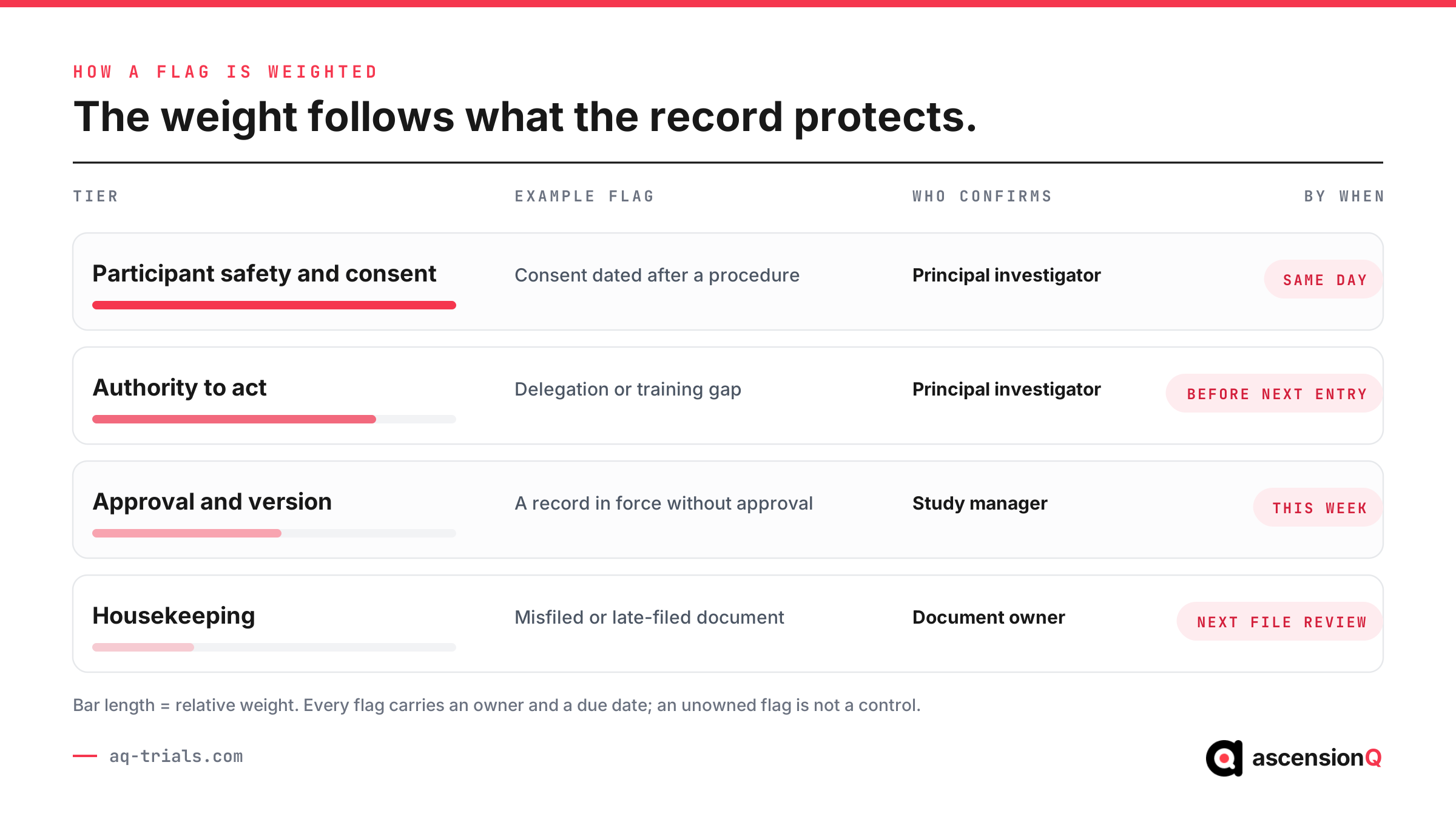
Routing matters as much as scoring. A flag belongs to the role that owns the record, with a due date, and an unowned open flag is the condition described in the guide to placeholder documents and gap ownership. Connected Intelligence routes each flag to the role holding that record, and the confirmation lands in the audit trail beside it.
Which Platforms Offer AI-Powered Quality Risk Detection?
Site file, eTMF and clinical trial management vendors now describe AI-assisted quality or risk detection, at a level of published detail that makes a brand-name comparison unhelpful. The useful question is narrower: which signals does the capability read, and does it read them across the records a site actually holds? A detector confined to one module sees one module’s worth of risk.
Quality risk detection reads patterns rather than single records. Three signals carry most of the value at site level, each with a record that confirms or dismisses it.
| Signal | What the pattern indicates | The record that confirms it | Where a confirmed signal goes |
|---|---|---|---|
| Deviation trends | One deviation type repeating, or a cluster at one visit, points at a process rather than an incident | The deviation log, read against the protocol section and the visit schedule | Investigator review under section 2.5.3, with measures to prevent recurrence where the deviation is important |
| Repeat CAPAs | An action closed and the same cause recurring indicates the root cause was never addressed | The CAPA record and its effectiveness check | Reopened root cause analysis, with sponsor notification where the noncompliance is serious |
| Training lapses | Certificates expiring faster than they are renewed, or delegations outliving their training, indicates a currency control that has stopped | The training file and the delegation log, compared by date | Principal investigator decision on the affected activities, logged per person |
Section 3.12.2 of ICH E6(R3) requires a root cause analysis and corrective and preventive actions where noncompliance significantly affects participant rights, safety or well-being or the reliability of results. A trend detector earns its place by raising that question earlier than a periodic review would, and the judgement on significance stays with the quality team. Three questions then separate a capability from a claim.
- Which records does it read across? A detector covering the site file, the deviation log, the training file and the delegation log finds the contradictions between them.
- Does every flag carry an owner, a due date and an attributable resolution? A dashboard count is a report. A routed flag is a control.
- Can the feature change a record on its own? The permission set answers this, in writing, before the system is qualified.
Intended use, human oversight and change control for model updates are set out in the guide to AI in GxP clinical trial systems and what MHRA expects, and the testing method in GAMP 5 and computerised system validation. One point is specific to gap detection: record the intended use narrowly, because “proposes a classification and flags an absent or contradictory record for human confirmation” is testable and “checks the site file” is not.
Also Read: Common MHRA GCP Inspection Findings and How to Avoid Them
The Limits of a Documentation Gap Flag
A flag describes the record, and describes the conduct only as far as the record does. That distance is where a site has to be careful in both directions.
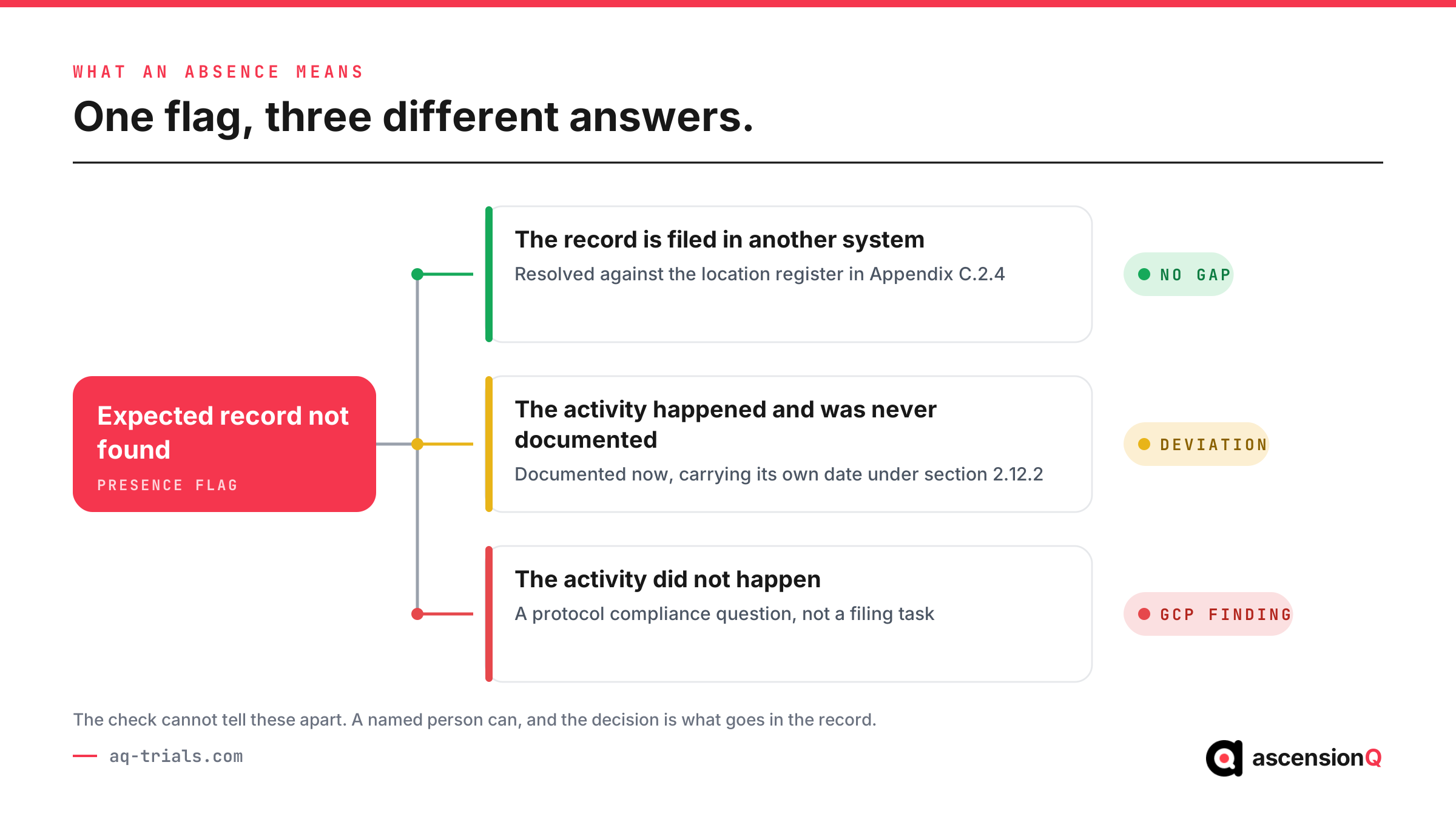
- An absence has three possible causes. The activity happened and the record sits elsewhere, it happened undocumented, or it did not happen. Section C.2.4 requires a record of where essential records are located, which resolves the first case quickly.
- A clinical-practice activity may need no delegation record. Section 2.3.3 states that documentation may not be required where activities form part of clinical practice, so a flag there resolves to a documented judgement.
- A complete file evidences records, not quality. Every slot can hold a current, approved document while the conduct departed from the protocol, which is why monitoring and audit stay separate functions. Section 2.12.2 requires source records to be contemporaneous and changes traceable, so a record created to close a flag carries its own date.
The inspection consequence follows from the same point. The MHRA’s good clinical practice inspections guidance, last updated on 22 September 2026, states that the trial master file is the basis for inspection, that all records within it must be made available including electronic records and emails, and that failure to provide it will affect the inspection results. A gap closed in the week it opened is a filing event. Found by an inspector, it is a finding.
Evaluating a platform that offers these checks is a commercial exercise as well as a technical one. AI for Compliance and Inspection Readiness: What a UK Site Should Look For in a Platform covers the specification to write, the dimensions to weight and the proof to ask for in a demo.
Gap Detection Inside the AQ Platform
AQ runs AI as Connected Intelligence, with AQ Assist as the in-platform assistant, over the modules a site keeps its evidence in. The design rule is the one this guide describes throughout: AQ’s AI proposes, flags and drafts, and a named person reviews and confirms before anything becomes a record.
- The expected set is configured per study. The electronic investigator site file holds the structured content list for each study, so a flag points at a slot the study justified rather than a generic checklist.
- Flags cross module boundaries. Delegation, training, documents and quality records sit on one connected record, which is what lets a training date be compared with a delegation date and a visit date.
- A named person confirms, and the action is in the audit trail. The proposal, the decision and the user appear in the same trail as manual entries, evidencing oversight rather than asserting it.
- A persistent gap escalates. A confirmed pattern routes into the quality management system as a deviation or CAPA action, keeping one event in one thread.
- Release evidence comes with each version. AQ is validated to GxP standards with every release, with installation, operational and performance qualification and a 21 CFR Part 11 and EU Annex 11 assessment, supplying the vendor half of a qualification file.
AQ holds NHS Data Security and Protection Toolkit Standards Met for 2026 and Cyber Essentials certification, operates ISO 27001-aligned controls, and the platform is UK-hosted. It has been in continuous daily NHS use for six years, at organisations including University Hospitals of Liverpool Group and Royal Free London, and was built by Phase 1 trial doctors. A live demo walks through a flag, a confirmation and the audit trail entry in sequence.
Frequently Asked Questions
How can AI identify documentation gaps in trials?
A check runs four comparisons over the same file. It matches expected records against those filed, classifies each document from its content, extracts versions and effective dates to establish currency, and compares dates and names across related records to surface contradictions. A named person then confirms or dismisses each flag.
Which platforms offer AI-powered quality risk detection?
Site file, eTMF and clinical trial management vendors describe AI-assisted quality and risk detection at a level that makes brand-by-brand comparison unhelpful. Evaluate instead on which records it reads across, whether every flag carries an owner and an attributable resolution, and whether the feature can change a record without a human confirmation.
Can AI check a site file for missing documents?
Yes, against a defined expected set. ICH E6(R3) section C.3.1 permits a structured content list for the storage repository to prospectively identify essential records, and that list is what a check compares the file against. A check without one reports absences it cannot justify.
How accurate is AI document classification?
Accuracy varies by document type rather than across a file. Templated records such as approval letters and laboratory certifications classify reliably. Free-text items such as correspondence documenting a trial-related decision depend on judgement. A site that measures its acceptance rate per document type knows where confirmation effort is needed.
Does an AI gap flag count as a quality check?
The flag is a detection step. The quality check is the documented decision a named person makes about it, recorded with the reason and visible in the audit trail. An unactioned flag evidences nothing, so routing matters as much as detection.