How is AI used in clinical trials? At a UK research site, AI reads across records that already exist and proposes something a person then confirms: a draft, a classification, a flag, a retrieved answer. It assists at every stage of a trial. It decides at none of them.
This guide maps AI use across the five stages of a trial as a UK site experiences them, separates the site’s own list from the sponsor’s, and defines the five terms vendors use interchangeably. Platform evaluation against those claims is a separate exercise, set out in AI for compliance and inspection readiness.
How Is AI Used in Clinical Trials?
AI appears in a trial in four recognisable families of work. Each one takes a record that already exists and returns something a person then acts on.
- Retrieval. A model reads a question in plain language and returns the passage in the protocol, the standard operating procedure or the site file that answers it, which removes the search step from a task that previously needed someone who knew where the document lived.
- Classification and extraction. A model reads a filed document, identifies what it is, and lifts the dates, names and version numbers off it into fields, which allows a register to be built from the documents themselves rather than from a typed index.
- Drafting. A model produces first-pass narrative text for a deviation description, a monitoring response or a procedure revision, which shortens the blank-page stage and leaves the author editing rather than composing.
- Cross-record flagging. A model compares records held in different places and raises a contradiction between them, which surfaces problems that no single record reveals on its own.
The four families differ in what a wrong answer costs. A retrieval failure wastes a minute. A classification failure puts a document in the wrong place. A flagging failure leaves a real problem unseen. The evidence a site holds for each one is proportionate to that cost, and Automation vs AI in a trial platform classes the features a platform ships against exactly that test.
AI changes who writes the first draft. It does not change who signs it.
What Do AI, Machine Learning, Generative AI and Agentic AI Mean in a Trial?
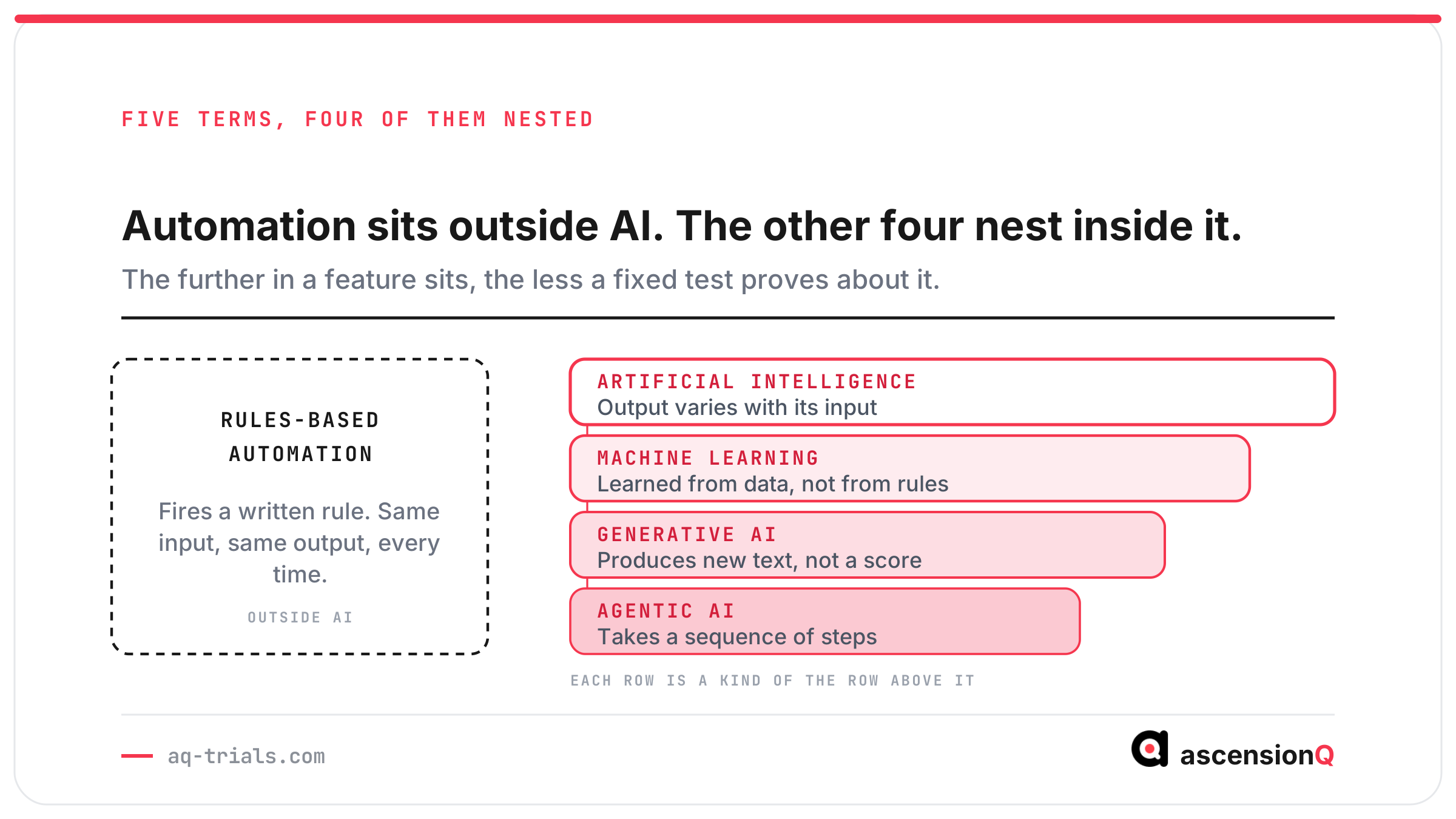
Five terms circulate in trial software marketing, and suppliers use them interchangeably. They describe different things, and the difference decides what evidence a site needs before it relies on a feature. The last of the five is covered in full in what is agentic AI in clinical trials, and where must a person decide?
| Term | What it means | What it does with a trial record |
| Artificial intelligence (AI) | The broad field of software performing tasks that previously needed human judgement | Returns a proposal that varies with its input, so two similar records can produce different outputs |
| Machine learning (ML) | Software deriving its behaviour from training data rather than from written rules | Scores, ranks or classifies a record against patterns found in prior data |
| Generative AI | Machine learning that produces new text or structured output rather than a score | Drafts a deviation narrative, a procedure revision or a summary of a monitoring visit |
| Agentic AI | Generative AI given tools and a goal, able to take a sequence of steps without a prompt at each one | Prepares a multi-step task, such as assembling a document pack, for a person to check |
| Rules-based automation | Software firing a predetermined rule, returning the same output every time | Sends a reminder on a fixed date, or blocks a save on a missing mandatory field |
Rules-based automation sits outside AI altogether, and it carries a lighter evidence burden because the same input always gives the same output and the feature can be tested exhaustively. Automation vs AI in a trial platform works through that split feature by feature, along with the ordering argument for automating a process before adding a model to it.
Machine learning in clinical trials and generative AI in clinical trials describe the same underlying technology at two levels of specificity. Agentic AI is the newest of the five to reach a trial site, and the question it raises is where a prepared sequence has to stop and pass to a named person.
Which AI Does a Site Buy and Which Does the Sponsor Buy?
Published answers to this question are written for sponsors, which is why a UK site reading them finds most of the capability irrelevant. Patient recruitment modelling, site selection analytics and protocol design optimisation are sponsor purchases. A site never buys them, and a site has no authority to act on their output.
| Capability | Bought by | Why it sits there |
| Patient recruitment modelling | Sponsor | Needs population data pooled across many sites, which a single site does not hold |
| Site selection and feasibility analytics | Sponsor | Ranks sites against one another, so the site is the subject of the analysis rather than its user |
| Protocol design optimisation | Sponsor | Changes the protocol, which a site has no authority to amend |
| Central monitoring and risk analytics | Sponsor | Reads data pooled across sites to find the site that looks unlike the others |
| Document classification and filing | Site | Acts on the site’s own file, which the site is accountable for |
| Cross-record quality flagging | Site | Compares the site’s own deviation, training, document and accountability records |
| Natural-language retrieval across site records | Site | Answers questions about documents the site already holds |
| Drafting of site-authored text | Site | Produces text a named person at the site then owns and signs |
The practical consequence is a short shopping list. A site buys AI that reads the records it is accountable for, and it buys the configuration that keeps a named person in front of every output. The role-by-role version of that list, down to what a research nurse and a trial pharmacist each touch in a working week, is set out in What AI a UK research site actually uses, role by role.
A sponsor’s AI chooses between sites. A site’s AI reads the site’s own record.
How Is AI Used in Trial Set-Up?
Set-up carries the most document handling and the least clinical risk of any stage, which is why it attracts the most AI assistance. Three set-up tasks take it well.
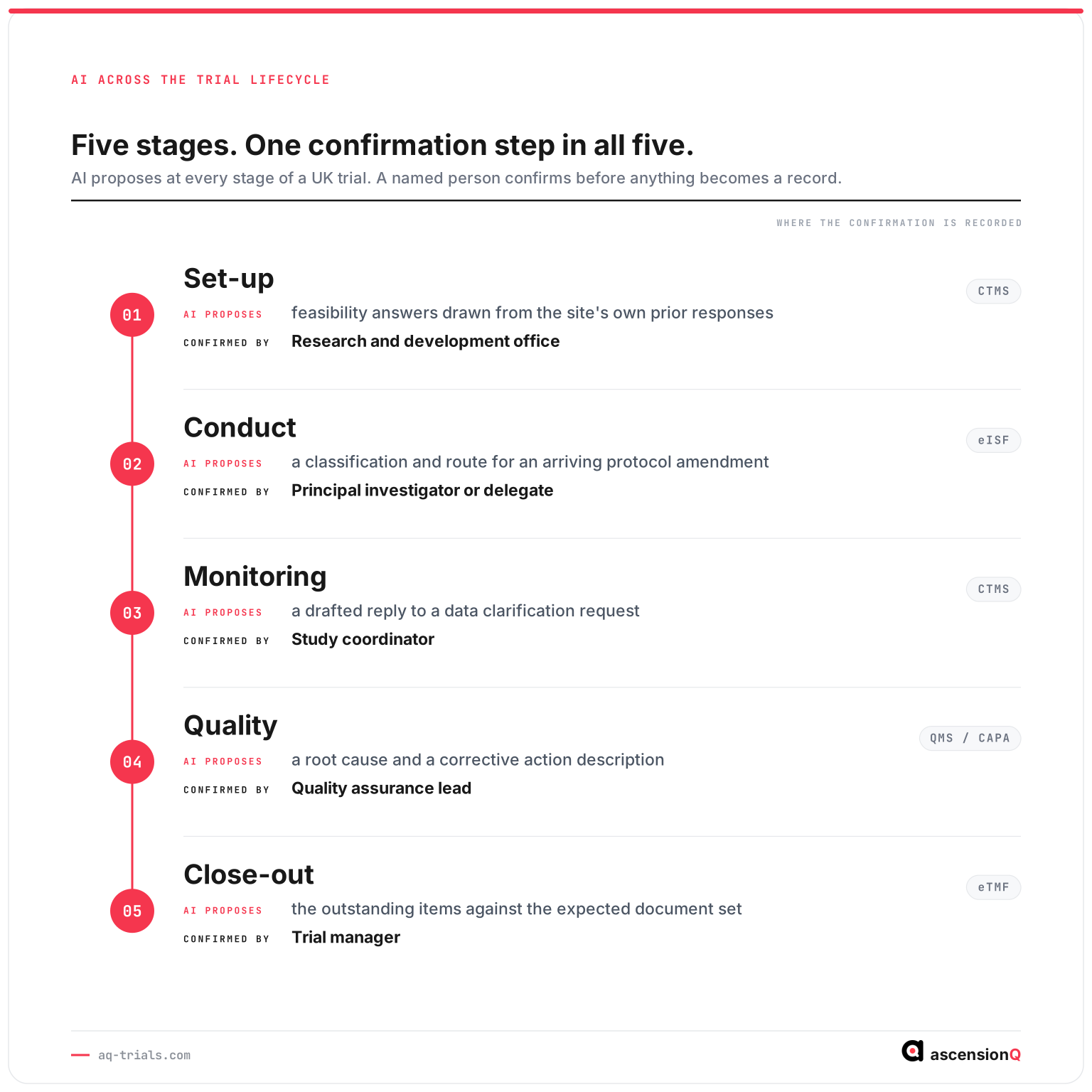
- Feasibility responses. A model retrieves the site’s prior answers, capacity figures and equipment list, which allows a questionnaire to be populated from the record rather than from memory.
- Essential document collection. Classification places each arriving document and raises the expected items still outstanding, which turns a chase list into a live register.
- Drafting checks. A model compares a local document against the protocol and raises the clauses that disagree, which puts the discrepancy in front of a person before the document is filed.
Every one of those outputs is a proposal. The greenlight decision, the contract and the delegation entries stay with named people throughout. Study set-up records sit in the CTMS, and the documents those checks read sit in the electronic investigator site file. UK set-up timelines are measured against a separate national benchmark, covered in the 150-day study set-up target. Which arriving documents a classification may place unaided, which it may only propose, and what the audit trail records when a proposal is accepted are set out in What AI May and May Not File in an eTMF or eISF. Which of the 150 days AI assistance can touch, and which set-up tasks stay with a named person, is covered in can AI speed up clinical trial set-up at a UK site.
How Is AI Used in Trial Conduct?
Conduct is the stage where the regulatory line is sharpest, because the records created here are the trial’s primary evidence. Three uses are established.
- Retrieval during a visit. A model answers a protocol question in plain language, which keeps a research nurse with the participant rather than in a binder.
- Filing an amendment. An arriving protocol amendment is classified and routed to the file and the people it affects, which shortens the gap between approval and implementation.
- Flagging a mismatch. A training record that does not cover a delegated activity is raised against the delegation log, which surfaces the problem while it can still be corrected.
The boundary matters more at this stage than the capability does. A model may propose an entry, and it must never make one. The activity-by-activity version of that line, and what the audit trail must show for an AI-assisted entry, is set out in Is It Safe to Use AI in GxP Clinical Trial Systems? What MHRA Expects. AQ’s AI proposes, flags and drafts, and a named person reviews and confirms, so the accountable entry stays with the individual the delegation log authorises.
Also Read: How AI Finds Documentation Gaps in an Investigator Site File covers how a check builds the expected document set, classifies what is filed against it, and scores and routes each flag.
How Is AI Used in Trial Monitoring?
Trial monitoring splits cleanly between the two parties. Central monitoring analytics read data pooled across every site in a study and raise the site that looks unlike the others, which is a sponsor activity performed on sponsor data. Site-side AI reads the site’s own record and prepares for a visit rather than performing one.
- Pre-visit preparation. Retrieval assembles the records a monitor has requested, which replaces a manual pull across several systems.
- Query response drafting. A model drafts a reply to a data clarification request, which leaves a named person verifying and sending rather than composing.
- Action tracking after a visit. Each monitoring finding is classified and routed to an owner with a due date, which converts a report into a set of tracked commitments.
Source data verification and source data review remain activities a person performs. The site’s duty is to produce the original record together with the metadata proving who entered it and when, whichever party reads it. Remote arrangements are covered in remote source data verification and eSource, and monitoring visits and their actions are tracked in the CTMS.
How Is AI Used in Quality Management?
Quality management is the stage where cross-record reasoning earns the most, because a quality problem at a site is usually a pattern rather than a single event. Four risk signals appear only across records rather than inside any one of them, and each has a record that confirms it. AI-assisted quality risk detection for UK research sites sets out those four signals, what each one indicates and who decides on it.
Three further uses sit alongside that detection work at this stage.
- Classification of a quality event. A deviation is placed into a category as it is logged, which makes trending possible at all, since an uncategorised log cannot be trended.
- Drafting a root cause statement. A model proposes the root cause wording and the corrective action description, which leaves a quality lead judging the analysis rather than phrasing it.
- Retrieval across the procedure set. A model answers whether an existing procedure already covers the event, which prevents a second procedure being written for a case already governed.
The quality record sits in the quality management system and the corrective and preventive action record in CAPA. AQ runs these checks across the connected record rather than one module at a time, and every AI action is written to the audit trail.
How Is AI Used at Trial Close-Out?
Close-out carries the least AI of the five stages and a great deal of paperwork. Three uses are worth having.
- Completeness checks before lock. A check compares the file against the expected document set, which puts the outstanding items in front of a person while the study team is still assembled.
- Classification of late arrivals. A document arriving after the main filing effort is placed correctly, which keeps the index accurate at the point it closes.
- Retrieval from the archive. A model locates a record inside a closed file years later, which answers a sponsor or inspector request without a manual search of the whole archive.
Retention is the constraint that shapes the rest. A summary a model produces is a new document rather than a replacement for the original, and the original is the record that must survive the retention period intact. The retention, hosting and transparency obligations are set out in UK GDPR for Clinical Trial Sites, and the trial master file side of the same record sits in the eTMF.
Also Read: How to Complete the MHRA Computerised Systems Inspection Dossier covers the system inventory every tool a site uses must appear in, including an AI feature inside a platform the site already runs.
Is AI Used in UK Clinical Trials Today?
Yes, in two separable ways. The distinction matters for anyone reading a regulator’s AI publication and trying to work out whether it applies to them.
- AI inside trial operations. Document classification, retrieval, drafting and cross-record flagging, running inside the systems a site already uses. The general computerised systems regime governs it, and no separate AI instrument applies.
- AI as the subject of a trial. An AI-enabled medical device under investigation, or an AI model used to generate evidence for a marketing authorisation. That work carries its own device or evidence-generation requirements on top.
The MHRA’s AI Airlock is the clearest example of the second category, and it is routinely misread as the first. The AI Airlock is a regulatory sandbox for AI-enabled medical devices, launched in spring 2024, with Phase 3 opened on 6 October 2026 and focused on post-market surveillance across a device’s lifecycle. It addresses devices rather than the software a site uses to run a trial, so a research office reading Airlock material finds nothing there that governs its document classification feature.
Artificial intelligence in clinical research covers two regimes. Read the publication before assuming it is yours.
Adoption at an individual site turns on seven conditions rather than on the technology. The AI readiness checklist for UK research sites scores each one from nought to three and reads the total against three bands, so a site can tell whether it should hold, pilot on one study or adopt across the portfolio.
Is AI in Clinical Trials Regulated in the UK?
Yes, through the general rules governing any computerised system in a trial rather than through a dedicated AI instrument. Three published items set the expectations a UK site works to.
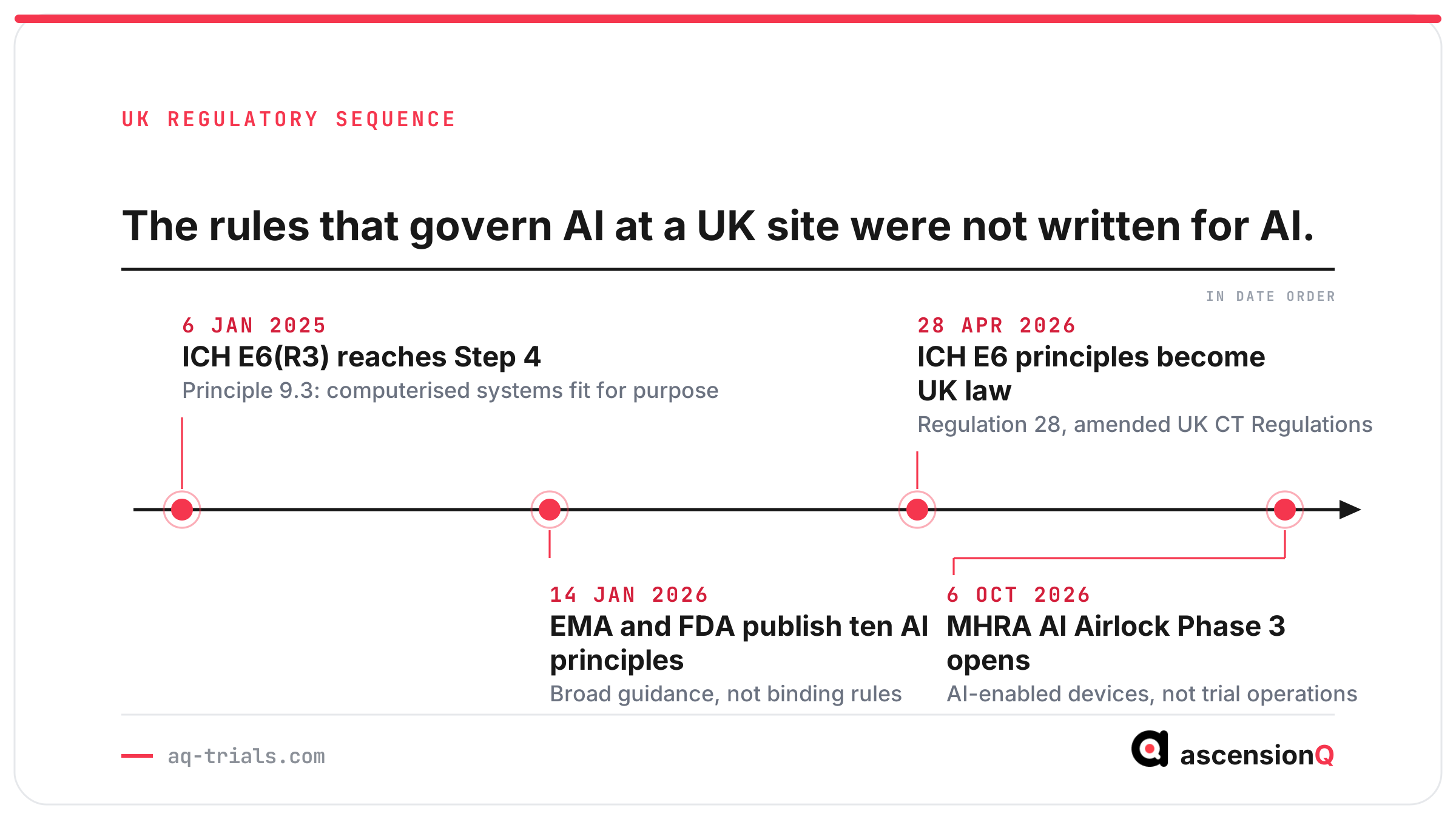
| Instrument | Date | What it asks of a site using AI |
| ICH E6(R3) Guideline for Good Clinical Practice | Step 4 on 6 January 2025; a legal requirement in the UK from 28 April 2026 | Principle 9.3 requires computerised systems used in clinical trials to be fit for purpose, with risk-based validation where appropriate. Section 2.12.10 sets the investigator’s duties for those systems, including secure attributable access. |
| EMA and FDA guiding principles of good AI practice in drug development | 14 January 2026 | Ten joint principles covering a human-centric approach, a risk-based approach, a clear context of use, data governance and documentation, performance assessment and life cycle management. |
| MHRA AI Airlock | Phase 3 opened 6 October 2026 | Nothing directly. The sandbox addresses AI-enabled medical devices rather than the systems a site uses to run trial operations. |
Compliance with the ICH E6 good clinical practice principles became a legal requirement in the UK on 28 April 2026 under Regulation 28 of the amended UK Clinical Trials Regulations, as stated in the MHRA’s guidance on compliance with ICH E6 GCP in the United Kingdom. The full text sits in the ICH E6(R3) guideline, adopted on 6 January 2025.
The EMA and the FDA published their ten guiding principles of good AI practice in drug development on 14 January 2026. The agencies describe them as broad guidance on AI use in evidence generation and monitoring across a medicine’s life cycle, intended to underpin future AI guidance in each jurisdiction rather than to operate as binding rules. Each of the ten mapped to what it asks of a UK site and of a sponsor, and how they sit alongside MHRA expectations, is set out in the EMA and FDA good AI practice principles. The site-side work those rules create for a single AI feature, from the intended use statement and the acceptance criterion through performance qualification to model change control, is set out in validating an AI feature in a regulated clinical trial system.
None of the three approves a platform. No trial platform is approved or certified by the MHRA, and a supplier claiming otherwise has misread the regime. What the rules require instead is validation for intended use, a named person in front of each output, and an audit trail showing both. The validation method is set out in GAMP 5 and computerised system validation. Accountability for an AI-assisted error stays with people under ICH E6(R3), and the chain across investigator, sponsor and vendor is set out in who is accountable when AI gets it wrong at a trial site?. The written procedure a research office uses to hold those duties, covering scope, roles, approval of a new use, training, monitoring, incident reporting and periodic review, is set out in how should a research site govern the use of AI?.
Can AI Replace a Research Nurse or a Monitor?
No. The obstacle is accountability rather than capability. ICH E6(R3) Principle 10.1 permits tasks to be transferred or delegated while the sponsor or the investigator keeps overall responsibility for their respective activities. Section 2.3.1 states that the investigator retains the ultimate responsibility for delegated activities, with oversight proportionate to the nature of the task and its importance to participant safety and data reliability.
A model is not a person a delegation log can name. An AI output therefore reaches the record only through someone who is. Three things stay with people as a result.
- The entry. A trial record is attributable to an identified individual, so the save is made by a person even where the text was drafted by a model.
- The clinical judgement. A model proposes and the investigator decides, which is the same division that already applies to a delegated member of the research team.
- The oversight. Delegation moves the task and keeps the responsibility, so adding a model adds a thing to supervise rather than removing one.
The delegation record naming each person and each activity is held in Digital DoA. A site that adds an AI feature gains a tool its staff use, and the delegation log it maintains does not change shape as a result.
A model can prepare the work. It cannot hold the responsibility for it.
AI in Clinical Trials Inside the AQ Platform
Connected Intelligence is the AI capability across the AQ Platform, and AQ Assist is the in-platform assistant a user works with directly. Both operate on one connected record rather than on a single module at a time.
- AQ’s AI proposes, flags and drafts, and a named person reviews and confirms, which keeps the accountable decision with the individual the delegation log authorises.
- Every AI action is written to the audit trail, so the proposal and the confirmation are both retrievable for an inspector years afterwards.
- Checks read across the electronic investigator site file, the quality management system, CAPA and the clinical trial Pharmacy record, which is what allows a contradiction between two record sets to surface at all.
- AQ is validated to GxP standards with every release, covering IQ, OQ and PQ with a 21 CFR Part 11 and EU Annex 11 assessment, so the AI features sit inside the validated scope of the version a site runs.
- The platform is UK-hosted, holds NHS DSPT Standards Met for 2026, is Cyber Essentials certified and runs ISO 27001-aligned controls.
AQ was built by Phase 1 trial doctors and has been in continuous daily NHS use for six years, with 13 sites on one connected record, 70 concurrent studies and more than 150 studies run on the platform. It supports MHRA compliance and is built for MHRA GCP inspection, and the judgement in every record stays with the research team. Book a live demo to see where a proposal becomes a confirmed record.
Frequently Asked Questions
How is AI used in clinical trials?
AI reads records that already exist and returns a proposal a person then confirms. Four families of work cover almost all of it: retrieving an answer from a document set, classifying and extracting data from a filed document, drafting narrative text, and flagging a contradiction across records held in different places. Sponsors additionally use AI for recruitment modelling, site selection and protocol design, which a site neither buys nor acts on.
Is AI used in UK clinical trials today?
Yes, in two separable ways. AI runs inside trial operations as document classification, retrieval, drafting and cross-record flagging within systems a site already uses. AI is also the subject of some trials, as an AI-enabled medical device under investigation or a model generating evidence for a marketing authorisation. The two carry different regulatory requirements, and publications about one frequently get read as applying to the other.
What is the difference between AI and automation in a trial?
Automation fires a predetermined rule and returns the same output for the same input every time, so it can be tested exhaustively. AI returns a proposal that varies with its input, so it needs a named person to confirm the output before it becomes a record. The practical consequence is a different evidence burden for each, and most features sold as AI in a trial platform turn out to be one or the other on inspection.
Can AI replace a research nurse or monitor?
No. A trial record is attributable to an identified individual, and a model is not a person a delegation log can name. ICH E6(R3) Principle 10.1 allows tasks to be delegated while overall responsibility stays with the investigator or sponsor, and section 2.3.1 puts the ultimate responsibility for a delegated activity with the investigator. A model can prepare work for those people and cannot take their place in the record.
Is AI in clinical trials regulated in the UK?
Yes, through the general computerised systems rules rather than a dedicated AI instrument. ICH E6(R3) Principle 9.3 requires computerised systems used in clinical trials to be fit for purpose, and compliance with the ICH E6 principles became a legal requirement in the UK on 28 April 2026. The EMA and the FDA published ten joint guiding principles for good AI practice in drug development on 14 January 2026. The MHRA’s AI Airlock covers AI-enabled medical devices rather than trial operations.
Which AI features does a research site buy rather than the sponsor?
A site buys AI that reads the records the site is accountable for: document classification and filing, cross-record quality flagging, natural-language retrieval across its own records, and drafting of text a named person at the site then owns. Recruitment modelling, site selection analytics, protocol design optimisation and central monitoring analytics all read data a site does not hold, and all belong to the sponsor.
Does a UK research site need AI to run clinical trials?
No. A site with complete, current and retrievable records meets its obligations whether or not a model helps produce them. AI shortens the work of keeping those records in that condition, and it earns its place where a problem spans several record sets and a person would otherwise have to notice it by eye. A site with disconnected records gains less from AI than it would gain from connecting them first.