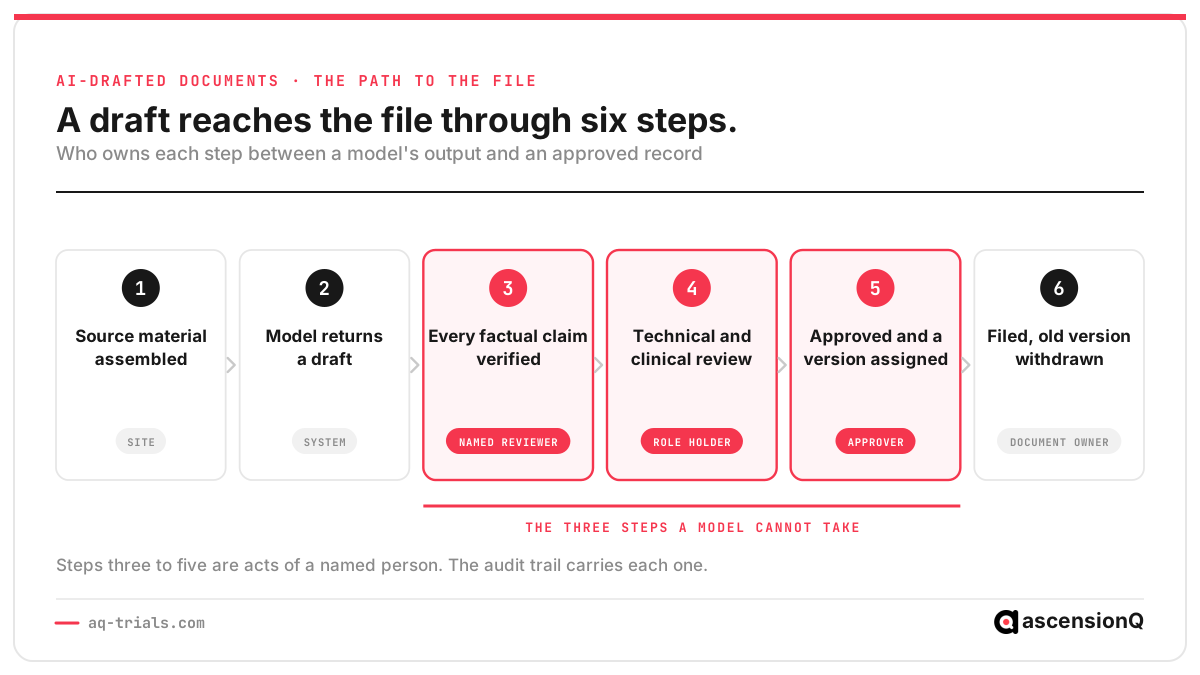
Can AI write clinical trial documents? Yes, as a draft. A model can produce a protocol section, a participant information sheet, a standard operating procedure or a letter to a regulator. A named person then verifies every factual claim, approves a version and files it. Accountability for accuracy stays with the organisation that submits the document.
Can AI Write Clinical Trial Documents?
A trial document has two lives. In the first it is language, and a model is competent at language. In the second it is evidence, and evidence carries a version, an approver, a date and a place in the file. The second life starts at approval. Everything a model produces sits in the first.
That division decides what a site has to control. ICH E6(R3), adopted at Step 4 on 6 January 2025 and applied in the UK from 28 April 2026, requires records to be attributable, legible, contemporaneous, original, accurate and complete at section 2.12.2. A draft meets none of those tests and needs to meet none of them. The approved version meets all of them. The work of a site is the passage between the two.
- What AI changes. The blank page disappears. A first draft of a procedure, a summary or a response arrives in minutes rather than days.
- What AI leaves alone. The approval, the version number, the effective date and the filing stay with named people in defined roles.
- What AI adds. A verification burden. Model output reads as confident whether or not the facts inside it hold, so someone checks each claim against a source.
This guide covers the documents a UK research site drafts, the review each one attracts, the version control around it and what the file holds afterwards. The wider map sits in our guide to how AI is used in clinical trials, and the questions to put to a vendor sit in our guide to AI for compliance and inspection readiness.
Which Clinical Trial Documents Can AI Draft?
Four classes of document absorb most of the drafting effort at a research site. Each has a different approver and a different consequence when the text is wrong. The table sets out what a model can usefully produce for each, and the decision that stays with a person.
| Document class | What a model can draft | What a person must decide | Who approves it |
| Protocol and protocol-related text | Procedural sections, schedule-of-assessments prose, plain-language restatements of eligibility criteria | Study design, endpoints, risk to participants, every number in the text | The sponsor, then the regulator and the ethics committee |
| Participant information and consent materials | A reading-level pass, a structural draft, alternative wording for a technical term | What participants are told, what they agree to, the public involvement behind it | The research ethics committee |
| Standard operating procedures | A first draft against a template, a gap list against a reference procedure | The process the site actually runs, the roles named in it, the training it triggers | The site quality lead or procedure owner |
| Monitoring and regulatory correspondence | A response outline against each finding, a readable summary of a technical issue | The facts asserted, the evidence behind each, the corrective action committed to | A person with authority for the submission |
Protocol text now has a published structure to draft against. ICH M11, the Clinical electronic Structured Harmonised Protocol, reached Step 4 on 19 November 2025 and supplies a template, a standardised table of contents and a technical specification for exchanging protocol content electronically. M11 fixes where content sits. It settles nothing about whether the content is correct.
A model is strongest where the form is known and the facts come from somewhere else. It is weakest where the form is known and the facts are assumed.
Who Owns Each Document a Model Drafts?
Ownership decides who answers for the text, and it sits where it always sat. ICH E6(R3) Principle 8.1 states that a well-designed trial protocol is fundamental to the protection of participants, and section 3.1.4 requires protocols and related documents to be fit for purpose, clear, concise and consistent. Those duties attach to the sponsor. A site that drafts protocol text drafts it for someone else to own.
- The sponsor owns the protocol. A site may suggest wording for a local procedure inside it. The sponsor issues the version, and changes travel the amendment route.
- The research ethics committee owns the opinion on participant information. The HRA participant information design and review principles require public contributors to be involved in designing and reviewing it, and the HRA states that participant information developed without public involvement will not normally receive a favourable opinion. A model is not a public contributor.
- The site owns its own procedures. An SOP describes what this site does, with these roles and these systems. Generic text fails that test on contact with an auditor.
- The signatory owns the correspondence. A response to a monitoring finding or an inspection deficiency binds the organisation that sends it.
The accountability chain behind these roles is set out in our guide to who is accountable when AI gets it wrong at a trial site.
Also Read: What AI May and May Not File in an eTMF or eISF
What Did the MHRA Find in AI-Drafted Inspection Responses?
The MHRA Inspectorate published its position on 29 June 2026 in a post titled Use of AI for GXP inspection responses. It is the clearest published UK statement on AI-drafted regulatory correspondence, and it describes real submissions.
The agency recorded responses that referenced guidance which does not exist and cited regulatory frameworks with no bearing on the finding. One ran past 90 pages and addressed none of the deficiencies raised. In another case, a response to a serious patient-safety deficiency contained non-existent references and inaccuracies, and inspector review time rose from around four hours to more than twenty.
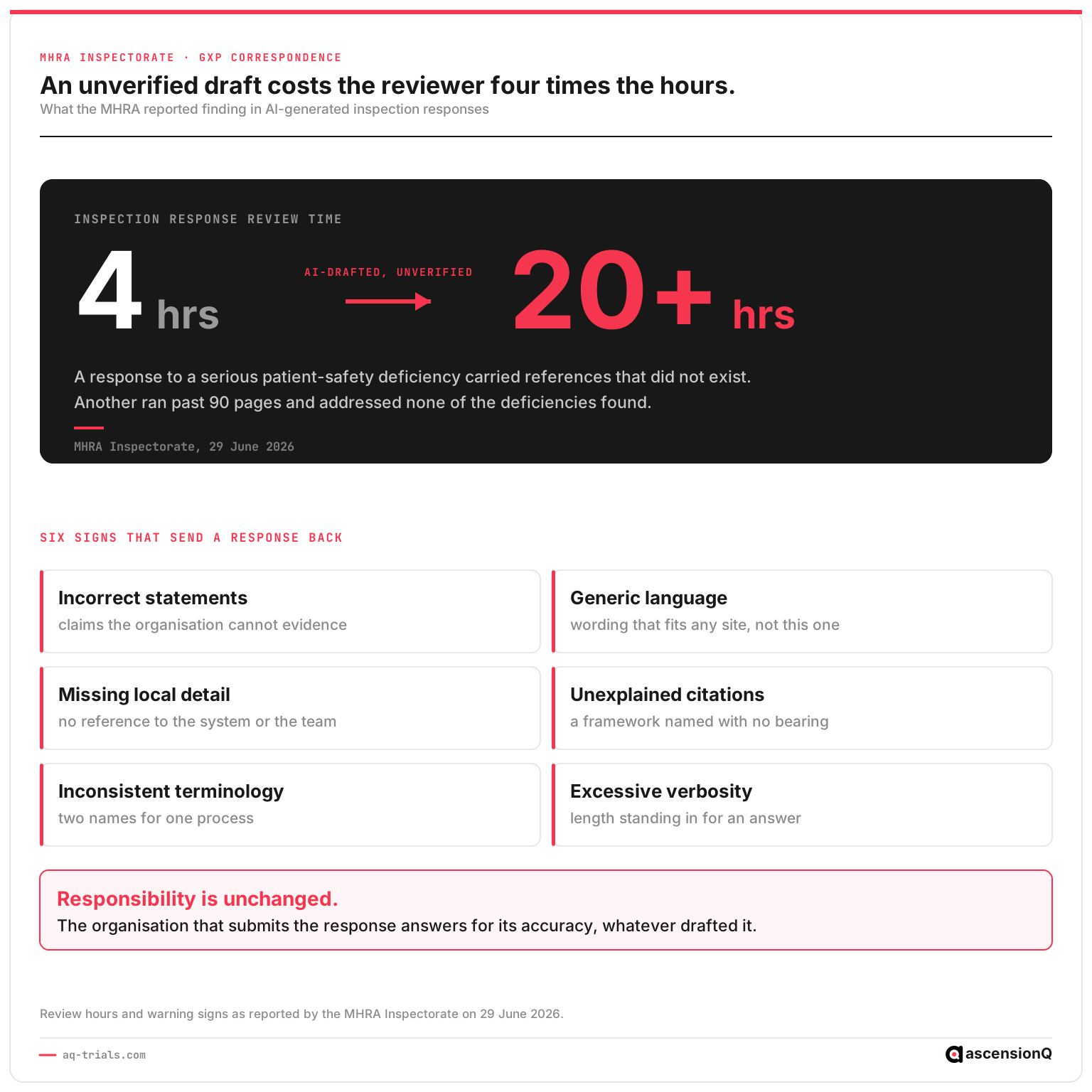
The MHRA position on the tools themselves is neutral. It assesses the outcome, meaning accurate, verified and properly overseen documentation, whether the text came from a model, a template, a consultant or a person at a keyboard. It asks that submissions be factually accurate and verifiable, technically reviewed by experienced people, and signed off by someone with authority and accountability. The consequences it names are concrete: rejection of the response, a higher risk rating for inspection prioritisation, referral to the Inspection Action Group, and regulatory action where failures look systemic.
The underlying failure mode, where a model produces a fluent citation to a source that was never published, is covered in our guide to AI in GxP clinical trial systems and what the MHRA expects. Inside a regulatory response that failure costs the regulator hours and costs the organisation its credibility on the finding it was answering.
What Must a Person Check Before an AI-Drafted Document Is Approved?
Verification of AI-drafted text differs from proofreading. The risk sits in assertions that read perfectly well. Seven checks cover the failure modes the MHRA describes and the ones an auditor raises at a site.
| Check | What it catches | Evidence it leaves |
| Every factual claim traced to a source | Assertions the organisation cannot evidence | A source named against each claim in the review record |
| Every regulatory citation opened | Guidance that does not exist, or a framework with no bearing | The instrument, version and date confirmed as read |
| Local detail present | Text that would fit any site rather than this one | Named systems, roles and study identifiers in the final version |
| Terminology consistent | Two names used for one process | Alignment with the site glossary and existing procedures |
| Length proportionate to the question | Volume standing in for an answer | A response mapped point by point to each finding |
| Commitments deliverable | Corrective actions the site has no capacity to complete | An owner and a date against each action |
| Sign-off authority confirmed | Approval by someone outside the role that holds the duty | The approver named, with the delegated activity recorded |
The second check carries most of the weight. A reviewer who opens each cited instrument and confirms its version and date removes the failure the MHRA describes most often. The alternative added more than sixteen hours to one inspector’s review.
How Should Version Control Work for an AI-Drafted Document?
Version control for an AI-drafted document follows the rules the site already operates. Model output enters at the same point as any other first draft and carries no special status.
- Drafts stay outside the controlled set. Model output has no version number and no effective date until a person approves it. It belongs in the working area, never in the investigator site file.
- Approval creates the version. The approved text takes the next number in the sequence, with the approver and the date recorded against it.
- The effective date governs use. Staff work to the version in force on the day, and training on a revised procedure happens before it takes effect.
- The superseded version is withdrawn. It stays retrievable for the retention period and leaves circulation at the point of replacement.
- Protocol changes travel the amendment route. ICH E6(R3) section 1.4.7 requires prior documented approval of an amendment from the research ethics committee before a protocol change is implemented, aside from action to remove an immediate hazard.
One question comes up at every site adopting this. Should the record keep the prompt, or the model version that produced the draft? ICH E6(R3) attaches its requirements to the trial record rather than to the authoring tool, so the approved document and its approval evidence carry the obligation. The validation position for a probabilistic feature is covered in our guide to validating an AI feature in a regulated clinical trial system.
What Does the Site File Record About an AI-Drafted Document?
An approved document on its own evidences very little. The records around it carry the decision, and an auditor asks for them together.
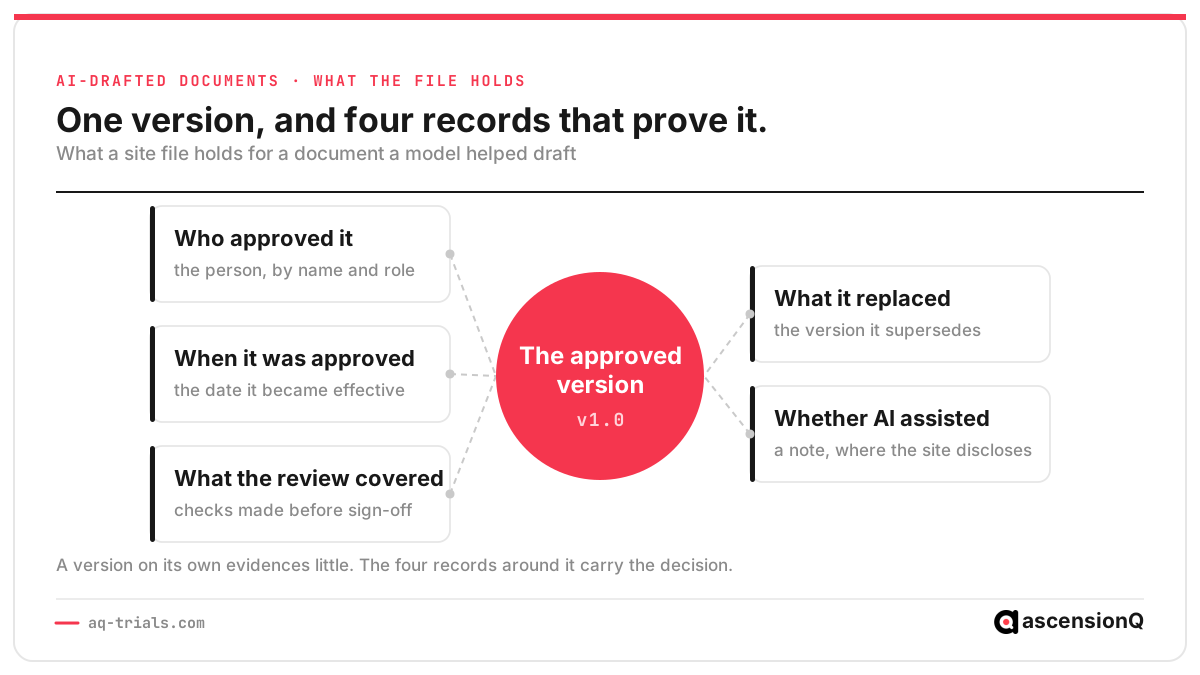
- The approved version. The text in force, with its number.
- The approver. A named person in a role that holds the duty, delegated and trained for it.
- The approval date. The date the version became effective, read against the activity it governed.
- The review evidence. What was checked before approval, at the level of detail the seven checks above produce.
- The superseded version. Withdrawn from use and retained for the retention period.
Section 2.12.2 of ICH E6(R3) adds one requirement that matters here. Changes to records should be traceable and should leave the original entry legible. A document rewritten in place, with no retained predecessor and no record of what changed, fails that test whatever drafted it.
Also Read: How Should a Research Site Govern the Use of AI?
Should a Site Disclose That AI Drafted a Document?
Disclosure of AI use in an inspection response is voluntary under the MHRA position published on 29 June 2026. It sets out what a disclosure should contain.
- A brief statement at the start of the submission.
- Identification of the sections AI was involved in.
- Confirmation that a person verified and approved the content.
Research governance is moving in the same direction. The HRA published its plan to enable safe, AI-powered innovation in health and social care research, last updated on 28 May 2026 and covering 2026 to 2028. The plan commits the HRA to clarifying its expectations for AI use within its remit, and it names writing research protocols, manipulating participant materials, consent processes and lay summaries of results among the examples. The HRA will align with the outputs of the National Commission into the Regulation of AI in Healthcare, which we cover in our guide to how UK AI regulation in healthcare affects clinical research.
A site that writes its disclosure position into its own procedure has an answer ready when a sponsor, a committee or an inspector asks it.
Where Does AI-Assisted Drafting Fail at a Site?
Five failures recur, and each one has a named artefact behind it.
| Failure | What it looks like in the file | The check that prevents it |
| A procedure the site does not run | An SOP naming a role, a form or a system the site never held | Local detail confirmed by the procedure owner |
| Participant information with no public involvement | No record of contributor input in the application | Public involvement arranged before the draft |
| A citation to guidance that does not exist | A response quoting an instrument no one can retrieve | Every citation opened and its date confirmed |
| A deviation description reused across studies | Identical root cause wording on unrelated deviations | Detail checked against the actual event |
| Length standing in for substance | A long response answering no finding directly | A response mapped point by point to each finding |
The fourth failure spreads quietly. A single generic root cause, drafted once and reused, turns a corrective and preventive action record into a formality. The MHRA treats superficial or generic corrective action as a quality system weakness in its own right, however the response was drafted. Sites that run this well keep the analysis with the person who investigated the event.
An auditor asks one question about a drafted document. Could the person who approved it defend every sentence in it?
Also Read: What Is Agentic AI in Clinical Trials, and Where Must a Person Decide?
AI-Assisted Drafting Inside the AQ Platform
Connected Intelligence is the AI capability in AQ Platform, and AQ Assist is the in-platform assistant that produces drafts inside it. AQ Assist proposes and drafts. A named person reviews and confirms, and every AI action is in the audit trail alongside the confirmation that followed.
- Drafting sits beside the controlled document. AQ QMS holds each controlled document with its own review cycle, approval and training assignment, so a version and its predecessor live in one place.
- Approval is an identified act. The approver, the date and the version are recorded against the document, which is the record set an inspector asks for.
- The site file stays the evidence. AQ eISF tracks each expected document as a slot with a code, a due date and an owner, so a draft never occupies an approved record’s position.
AQ Platform is UK-hosted, holds NHS DSPT Standards Met (2026) and Cyber Essentials certification, and operates ISO 27001-aligned controls. It is validated to GxP standards with every release, covering IQ, OQ and PQ with a 21 CFR Part 11 and EU Annex 11 assessment. The duties in our guide to UK GDPR for clinical trial sites apply unchanged to drafting that touches participant data.
Book a live demo to see how a drafted document travels from proposal to approved version inside one connected record.
Frequently Asked Questions
Can AI write clinical trial documents?
AI can write a draft of a clinical trial document. A model produces protocol text, participant information, standard operating procedures and regulatory correspondence at draft quality. The document becomes a record when a named person verifies the facts in it, approves a version and files it.
Can AI write a clinical trial protocol?
A model can draft procedural sections of a protocol against the ICH M11 structure, which reached Step 4 on 19 November 2025. The sponsor owns the protocol under ICH E6(R3) and stays responsible for the design, the endpoints and the risk assessment.
Who is responsible for a document that AI drafted?
The person who approves the document holds responsibility for it, and the organisation that submits it answers for its accuracy. The MHRA Inspectorate confirmed this position on 29 June 2026, stating that responsibility is unchanged by the use of AI and that materially false statements to inspectors remain regulatory offences.
Do you have to tell the MHRA that AI drafted a response?
Disclosure is voluntary. The MHRA position published on 29 June 2026 states that organisations choosing to disclose should include a brief statement at the start of the submission, identify the sections involved, and confirm that a person verified and approved the content.
Can AI write a participant information sheet?
A model can produce a draft and a reading-level pass. The HRA participant information design and review principles require public contributors to be involved in designing and reviewing it, and information developed without public involvement will not normally receive a favourable opinion.
What does the site file need to show for an AI-drafted SOP?
The file holds the approved version, the named approver, the approval and effective dates, evidence of what was reviewed before approval, and the superseded version withdrawn from use. ICH E6(R3) section 2.12.2 requires changes to records to be traceable without obscuring the original entry.
Does an AI drafting feature need validating?
A drafting feature inside a regulated system needs validation for its intended use, with model versions under change control. ICH E6(R3) Principle 9.3 requires computerised systems to be fit for purpose, through risk-based validation where appropriate.