Who is accountable when AI makes a mistake in a clinical trial? A person, every time. ICH E6(R3), adopted in its consolidated final version on 16 June 2026, leaves ultimate responsibility for a delegated activity with the investigator at section 2.3.1 and ultimate responsibility for a transferred activity with the sponsor at section 3.6.6.
This guide covers the accountability chain across investigator, sponsor and vendor, what the delegation log records when a named person confirms an AI proposal, the route an AI-assisted error travels, and what an inspector asks for. The wider map sits in how is AI used in clinical trials?, and the supplier questions sit in AI for compliance and inspection readiness.
- Accountability attaches to a role and a person. A tool holds no role, so an AI proposal arrives with nobody attached to it until somebody confirms it.
- Three parties answer for three different things at once, and the chain holds only where each is separately documented.
Who Is Accountable When AI Makes a Mistake in a Clinical Trial?
Three answers apply simultaneously, and they do not compete. The investigator answers for the trial activity the error touched. The sponsor answers for the conduct of the trial and the integrity of its data. The vendor answers for the system behaving as specified. An AI-assisted error therefore produces three separate questions rather than one argument about blame.
- The investigator. Section 2.3.1 of ICH E6(R3) states that the investigator may delegate trial-related activities to other persons or parties, and that the investigator retains the ultimate responsibility, which means an AI proposal confirmed by a delegated nurse remains the investigator’s activity.
- The sponsor. Section 3.6.6 states that a sponsor may transfer any or all of its trial-related activities to a service provider, and that the ultimate responsibility for those activities resides with the sponsor, which keeps a vendor contract outside the chain of regulatory accountability.
- The vendor. MHRA guidance on good clinical practice for clinical trials, last updated on 22 September 2026, lists organisations that develop and maintain trial-specific computerised systems among those that must comply with GCP, which puts the supplier inside the inspection regime in its own right.
Principle 10.1 states the rule above all three. Parties involved in a trial retain overall responsibility for their respective activities. Principle 10.2 adds that responsibility for the conduct of the trial, including the quality and integrity of the trial data, stays with the sponsor or the investigator for transferred or delegated activities.
Responsibility moves between people. It never moves into the software.
What Does ICH E6(R3) Say About a Delegated Activity?
Six provisions carry the weight, and the final consolidated guideline states each plainly. Step 4 endorsement came on 6 January 2025, Annex 2 reached Step 4 on 3 June 2026, and the consolidated version carries 16 June 2026. Compliance with the ICH E6 principles became a UK legal requirement on 28 April 2026 under the amended Clinical Trials Regulations.
| Provision | What it requires | What it means for an AI feature |
|---|---|---|
| 2.3.1 | The investigator may delegate trial-related activities and retains the ultimate responsibility. Oversight should depend on the nature of the activity | A higher-risk AI proposal attracts closer investigator oversight than a low-risk one |
| 2.3.2 | Persons and parties with delegated activities should be appropriately qualified | Competence to judge an AI proposal sits in the training record of the person confirming it |
| 2.3.3 | A record should be kept of delegated persons and parties, proportionate to the significance of the activities | The delegation record names the individual who may confirm each class of proposal |
| 3.6.4 | Activities not specifically transferred are retained by the sponsor | Silence in a vendor agreement leaves the activity with the sponsor |
| 3.6.6 | Ultimate responsibility for transferred activities resides with the sponsor | A vendor’s AI feature does not relieve the sponsor of the outcome |
| 3.6.9 | The sponsor should oversee important transferred activities, including those subcontracted by the service provider | A model a vendor licenses from a third party remains inside the sponsor’s oversight |
Two further provisions govern the system itself. Principle 9.3 requires computerised systems to be fit for purpose, through risk-based validation where appropriate. Section 2.12.1 makes the investigator responsible for data integrity irrespective of the media used. The detail sits in validating an AI feature in a regulated clinical trial system.
The Accountability Chain, Link by Link
Four parties appear in the chain, and each holds one artefact that proves its link. An inspection runs the chain backwards, starting from the wrong entry and asking who confirmed it.
| Party | What it answers for | The instrument | The artefact that proves it |
|---|---|---|---|
| Sponsor | The conduct of the trial, the quality and integrity of the data, and oversight of everything transferred | ICH E6(R3) 3.6.4, 3.6.6, 3.6.9 and Principle 10.2 | The vendor agreement, the oversight plan and the system inventory |
| Investigator | Every trial activity at the site, including each one delegated to a member of the team | ICH E6(R3) 2.3.1, 2.12.1 | The delegation record and the training file behind each name on it |
| The named person who confirmed | The specific decision recorded against their account on that date | ICH E6(R3) 2.3.2, 2.3.3 | The audit trail entry and their delegated authority for that activity |
| Vendor | The system performing as specified, and the validation evidence supporting it | MHRA GCP guidance, ICH E6(R3) Principle 9.3 | The release validation pack and the model version record |
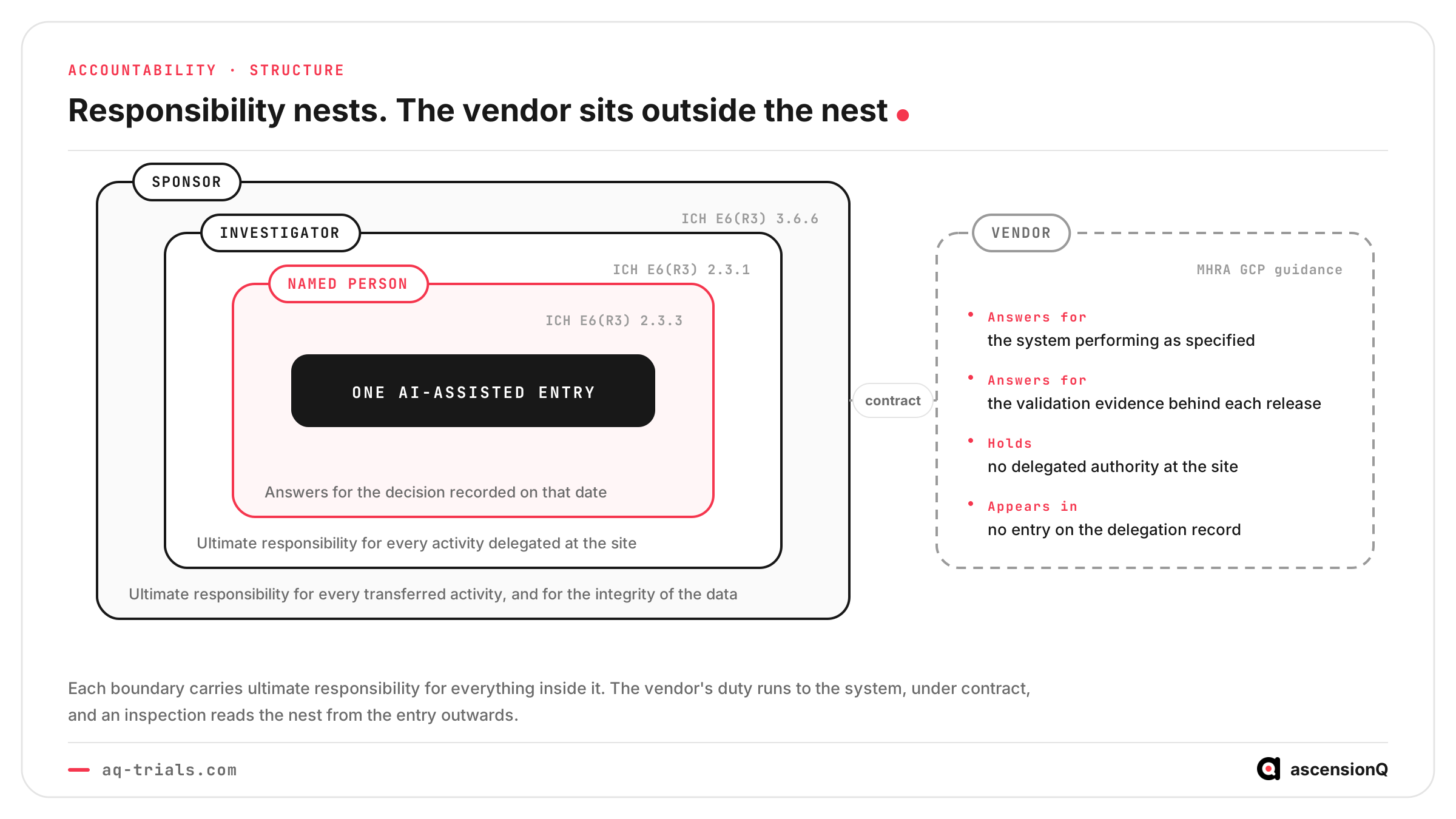
The chain has one weak point in practice. A site that lets a shared account confirm AI proposals breaks the third link, because the audit trail then names a mailbox rather than a person.
Also Read: Is it safe to use AI in GxP clinical trial systems? What MHRA expects covers what AI may do and must never do at a site, and what the audit trail has to show for an AI-assisted entry.
Where Does a Vendor’s Responsibility Start and Stop?
A vendor’s responsibility is real and bounded. It covers the system doing what the specification says, the validation evidence behind each release, and notification when a change alters behaviour. It stops at the trial decision, because the vendor appears nowhere in the site’s delegation record.
- Inside the vendor’s scope. Fitness for intended use, the audit trail capturing the proposal and the confirmation, the model version recorded against each output, and disclosure of a model change.
- Shared. Validation, split between the vendor’s release qualification and the site’s qualification of its configuration and data.
- Outside the vendor’s scope. Whether a proposal was right for this participant on this protocol, who confirmed it, and whether that person held authority for the activity.
MHRA inspection practice puts this on the record. The GCP guidance introduced a separate dossier on 22 September 2026 for organisations providing computerised systems in support of clinical trials, with its own template, spreadsheet and checklist. The site-side system inventory sits in how to complete the MHRA computerised systems inspection dossier, and the contract terms worth asking for are set out once in the inspection readiness evaluation guide.
What Does the Delegation Log Record When Someone Confirms an AI Proposal?
The delegation record answers a question the audit trail cannot. The audit trail says who confirmed the entry. The delegation record says whether that person was permitted to. Section 2.3.3 asks for a record of delegated persons and parties, proportionate to the significance of the activities, and an AI confirmation right is worth naming at that level of detail.
| Field | What it holds | Worked example |
|---|---|---|
| Named individual | The person, not a role mailbox or a shared account | Research nurse, Northgate General, named on the site delegation record |
| Activity delegated | The activity in the site’s own words, at the level the person performs it | Confirming a proposed document classification into the site file |
| Scope and limit | The classes of proposal this person may confirm, and the classes that escalate | Training and approval records yes, certified copies escalate to the quality lead |
| Effective dates | The date authority began and the date it ended | Authority effective from the date of the investigator’s signature |
| Evidence of competence | The training record covering the system and the activity | Protocol training, GCP and recorded system training on the AI feature |
| Investigator signature | The delegation itself, signed by the principal investigator | Signed entry on the current version of the delegation record |
Two records therefore have to agree on a date. An AI-assisted entry confirmed on a Tuesday needs the confirming person’s authority live on that Tuesday, and a superseded delegation record reads identically to the current one. AQ’s digital delegation of authority holds the delegation entry and the audit trail in one connected record, so the authority behind a confirmation is retrievable from the entry itself.
What Happens When an AI-Assisted Entry Turns Out To Be Wrong?
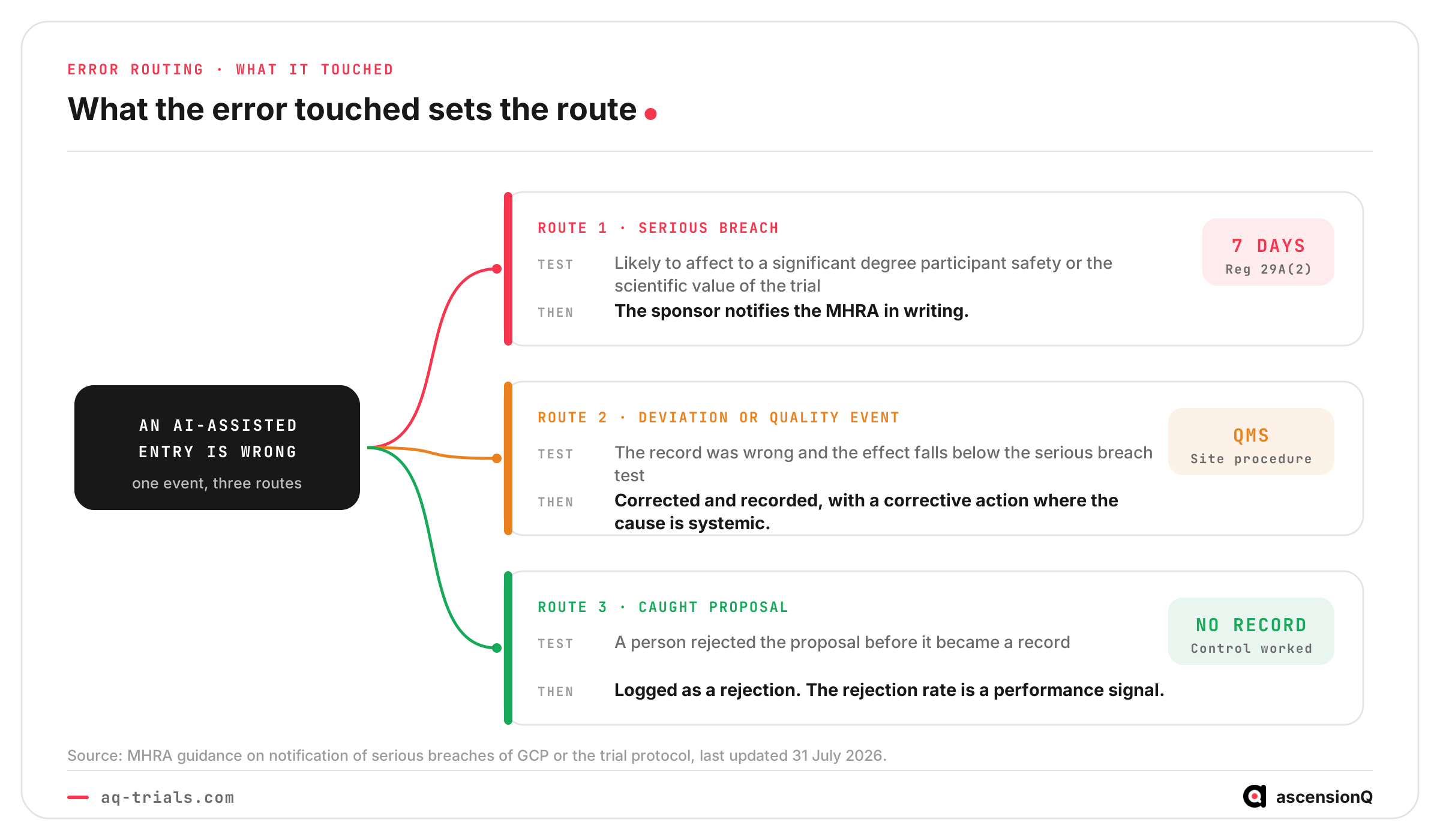
The route depends on what the error touched rather than on what produced it. An AI-assisted error and a typing error travel the same three routes. The MHRA guidance on notification of serious breaches, last updated on 31 July 2026, sets the top route.
- Route one, a serious breach. Regulation 29A(2) defines a serious breach as one likely to affect to a significant degree the safety or physical or mental integrity of participants, or the scientific value of the trial. The sponsor notifies the licensing authority in writing within 7 days of becoming aware of it.
- Route two, a deviation or a quality event. The error is corrected, recorded and assessed for root cause inside the site’s quality system, with a corrective action where the cause is systemic.
- Route three, a caught proposal. A person rejected the proposal before it became a record. The rejection is evidence the control worked, and the rejection rate is a performance signal for the feature.
Two points in the guidance matter at a site. The investigator or institution should have a process to identify serious breaches and notify the sponsor promptly, and where the sponsor does not report one the site believes is serious, the site should consider reporting it to the MHRA directly. The guidance also states that reporting should not be delayed by debates over who is responsible.
Route two carries the signal worth watching. A single wrong proposal is an event. A pattern across one activity is a finding, and detection of that pattern is covered in AI-assisted quality risk detection for UK research sites.
What Will an Inspector Ask For?
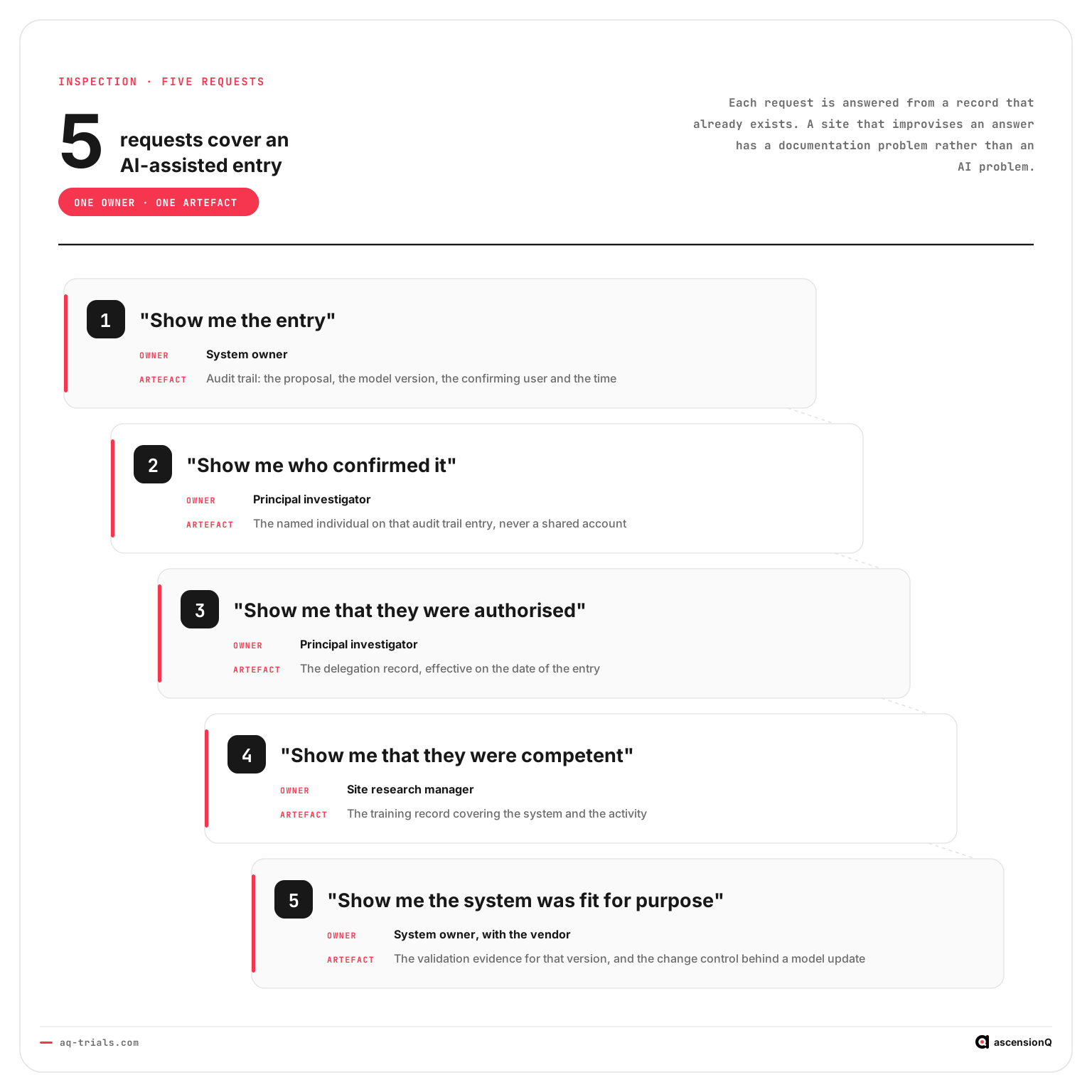
Five requests cover it, each with one owner and one artefact. A site that answers all five from the record holds the chain. A site that answers three and improvises two has a documentation problem rather than an AI problem.
- Show me the entry. The audit trail, with the proposal, the model version, the confirming person and the time. Owner: the system owner.
- Show me who confirmed it. The named individual on the audit trail entry. Owner: the principal investigator.
- Show me that they were authorised. The delegation record, effective on the date of the entry. Owner: the principal investigator.
- Show me that they were competent. The training record covering the system and the activity. Owner: the site research manager.
- Show me the system was fit for purpose. The validation evidence for that version and the change control behind a model update. Owner: the system owner, with the vendor’s release pack.
The recurring themes an MHRA GCP inspection raises at UK sites are covered in MHRA GCP inspection common findings. Delegation and training evidence appear in them with or without an AI feature in the system.
Does UK GDPR Add a Separate Accountability Duty?
Yes, and it runs alongside the GCP chain. The Information Commissioner’s Office states in its guidance on the accountability and governance implications of AI that overall accountability for compliance lies with the controller, that senior management and data protection officers are also accountable, and that these issues cannot be delegated to data scientists or engineering teams.
- A data protection impact assessment is likely required for most AI uses, and a decision that one is unnecessary has to be documented with its reasoning.
- Controller status follows who sets the purposes and means of the processing, regardless of how a contract describes the parties.
- The assessment is a live document, kept current rather than filed once at procurement.
The split for a UK trial site sits in UK GDPR for clinical trial sites. The ICO notes that its AI guidance is under review in light of the Data (Use and Access) Act, so the page is worth re-reading before a procurement.
Accountability Inside the AQ Platform
Connected Intelligence is the AI capability across the AQ Platform, and AQ Assist is the in-platform assistant. Both read one connected record, which allows a confirmation, the authority behind it and the activity it touched to be retrieved together rather than from three systems.
- AQ’s AI proposes, flags and drafts, and a named person reviews and confirms, which keeps every AI-assisted entry attributable to an individual the delegation record authorises.
- Every AI action is written to the audit trail, so the proposal, the model version and the human confirmation stay retrievable for an inspector years afterwards.
- AQ Digital DoA holds the delegation record in the same connected record as the entry, which allows the authority behind a confirmation to be checked against the date the confirmation was made.
- A confirmed error routes into AQ QMS as a deviation and into AQ CAPA where the cause is systemic, so a recurring AI-assisted error is handled as a quality event with an owner and a due date.
- Every AQ release goes through validated release and change control, with installation and operational qualification evidence and a 21 CFR Part 11 and EU Annex 11 assessment, so the vendor link in the chain arrives with its evidence attached. The site runs performance qualification against its own configuration.
AQ holds NHS Data Security and Protection Toolkit Standards Met for 2026, is Cyber Essentials certified, operates ISO 27001-aligned controls, and the platform is UK-hosted. It supports MHRA compliance and is built for MHRA GCP inspection. AQ was built by Phase 1 trial doctors and has been in continuous daily NHS use for six years, with 13 sites on one connected record and 70 concurrent studies, at University Hospitals of Liverpool Group, Royal Free London and Liverpool School of Tropical Medicine. Book a live demo to follow one AI-assisted entry back to the delegation record behind the person who confirmed it.
Also Read: What AI may and may not file in an eTMF or eISF covers the confirmation step at the point a document reaches the file.
Frequently Asked Questions
Who is accountable when AI makes a mistake in a clinical trial?
A person, in three places at once. Section 2.3.1 of ICH E6(R3) leaves ultimate responsibility for a delegated activity with the investigator. Section 3.6.6 leaves ultimate responsibility for a transferred activity with the sponsor. The vendor answers separately for the system performing as specified. No provision assigns responsibility to the tool itself.
Can a site transfer responsibility for an AI error to the software vendor?
No. Section 3.6.6 of ICH E6(R3) states that ultimate responsibility for transferred trial-related activities resides with the sponsor, and section 3.6.4 adds that activities not specifically transferred are retained by the sponsor. A contract allocates commercial risk between the parties. It leaves the regulatory position unchanged.
What does a delegation log record when a person confirms an AI proposal?
Six fields. The named individual, the activity in the site’s own words, the classes of proposal that person may confirm and the classes that escalate, the effective dates of the authority, the training record behind it, and the investigator’s signature. Section 2.3.3 asks for documentation proportionate to the significance of the activity.
Is an AI-assisted error a serious breach?
It depends on the effect rather than the cause. Regulation 29A(2) of the amended UK Clinical Trials Regulations defines a serious breach as one likely to affect to a significant degree participant safety or the scientific value of the trial. Where it meets that test, the sponsor notifies the MHRA in writing within 7 days of becoming aware of it.
Who is accountable if an AI feature was never validated?
Both ends of the chain. Principle 9.3 of ICH E6(R3) requires computerised systems to be fit for purpose through risk-based validation where appropriate, and section 2.12.1 makes the investigator responsible for data integrity irrespective of the media used. The vendor answers for its release qualification. The site answers for qualifying its own configuration.
What will an inspector ask when a site uses AI?
Five things. The audit trail entry with the proposal and the model version, the named person who confirmed it, the delegation record showing they were authorised on that date, the training record showing they were competent, and the validation evidence for the version that ran. Each request has one owner and one artefact.