Can AI file documents in an eTMF? It can classify a document, propose the destination and populate the index fields. The filing is an act a named person confirms. The European Medicines Agency expects an eTMF audit trail to show the user behind every upload, so the record needs an accountable person rather than a model.
This guide covers the four steps of a filing decision, which document types a reading check can place and which need a person, what changes when the destination is a site file, how a site sets its threshold, and what the audit trail holds. The wider map of AI use across a trial sits in How is AI used in clinical trials?, and the evaluation questions for a supplier offering this capability sit in AI for compliance and inspection readiness.
- A classification is a proposal about what a document is. A filing is a record of where it lives, and the two are separate events with separate owners.
- Document type decides how much confirmation a filing needs. A templated approval letter and a piece of trial correspondence carry different risks in one queue.
Can AI File Documents in an eTMF?
A filing decision breaks into four steps. AI performs three of them, and the fourth creates the record.
- Read. The document is read and its type proposed from its content, which means a scan named “scan_0043.pdf” arrives with a candidate identity.
- Place. The proposed type maps to a destination in the file structure, which turns an upload into a location a person accepts or moves.
- Populate. Dates, versions and names are extracted into the index fields, which builds the index from the documents rather than from typing.
- Confirm. A named person accepts, amends or rejects the proposal, and that acceptance is the filing event the trail records.
The identity and extraction mechanics behind the first three steps are set out in how AI finds documentation gaps in an investigator site file. This guide takes the question that follows: what a site may let the system place on its own, and what it must route to a person.
The anchor for step four sits in the EMA’s Guideline on the content, management and archiving of the clinical trial master file (paper and/or electronic), reference EMA/INS/GCP/856758/2018, adopted on 6 December 2018. Section 4.1.2 states that the eTMF should record date, time and user for creating, uploading, deleting or changing a document. A model holds no user identity, so a proposal needs a person attached before it becomes a filed record.
A second instrument sharpens the point about index fields. The EMA’s Guideline on computerised systems and electronic data in clinical trials, reference EMA/INS/GCP/112288/2023 and adopted on 7 March 2023, states at section 4.7 that data fields should not be prepopulated or automatically filled in, with an exception for non-editable fields derived from data already entered. That section addresses clinical data capture rather than document metadata, and the principle underneath reads across: a value nobody entered needs a traceable derivation or a human confirmation.
A classification proposes. A filing commits.
Which Document Types Can a Reading Check Place, and Which Need a Person?
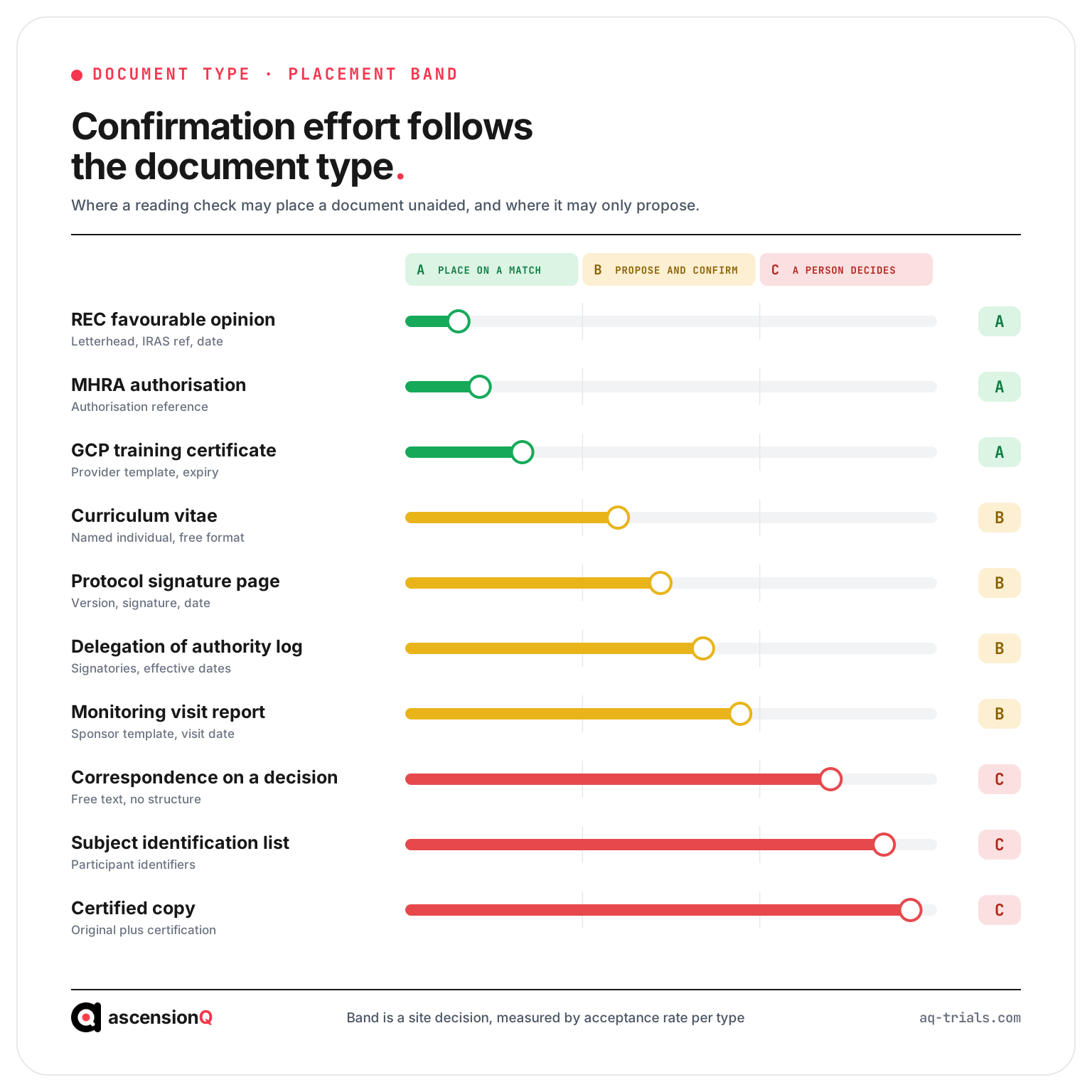
Confirmation effort belongs where the document type puts it. A reading check identifies a templated approval letter with near certainty. It identifies trial correspondence as correspondence, which answers nothing about whether the document is essential. Three bands separate the file.
- Band A, place on a confirmed match. The document carries machine-readable identifiers and one plausible destination, and nothing about it turns on judgement.
- Band B, propose and confirm. The type is clear and the version decision is open, so the proposal is correct and incomplete at once.
- Band C, a person decides. The open question is essentiality or confidentiality rather than identity, and no reading answers it.
| Document type | What identifies it | Band | Why it sits there |
|---|---|---|---|
| Research ethics committee favourable opinion | Committee letterhead, study title, IRAS reference, decision, date | A | Fixed layout, one destination, and a reference number confirming the study |
| MHRA clinical trial authorisation | Authorisation reference, product, sponsor, date | A | Issued once per trial in a stable format, so a match is right or obviously wrong |
| GCP training certificate | Provider template, delegate name, completion date, expiry | A | Templated and dated, the name checked against the staff record |
| Curriculum vitae | Free format, recognisable structure, named individual | B | Identity is unmistakable. Currency is a question about the staff record |
| Signed protocol signature page | Protocol version, signature, date | B | The version extracts cleanly. Whether it is in force depends on the approval record |
| Delegation of authority log | Study code, site, signatories, effective dates | B | A superseded log reads identically to the live one, so only dates separate them |
| Monitoring visit report or follow-up letter | Sponsor or CRO template, visit date, findings | B | Filing section varies by organisation, and the ICH GCP list is not exhaustive |
| Trial-related correspondence recording a decision | Free text, no fixed structure | C | The type is easy. Essentiality is the whole decision |
| Subject identification code list | Participant identifiers against trial numbers | C | Section 3.1 keeps it with the investigator, so a proposal is a confidentiality risk |
| Certified copy of a wet-ink original | Scanned original plus a certification statement | C | Section 5.1 requires checks on congruency, metadata, naming and image quality |
Band membership is a site decision rather than a property of the document. A site with one sponsor places a monitoring visit report confidently. A site running seventy concurrent studies sees four template variants of it, which moves it down a band. The acceptance rate per type settles it, and validating an AI feature in a regulated clinical trial system covers how that rate becomes an acceptance criterion.
Also Read: ALCOA+ and the Trial Master File covers the nine attributes a filed record carries and the four that sit with the system.
What Changes When the Destination Is an eISF Rather Than an eTMF?
Both files hold evidence for the same trial, and they answer to different parties. Section 4.1.3 of the TMF guideline makes the investigator or institution responsible for the suitability of the investigator trial master file. Sections 3.2 and 6.1 keep the sponsor responsible for the trial and for oversight, including where a contract research organisation holds the documents. An automatic destination therefore carries an accountability consequence.
- Investigator only. The subject identification code list stays at the site under section 3.1, and participant-identifiable source records stay with it.
- Both files. Approvals, the protocol and its amendments, agreements, delegation records and training evidence appear in each, in copies that have to agree.
- Sponsor only. The master randomisation list sits with the sponsor under the same section, and a proposal routing it to a site file breaks the blind.
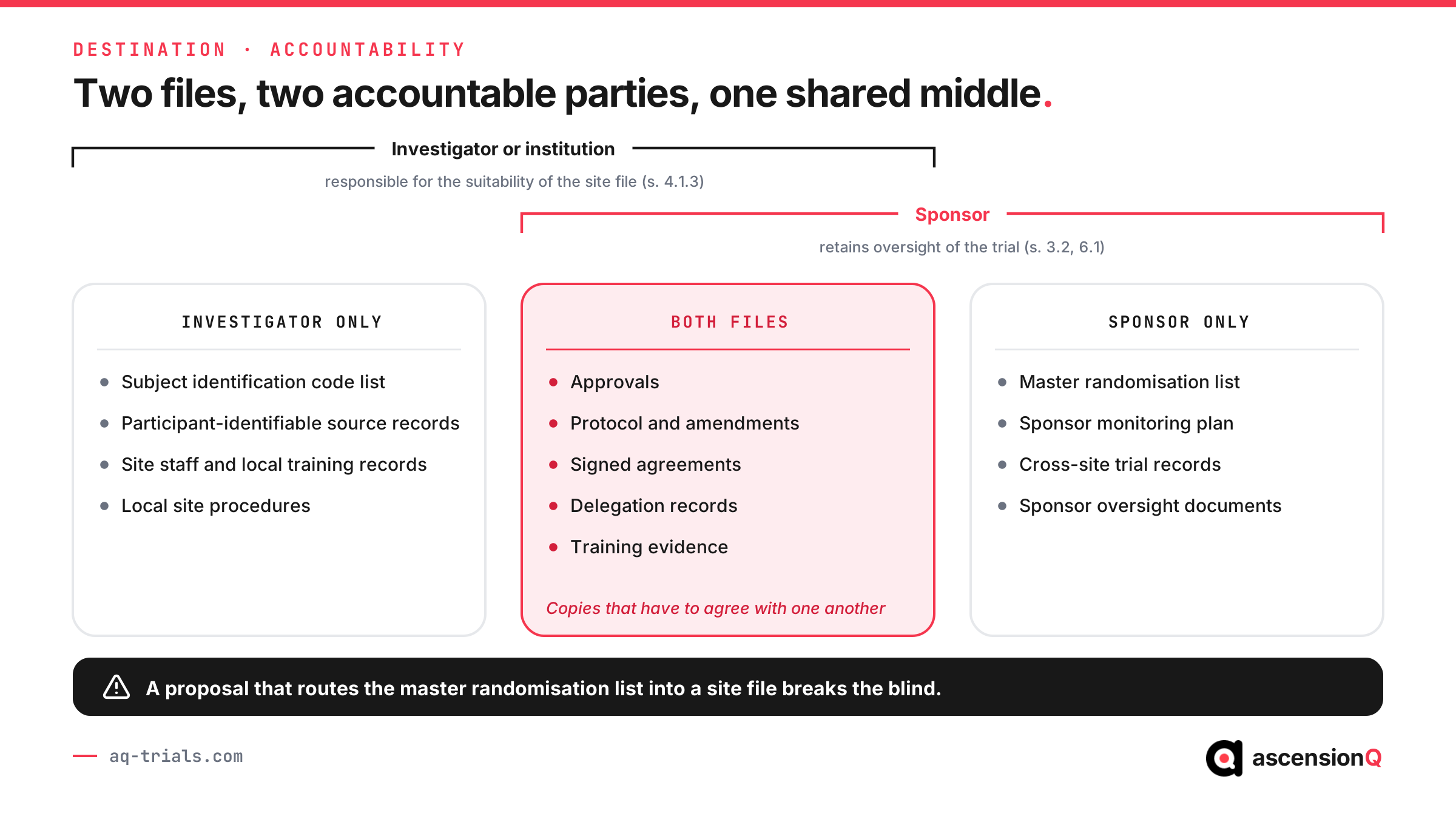
Structure makes the middle band workable. The TMF Reference Model is maintained by CDISC, which also publishes an Investigator Site File Reference Model mapped to TMF Reference Model v3.3.1. A shared structure lets one classification point at the corresponding slot in each file, and the zone-by-zone mapping of the site-held share sits in the guide to the TMF Reference Model and the investigator site file.
Section 3.4 adds the ordering rule for both files. Documents should be filed in each relevant section in chronological order, and the organisation should define which date it files on, whether receipt, filing, approval or expiry. A site that leaves that undefined gives a reading check no basis for ordering two correctly classified versions of one document.
How Should a Site Set Its Confirmation Threshold?
Two variables set the threshold, and the model’s reported confidence is part of only one. The first is how certain the classification is for that document type at that site. The second is what a misfiling costs. A policy written on both gives four handling rules a filing procedure can state plainly.
| Classification certainty | Cost of a misfiling | Handling rule | Worked example |
|---|---|---|---|
| High | Low | Place on the proposal, destination visible and reversible | A GCP certificate reaching the training section |
| High | High | Place on the proposal, with a named confirmation before it counts as filed | An amendment approval other records are dated against |
| Low | Low | Hold in a queue with a review date, and measure how long it runs | Sponsor correspondence with no decision in it |
| Low | High | Route to the role owning the record before a destination is applied | A certified copy or a participant-identifiable record |
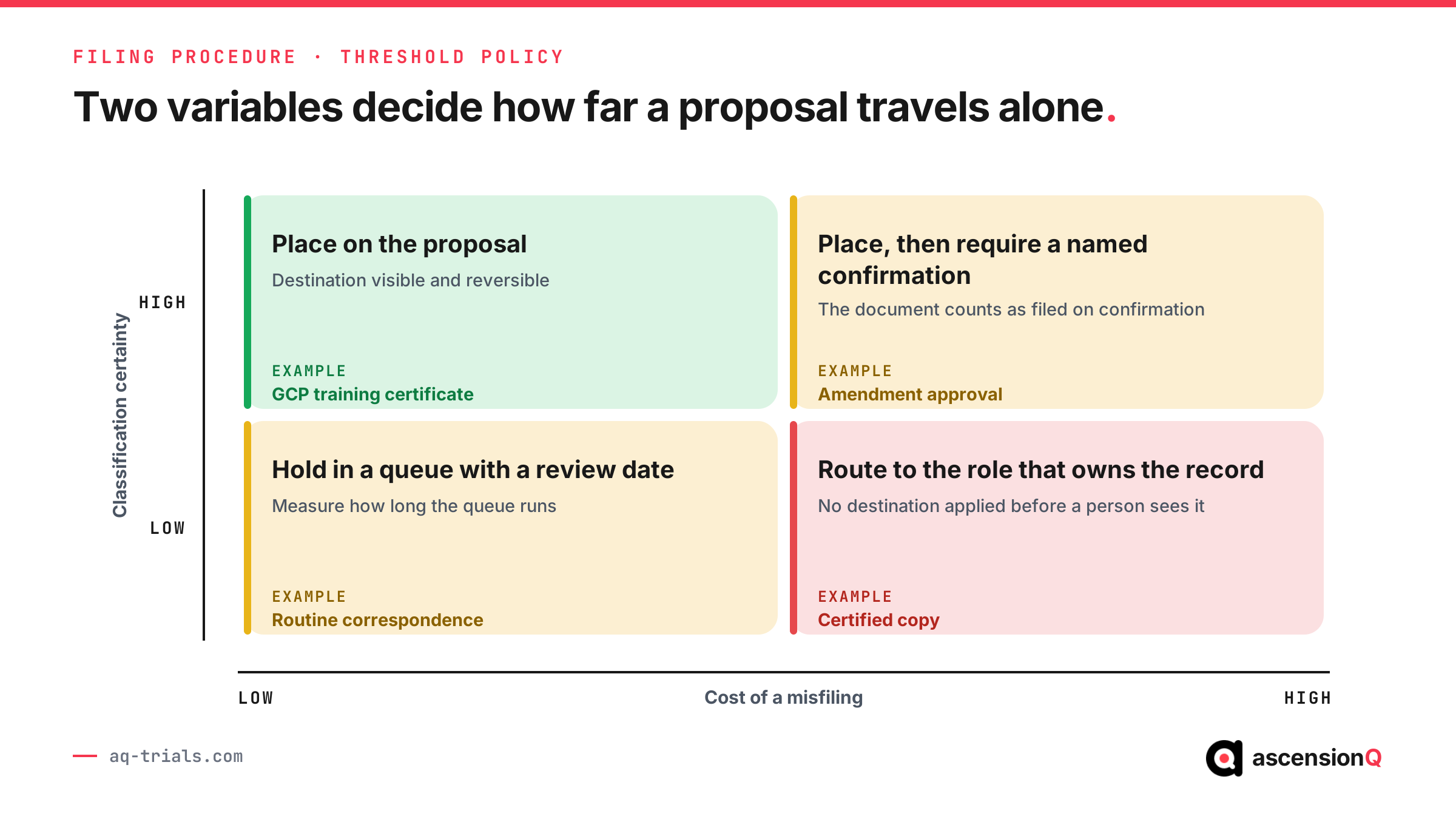
Section 4.2 supplies the review mechanism behind the table. The sponsor or investigator should apply risk-based quality checks confirming that documents sit in the right location, are indexed correctly, are filed on time, and are accessible only per assigned roles, and that the audit trail has been reviewed. A threshold policy predicts where errors appear. The quality check tests it.
Set the threshold by what a wrong answer costs, not by what the model reports.
What Does the Audit Trail Record When a Filing Proposal Is Accepted?
One accepted proposal writes two events, and an inspector reading the file years later needs both. The upload carries its own timestamp. The confirmation carries a different user, a different time, and whatever the person changed.
| What the trail holds | Where the expectation comes from | What it answers at inspection |
|---|---|---|
| Upload event with date, time and user | TMF guideline section 4.1.2 | When the document entered the file, under whose account |
| The proposed classification and destination | Computerised systems guideline section 6.2.1, initial entry | What the system suggested, apart from what was filed |
| The model version that produced the proposal | Section 4.10, consistent intended performance across the system life cycle | Which validated configuration ran that day |
| The confirming user, their role and organisation | Section 6.2.1, who made the change | Whether that person was authorised for the record |
| Each amended field, with previous and current values | Section 6.2.1, captured per field rather than per page | What the person corrected |
| The reason for a change, where one applies | Section 6.2.1, and why where applicable | Why a destination or metadata value moved |
Two further constraints follow. Section 6.2.1 requires the trail to be computer-generated, secure, timestamped and human-readable, held inside the system and exportable as a dynamic data file. Section 6.12 states that static formats of dynamic data will not be considered adequate, so a printed extract is not the record. Inside AQ, a filing proposal and the confirmation that accepts it are written to the same audit trail as a manual filing, with the model version recorded against the proposal. The activity-level version of this line, covering what AI may do and must never do at a UK site, sits in Is It Safe to Use AI in GxP Clinical Trial Systems? What MHRA Expects.
The underlying duty is older than any of it. ICH E6(R3), adopted at Step 4 on 6 January 2025, requires at section 2.12.2 that source records be attributable, legible, contemporaneous, original, accurate and complete, with changes traceable and the original entry never obscured. Compliance with the ICH E6 good clinical practice principles became a legal requirement in the UK on 28 April 2026 under Regulation 28 of the amended UK Clinical Trials Regulations, as stated in the MHRA’s guidance on compliance with ICH E6 GCP in the United Kingdom, last updated on 28 April 2026.
Where Does Auto-Filing Go Wrong?
Three failure modes account for most of it, and each produces a file that looks complete.
- The right type, the wrong study. A classifier reads the document and not the context around it. A GCP certificate for a nurse delegated on nine studies has one identity and nine destinations, so a single-destination proposal is wrong eight times over.
- The right type, the superseded version. Two delegation logs for one site classify identically. Only the effective dates separate them, which is why section 3.4 asks an organisation to define its filing date in advance.
- A queue counted as a file. Section 4.2 lists timely filing as a quality check in its own right, and section 3.5.4 expects filing timelines set in procedures or a TMF plan. A proposal waiting three weeks is unfiled, and the completeness report shows it as received.
The third failure is worth instrumenting, because it is invisible by design. Completeness scoring against an expected document set is covered in TMF completeness tracking and RAG scoring. A site adding AI document filing should report the unconfirmed queue beside that completeness figure rather than inside it.
One further limit is worth stating plainly. The computerised systems guideline says at section 2 that AI requirements beyond its general expectations “will not be covered in this guideline initially” and may reach a future annex. No published instrument authorises or prohibits eTMF auto-classification by name. The general computerised systems regime governs it: validation for intended use, a named person in front of each output, and a trail showing both.
Also Read: How to Complete the MHRA Computerised Systems Inspection Dossier covers the system inventory an AI filing feature has to appear in, including one running inside a platform the site already lists.
AI-Assisted Filing Inside the AQ Platform
Connected Intelligence is the AI capability across the AQ Platform, and AQ Assist is the in-platform assistant. Both read one connected record rather than a single module, which is what lets a filing proposal be tested against the study, the delegation entry and the training record behind it.
- AQ’s AI proposes, flags and drafts, and a named person reviews and confirms, which keeps the filing event attributable to the individual the delegation log authorises.
- Every AI action is written to the audit trail, so the proposal, the model version and the confirmation stay retrievable for an inspector years afterwards.
- The eTMF and the electronic investigator site file sit on one structure, which allows a single classification to reach the matching slot in each file without a second index.
- A confirmed pattern of misfiling routes into the quality management system as a deviation or a corrective action, so a recurring filing problem is handled as a quality event.
- AQ is validated to GxP standards with every release, covering installation, operational and performance qualification with a 21 CFR Part 11 and EU Annex 11 assessment, so filing features sit inside the validated scope of the version a site runs.
AQ holds NHS Data Security and Protection Toolkit Standards Met for 2026, is Cyber Essentials certified, operates ISO 27001-aligned controls, and the platform is UK-hosted. It supports MHRA compliance and is built for MHRA GCP inspection. AQ was built by Phase 1 trial doctors and has been in continuous daily NHS use for six years, with 13 sites on one connected record, at organisations including University Hospitals of Liverpool Group and Royal Free London. Book a live demo to see a classification proposal, a confirmation and the audit trail entry in sequence.
Frequently Asked Questions
Can AI file documents in an eTMF?
AI can read a document, propose its type and destination, and populate the index fields from its content. The filing itself is a confirmation a named person makes. Section 4.1.2 of the EMA trial master file guideline expects the eTMF to record date, time and user for creating, uploading, deleting or changing a document, and a model has no user identity to record.
Does eTMF auto-classification need validating?
Yes. Section 4.1.2 of the EMA trial master file guideline states that eTMF systems should be validated to demonstrate the functionality is fit for purpose. Section 4.10 of the EMA computerised systems guideline requires validation for accuracy, reliability and consistent intended performance across the system’s life. A probabilistic classifier is validated against an acceptance rate rather than a single correct answer.
Which documents should never be filed automatically?
Three groups. Participant-identifiable records and the subject identification code list, which section 3.1 of the EMA guideline keeps with the investigator. Certified copies, where section 5.1 requires document-level checks on content congruency, metadata accuracy, file naming and image quality. Trial correspondence recording a decision, where the open question is whether the document is essential at all.
What does an eTMF audit trail have to show for an AI-filed document?
Two events rather than one. The upload with its date, time and user. The confirmation with the confirming person, their role and organisation, the time, each amended field with its previous and current value, and a reason where one applies. Section 6.2.1 of the EMA computerised systems guideline requires changes captured per field rather than per page.
Can AI file documents in an investigator site file as well as a trial master file?
Yes, and the accountability differs. Section 4.1.3 of the EMA guideline makes the investigator or institution responsible for the suitability of the investigator trial master file. Sections 3.2 and 6.1 keep the sponsor responsible for oversight. A proposal routing a sponsor-only record such as the master randomisation list into a site file causes a blinding problem rather than a filing error.