Digital twins in clinical trials are model-generated predictions of how one participant would have progressed without the investigational treatment. The prediction supports the statistical analysis of a real trial. Regulators have qualified one narrow use of this method, and nothing a UK research site buys or runs changes because of it.
The term travels further than the method does. Vendors apply it to prognostic models, to comparator populations drawn from old trials, and to physiological simulations that run before a medicine reaches a person. Those are three different things with three different evidence requirements. This guide separates them, records what the European Medicines Agency, the Food and Drug Administration and the MHRA have actually published, and states what each one asks of a research site. The wider picture sits in our guide to how AI is used in clinical trials, and the buying questions sit in our guide to AI for compliance and inspection readiness.
What Are Digital Twins in Clinical Trials?
A digital twin is a statistical model of one individual, trained on records from people who came before them, used to predict that individual’s course over the trial period. The model produces a number, or a trajectory of numbers, for a participant who is enrolled and treated in the ordinary way. The prediction is evidence about expected progression. It is not a second participant.
Three distinct methods carry the label in vendor material and conference programmes:
- A prognostic prediction for a randomised participant. The model forecasts the outcome that participant would reach under control conditions. The forecast enters the analysis as a covariate. Every participant is still randomised, and the control arm is still recruited.
- A modelled comparator population. Predictions for many simulated individuals are pooled and compared against the treated arm. The comparison replaces part or all of a concurrent control group.
- A physiological or organ-level simulation. The model represents a biological system rather than a person’s trial outcome. The work happens in discovery and in non-clinical development, before a protocol exists.
The first method has a regulatory position. The second has conditions attached in draft guidance. The third sits outside clinical trial conduct altogether. A site reading a vendor claim about digital twins should establish which of the three is on offer before reading anything else, because the three carry different proof. That reading is the same discipline our guide to automation against AI in a trial platform applies to feature claims generally.
What Is a Synthetic Control Arm, and How Is It Different?
A synthetic control arm is a comparator group assembled without recruiting comparator participants into the trial. The phrase covers two arrangements that differ in one important respect. An external control arm uses records from real people treated elsewhere, in a completed trial or in routine care. A modelled control arm uses predictions generated by a model. The first is real data about real patients in the wrong setting. The second is computed data about people who do not exist.
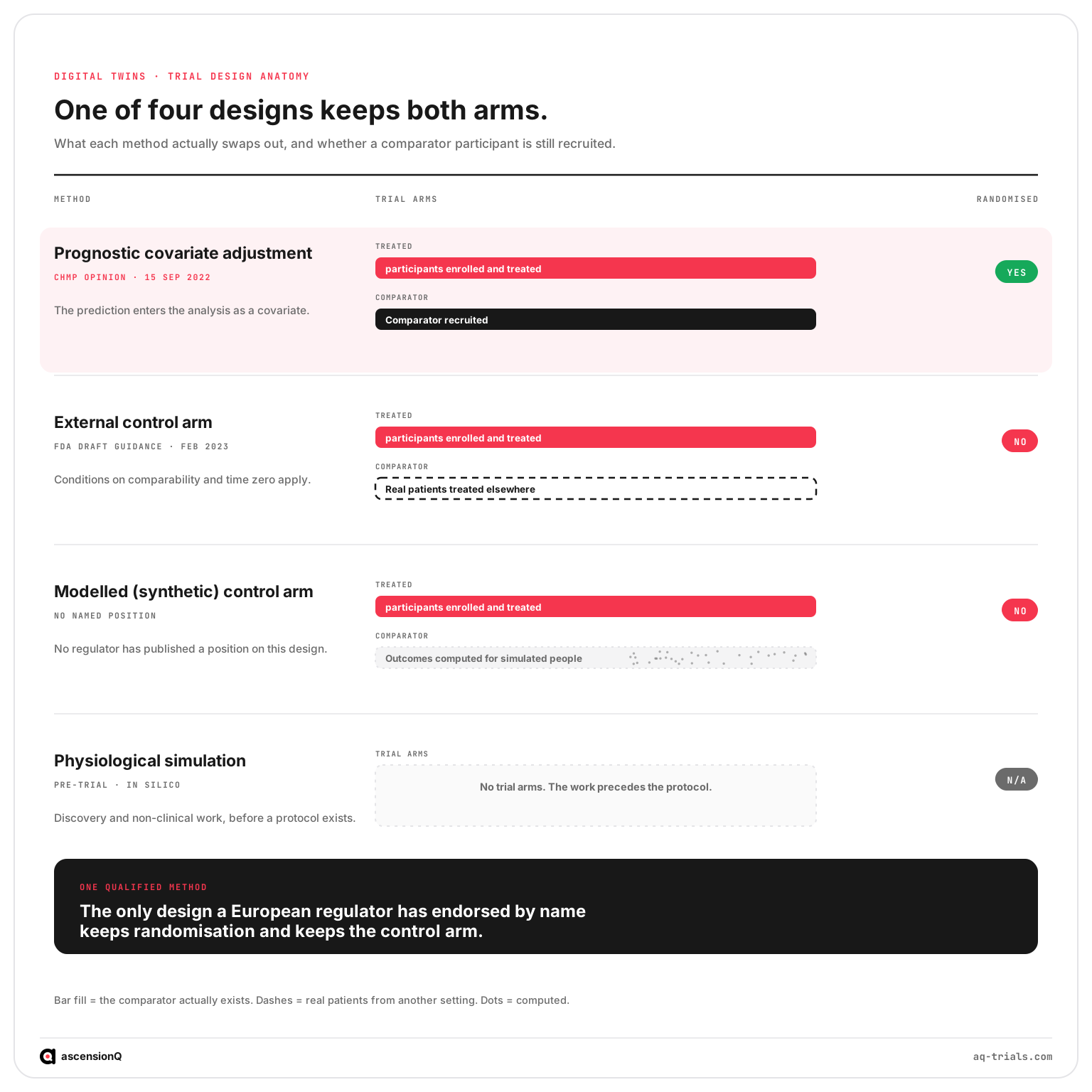
The four terms line up as follows. The column that matters to an inspector is the last one.
| Method | What stands in for the comparator | Concurrent control arm recruited | Published regulatory position |
| Prognostic covariate adjustment | A predicted control outcome per randomised participant, used as a covariate | Yes | CHMP qualification opinion, 15 September 2022 |
| External control arm | Patient-level records of real people treated elsewhere | No | FDA draft guidance, February 2023 |
| Modelled or synthetic control arm | Outcomes computed for simulated individuals | No | None specific to the method |
| Physiological simulation | Nothing. It precedes the trial | Not applicable | Discussed as in silico data in MHRA policy, April 2024 |
Only the first row describes a design a European regulator has examined and endorsed by name. The second row has conditions set out in draft. The third row is where most of the marketing language sits and where the least published support exists.
A method with no named regulatory position is unproven rather than forbidden. The burden of proving it falls on the sponsor who proposes it.
What Have the EMA, the FDA and the MHRA Published on Digital Twins?
Five documents govern how AI and modelled evidence reach a medicines regulator. None of them uses the phrase digital twin. That absence is the single most useful fact a site can hold about this topic, because a term that no regulator has defined cannot be the basis of a compliance claim.
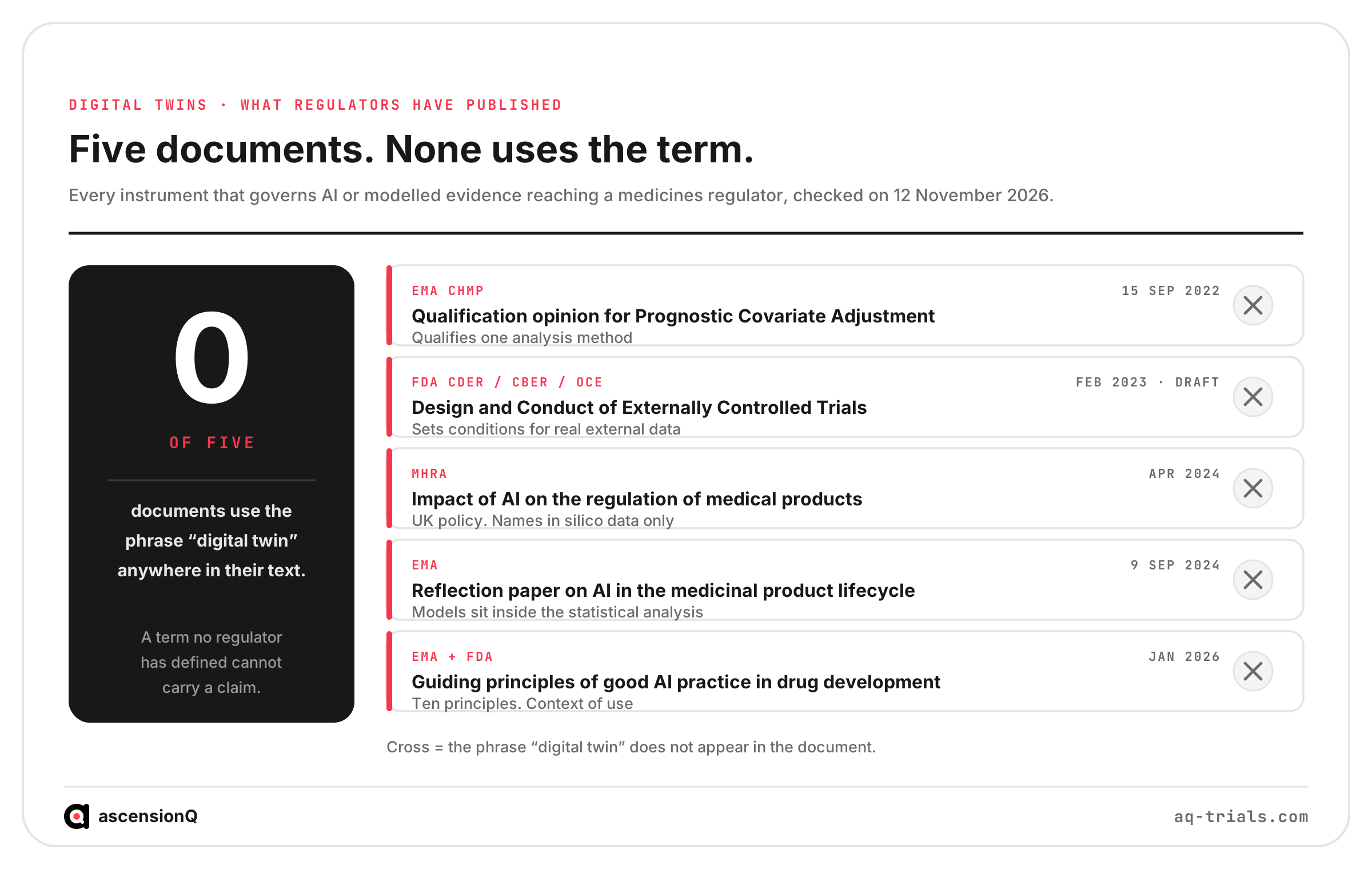
| Document | What it asks of the sponsor | What it reaches at the site |
| CHMP qualification opinion, 15 September 2022 | Justify the prognostic model and prespecify the covariate in the analysis | Recruitment to both arms, exactly as any randomised trial |
| FDA externally controlled trials, February 2023 draft | Show comparability, measurable prognostic factors and a consistent time zero | Nothing. The comparator sits outside the trial entirely |
| MHRA policy on AI in medical products, April 2024 | Expect AI to reach trial design and evidence generation | Nothing. The document sets UK policy rather than site requirements |
| EMA reflection paper, 9 September 2024 | Show that algorithms, models and datasets are fit for purpose | Existing data integrity duties, unchanged |
| EMA and FDA guiding principles, January 2026 | Define a context of use and validate in proportion to risk | Nothing directly. The principles bind development activity |
Each document reaches the subject from a different direction. The EMA reflection paper places models used for data transformation, analysis or interpretation inside the statistical analysis, and states that incremental learning approaches are not accepted for late-stage pivotal trials. The same paper puts responsibility on the clinical trial sponsor, marketing authorisation applicant or holder to show that algorithms, models and datasets are fit for purpose. MHRA policy of April 2024 discusses in silico data in the place of animal models and expects AI to affect clinical trial design, without naming any modelled comparator design. The ten joint EMA and FDA principles of January 2026, which our guide to the EMA and FDA good AI practice principles takes one by one, require a well-defined context of use and proportionate validation rather than approval of a technique in the abstract.
Primary sources, each fetched for this guide: the CHMP qualification opinion for PROCOVA, the FDA draft guidance on externally controlled trials, the EMA reflection paper on AI in the medicinal product lifecycle, and the joint guiding principles of good AI practice in drug development.
What Did the EMA Qualify in 2022?
The CHMP adopted a qualification opinion for Prognostic Covariate Adjustment on 15 September 2022. The opinion is the clearest statement a European regulator has made about prognostic models in trial analysis, and its content is narrower than the digital twin language built on top of it.
Four points carry across to any UK trial that proposes the method:
- The qualification is of an analysis method. The CHMP qualifies the approach as prognostic score adjustment. The model’s prediction enters a standard analysis of covariance as one covariate.
- Randomisation stays. The opinion describes a design in which each subject is randomised to active treatment or control. The predicted outcome sharpens the analysis of the trial’s own data.
- Control participants stay. The method removes no one from the control arm. A site recruiting to such a trial recruits to both arms as normal.
- Model building was left open. The CHMP did not qualify a formal procedure for building the prognostic model, so each application still argues its own model.
The gap against the vendor claim is plain. A qualified method that keeps both arms intact is a long way from a modelled arm that replaces recruitment. Validation of any such feature in a system a site operates follows the route in our guide to validating an AI feature in a regulated clinical trial system.
Also Read: Is It Safe to Use AI in GxP Clinical Trial Systems? What MHRA Expects
Does a Digital Twin Replace a Control Participant?
No method endorsed by name in any of the five documents above replaces a control participant with a prediction. Designs that drop the concurrent control arm rely on records of real people, and the FDA draft guidance of February 2023 sets the conditions those records must meet. The guidance covers patient-level data from other clinical trials and real-world data from registries, electronic health records and medical claims.
Its conditions tell a site what makes such a design fragile:
- Eligibility criteria, treatment administration, patterns of care and outcome assessment in the external source must be comparable to the trial.
- Important prognostic factors must be measurable in the chosen source, confirmed before the design is committed to.
- Time zero must be defined consistently across both arms, which is how immortal time bias enters.
- Outcome assessment should be consistent and ideally blinded to treatment.
- Such trials are more likely to convince where the expected effect on a well characterised outcome is large. A modest expected effect, a variable disease course or a poorly understood natural history makes the design unsuitable.
- Non-inferiority designs are not recommended with external controls.
Every one of those conditions is a sponsor obligation argued with a regulator before the trial opens. A site reads them in the protocol rather than deciding them.
What Changes for a UK Research Site?
Very little changes, and the honest answer is worth stating plainly. A modelled comparator or a prognostic adjustment is a design and analysis decision taken by the sponsor, written into the protocol and the statistical analysis plan, and argued with the regulator. The site delivers the protocol in front of it. The duties in ICH E6(R3), consolidated at Step 4 on 16 June 2026, read the same whether the analysis uses a prognostic model or an ordinary comparison. The investigator still ensures the integrity of data under their responsibility, and still ensures the accuracy, completeness, legibility and timeliness of the data reported.
Three points of contact are real, and all three are things a site already does.
| Point of contact | What the site does | The record it leaves |
| The protocol and the analysis plan | Read the comparator design, confirm the randomisation and visit schedule the site must deliver, and raise anything the site cannot support | The feasibility response and the signed protocol in the site file |
| Participant information and consent | Explain the comparison the trial makes, and any secondary use of the participant’s data in model development, in the approved wording | A signed consent form at the version in force on the date of signing |
| Source data quality | Record visits, outcomes and deviations completely and on time, because a prognostic model is applied to the records the site produces | Source records, the audit trail behind each entry and the deviation log |
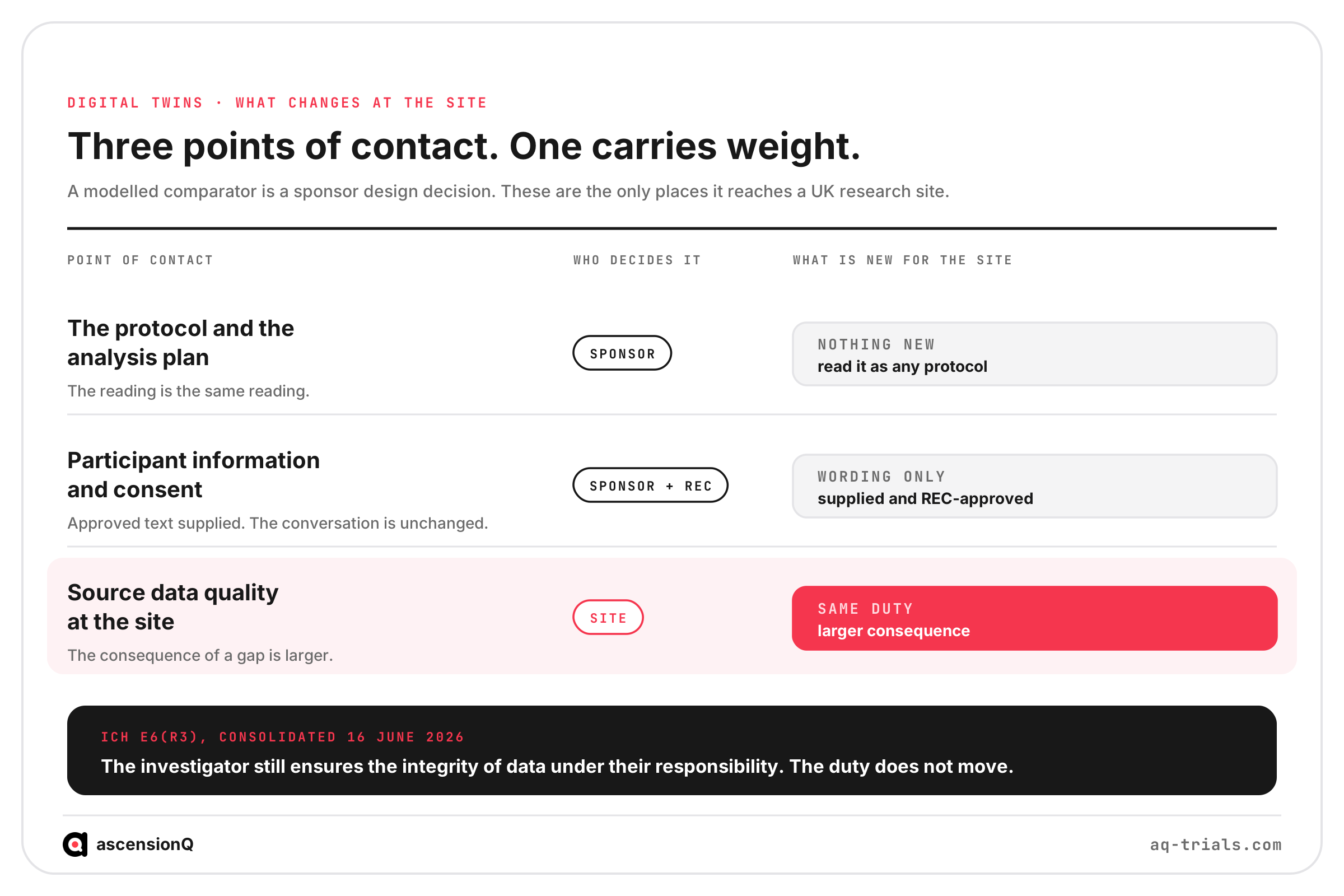
The third row carries the practical weight. A prognostic model predicts an outcome and then meets the outcome the site actually recorded. Missing visits, late entries and unexplained deviations degrade that comparison in a way a simple count of recruited participants does not show. Transparency duties over any secondary use of participant data follow the route set out in our guide to UK GDPR for clinical trial sites.
Also Read: Who Is Accountable When AI Gets It Wrong at a Trial Site?
What Does an Inspector Ask a Site About a Modelled Comparator?
An inspector at a UK site asks about the site’s own conduct. The model belongs to the sponsor’s submission, and the statistical method sits with the sponsor and the regulator who examined it. The questions at the site stay where they always were:
- Source data for each participant, with an audit trail that shows who entered what and when.
- The delegation log and training records for every person who performed a trial activity.
- Consent records matching the approved version in force on the date each participant signed.
- Deviation and CAPA records, with the reasoning behind each decision.
- The system inventory and validation status of every computerised system the site used, which our guide to the MHRA computerised systems inspection dossier sets out row by row.
A site that holds those five things answers a digital twin question in one sentence and moves on. AI inside the systems a site runs is a separate subject with its own expectations, covered in our guide to AI in clinical trial monitoring and, for software that acts across systems on a goal rather than an instruction, in our guide to agentic AI in clinical trials.
Digital Twins and the Site Record Inside the AQ Platform
AQ Trials builds no digital twin and no modelled comparator. The site’s contribution to any analysis of that kind is the completeness and the timeliness of its own record, and that is what the platform is built to hold. Connected Intelligence reads across the connected record and proposes, flags and drafts, and a named person reviews and confirms every proposal before it becomes a record. Every AI action is in the audit trail, with the proposal, the version and the person who confirmed it in one place.
That matters to a trial using a prognostic design for one reason. The comparison depends on records produced at the site on the dates they were produced. Three modules carry the records a prognostic comparison leans on, on one connected record across 13 sites and 70 concurrent studies in six years of continuous daily NHS use:
- AQ CTMS holds each visit against its window, so a late visit is visible as a date rather than as an absence.
- AQ QMS holds every deviation with the reasoning behind its classification, which is what explains a gap in an outcome series.
- AQ Digital DoA holds who was delegated and trained for each activity on the day it was performed.
Book a live demo to see how one AI-assisted action is recorded end to end, from the proposal to the named person who confirmed it.
Frequently Asked Questions
What are digital twins in clinical trials?
A digital twin in a clinical trial is a statistical model of one individual, trained on records of people treated before them, that predicts how that individual would progress under control conditions. The prediction supports the analysis of a real trial. The term also gets applied to modelled comparator populations and to physiological simulations, which are different methods with different evidence requirements.
Is a digital twin the same as a synthetic control arm?
No. A digital twin is a prediction for one individual. A synthetic control arm is a whole comparator group assembled without recruiting comparator participants. Some synthetic control arms use records of real patients treated elsewhere, which regulators call an external control arm. Others use computed outcomes for simulated individuals. The distinction decides what evidence a sponsor has to produce.
Has any regulator approved digital twins in clinical trials?
No regulator has published a position using that term. The closest instrument is the CHMP qualification opinion for Prognostic Covariate Adjustment, adopted on 15 September 2022, which qualifies a prognostic model used as a covariate in the analysis of a randomised trial. Externally controlled designs are addressed separately in FDA draft guidance of February 2023.
Can a digital twin replace a placebo group?
Nothing qualified by name allows it. The method the CHMP qualified in September 2022 keeps randomisation and keeps the control arm, and uses the prediction only as a covariate. Designs that drop a concurrent control arm rely on patient-level records of real people, under conditions the FDA sets out in draft guidance, and remain a case-by-case argument with the regulator.
Does a digital twin change what a UK research site has to do?
Very little. The comparator design belongs to the sponsor’s protocol and statistical analysis plan. Site duties under ICH E6(R3) are unchanged, including the investigator’s responsibility for the integrity of data under their control. The three points of contact are reading the protocol, delivering the approved consent documents, and recording source data completely and on time.
Who is accountable for a modelled comparator in a trial?
The sponsor. The EMA reflection paper on AI in the medicinal product lifecycle places responsibility on the clinical trial sponsor, marketing authorisation applicant or holder to show that algorithms, models and datasets are fit for purpose. The investigator remains accountable for the conduct of the trial at the site and for the data the site produces.
Should a site raise a concern about a modelled comparator design?
Yes, where the site cannot deliver what the design assumes. A design relying on complete outcome data at fixed intervals fails at a site that cannot schedule those visits reliably. Raise it in feasibility, in writing, before the site signs up to the protocol. That is a capacity question rather than a statistical one.