How is AI used in clinical trial monitoring? In three places. Analytics read data pooled from every site and raise the ones that sit outside the expected range. Models draft the narrative parts of a monitoring report. Retrieval assembles the records a monitor has asked a site to produce. A named person confirms each output.
This guide covers the three monitoring modes ICH E6(R3) recognises, how risk-based monitoring analytics raise a signal, which parts of a monitoring report a model may draft, and what a UK research site still has to produce for source data verification. The wider map sits in how is AI used in clinical trials?, and the supplier questions sit in AI for compliance and inspection readiness.
- Monitoring is a sponsor activity performed on a site’s records. The site produces the evidence and answers for it.
- Analytics change which site receives a visit. The visit, the verification and the finding stay with people.
How Is AI Used in Clinical Trial Monitoring?
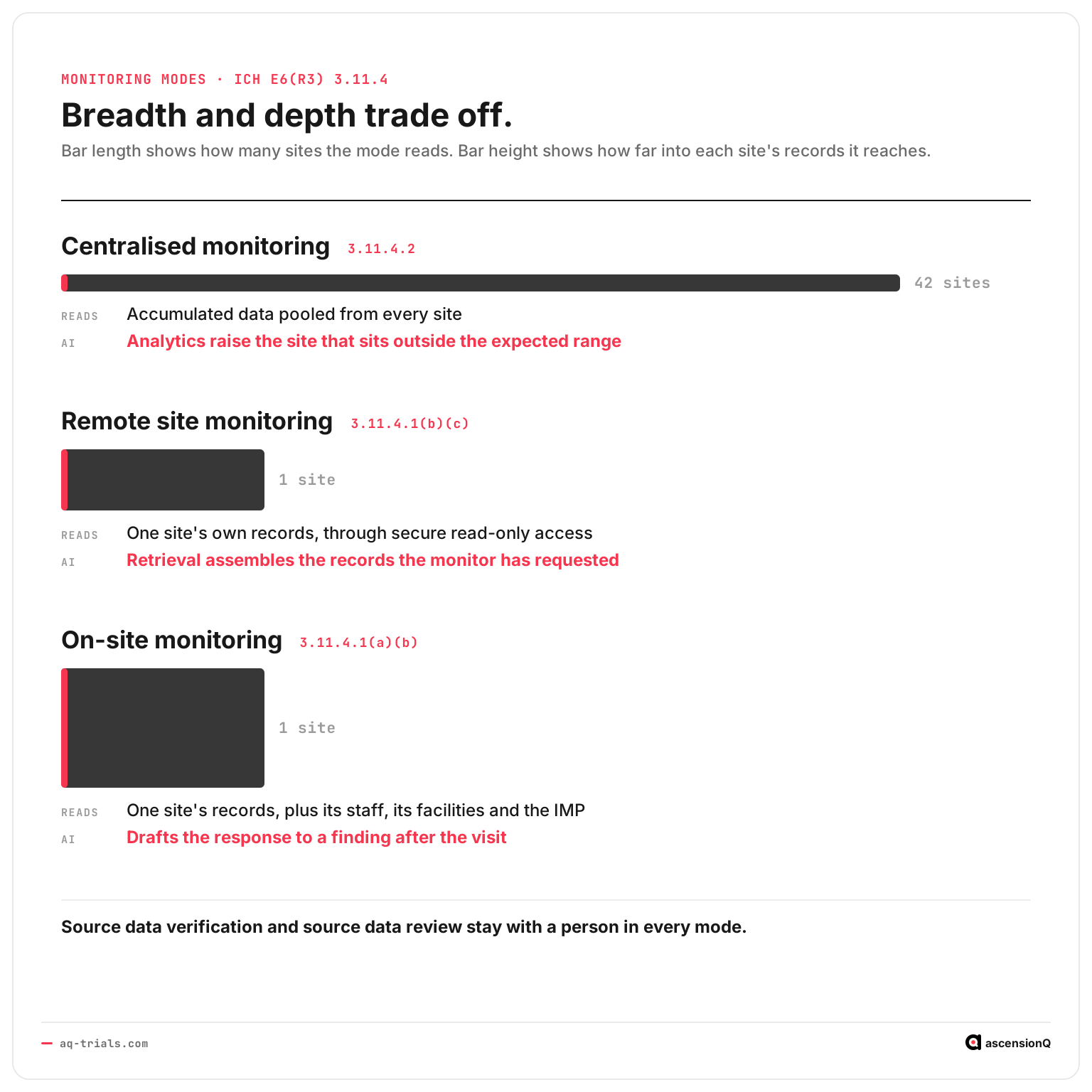
Trial monitoring covers the sponsor’s checks on how a study is running at each site. AI enters it at three points. The three differ in whose data is read and who acts on the output.
- Centralised analytics. A model evaluates data accumulated across every participating site and raises the site whose pattern differs from the rest, which allows a sponsor to direct a visit at the site most likely to need one.
- Report and correspondence drafting. A model produces first-pass narrative for a monitoring report or a data clarification response, which leaves the author editing rather than composing.
- Retrieval at the site. A model assembles the records a monitor has requested from across the site’s systems, which removes the manual pull that used to precede a visit.
The three differ in what a wrong output costs. A wrong analytic sends a monitor to the wrong site. A wrong draft reaches a person who is already reading it before it is sent. A wrong retrieval leaves a record out of the pack, and the monitor asks for it again.
Analytics change which site gets a visit. They do not change who signs the finding.
What Does ICH E6(R3) Require of Monitoring?
ICH E6(R3) was adopted on 16 June 2026 in its consolidated final version, and section 3.11.4 sets out monitoring. Compliance with the ICH E6 principles became a UK legal requirement on 28 April 2026 under the amended Clinical Trials Regulations. The guideline names three ways of monitoring a trial and leaves the mix to the sponsor’s risk assessment.
| Mode | What ICH E6(R3) states | Section | What AI contributes |
|---|---|---|---|
| On-site monitoring | Frequency follows the identified risks and is modified using the knowledge gained. Monitoring may be on-site, remote, or both, depending on the activity | 3.11.4.1(a)(b) | Drafting the site’s response to a finding after the visit |
| Remote site monitoring | May include remote, secure, read-only access to source records, data acquisition tools and essential record retention systems | 3.11.4.1(c) | Retrieval assembling the records the monitor has requested |
| Centralised monitoring | A timely evaluation of accumulated data by qualified sponsor staff, such as a medical monitor, a data scientist or a biostatistician | 3.11.4.2(a) | Analytics identifying systemic or site-specific issues across pooled data |
| The monitoring plan | Tailored to the identified safety and data quality risks, describing the strategy, the methods and tools, and the rationale | 3.11.4.3 | None. The plan is written and approved by people |
Two further provisions bear directly on an AI feature. Section 3.11.4.2(b) states that centralised monitoring can complement site monitoring, reduce it, or be used on its own, and that centralised data analytics can identify systemic or site-specific issues including protocol noncompliance and potentially unreliable data. Principle 9.3 requires computerised systems to be fit for purpose through risk-based validation where appropriate, which places an analytic inside the evidence regime set out in validating an AI feature in a regulated clinical trial system.
Annex 2 reached Step 4 on 3 June 2026 and sits inside the same consolidated guideline, and section 3.11.4 requires the monitoring approach to take decentralised settings into account and to state that approach in the monitoring plan.
How Do Risk-Based Monitoring Analytics Work?
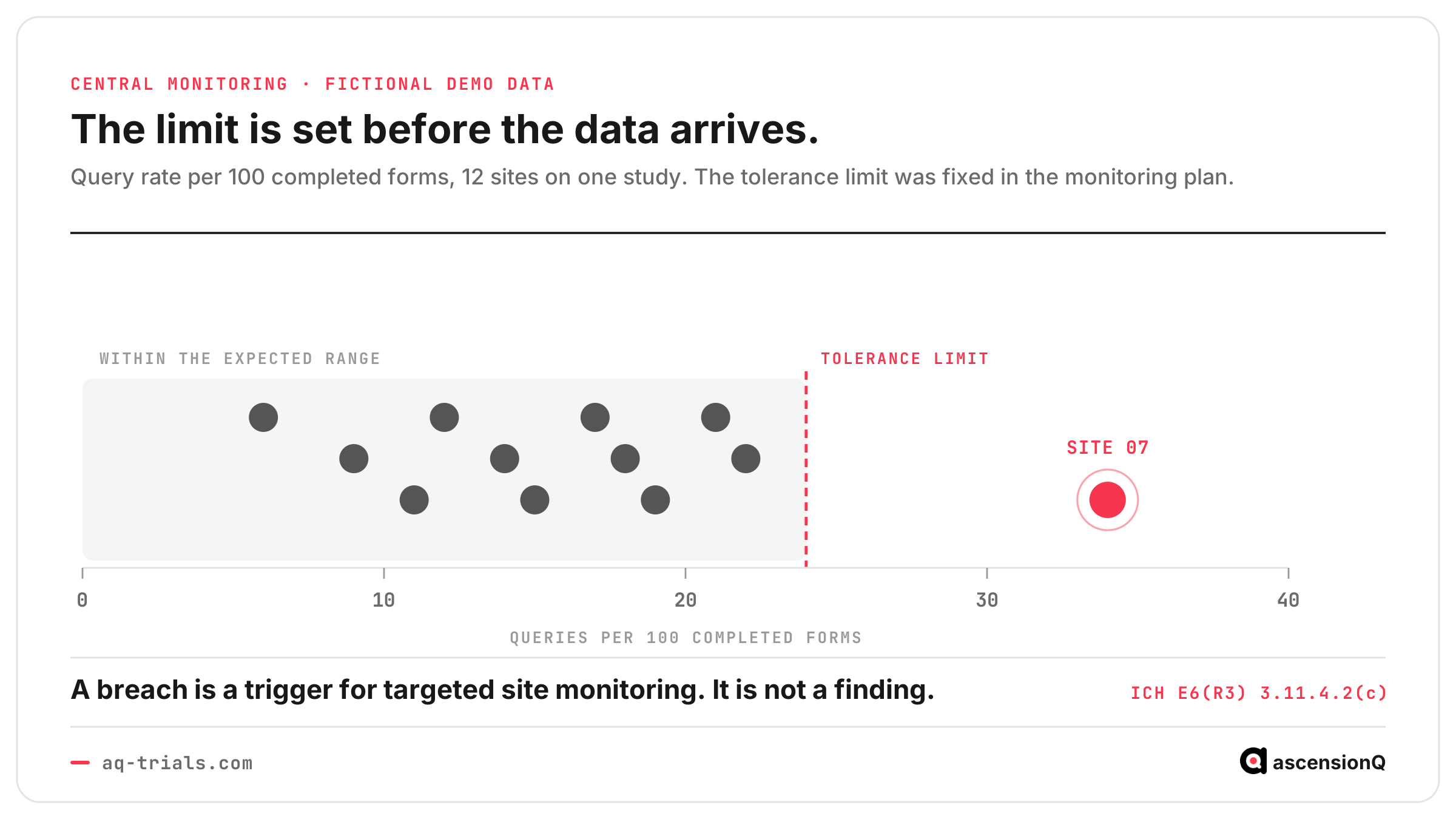
An analytic compares one site against the study it belongs to. The comparison carries weight only where the expected range was fixed in advance. MHRA guidance on oversight and monitoring activities, published on 28 January 2022, states that predefined tolerance limits may trigger further action, and that the monitoring plan should specify the escalation triggers alongside the monitoring type and the source data verification percentages.
The same guidance names the metrics sponsors use for statistical monitoring. Each one reports a pattern in data the site has already reported, and each one is settled by a record the site holds.
| Metric | What an unusual value may indicate | The record that settles it |
|---|---|---|
| Recruitment rate | Eligibility applied differently at this site, or a local population that differs from the others | The screening log read against the eligibility criteria |
| Screen failure rate | A protocol criterion interpreted differently by the site team | The screening log and the protocol training records |
| Query rate per completed form | Data entered from an unclear source, or staff working without current system training | The source records and the training file |
| Serious adverse event reporting rate | Under-reporting at this site, or a genuine safety difference in its participants | The medical notes and the safety reporting log |
| Missed visits and withdrawals | Visit windows applied loosely, or a scheduling constraint at the site | The visit schedule and the deviation record |
| Protocol non-compliances | A procedure the site performs differently from the protocol | The deviation record and the relevant source documents |
Three limits apply to every analytic of this kind, and a site evaluating a platform is entitled to ask about each.
- An outlier method finds difference, not error. MHRA states that such tools may miss a systematic issue affecting every site, because in that situation no site would be an outlier.
- The metric set is a judgement. MHRA states that there is no list of accepted or validated quality metrics or risk indicators, so each sponsor settles its own.
- A signal reads reported data. The record behind the signal settles whether the pattern reflects a real problem at the site.
Signals a site raises inside its own quality system are a different set, built from the site’s own deviation, CAPA, training and document records. Those are covered in AI-assisted quality risk detection for UK research sites.
Also Read: Is it safe to use AI in GxP clinical trial systems? What MHRA expects covers what AI may do and must never do at a site, and what the audit trail has to show for an AI-assisted entry.
Can AI Write a Monitoring Report?
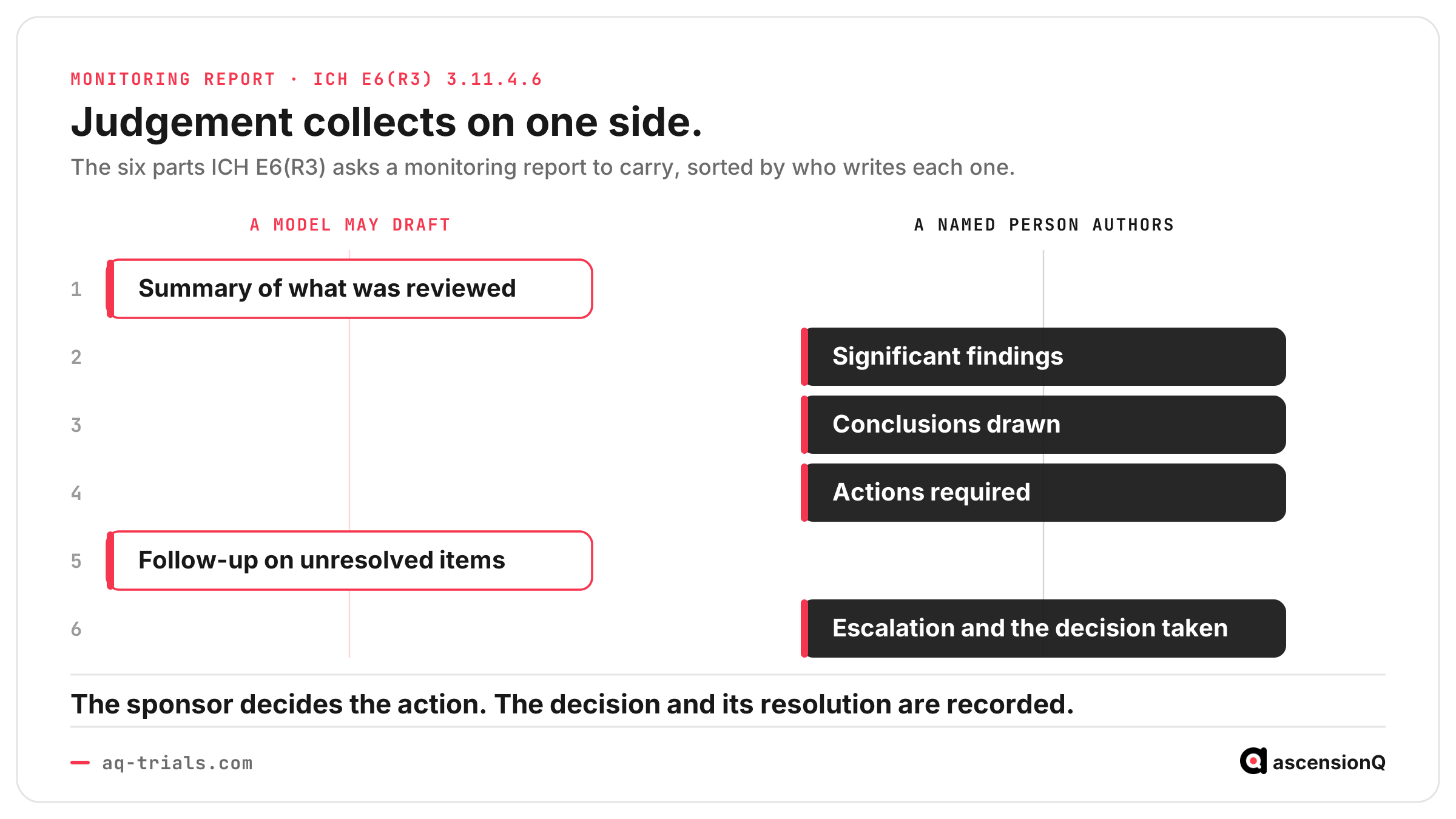
A model can draft part of one. Section 3.11.4.6(a) of ICH E6(R3) states that a monitoring report should summarise what was reviewed, the significant findings, the conclusions, the actions required and the follow-up on earlier unresolved items, with the content and the frequency set in the sponsor’s procedures. Section 3.11.4.6(c) adds that findings requiring escalation should be described, that the sponsor decides the action, and that the decision and its resolution should be recorded.
Two of those parts are assembly from records the system already holds. Four of them are judgements that commit the sponsor to a position.
- A model may draft the summary of what was reviewed. The content is a list of the records examined and the dates they cover, which makes it a retrieval task with a verifiable answer.
- A model may draft the follow-up on unresolved items. Those items carry forward from the previous report, which makes the list an assembly rather than an assessment.
- A named person authors the significant findings. A finding is a judgement that something is wrong, and it carries a consequence for the site.
- A named person authors the conclusions and the actions required. Both bind the sponsor, and both become the thing the site is measured against at the next visit.
- A named person authors the escalation. Section 3.11.4.6(c) places the decision with the sponsor and requires the decision and its resolution to be recorded.
One practical point follows for a site that receives a drafted report. The site responds to the finding rather than to the drafting, and the response is filed against the study record with the date it was sent.
What Must a Site Still Evidence for Source Data Verification and Source Data Review?
Source data verification compares reported data against the source record. Source data review reads the source record itself for quality and consistency. Section 3.11.4 of ICH E6(R3) lists both among the monitoring approaches, and both remain activities a person performs. The site’s duty is to produce the original record together with the metadata proving who entered it and when.
- The original record stays with the investigator. MHRA guidance states that the investigator must retain the original source document or a certified copy, and that the sponsor should not have exclusive control of source documents.
- Direct access on request. Section 2.12.14 states that on request of the monitor, the auditor, the IRB or IEC, or a regulatory authority, the investigator should make the records available for direct access.
- Metadata travels with the entry. Section 2.12.1 makes the investigator responsible for data integrity irrespective of the media used, so an electronic entry carries who made it, when, and what changed since.
- Critical data first. MHRA guidance states that verification should focus on the data that matters to the reliability of the results, such as consent, eligibility, the primary outcome, safety reporting and accountability for the investigational medicinal product (IMP).
- A sampling escalation route. MHRA guidance states that where a sample is used there should be an escalation procedure for problems found inside that sample.
Section 3.11.4.5.4(b) allows these checks to be performed on samples supported by data analytics, with the sample size adjusted on the basis of previous results. Section 3.11.4.5.4(b)(ii) and (iii) describe what that review looks for: missing data, inconsistent data, data outliers, an unexpected lack of variability, protocol deviations, and trends in the range and consistency of data within and across sites. The analytic chooses the sample. The verification stays manual. Remote arrangements for the reading step are covered in remote source data verification and eSource.
Also Read: How AI finds documentation gaps in an investigator site file covers the check that compares the records a trial should hold against the records actually filed.
How Does a UK Site Use AI Around a Monitoring Visit?
A UK research site has four moments where AI earns its place in monitoring. All four sit either side of the visit rather than inside it.
- Before the visit. Retrieval assembles the records on the monitor’s request list from across the site’s systems, which replaces a manual pull that often runs across several days.
- During the visit. A person answers the monitor. The site’s AI contributes nothing at this point, and an inspector would expect the same.
- After the visit. Each monitoring finding is classified and routed to a named owner with a due date, which converts a report into a set of tracked commitments.
- Between visits. A model drafts the reply to a data clarification request, which leaves a named person verifying the content and sending it.
The same pattern holds at the other end of a study, where AI shortens the document handling inside set-up and leaves the approvals with people. That ground is covered in can AI speed up clinical trial set-up at a UK site?. The organisations that must comply with GCP include those that develop and maintain trial-specific computerised systems, which MHRA guidance on good clinical practice for clinical trials, last updated on 6 November 2026, places inside the inspection regime in their own right.
AI in Trial Monitoring Inside the AQ Platform
Connected Intelligence is the AI capability across the AQ Platform, and AQ Assist is the in-platform assistant. Both read one connected record, which allows the records behind a monitoring request to be assembled from one place rather than from several systems.
- AQ’s AI proposes, flags and drafts, and a named person reviews and confirms, which keeps a monitoring response attributable to an individual the delegation record authorises.
- Every AI action is written to the audit trail, so the proposal, the model version and the human confirmation stay retrievable years after the visit.
- AQ CTMS holds the monitoring visit, its findings and the actions arising on the study record, which allows an open monitoring action to be read against the study it belongs to.
- A recurring finding routes into AQ QMS as a deviation and into AQ CAPA where the cause is systemic, so a repeated monitoring finding is handled as a quality event with an owner and a due date.
- Every AQ release goes through validated release and change control, with installation, operational and performance qualification evidence and a 21 CFR Part 11 and EU Annex 11 assessment, so the system arrives with its validation evidence attached.
AQ holds NHS Data Security and Protection Toolkit Standards Met for 2026, is Cyber Essentials certified, operates ISO 27001-aligned controls, and the platform is UK-hosted. It supports MHRA compliance and is built for MHRA GCP inspection. AQ was built by Phase 1 trial doctors and has been in continuous daily NHS use for six years, with 13 sites on one connected record and 70 concurrent studies, at University Hospitals of Liverpool Group, Royal Free London and Liverpool School of Tropical Medicine. Book a live demo to follow one monitoring finding from the visit through to the closed action behind it.
Also Read: Who is accountable when AI gets it wrong at a trial site? covers the chain of responsibility behind every confirmed AI output.
Frequently Asked Questions
How is AI used in clinical trial monitoring?
In three places. Centralised analytics evaluate data accumulated across every site and raise the ones outside the expected range, which ICH E6(R3) describes at section 3.11.4.2. Models draft the narrative parts of a monitoring report and the replies to data clarification requests. Retrieval assembles the records a monitor has requested from the site.
What is centralised monitoring in a clinical trial?
Section 3.11.4.2(a) of ICH E6(R3) describes it as a timely evaluation of accumulated data by qualified sponsor staff, such as a medical monitor, a data scientist or a biostatistician. It can complement site monitoring, reduce it, or be used on its own. It can also support the selection of sites or processes for targeted site monitoring.
Can AI write a monitoring report?
It can draft two parts of one. The summary of what was reviewed and the follow-up on earlier unresolved items are assembled from records the system already holds. The significant findings, the conclusions, the actions required and the escalation are judgements a named person authors, and section 3.11.4.6(c) places the decision on the action with the sponsor.
Does AI replace source data verification?
No. Section 3.11.4.5.4(b) of ICH E6(R3) allows checks to be performed on samples supported by data analytics, with the sample size adjusted on previous results. The analytic chooses the sample. A person performs the verification, and the site still produces the original record with the metadata proving who entered it and when.
What does ICH E6(R3) say about remote monitoring?
Section 3.11.4.1(b) states that investigator site monitoring may be on-site, remote, or both, depending on the activity and its objectives. Section 3.11.4.1(c) adds that it may include remote, secure, read-only access to source records, data acquisition tools and essential record retention systems. Section 3.11.4 requires the monitoring approach to take decentralised settings into account.
What are the limits of risk-based monitoring analytics?
Three. MHRA guidance states that outlier tools may miss a systematic issue affecting every site, because no site would then be an outlier. It also states that no list of accepted or validated quality metrics or risk indicators exists, so each sponsor settles its own. A signal reports a pattern in reported data, and the record behind it settles whether a real problem exists.