Can AI speed up clinical trial set-up? It can shorten the document handling inside set-up, which is the part a site controls. Feasibility responses, essential document collection and drafting checks all compress. The approval clock, the contract and the green light decision do not move, because each one belongs to a named person.
Can AI Speed Up Clinical Trial Set-Up?
Set-up at a UK research site is two kinds of work inside one deadline. The first is document handling: a feasibility questionnaire, essential document collection, a local document checked against the protocol, a delegation log. The second is decision work: a recruitment figure committed to, a contract agreed, capacity confirmed, a pharmacy green light given. AI assistance reaches the first kind and stops at the second.
That division decides what a site can expect. Three activities take AI assistance well, and each works the same way.
- Retrieval from the record. A model reads answers the site has already given and offers them again, removing the search step from a questionnaire.
- Classification against an expected set. A check reads each arriving document, places it and reports what is outstanding, which turns a chase list into a live register.
- Comparison against a reference text. A model reads a local document beside the protocol and raises the clauses that disagree, which puts a discrepancy in front of a person before filing.
Every one of those outputs is a proposal. AI across the whole trial lifecycle sits in our guide to how AI is used in clinical trials, and judging a vendor’s AI claim before buying sits in AI for compliance and inspection readiness. This guide takes one stage task by task.
What Does the 150-Day Target Actually Measure?
The UK measures set-up with a published indicator, and it is narrower than the phrase “study set-up” suggests. Indicator 1 of the UK Clinical Research Delivery key performance indicators methodology measures the proportion of commercial contract trials of investigational medicinal products recruiting a first participant within 150 days of applying for regulatory approval. The target is 95%.
| Element of the indicator | What the published methodology states |
| Clock start | The date an initial clinical trial authorisation application is submitted through the Integrated Research Application System. |
| Clock stop | The date the first participant is recruited, which for an interventional trial is the first participant’s first study visit. |
| Time that pauses | Only the joint MHRA and research ethics committee assessment, from a request for further information until a complete response. |
| Studies in scope | Commercial contract trials of investigational medicinal products, excluding advanced therapy trials. |
The clock covers regulatory review and site set-up in one figure, so a site reads its performance out of a number it only partly owns. The indicator also carries defined exclusions. Our guide to the UK set-up KPI exclusions covers which studies drop out of the count.
The latest edition, data to September 2026, was published on 21 October 2026. The Health Research Authority reported the same day that set-up times for commercial clinical trials continue to drop: an average of 100 days for January to March 2026, against 169 days in 2024/25 and 122 days in the first half of 2025/26. All 24 commercially sponsored trials set up in that quarter met the 150-day target.
The national number is already inside target. The question for a site is which days inside the 150 belong to the site at all.
Also Read: The 150-day study set-up target: an NHS R&D playbook
Where Does the Time Go Inside the 150 Days?
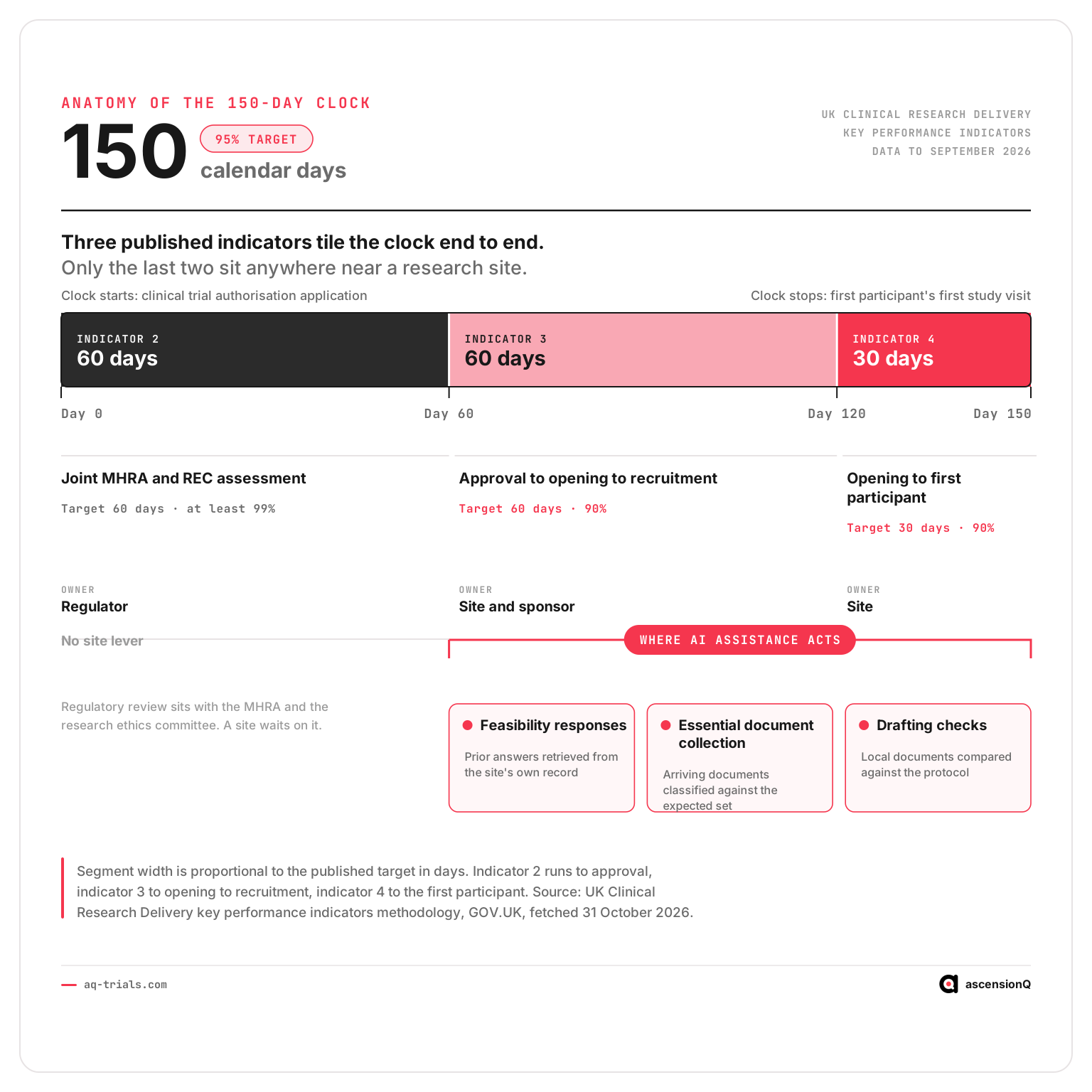
The 150 days hold two segments with different owners. The first is the joint assessment, and a site has no lever on it. Combined review is reported separately against a 60-day target, and the Health Research Authority put the median research ethics committee outcome at 26 days so far in 2026. The second segment runs from approval to a first study visit, and almost everything a site does sits there. Three published indicators tile the clock end to end. Indicator 2 allows 60 days to combined review approval, indicator 3 allows 60 days from approval to opening to recruitment, and indicator 4 allows 30 days from opening to the first participant.
Site time inside that second segment divides again, and our taxonomy of study set-up challenges sets out where it goes.
- Waiting on another party. Contract countersignature, sponsor responses, an investigational medicinal product (IMP) shipment, a laboratory kit delivery. AI assistance shortens none of it.
- Waiting on a decision. Capacity confirmation, costing authorisation, a pharmacy green light. Each needs a named person and a reason, so each keeps its own duration.
- Handling documents. Searching for a prior answer, chasing a certificate, reading a local procedure against the protocol, assembling an outstanding-item list before a site initiation visit. This is the compressible share.
A site that wants a shorter set-up should size the third category first. The defensible claim for AI assistance is a smaller document-handling share, measured against the site’s own previous studies. A claim beyond that belongs on the marketing red flag list in the inspection readiness evaluation guide.
Which Set-Up Tasks Can AI Assist, and Which Stay With People?
Set-up at a UK site runs as twelve tasks. Each has an output, an owner and a record that proves it happened. The table sets out what AI can propose, what remains with a named person, and the record an inspector reads.
| Set-up task | What AI can propose | What stays with a named person | The record that proves it |
| Feasibility enquiry triage | Reads the protocol’s criteria against the site’s capability record and ranks the enquiry | The decision to express interest in the study | The enquiry and its outcome in the study record |
| Feasibility questionnaire | Populates recruitment history, equipment and staffing from previous responses | Every recruitment and capacity figure the site commits to | The submitted questionnaire and its named author |
| Costing and the SoECAT | Extracts the activity list from the protocol schedule and raises activities with no cost line | The costing itself and the authorisation to sign it | The signed SoECAT |
| Contract review | Compares the draft against positions the site has agreed before and raises the clauses that differ | Every negotiated term, and the signature | The executed agreement |
| Capability and capacity confirmation | Reports current study load, delegation coverage and room availability | The confirmation that the site can deliver the study | The capacity decision recorded against the study |
| Essential document collection | Classifies each arriving document and reports what is outstanding | Acceptance of each filing proposal | The site file index and its audit trail |
| Protocol consistency checks | Reads a local document beside the protocol and raises the clauses that disagree | The resolution of every discrepancy raised | The approved version of the local document |
| Participant information | Drafts a local adaptation from the approved master document | Review, approval routing and submission | The approved sheet and its version history |
| Delegation log build | Proposes the activities each role carries, from the protocol schedule and the staff record | Who holds each delegated activity, and the investigator’s signature | The delegation log |
| Training and competence | Reports staff with no current record for an activity delegated to them | The judgement that a person is competent | The training file |
| Pharmacy set-up | Lists the IMP handling steps the protocol requires and raises those with no local procedure | The pharmacy green light | The clinical trial pharmacy site file |
| Site initiation and green light | Assembles the outstanding-item list ahead of the visit | The green light decision and the date of first dispense | The green light record and the initiation visit report |
Read the middle two columns together and the pattern holds. AI produces text, a classification, a list or a comparison. A person produces a commitment, a signature or a decision. In AQ Platform, the AI proposes each of those set-up outputs and a named person reviews and confirms it, and every proposal and confirmation is written to the audit trail. Study set-up records sit in the CTMS, the documents these checks read sit in the electronic investigator site file, and delegation entries sit in Digital DoA.
Also Read: What AI a UK research site actually uses, role by role
How Does AI Assist a Feasibility Response?
A feasibility questionnaire asks a site about itself. Most of the answers already exist in the site’s records, and the cost of the questionnaire is the search rather than the writing. Retrieval closes that gap by reading the previous answers and offering them against the new questions.
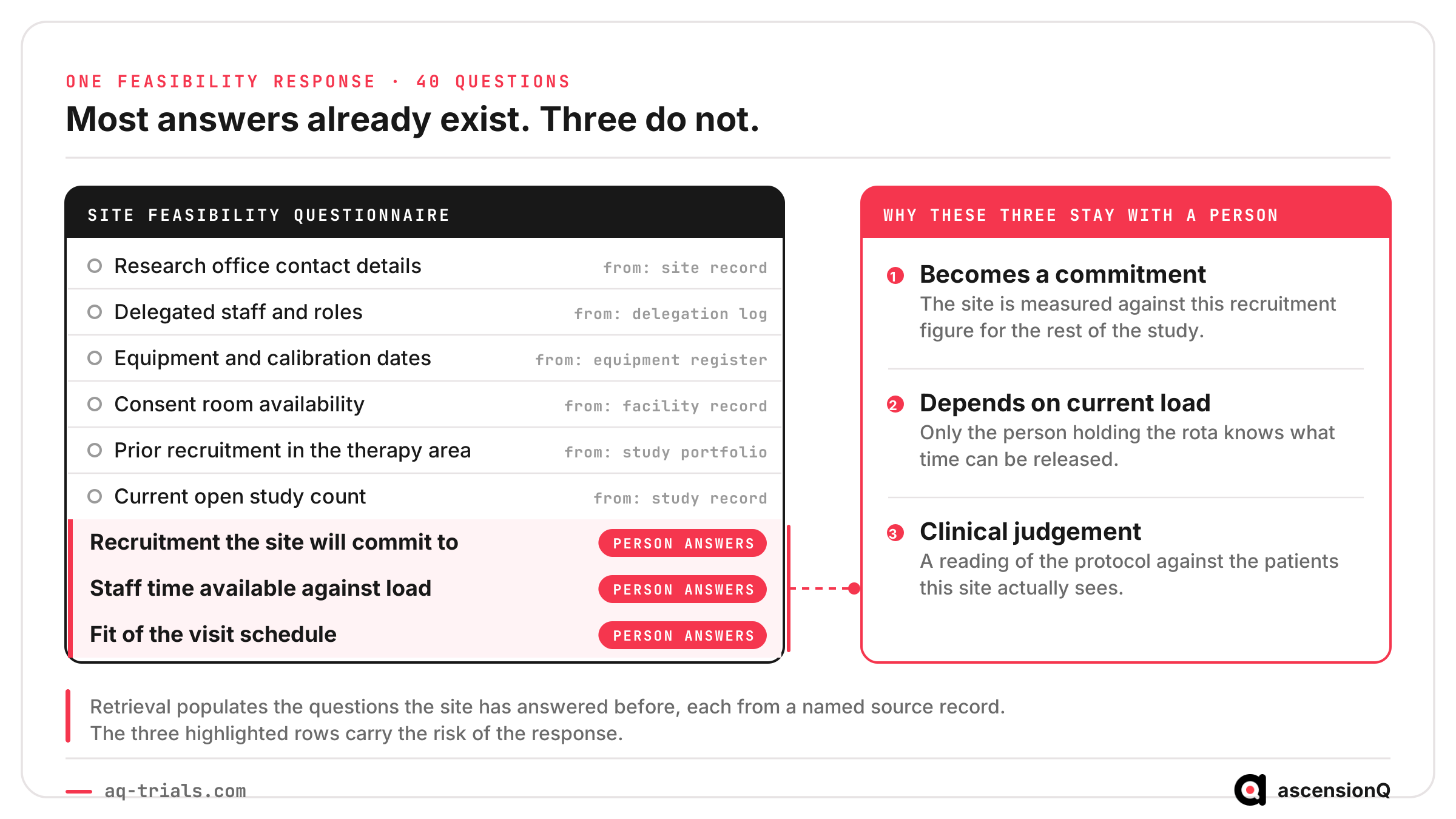
A worked example makes the split clear. A respiratory questionnaire arrives with 40 questions. Most ask for facts the site has stated before, each with a source record.
- Populated from the record. Research office contacts, staff list and roles, delegation coverage, equipment inventory with last calibration dates, consent room availability, prior recruitment in the therapy area.
- Answered by a person. The recruitment figure the site will commit to for this protocol, the staff time the site can release against its current load, and the clinical judgement on whether the protocol’s visit schedule fits the patient group.
Those remaining answers carry the risk of the response. A recruitment figure becomes a commitment the site is measured against, so it needs a person who can defend the number.
How Does AI Assist Essential Document Collection?
Essential document collection is a chase against a list. A check reads each arriving document and reports the items still missing. The detection mechanics sit in how AI finds documentation gaps in an investigator site file, and the filing act itself sits in what AI may and may not file in an eTMF or eISF.
What belongs to set-up is the chase, and three things change about it.
- The list stays current between meetings. A register that updates on arrival replaces a spreadsheet rebuilt before each call.
- The chase names an owner. An outstanding item sits against the party who owes it, so a research office chases the sponsor, the pharmacy and the laboratory separately.
- An expiring document surfaces early. A certificate lapsing before first dispense appears as an outstanding item rather than a later finding.
Our investigator site file essential documents checklist lists the records a site collects in this period.
How Does AI Assist Drafting Checks Against the Protocol?
Several set-up documents are local texts that must agree with a central one. A participant information sheet adapts an approved master. A pharmacy manual follows the protocol’s handling requirements. A local procedure follows its visit schedule and assessment list. Each can disagree with its source in a way a reader misses on a first pass.
A comparison check reads the two texts and raises the differences. Four kinds come up repeatedly during set-up.
- A visit window in a local procedure that is wider than the protocol allows.
- An assessment in the protocol schedule with no matching local step.
- Storage conditions in a pharmacy manual that differ from the protocol’s stated range.
- A participant information sheet describing a procedure the approved master omits.
A raised difference is a reading, and the resolution is a judgement. Our guide to AI in GxP clinical trial systems and the MHRA sets out that boundary and what the audit trail must hold for an AI-assisted entry. Whether a feature of this kind is rules-based work or AI is answered in automation versus AI in a trial platform.
What Does AI Not Speed Up in Set-Up?
A site planning a timeline should treat the following as fixed.
- The joint assessment clock. Combined review runs to its own published target, with the MHRA and the research ethics committee.
- Contract negotiation. A comparison shortens the reading. The negotiation runs at the speed of two legal teams.
- Costing authorisation. The activity list extracts from the protocol. The costing is an authorised act, and our guide to what a SoECAT is covers the form it takes.
- Capacity. A site with no free research nurse hours gains nothing from faster paperwork.
- Pharmacy green light. Green light follows the local work behind a first dispense, as our guide to pharmacy green light before the site initiation visit sets out.
- Physical dependencies. IMP shipment, laboratory kit delivery and equipment calibration each take their own time.
Set-up gets shorter when the waiting gets shorter. Document handling is the piece of the waiting a site can act on by itself.
What Must Be in Place Before the First Participant?
A faster set-up changes nothing about the records that must exist on the day of the first study visit. ICH E6(R3), adopted at Step 4 on 6 January 2025, sets the requirements.
- Documented approval before the trial starts. Section 2.4.2 requires a documented and dated approval from the review body covering the protocol, the consent materials and the recruitment procedures. Section 1.4.6 bars enrolment before it.
- Agreements in place first. Section 3.6.1 requires agreements with investigators and service providers to be documented before those parties begin work.
- Oversight that matches the delegation. Section 2.3.1 keeps ultimate responsibility with the investigator. Section 2.3.2 requires delegates to be qualified and informed, and section 2.3.3 requires a record of each delegated activity.
- Accuracy owned by a person. Section 2.12.5 places the accuracy, completeness and timeliness of reported data with the investigator.
- Systems fit for purpose. Section 9.3 requires computerised systems to be fit for purpose, with risk-based validation.
An AI-assisted set-up meets the same tests as any other. A delegation log proposed by a model and signed by the investigator satisfies section 2.3.3 in the same way as one typed by hand. Validation of the feature that produced the proposal is a separate duty, covered in our guide to validating an AI feature in a regulated clinical trial system.
AI in Trial Set-Up Inside the AQ Platform
AQ Trials builds clinical research operations software for UK sites, clinical trials units, sponsors and CROs. Connected Intelligence is the AI capability across the platform, and AQ Assist is the in-platform assistant. Set-up work spans AQ CTMS, AQ eISF, AQ Digital DoA and AQ Pharmacy, and the AI reads across all of them.
Two mechanisms carry the set-up gain. Connected Intelligence reads the site’s existing records and proposes a feasibility answer, a classification, a delegation entry or a difference against the protocol, and a named person reviews and confirms every one. Each proposal, the model version behind it and the human confirmation are written to the same audit trail, so the record shows who decided and when.
AQ Platform is UK-hosted, meets NHS DSPT Standards Met (2026), holds Cyber Essentials certification and operates ISO 27001-aligned controls. It is validated to GxP standards with every release, and has been in continuous daily NHS use for six years across 13 sites on one connected record.
Book a live demo to see a set-up task list, a delegation log and a site file index working from one connected study record.
Frequently Asked Questions
Can AI speed up clinical trial set-up?
AI shortens the document handling inside set-up. Feasibility responses populate from the site’s own records, arriving documents classify against an expected set, and local documents are compared against the protocol. The approval clock, the contract, the costing and the green light decision keep their own duration, because each one needs a named person.
What is the 150-day study set-up target in the UK?
Indicator 1 of the UK Clinical Research Delivery key performance indicators measures the proportion of commercial contract trials of investigational medicinal products recruiting a first participant within 150 days of applying for regulatory approval, against a 95% target. The clock starts at the clinical trial authorisation application and stops at the first participant’s first study visit.
Which set-up tasks can AI do at a research site?
AI assists three kinds of set-up task: retrieval of answers the site has already given, classification of arriving documents against an expected set, and comparison of a local document against the protocol. Those three reach feasibility responses, essential document collection, delegation log drafting and training gap reports.
Can AI complete a feasibility questionnaire on its own?
AI can populate the questions that ask for facts the site has recorded before, such as staffing, equipment, calibration dates and prior recruitment. The recruitment figure the site commits to, the staff time it can release and the clinical judgement on the visit schedule stay with a person.
Does AI shorten the regulatory approval clock?
No. The joint MHRA and research ethics committee assessment runs to its own published target and sits outside the site’s control. A site can affect the segment that runs from approval to the first study visit.
Who signs off a trial that was set up with AI assistance?
The same people as any other trial. ICH E6(R3) section 2.3.1 keeps ultimate responsibility with the investigator and section 2.3.3 requires a record of who received each delegated activity. A model-drafted delegation log signed by the investigator satisfies those sections.