A trial pharmacy reaches green light by finishing the local set-up work that has to be true before a first dispense: a storage location signed off, a supply and prescribing route agreed with the sponsor, a study pharmacy file opened, named staff authorised and trained, and a readiness statement the investigator can rely on. Green light is the sponsor’s written authorisation for the site to begin. Pharmacy readiness is what the site brings to that decision.
This guide covers what green light means for a pharmacy, the checklist to clear before the site initiation visit (SIV), who signs the readiness sign-off, the conditions for a first dispense, and what a protocol amendment changes. It sits under the guide to IMP accountability in clinical trials, which sets out the record this set-up work exists to produce.
- Green light rests on four separate permissions, each with a different issuer and a different artefact.
- Six conditions must all hold before a first dispense, and one open condition blocks it.
- The site initiation visit tests readiness. It does not create it.
What Does Green Light Mean for a Trial Pharmacy?
Green light for a trial pharmacy means the sponsor has authorised this site to begin, and that authorisation rests on four separate permissions. Teams often treat the four as one event. Each has a different issuer, artefact and limit.
ICH E6(R3) section 3.15.3(a) fixes the order for supply. It states that “investigational product should be supplied after obtaining the required approval/favourable opinion from the IRB/IEC and the regulatory authority(ies) for the trial”. Stock arriving earlier starts the accountability record on a defect.
| Permission | Who issues it | What the site holds | Does not authorise alone |
|---|---|---|---|
| Regulatory and ethics approval | MHRA and a Research Ethics Committee | The approved protocol version and approval letters | Activity at this particular site |
| Confirmation of capacity and capability | The participating NHS organisation | Written confirmation it is ready to start | Receipt of IMP before the sponsor releases stock |
| Sponsor green light to the site | The sponsor or the CRO | A site activation letter naming the start date | A dispense before stock clears quarantine |
| Pharmacy readiness sign-off | The pharmacy service and the principal investigator | A signed readiness record in the pharmacy site file | Anything alone; it evidences the site’s own preparation |
The HRA guidance on NHS site set-up in England leaves the second permission with the organisation, which “will provide you with confirmation of this via email, indicating that they are ready to start the study”. The start date is agreed in advance and “may be dependent on a site initiation visit”. The national pharmacy review held before an application reaches an ethics committee is covered in the guide to HRA Technical Assurance for pharmacy and radiation. Everything below is local.
What Must Be in Place in Pharmacy Before the Site Initiation Visit?
Five groups of evidence must be in place in pharmacy before the site initiation visit: the facility, the supply route, the study file, the people and the dispensing arrangement. A department that assembles them during the visit has lost the start date.
| Group | What pharmacy prepares | The record it leaves |
|---|---|---|
| Facility and equipment | A secured storage location, with the fridge or freezer allocated and monitored | Location record, equipment list, calibration certificates |
| Supply route | The pharmacy manual read, the shipping route agreed, accounts issued | Manual version log, sponsor contact record, access record |
| Study file | The file opened and indexed, holding the protocol, label sample and handling instructions | The index, with a version number per document |
| People | The delegation log signed per person and activity, training completed and dated | Delegation log, training records, named code break route |
| Dispensing arrangement | The prescription route agreed, the log format fixed, the second check settled | Blank prescription template, blank log, local working instruction |
ICH E6(R3) names site initiation as a monitoring activity in section 3.11.4.5.2, and that section sets what the visit tests. Clause (a) covers qualifications, resources and facilities, including equipment and site staff. Clause (b) asks whether pharmacy staff follow the current approved protocol and its related documents. Section 3.11.4.5.3(a) adds acceptable storage conditions, the instruction given on handling, and whether receipt, storage, use, return and destruction are documented.
Prepare the walkthrough in the monitor’s own order: the locked storage location, the monitored fridge and its calibration certificate, the indexed file, the delegation log, the blank prescription and log, then the code break route. The storage record set behind the monitoring line sits in the investigational product storage records checklist. A twelve-section index for the file, with the owner and signatory for each section, is set out in what belongs in a pharmacy site file.
Also Read: What Is a Clinical Trial Pharmacy?
Who Signs the Pharmacy Readiness Sign-Off?
The pharmacy readiness sign-off carries two signatures: one from pharmacy for the service, and one from the principal investigator for the delegation. ICH E6(R3) section 2.10.2 allows the investigator to delegate IMP management to a pharmacist, who then works under the investigator’s oversight. Section 2.2.2 puts the resource test on the investigator, who should have “an adequate number of available and qualified staff, and adequate facilities for the foreseen duration of the trial”. The R&D office holds the organisational confirmation behind that statement.
- The trials pharmacist prepares the statement, which names the study, the protocol version, the storage location and each authorised member of staff.
- The lead or chief pharmacist signs for the service, which commits capacity for the study’s duration rather than its first month.
- The principal investigator signs the delegation log, which authorises each person for each activity and makes every later entry attributable.
A hypothetical example shows the shape of it. At Northgate General, study NGH-017 opened its pharmacy file four weeks before the planned visit. The readiness statement named protocol version 3.0, fridge PH-04 for 2 to 8 degrees Celsius storage, and three authorised staff. The principal investigator signed the delegation log the same day, and the statement sat at section 1, so the monitor read it unprompted.
Descriptor 4.3 of the Professional Standards for Hospital Pharmacy Services asks for governance arrangements covering investigational medicinal products. A signature from a person missing from the delegation log breaks the record even where the action was correct, and the authorised and trained condition behind every pharmacy entry sets out what an inspector asks of one line.
What Must Be True Before the First Dispense?
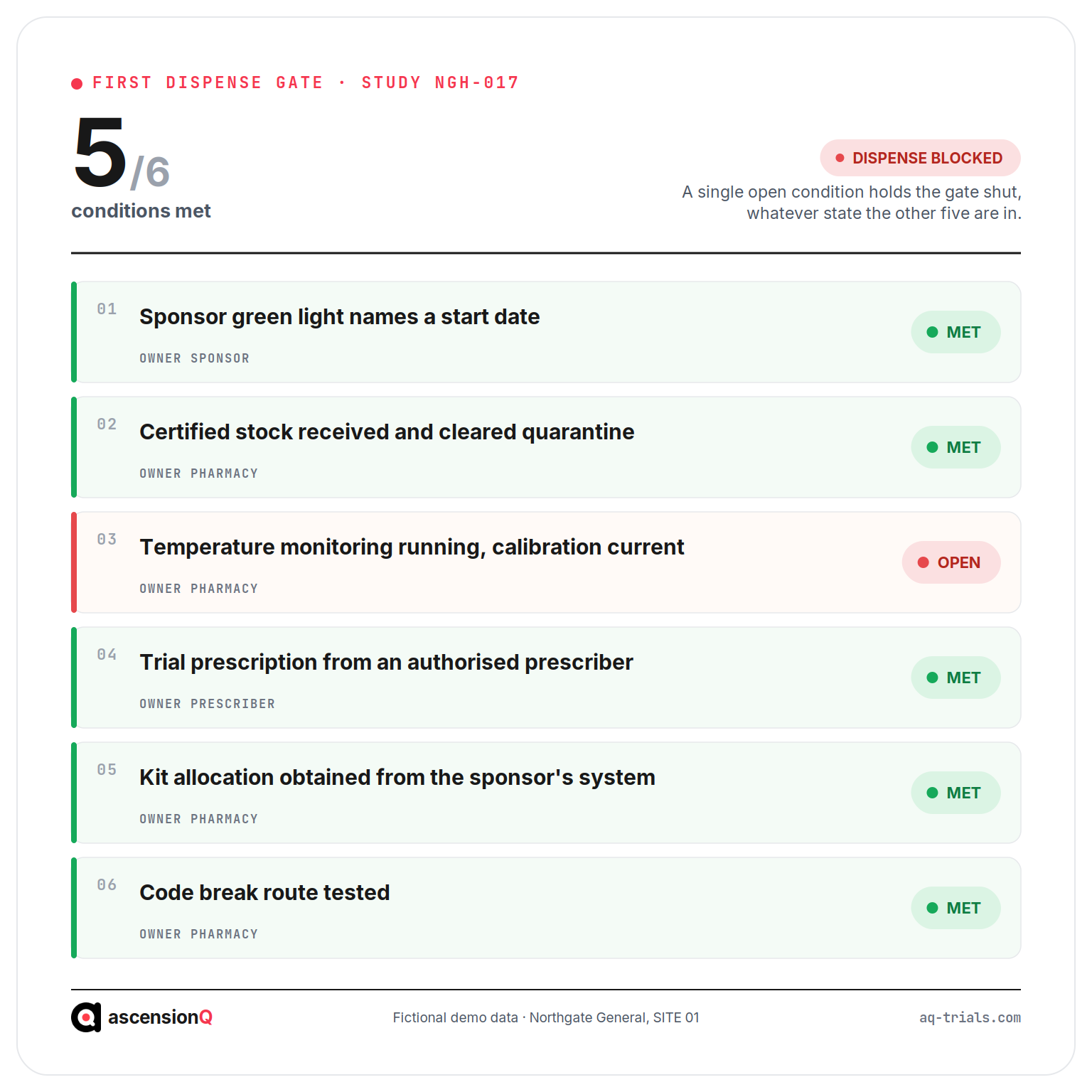
Six conditions must all be true before a first dispense. They behave as one gate rather than a scoring sheet, so a single open condition blocks it.
- The sponsor’s green light names a start date, which gives pharmacy a documented authority rather than a verbal agreement.
- Certified stock has arrived and cleared quarantine, which puts usable units on the shelf with batch, expiry and kit number recorded.
- Temperature monitoring is running and calibration is current, which shows the stock held its conditions from arrival.
- A trial prescription from an authorised prescriber exists, which ties the kit to one participant and one visit.
- The allocation has been obtained from the sponsor’s system, which fixes the kit number and keeps site ledger and sponsor record on the same unit.
- The code break route has been tested, which proves the site can unblind inside the protocol’s timeframe.
A Qualified Person certifies the batch and the sponsor releases that stock to a named site, both set out in who releases IMP to a UK site and what QP release is. The mechanisms by which a UK site breaks a code, and the record each leaves, are set out in how a pharmacy keeps the blind and breaks it in an emergency.
Five conditions met and one open is a blocked dispense, not a partial one.
What Does a Protocol Amendment Change for Pharmacy?
A protocol amendment changes pharmacy set-up whenever it touches the product, the dose, the storage conditions, the prescribing route or the authorised people. ICH E6(R3) section 1.4.7 allows no protocol change without prior documented approval, except to eliminate an immediate hazard.
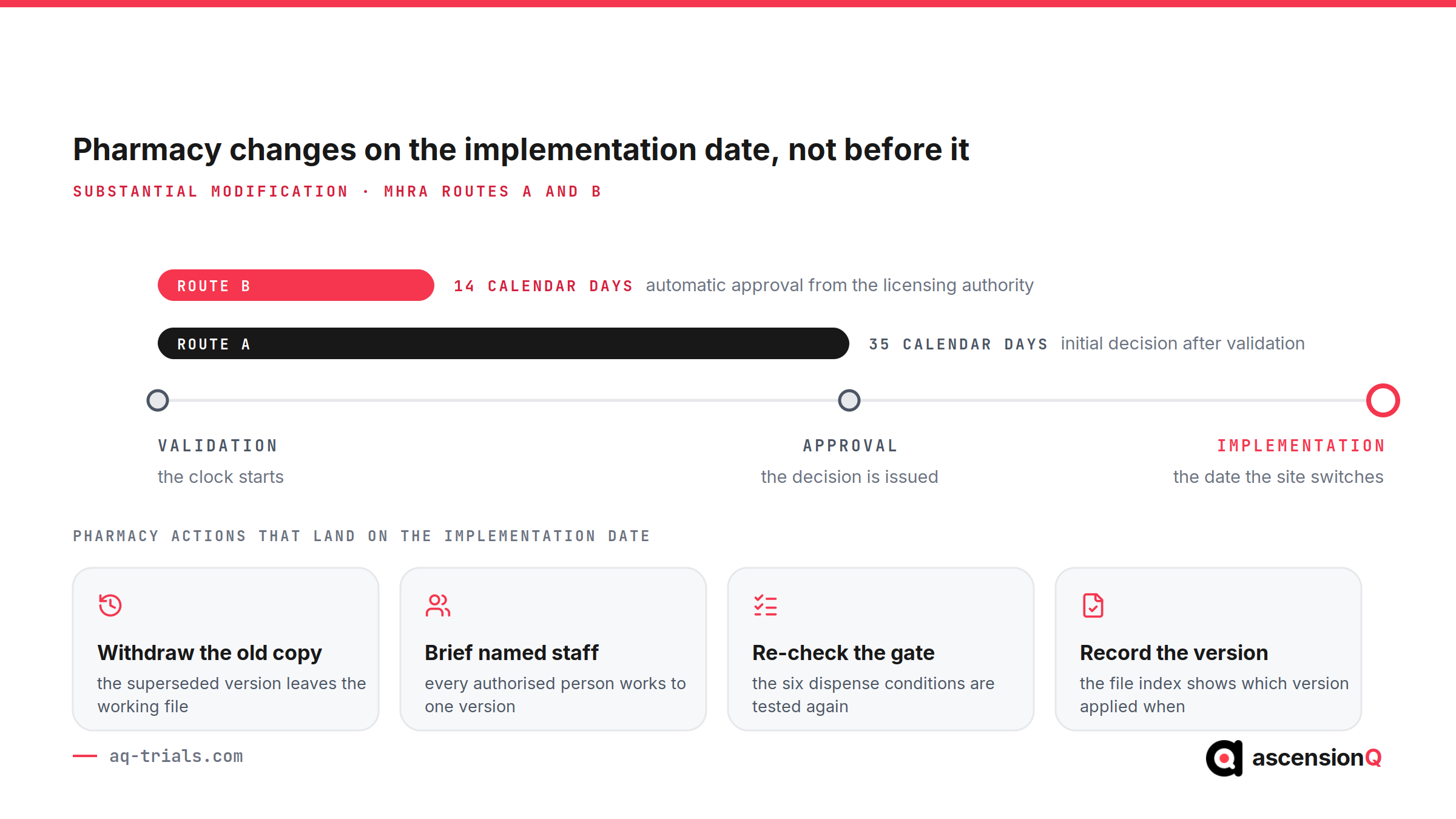
MHRA guidance on modifying a clinical trial approval separates minor modifications, implemented at any time, from substantial modifications, which require approval first. A substantial modification runs through Route A, where the decision follows within 35 calendar days of validation, or Route B, where an eligible application receives automatic approval from the licensing authority within 14 calendar days. Pharmacy works to the implementation date at the site, and the working copy changes on that date rather than at the next audit.
| What the amendment changes | What pharmacy does | What is re-signed or re-filed |
|---|---|---|
| The protocol version | Files the new version and withdraws the superseded working copy | The file index and the readiness statement |
| The dose or regimen | Updates the prescription route and dispensing instruction before that date | The local working instruction |
| The product or its label | Checks the label against the required particulars and who may apply it | The label sample held in the file |
| The storage condition | Re-allocates storage and confirms monitoring covers the new range | The storage location record |
| The authorised activities or staff | Adds the activity or person and records the training | The delegation log and the training record |
The particulars a UK trial label must show, and when a label may be changed at a site, are set out in the IMP labelling requirements for UK trials.
Where Does Pharmacy Set-Up Stall?
Pharmacy set-up stalls where the department first hears about a study after the governance work has closed. It then begins from zero in the week the sponsor expects a start date.
| Set-up step | Pharmacy engaged at site selection | Pharmacy engaged after approval |
|---|---|---|
| Pharmacy manual review | Read at feasibility, so questions reach the sponsor early | Read in the visit week, so questions become visit actions |
| Storage allocation | Capacity checked before the site accepts the study | Capacity found short after the start date is agreed |
| First stock request | Placed as soon as the sponsor releases the site | Placed after the visit, adding shipping lead time |
| Visit outcome | A confirmation, with a start date that holds | An action list, with a start date that moves |
The set-up work is short. The queue in front of it is not.
The stall shows only where the dates sit in one place. The interval from approval to a first participant belongs in the study record a clinical trial management system holds, and the 90-day clinical trial set-up target shows how its local segments behave.
Frequently Asked Questions
What does green light mean for a trial pharmacy?
That the sponsor has authorised this site to begin. That authorisation rests on four separate permissions, which teams often treat as one event.
Who signs the pharmacy readiness sign-off?
Two people: pharmacy signs for the service, and the principal investigator signs for the delegation.
Where does pharmacy set-up usually stall?
Where the department first hears about a study after the governance work has closed, and then starts from zero in the week the sponsor expects a start date.
Pharmacy set-up produces records that stay retrievable long after the visit, because the authority for a first dispense is questioned months later. The electronic pharmacy site file page is the parent page for these pharmacy guides. Book a live demo to talk through how your site holds its study evidence.